
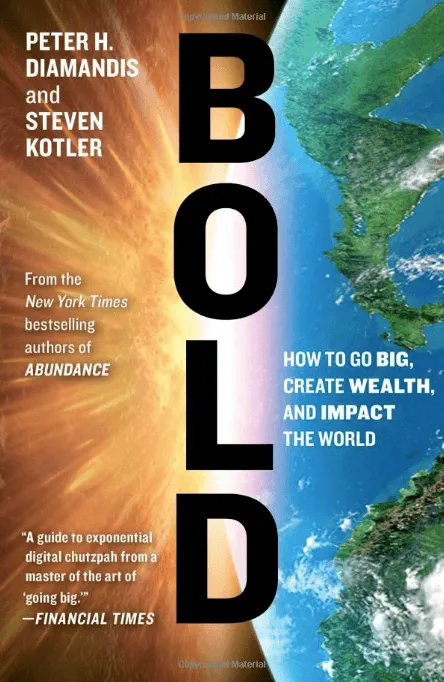
“A visionary roadmap for people who believe they can change the world—and invaluable advice about bringing together the partners and technologies to help them do it.” —President Bill Clinton
A radical, how-to guide for using exponential technologies, moonshot thinking, and crowd-powered tools, Bold unfolds in three parts. Part One focuses on the exponential technologies that are disrupting today’s Fortune 500 companies and enabling upstart entrepreneurs to go from “I’ve got an idea” to “I run a billion-dollar company” far faster than ever before. The authors provide exceptional insight into the power of 3D printing, artificial intelligence, robotics, networks and sensors, and synthetic biology. Part Two draws on insights from billionaires such as Larry Page, Elon Musk, Richard Branson, and Jeff Bezos and reveals their entrepreneurial secrets. Finally, Bold closes with a look at the best practices that allow anyone to leverage today’s hyper-connected crowd like never before. Here, the authors teach how to design and use incentive competitions, launch million-dollar crowdfunding campaigns to tap into tens of billions of dollars of capital, and finally how to build communities—armies of exponentially enabled individuals willing and able to help today’s entrepreneurs make their boldest dreams come true.
There is a version of the future that most people cannot see. Not because it is hidden — the data is public, the trajectories are measurable, the compound curves of exponential technology are documented in peer-reviewed journals and venture capital portfolios and the production statistics of every major industry being disrupted by computation. The version of the future most people cannot see is not hidden. It is simply incomprehensible from a linear vantage point. And almost every human being alive today — including most of the engineers building the future — is thinking about it linearly.
Peter Diamandis spent the better part of two decades trying to fix that problem. The result is Bold: How to Go Big, Make Bank, and Better the World, a book that belongs on the same shelf as Peter Drucker’s work on organizational management and Clayton Christensen’s work on disruption — not because it makes the same arguments, but because it is operating at the same level of ambition: a complete rethinking of how competitive advantage is created, how organizations grow, and what it means to solve a problem at scale in the twenty-first century.
Diamandis is the founder of the XPRIZE Foundation, co-founder of Singularity University, and a man who has spent his professional life at the intersection of audacious goals and practical execution. His previous book, Abundance, made the case that the combination of exponential technology and entrepreneurial ingenuity would allow us to meet every major human need on the planet within the next several decades. Bold is the operational manual for how to participate in that project — how to identify the exponential curves that are about to reshape your industry, how to build organizations that can move at exponential speeds, and how to leverage the new tools of the digital economy to build movements and funding structures that would have been impossible a generation ago.
This is not a book about optimism. It is a book about pattern recognition. The pattern Diamandis has identified — across technology, across industries, across the history of how transformative companies get built — is one of the most important insights available to anyone who wants to do significant work in the world. And almost nobody understands it well enough to act on it.
The Exponential Curve and Why Your Brain Cannot See It
The central concept in Bold is deceptively simple. When a technology becomes digitized — when its core functions can be expressed as bits rather than atoms — it begins following a fundamentally different growth curve than anything that came before it. Instead of linear growth (add one unit of input, get one unit of output), digitized technologies follow exponential growth: each doubling of processing power, storage capacity, or network bandwidth produces roughly twice the capability at a fraction of the cost.
Gordon Moore observed this pattern in semiconductor manufacturing in 1965. What his observation captured was not a law of physics — it was a law of economics and manufacturing optimization. When you can store more computation on a chip at lower cost, you invest those savings into research that allows you to store even more computation on a chip at even lower cost. The compounding is self-sustaining because the economics of digital technology produce reinvestment cycles that physical manufacturing cannot match.
But here is where it becomes important for understanding Bold: Moore’s Law was not a one-industry phenomenon. It was the first clearly documented instance of a pattern that would eventually govern every industry that became digitized. Cameras became digital, and within fifteen years, a consumer smartphone contained a camera more capable than professional equipment that cost tens of thousands of dollars in 1990. Music became digital, and the entire infrastructure of physical distribution — pressing plants, distribution networks, retail stores — became economically irrelevant within a decade. Medicine is becoming digital, and the implications are only beginning to be understood.
Diamandis calls this the Six Ds of Exponential Growth: Digitization, Deception, Disruption, Demonetization, Dematerialization, and Democratization. The sequence is consistent. When a technology digitizes, it first appears to be linear — it enters a period of Deception where progress seems slow and insignificant. Then it crosses an inflection point, enters a period of explosive Disruption, and in the process Demonetizes the previous analog product (makes it free or nearly free), Dematerializes the physical infrastructure that product required, and ultimately Democratizes access to something that was previously available only to the wealthy or the powerful.
Consider what has happened to photography. Twenty-five years ago, taking a professional-quality photograph required a camera body that cost thousands of dollars, lenses that added thousands more, darkroom equipment or expensive film processing, and years of training. Today, every person on Earth with a smartphone — nearly four billion people — carries a camera more capable than the professional equipment of 1995. The camera industry did not grow. It was Demonetized and Dematerialized. And photography was Democratized to a degree that would have seemed impossible to predict in 1990.
The reason this pattern matters for the reader of Bold is not academic. It is strategic. If you are building a company, choosing a career, making investment decisions, or simply trying to understand what the world will look like in ten years, your ability to identify which industries are currently in the Deceptive phase — the phase where the technology looks weak and the incumbents feel safe — is the single most important competitive intelligence available. The companies that dominate the twenty-first century will be built in the Deceptive phase of industries that are currently being dismissed by the incumbents who built the previous paradigm.
Moonshots: Why Your Goals Are Too Small
One of the most counterintuitive arguments in Bold is that thinking big is not just more satisfying than thinking small — it is actually easier. Diamandis makes this case through what he calls the difference between a 10% improvement and a 10x improvement. A 10% improvement requires you to work within the existing system. You use the existing tools, the existing processes, the existing assumptions about how the problem is structured. The competition for 10% improvements is fierce because every existing player in your industry is trying to achieve the same incremental gains using the same knowledge base.
A 10x improvement requires you to throw out the existing system. You cannot achieve a 10x improvement by doing what the incumbents are doing faster or cheaper. You have to fundamentally rethink the problem — which means you approach it with different tools, different assumptions, and a different team. The counterintuitive result is that the competition for 10x improvements is often less fierce than the competition for 10% improvements, because the incumbents are organizationally incapable of pursuing them. A company that has built its entire infrastructure around an existing approach cannot simultaneously pursue the approach that would make its existing infrastructure irrelevant.
This is the essence of the moonshot philosophy that Diamandis describes. The XPRIZE competitions — which have offered large prizes for solving problems like private spaceflight, lunar landing, and ocean cleanup — are built on this insight. When you announce a $10 million prize for the first team to build a reusable private spacecraft, you do not get slightly better aerospace engineering from the existing aerospace contractors. You get an entirely different population of innovators who approach the problem with fundamentally different assumptions. The Ansari XPRIZE for private spaceflight attracted twenty-six teams from seven countries who collectively spent more than $100 million trying to win a $10 million prize. The prize did not incentivize incremental improvement. It catalyzed a community of moonshot thinkers who would not have engaged with the problem under any other framing.
The practical application of this insight for individuals and organizations is not to announce XPRIZE competitions. It is to deliberately set goals that force you outside the incrementalist framework — goals that are large enough to make the existing playbook irrelevant, that attract different resources and different thinking, and that create a forcing function for the kind of creative problem solving that incremental targets cannot generate.
Diamandis draws on the research of NASA psychologist and flow state researcher Ary Goldberger, who found that humans operate most effectively in a zone between boredom and anxiety — a zone where the challenge slightly exceeds current capability. Incremental goals tend to create boredom in high performers. Goals so large they seem delusional tend to create paralysis. Moonshots — goals that are 10x beyond current achievement, clearly defined, with a credible if not certain path to execution — hit the psychological sweet spot that produces maximum engagement, maximum creativity, and maximum persistence.
The Psychology of Bold: What Separates Exponential Entrepreneurs
Diamandis collaborated with Steven Kotler — author of The Rise of Superman and one of the leading researchers on flow state and peak human performance — to develop the psychological framework in Bold. The result is a profile of the mindset that separates entrepreneurs who build at exponential scale from those who build incrementally — and a set of practices for cultivating that mindset deliberately.
The first element is what Diamandis calls a Massively Transformative Purpose, or MTP. This is not a mission statement. A mission statement is an organizational communication tool. An MTP is a personal orientation device — a statement of the problem in the world that you feel most urgently and most personally called to solve, stated at a scale that cannot be accomplished in a single career, a single company, or a single decade. Google’s unofficial MTP is to organize the world’s information. Tesla’s is to accelerate the world’s transition to sustainable energy. The MTP functions as a cognitive filter that governs every major decision — where to invest time, what opportunities to pursue, which partnerships to make, what to walk away from — with a consistency and clarity that no amount of strategic planning can replicate.
The second element is a comfort with the kind of uncertainty that immobilizes most decision-makers. Exponential entrepreneurs are not reckless. They are not dismissive of risk. What they have that most people lack is a calibrated relationship with uncertainty — an ability to assess the probability distribution of outcomes, make a decision under incomplete information, act decisively on that decision, and update rapidly when new information arrives without collapsing into either overconfidence or paralysis. Diamandis traces this psychological capacity back to what cognitive scientists call “positive affect” — a baseline emotional orientation toward the future that interprets uncertainty as opportunity rather than threat.
The research on positive affect and entrepreneurial performance is robust. Barbara Fredrickson’s broaden-and-build theory at the University of North Carolina shows that positive emotional states literally expand the cognitive field — the range of options you can perceive and consider in any given decision situation. People in negative emotional states narrow their attention to the most immediate threats. People in positive emotional states are capable of thinking more broadly, making more creative connections, and considering longer time horizons. The exponential entrepreneur is not someone who never experiences fear, doubt, or discouragement. It is someone who has built the psychological infrastructure to return quickly to a baseline of positive affect — and who therefore spends more total time in the cognitive state that produces exponential thinking.
The third element is what Diamandis calls “skunk works” thinking — the capacity to run high-risk, high-reward exploratory projects in organizational structures that are insulated from the risk aversion of the core business. Lockheed’s original Skunk Works was a division created during World War II to develop advanced aircraft designs without the constraints of the main organization’s procurement and approval processes. The concept has been rediscovered repeatedly by the most innovative large organizations — Google’s X division, Amazon Lab126, the Defense Advanced Research Projects Agency — because it solves a fundamental organizational problem: the structure that makes a large organization reliable and efficient at executing its core business makes it incapable of developing the things that will replace its core business.
The Crowd: Leveraging Billions of Minds
The third section of Bold is perhaps its most practically useful for someone who does not already command large organizational resources. Diamandis walks through what he calls the “tools of the billionaire” — technologies and platforms that have made capabilities previously available only to the largest corporations accessible to individuals and small teams. The implications are still not fully understood, even by the people building these platforms.
Crowdfunding is the most visible example. When Kickstarter launched in 2009, it was understood primarily as a way for creative projects — films, albums, games — to raise small amounts of money from enthusiastic fans. What Diamandis identifies is a much more fundamental shift: crowdfunding platforms are mechanisms for validating market demand before building a product, for creating a community of invested stakeholders before the first product ships, and for accessing capital from a distributed pool of investors whose collective wisdom about product-market fit is often more accurate than the judgment of any single venture capital firm.
The Pebble smartwatch raised $10.3 million on Kickstarter in 2012 — at the time the largest crowdfunding campaign in history — despite being rejected by every major consumer electronics company it had approached. The venture capital firms that passed on Pebble were not stupid. They were applying rational filters based on historical market data about the demand for smartwatches. What they could not access was the real-time signal from 68,929 people who were willing to pay in advance for a product that did not yet exist. The crowd had information that the institutions did not have, and the crowdfunding platform made it possible to capture that information as capital.
Crowdsourcing is the second major tool Diamandis profiles. Platforms like InnoCentive allow organizations to post specific technical problems — problems that their own research teams have been unable to solve — to a global community of experts and solvers. The research on InnoCentive’s results, conducted by Harvard Business School professor Karim Lakhani, produced a striking finding: the problems that had stumped in-house research teams for months or years were most frequently solved not by the world’s foremost experts in the relevant field, but by experts in adjacent fields who brought a fresh conceptual framework to the problem. The diversity of perspective that a crowdsourcing platform can access is categorically different from the diversity available to any single organization.
Digital communities are the third tool. Diamandis profiles the building of large-scale online communities — not social media followings, but active, engaged communities organized around a specific purpose or problem — as one of the most powerful organizational assets available in the current environment. The community Elon Musk built around Tesla and SpaceX through direct communication on Twitter and through regular media engagement created a pool of brand advocates, talent recruits, and idea sources that would have been impossible to build through traditional marketing. The community itself became a form of competitive advantage — one that was generated not by marketing spend but by the authentic engagement of a founder who communicated his MTP clearly and consistently and attracted the people who shared it.
Exponential Organizations and the Infrastructure of Scale
What does an organization built for exponential growth actually look like? This is the question Diamandis addresses in the middle section of Bold, and the answer diverges significantly from the traditional structures that most management education still teaches.
The traditional organizational pyramid was designed for a world of stable information environments — a world where the relevant knowledge was held inside the organization, where competitive advantage came from proprietary processes and protected markets, and where scale was achieved by adding more people doing more of the same things. This model produces reliable, predictable growth in stable environments. It produces catastrophic underperformance in environments characterized by rapid change — precisely because the hierarchical structure that makes it reliable is also the structure that makes it slow to respond to new information.
Exponential organizations, as Diamandis defines them, are built on an opposite set of principles. They use external resources rather than owned assets wherever possible — they access computation through cloud providers rather than owning servers, they access talent through freelance platforms and distributed teams rather than full-time employees, they access manufacturing through contract manufacturers rather than owned factories. This is not primarily a cost optimization strategy. It is a strategic choice to maintain organizational flexibility — to be able to scale rapidly in response to demand without the organizational inertia that owned assets create.
The organizational structures Diamandis profiles are flat, with authority distributed to small autonomous teams rather than concentrated in hierarchical layers of management. The teams are given clear goals — and the MTP provides the overarching direction that keeps independent teams aligned — but they are not given detailed instructions about how to achieve those goals. The people closest to the problem are given the authority to solve it. The management layer exists to remove obstacles, not to direct traffic.
Amazon’s famous “two-pizza team” rule — no team should be larger than two pizzas can feed — is an example of this principle in practice. Small teams move faster, communicate more effectively, and take more ownership of outcomes than large teams. They also fail faster, which in an exponential environment is a feature rather than a bug. The goal is not to never fail. The goal is to fail cheaply and quickly, extract the learning, and move on — to maximize the number of iterations within a given time horizon rather than to maximize the quality of any single attempt.
The Abundance Mindset in Practice
The philosophical foundation of Bold — and of Diamandis’s work more broadly — is what he calls the abundance mindset. This is not the pop-psychology concept of “abundance thinking” as a form of positive visualization. It is a specific cognitive orientation toward problem-solving that has practical, measurable consequences for the quality of strategic decisions.
The scarcity mindset — which is the default human cognitive orientation, shaped by evolutionary pressures that operated in environments of genuine scarcity — approaches every problem by asking: what do I not have enough of, and how do I protect what I have? This produces risk-averse, zero-sum strategic thinking. If the total amount of value in the world is fixed, then every gain by a competitor is a loss for me, and the optimal strategy is defensive protection of existing position.
The abundance mindset asks a different question: what new value could be created that does not exist yet? This is not idealism. It is a realistic assessment of what exponential technologies actually do. When computation costs fall by a factor of a thousand, the pie is not divided differently — it gets larger. When a new platform creates a new distribution channel, it does not redistribute existing revenue from old channels — it creates new markets that did not previously exist. The music streaming industry did not kill the music business. It dramatically expanded the total global market for recorded music while destroying the specific businesses that had been built around the economics of physical distribution.
Diamandis is careful to acknowledge the distributional challenges created by exponential technology — the displacement of workers in automatable industries, the concentration of value in platform monopolies, the widening gap between those who own the exponential assets and those who do not. These are real problems that require policy responses. But they are problems of distribution, not problems of total value creation. The abundance mindset does not deny the challenges of distributional politics. It insists on separating the question of how to create more value from the question of how to distribute it — and recognizes that conflating the two questions produces worse outcomes on both dimensions.
Using Bold: A Practical Framework for Exponential Thinking
The final section of Bold is the most immediately actionable. Diamandis offers a concrete framework for applying exponential thinking to individual decision-making, career planning, and organizational strategy. The framework begins with what he calls the “six Ds audit” — a systematic examination of your industry, your organization, or your career through the lens of exponential development curves.
The first question is: what parts of your industry or profession are in the process of being digitized? Digitization is the trigger for everything that follows. Any function that can be expressed as an algorithm, any product that can be delivered as bits rather than atoms, any service that can be automated through machine learning, is on an exponential trajectory. The question is not whether the transformation will happen. It is where you are on the curve.
The second question is: what is currently in the deceptive phase — growing, but not yet fast enough to look threatening? The deceptive phase is where the most important strategic decisions get made. Companies that recognized the deceptive phase of streaming music in 2005, of smartphone computing in 2006, of electric vehicles in 2010 had a strategic window that closed rapidly once the disruption became obvious to everyone. The companies that responded in the obvious phase were too late to build competitive positions. The companies that acted in the deceptive phase — when the technology still looked weak and the incumbents still felt safe — built the dominant positions of the next era.
The third question is: what is your personal MTP? Diamandis is insistent that the clarity of your organizing purpose is not a soft leadership question — it is the single most important strategic input into every major decision you make. A clearly articulated MTP that genuinely reflects your deepest motivations produces a consistency of direction across decisions that no amount of strategic planning can replicate. It also produces what Diamandis calls “mission gravity” — the capacity to attract collaborators, resources, and opportunities that align with the purpose, in the way that a powerful magnetic field attracts aligned particles.
The fourth question is: where can you leverage exponential tools — crowdfunding, crowdsourcing, digital community, machine learning — to achieve outcomes that would be impossible with traditional resources? The democratization of exponential capabilities means that the resource gap between a determined individual or small team and a large incumbent organization has never been smaller. A motivated person with a clear MTP, access to the internet, and the knowledge to leverage available platforms can build movements, raise capital, access expertise, and reach audiences at a scale that would have required decades of institutional building a generation ago.
What Bold Actually Demands
There is a question that Bold raises but does not fully answer, and it is the most important question for any individual reader: what does it actually cost to think exponentially? Not in terms of resources or strategy, but in terms of psychological and emotional commitment.
The honest answer — which comes through clearly in the profiles of exponential entrepreneurs that Diamandis includes throughout the book — is that exponential thinking is expensive. It requires a willingness to be wrong at a scale that is uncomfortable. It requires the ability to hold a conviction about the future that is not yet validated by evidence, and to act on that conviction in the face of reasonable skepticism from people whose opinion you respect. It requires a capacity to absorb failure — not just the minor setbacks of incremental projects, but the catastrophic failures that accompany ambitious undertakings — without letting those failures revise your core estimate of your own capability.
Elon Musk, who serves as the book’s most sustained case study, has said publicly that in 2008, when both Tesla and SpaceX were simultaneously near bankruptcy, he genuinely believed there was a significant probability that both companies would fail. He continued anyway. Not out of delusion, but out of a specific calculation: that the expected value of continuing — even at low probability of success — was higher than the certainty of stopping. That calculation requires a degree of psychological resilience that is not common, and that is not produced by reading about abundance mindsets. It is produced by what Viktor Frankl would recognize as a relationship with meaning strong enough to survive the most severe circumstances.
Diamandis does not pretend this is easy. What he argues — convincingly — is that it is learnable. The psychological tools for managing uncertainty, for maintaining a positive affect baseline under pressure, for separating the validity of a goal from the setbacks encountered in pursuing it — these are skills, not traits. They can be developed through deliberate practice, through the right environments, through the communities of exponential thinkers that Singularity University and the XPRIZE community have built. The person who wants to think boldly does not have to become Elon Musk. They have to become the kind of thinker who can hold a 10x vision long enough and with enough clarity to act on it consistently — and to recover from the inevitable failures without letting them shrink the vision.
The Core Takeaway
Bold is, at its core, a book about the relationship between the size of your thinking and the size of your impact. It argues — with evidence, with case studies, and with practical tools — that the path to significant impact in the twenty-first century runs through exponential technology and the psychological infrastructure required to leverage it. It is not a book that everyone will find useful. People who are not interested in building things at scale, who are not motivated by large-scale problem solving, who prefer the certainty of incremental improvement to the uncertainty of 10x ambition — they will find the book’s premises alien and its prescriptions impractical.
But for anyone who suspects that the world is being reorganized by forces most people cannot yet see, and who wants to be a participant in that reorganization rather than a spectator — for that reader, Bold is essential. It provides the cognitive framework for understanding exponential change, the psychological tools for operating effectively within it, and the practical playbook for leveraging the new tools of the digital economy to build organizations and movements that matter.
The future belongs to the people who can see the exponential curve before it becomes obvious. Bold teaches you how to look.
The Exponential Entrepreneur’s Reading of History
One of the underappreciated dimensions of Bold is its reading of historical disruption. Diamandis and Kotler trace the pattern of exponential disruption backward through history — not to industrial revolutions or mechanical innovations, but specifically to the moment when each major technology became digitized and therefore subject to the compounding dynamics of Moore’s Law. The insight is clarifying because it makes visible what was previously obscured: the regularity of the pattern, and therefore the predictability of what comes next.
When the telephone became digital — when the copper wire and analog signal were replaced by packet-switched networks and digital encoding — the economics of global communication changed permanently. The cost of a transatlantic phone call fell from several dollars per minute in 1985 to effectively zero in 2005. The infrastructure that telephone monopolies had spent decades building — and that governments had regulated as natural monopolies because of the massive capital requirements — became a cost disadvantage rather than a competitive moat. The new entrants were not building better telephone networks. They were building a fundamentally different kind of communication system that happened to subsume the telephone as a feature.
The same pattern played out in video. The cost of producing and distributing a major film in 2000 required studio infrastructure — sound stages, distribution deals with theater chains, marketing budgets in the tens of millions. By 2010, a filmmaker with a consumer-grade camera and a YouTube account could reach a larger audience than most theatrical releases. By 2020, the platforms producing prestige television — Netflix, Amazon, Apple — had budgets that exceeded traditional studio output while operating at a cost-per-viewer that made the traditional model economically indefensible. The content did not change. The distribution infrastructure was Demonetized, Dematerialized, and Democratized on an exponential schedule.
What makes Bold particularly useful is that Diamandis is explicit about where we are now in the curves of the next generation of exponential technologies. Synthetic biology, where the cost of gene sequencing has fallen faster than Moore’s Law — the human genome cost $2.7 billion to sequence in 2003 and less than $1,000 in 2014 — is in the Deceptive phase for most industries that will eventually be transformed by it. The ability to program biological systems like software will eventually disrupt pharmaceutical manufacturing, materials science, food production, and the entire diagnostic and treatment infrastructure of medicine. Most of that disruption is not yet visible because the technology is still in early development cycles. But the cost curves are already established. The question is not whether it will happen. The question is which decade it happens in.
Artificial intelligence presents a similar trajectory. The capabilities of large language models, image recognition systems, and reinforcement learning algorithms have followed exponential improvement curves for two decades — largely invisible to mainstream observation because they were operating in research environments. The recent sudden visibility of AI capabilities — the moment when AI became a mainstream conversation — is not the beginning of an exponential curve. It is the moment when an existing exponential curve crossed the threshold of human-level performance on specific tasks and therefore became impossible to ignore. The disruption that follows that moment has historically been faster and more comprehensive than the disruptions that preceded it. We are not at the beginning of the AI disruption. We are at the inflection point.
What This Book Asks of the Reader
A book like Bold makes an implicit demand on its reader that is easy to miss in the excitement of the ideas. The demand is not intellectual. The framework is not complicated. The demand is psychological — and it is substantial.
To act on the principles in Bold requires accepting a specific form of discomfort: the discomfort of operating ahead of consensus. The exponential thinker, by definition, is acting on a view of the future that most of their peers do not yet share. They are making decisions on the basis of exponential curves that their colleagues still perceive as linear. They are investing in technologies that appear weak and unimportant to the incumbents who will eventually be disrupted by them. They are building toward goals that their networks may regard as unrealistic or grandiose.
The psychological literature on contrarianism is relevant here. Solomon Asch’s conformity experiments in the 1950s demonstrated that the pressure of social consensus can override individual perception — that people will deny what they can plainly see with their own eyes if the group around them insists on a different interpretation. The exponential thinker has to develop what Diamandis calls “reality distortion resistance” — not the cognitive stubbornness that refuses all disconfirming evidence, but the psychological groundedness that can maintain a calibrated independent view in the face of social pressure to conform to the consensus.
This is not a minor psychological feat. It is the thing that separates the investors who bought Amazon in 1999, rode it down 95% in the dot-com crash, and held it through the recovery — because they understood the exponential curve being built — from the investors who sold at the bottom because the social consensus had shifted to the view that the internet was a speculative bubble. Both groups had access to the same information. The difference was not intelligence. It was the capacity to maintain an independent view under extreme social pressure.
Diamandis does not claim this capacity is easy to develop. He does claim it is teachable — that the right environment, the right community of fellow exponential thinkers, and the right frameworks for thinking about uncertainty can build this capacity deliberately. That is the deeper promise of Bold: not just a new way of thinking about technology and business, but a training system for the psychological capacities that make it possible to act on exponential thinking in the real world, under real pressure, with real stakes. That is what makes it worth the sustained attention it demands.

