
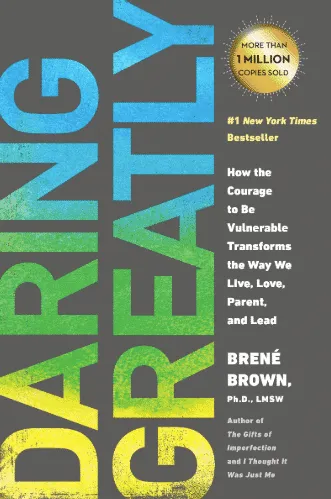
The number one New York Times best seller. One million copies sold!
From thought leader Dr. Brené Brown, a transformative new vision for the way we lead, love, work, parent, and educate that teaches us the power of vulnerability.
“It is not the critic who counts; not the man who points out how the strong man stumbles, or where the doer of deeds could have done them better. The credit belongs to the man who is actually in the arena, whose face is marred by dust and sweat and blood; who strives valiantly; ...who at the best knows in the end the triumph of high achievement, and who at worst, if he fails, at least fails while daring greatly.” (Theodore Roosevelt)
Every day we experience the uncertainty, risks, and emotional exposure that define what it means to be vulnerable or to dare greatly. Based on 12 years of pioneering research, Dr. Brené Brown dispels the cultural myth that vulnerability is weakness and argues that it is, in truth, our most accurate measure of courage.
Brown explains how vulnerability is both the core of difficult emotions like fear, grief, and disappointment, and the birthplace of love, belonging, joy, empathy, innovation, and creativity. She writes: “When we shut ourselves off from vulnerability, we distance ourselves from the experiences that bring purpose and meaning to our lives.”
Daring Greatly is not about winning or losing. It’s about courage. In a world where “never enough” dominates and feeling afraid has become second nature, vulnerability is subversive. Uncomfortable. It’s even a little dangerous at times. And, without question, putting ourselves out there means there’s a far greater risk of getting criticized or feeling hurt. But when we step back and examine our lives, we will find that nothing is as uncomfortable, dangerous, and hurtful as standing on the outside of our lives looking in and wondering what it would be like if we had the courage to step into the arena - whether it’s a new relationship, an important meeting, the creative process, or a difficult family conversation. Daring Greatly is a practice and a powerful new vision for letting ourselves be seen.
There’s a conversation that happens in every man’s life — if he’s paying attention — when he realizes that the armor is costing more than whatever it was built to protect. Not one dramatic conversation. A series of small moments: the relationship that stalled out because he couldn’t quite close the distance. The creative work he never started because he couldn’t tolerate the possibility of it being insufficient. The friendship that dried up because he kept the doors to his interior life locked even to people who would have welcomed entry. The years that passed in a kind of managed numbness that he called stability and that everyone around him could see was something else entirely.
Brené Brown spent twelve years interviewing people about shame, vulnerability, and what she calls “wholeheartedness” — living from a place of worthiness rather than from the constant low-grade anxiety of trying to prove you’re enough. Her 2010 TED talk on vulnerability became one of the most viewed talks in TED history, touching something in millions of people that they recognized immediately but couldn’t have named before she named it. Daring Greatly, published in 2012, is the full articulation of the framework that talk introduced: a research-grounded, practically-oriented examination of what vulnerability actually is, why we avoid it with such ferocity, and what we lose in the avoidance that no other approach to living can recover.
The title comes from Theodore Roosevelt’s famous 1910 speech, often called “The Man in the Arena”: “It is not the critic who counts; not the man who points out how the strong man stumbles, or where the doer of deeds could have done them better. The credit belongs to the man who is actually in the arena, whose face is marred by dust and sweat and blood; who strives valiantly; who errs, who comes up short again and again, because there is no effort without error and shortcoming…”
That is the posture Brown advocates. Not the posture of invulnerability — the posture of managed distance and controlled exposure — but the posture of genuine engagement: with work, with relationships, with creative endeavor, with life in its actual texture and complexity. The willingness to show up fully, to be seen, to risk the full range of possible outcomes including the painful ones. Daring greatly.
Today we’re going deep on what that actually means — the research Brown draws on, the specific mechanics of vulnerability and shame, the way these dynamics play out differently in men and women, and the practical implications for the areas of your life where the armor has been on the longest.
The Research: What Wholehearted People Actually Do Differently
Brown is a researcher, and this matters because Daring Greatly is not a self-help book in the traditional sense — not a collection of inspiring anecdotes wrapped in motivational language. It’s grounded in qualitative research: thousands of hours of interviews with people across age groups, professions, and life circumstances, coded and analyzed to identify what distinguishes people who report a sense of love, belonging, and genuine connection from people who report its absence.
What she found consistently surprised her. The people who reported deep connection, genuine belonging, and what she came to call “wholeheartedness” were not uniformly successful, attractive, accomplished, or admired. They had the full range of life experiences including failure, rejection, loss, and shame. What they had in common was not the absence of struggle but a specific orientation toward it — and toward themselves within it.
They had, in Brown’s terminology, a strong sense of love and belonging — not as something contingent on performance or external validation, but as something they believed they were worthy of. They leaned into vulnerability — not as performance, not as a virtue they had decided to adopt, but as a recognition that vulnerability is the price of admission for every experience that matters. They were compassionate — to themselves first, and from that foundation to others. They were authentic — willing to let go of who they thought they should be in order to be who they were. And they were willing to talk about vulnerability and shame rather than treating those experiences as evidence of defect.
The people on the other side of this divide — the ones who reported feeling disconnected, isolated, and perpetually insufficient — were characterized by what Brown calls “foreboding joy” (the habit of bracing for catastrophe whenever things are going well), by perfectionism (the pursuit of perfection as armor against shame and criticism), by numbing behaviors (using work, alcohol, busyness, or any of a dozen other substances and activities to manage the discomfort of vulnerability), and by the near-universal experience of chronic shame.
Brown distinguishes sharply between shame and guilt — a distinction that has profound practical implications. Guilt says “I did something bad.” Shame says “I am bad.” Guilt is associated with better outcomes — it motivates repair and course-correction. Shame is associated with worse outcomes across nearly every domain studied: mental health, relationship quality, substance abuse, violence, and more. Guilt acknowledges the behavior while preserving the person. Shame attacks the person. And yet shame is the primary tool used in most systems of social control — in families, in schools, in workplaces, in religious communities — because it works in the short term even as it destroys in the long term.
“Vulnerability is not winning or losing; it’s having the courage to show up and be seen when we have no control over the outcome.” — Brené Brown, Daring Greatly
The core finding is stark and important: vulnerability is the birthplace of connection, creativity, belonging, joy, and love. Not suffering through vulnerability with clenched teeth. Not performing vulnerability as a social tactic. Genuine openness to uncertainty and emotional exposure — the willingness to be seen without guarantees about what will happen next. Everything that most people want from their lives — deep relationships, meaningful work, the feeling of belonging, the capacity for genuine joy — requires it. And most people spend enormous energy avoiding it.
Shame: The Swampland of the Soul
Brown calls shame “the swampland of the soul” — and her research on it is the most original and most practically important part of her work. Shame is the intensely painful feeling or experience of believing that we are flawed and therefore unworthy of love and belonging. It’s the feeling that if people could see us — really see us, the full truth of us — they would withdraw their approval, their connection, their love.
Everyone experiences shame. There is no research suggesting otherwise. The variable is not whether you experience it but whether you have the skills to recognize it, name it, and process it in ways that don’t allow it to run your behavior from the background. People with high shame resilience can acknowledge the shame experience, reality-test the story shame is telling them, reach out to trusted others, and speak their shame experience aloud — which consistently reduces its power. People with low shame resilience either numb it through various means, externalize it through blame and aggression, or let it sit in the background as a constant low-level motivator, shaping every choice in ways they’re not consciously aware of.
The shame triggers differ somewhat by gender, and Brown’s data on this is both striking and relevant to men specifically. For women, the most common shame triggers cluster around appearance, motherhood, relationship quality, and professional achievement — a constellation that communicates the social demand to be everything to everyone simultaneously. For men, the trigger is remarkably consistent across research samples: perceived weakness. Do not be weak. Do not need help. Do not fail. Do not show fear. The specific content of the shame trigger matters less than the fact that it’s there, operating continuously, generating a kind of low-grade vigilance about any situation that might produce the experience it dreads.
Brown notes that the way men in her research most commonly describe their experience of vulnerability is fascinating: they almost universally describe it as something they witness in other men but don’t experience themselves. When she asked men about the moments of vulnerability they’d described — the job loss, the illness, the marriage failure — they invariably reframed them through the lens of what they learned from the experience, the ways they were ultimately strengthened by it, the distance they’ve now achieved from it. The willingness to simply say “this was terrifying and I didn’t know what to do” — to locate themselves in the experience rather than outside it — was rare.
This reframing pattern is not weakness. In many ways it’s a sophisticated coping mechanism that allows men to function under conditions of extreme adversity without collapsing. The problem is when it becomes habitual — when the reframing happens automatically regardless of whether the experience has actually been processed, when “what I learned from it” becomes a way of never having to acknowledge that you were genuinely in the arena, genuinely uncertain, genuinely at risk of losing something that mattered. That pattern forecloses connection, because genuine connection requires genuine disclosure, and genuine disclosure requires actually being present in your experience rather than permanently managing it from a safe analytical distance.
Vulnerability and Men — The Cage That Has No Door
Brown describes a conversation with a male executive that crystallized something important about men’s relationship to vulnerability. After a talk she gave on vulnerability and shame, the man approached her and said: “My wife and daughters — they would love nothing more than for me to be vulnerable and to let them in. But I can guarantee you that if I show vulnerability, my wife will lose respect for me, my employees will stop trusting me, and I won’t be able to hold it together.”
She thought about this for a long time. What she concluded is that he wasn’t wrong — not entirely. The cultural messages that men receive about vulnerability are not imaginary. There are real social contexts in which male emotional disclosure is penalized, in which admitting uncertainty or fear or need is used against the man who expressed it. The cage is real. The question is whether the cage has a door.
Her research suggests that it does — but that the door is invisible to anyone who believes the only choice is between total invulnerability and total exposure. The actually wholehearted men she interviewed — the ones who had found a way to live with genuine connection and genuine self-respect simultaneously — had found a third path. Not performance of toughness. Not indiscriminate emotional disclosure. But a deliberate, selective, courageous willingness to be seen in contexts where being seen was appropriate and with people who had earned the right to see them.
This distinction matters enormously and it’s often lost in discussions of vulnerability in men’s spaces. Vulnerability is not synonymous with indiscriminate emotional expression. It is not the demand that men cry publicly or share their feelings with casual acquaintances. It is the willingness, in appropriate contexts with appropriate people, to show up fully — to drop the management, to allow the actual experience, to let the distance close. This is a sophisticated skill. It requires judgment about context and relationship. It is not weakness in any meaningful sense of that word.
Brown also names the specific collateral damage that the no-vulnerability posture produces in men’s lives — damage that is often invisible to the man experiencing it because it’s framed as normal or as strength. The inability to ask for help. The isolation of the leadership role with no one to actually talk to about what it’s like. The relationship that plateaued years ago because the wife stopped trying to reach a husband who was systematically unavailable. The midlife moment of looking at a life that looks successful from the outside and feeling emptied out inside. These are not character failures. They are the predictable outcomes of a posture that prioritizes social invulnerability over genuine engagement — and they extract a cost that no amount of external accomplishment offsets.
Perfectionism — The Twenty-Ton Shield
One of Brown’s most important conceptual contributions is her reframing of perfectionism. The conventional understanding of perfectionism treats it as a high standard applied to work — an admirable drive for excellence that, taken too far, becomes counterproductive. Brown’s research suggests this is completely wrong about what perfectionism actually is.
Perfectionism, in her framework, is a defensive posture — an attempt to protect against the experience of shame by making oneself impossible to legitimately criticize. If I do everything perfectly, the logic goes, there will be no opening for attack. If my work is beyond reproach, no one can accuse me of falling short. If my body, my parenting, my career, my public presentation are all immaculate, the shame trigger can’t fire because the source of shame has been eliminated.
The failure of this strategy is predictable once you understand it: perfectionism can never actually achieve its goal, because the goal is fundamentally irrational. No amount of performance can protect you from the subjective experience of shame. The shame trigger doesn’t require an external precipitant — it can fire on a Tuesday morning for no discernible reason, and it will, and all the perfect work and the perfect body and the perfect presentation provide exactly zero protection. The people most caught in perfectionism are often the most shame-prone — because the same sensitivity that makes the shame intolerable is what drives the compulsive pursuit of a standard that was never actually attainable.
The costs are severe. Brown catalogs them in her research: perfectionism is highly correlated with depression, anxiety, addiction, and life paralysis — the failure to attempt things because the risk of imperfect execution is intolerable. The perfectionist doesn’t try the creative project, doesn’t apply for the role that stretches beyond current qualifications, doesn’t initiate the difficult conversation with a partner, because the possibility of falling short in those arenas is unacceptable. Life shrinks to the domain of the already-mastered, and vitality shrinks with it.
The antidote is not lowering standards — Brown is careful about this. The antidote is distinguishing between healthy striving (doing your best because the work matters and growth matters) and perfectionism (performing immaculately because you believe your worth depends on it). The first orientation produces excellent work and sustainable effort. The second produces anxiety, paralysis, and work that is optimized for criticism-avoidance rather than genuine quality.
The practical question she poses is devastating in its simplicity: How would you live if you already knew you were enough? Not if you achieved a particular level of success, or reached a particular body composition, or accumulated a particular level of regard from people you respect. But already, now, as you are. The perfectionist’s entire life is organized as preparation for a worthiness that keeps receding. The wholehearted person has stopped preparing and started living — because the worthiness was never contingent in the first place, even if it took years to understand that.
Numbing and the Unavailability of Selective Emotion
Brown’s research on numbing is one of the most challenging and most important sections of Daring Greatly, and it contains an insight that I think is genuinely life-changing for many men who encounter it: you cannot selectively numb emotion.
When you use alcohol, overwork, compulsive exercise, pornography, television, food, gambling, or any of the other common numbing behaviors to take the edge off the difficult end of the emotional spectrum — the anxiety, the shame, the grief, the uncertainty, the loneliness — you don’t successfully blunt only the painful emotions. The numbing is nonselective. It also blunts joy, gratitude, connection, love, and wonder. You get a flatter emotional landscape. The lows become more tolerable, and the highs become inaccessible. The result is the managed numbness that so many people experience as their normal state and mistake for equanimity.
This mechanism explains something that many men find puzzling about their own emotional lives: the feeling that positive experiences — time with children, success at work, romantic connection — are landing at half-amplitude, or not landing at all. The intellectual understanding that something good is happening, combined with the felt sense that you’re watching it from behind glass rather than actually experiencing it. This is not a character defect. It’s the direct consequence of years of practicing the numbing that kept the difficult emotions manageable. The price was full emotional availability — full access to the entire range — and most people paid it without knowing they were doing so.
Numbing is not the same as coping. There are healthy forms of emotion regulation — exercise, connection with others, creative work, solitude, sleep — that genuinely process and reduce the intensity of difficult emotions rather than suppressing their signal. Brown is clear about this distinction. The question about any given coping behavior is not just whether it reduces distress in the short term but whether it actually processes the underlying experience or simply defers and buries it. The behaviors that produce short-term relief but long-term emotional unavailability are the numbing behaviors, regardless of whether they’re socially acceptable.
The path forward, in her framework, is not the elimination of all numbing — that’s neither realistic nor necessary — but the development of enough awareness to recognize when you’re using a behavior to numb rather than to cope, and to ask whether the cost is worth paying. Usually, with enough honesty, it isn’t. The anxiety you were trying to avoid was survivable. The joy you were preventing access to was not replaceable. The trade was never as favorable as it felt in the moment of choice.
Daring Greatly in Relationships, Work, and Parenting
Brown applies her vulnerability framework across the major life domains in the second half of Daring Greatly, and the specific applications are worth examining in some detail.
In relationships, daring greatly means what she calls “staying in the arena” — maintaining emotional presence and genuine engagement through the inevitable difficulties of close connection rather than withdrawing into managed distance when the stakes get high. It means the willingness to initiate difficult conversations rather than letting important things go unaddressed. It means allowing your partner to see your uncertainty and need rather than performing competence and self-sufficiency continuously. It means tolerating the discomfort of genuine interdependence — which is the only context in which genuine intimacy exists.
The failure mode she describes in long-term relationships is one that many men will recognize: the gradual development of parallel lives, where functional cooperation and basic civility persist but genuine closeness has been replaced by polite distance. This trajectory is not usually the product of anyone’s malice. It’s the product of accumulated small retreats from vulnerability — the moments of potential intimacy that were deflected, the bids for connection that were missed, the conversations about important things that were deferred until they became too late to have. The remedy is not dramatic. It’s the next opportunity for genuine disclosure, genuine curiosity about the other person’s interior life, genuine engagement with difficulty rather than retreat from it.
In work and creative life, daring greatly means what she describes as “showing up as a maker” — engaging in creative work from a place of genuine investment in the outcome rather than from the protective distance of the armchair critic. The willingness to make something that could fail, to propose ideas that might be rejected, to lead in directions that might not work — these require vulnerability in the specific sense that matters most in professional contexts. The organizations and individuals who produce extraordinary work, Brown finds, are characterized not by risk elimination but by what she calls a “culture of vulnerability” — an environment where people can acknowledge uncertainty, ask for help, and admit failure without these behaviors becoming fodder for political use against them.
The section on parenting is perhaps the most direct, because the way parents model vulnerability (or its absence) for children directly shapes children’s understanding of what it means to be an adult and what emotional lives are for. Children raised by parents who treat shame as unspeakable and vulnerability as weakness learn exactly those lessons. Children raised by parents who can say “I made a mistake, I’m sorry, let me repair that” or “I don’t know and I’m scared about it” or “that really hurt me” — without catastrophe following — learn that feelings are survivable, that imperfection doesn’t destroy belonging, and that the interior life is something to be engaged rather than suppressed. That learning may be the most valuable inheritance any parent can provide.
What This Means for You
There is a specific kind of man who reads Daring Greatly and comes away with a list of insights that he files in the back of his mind alongside other things he knows intellectually and does nothing about. He knows vulnerability is important. He can explain the research. He can cite the shame resilience framework. But when the moment arrives — when the conversation calls for something real, when the relationship needs him to close the distance, when the creative work waits for him to commit — the armor goes back on automatically and the insights remain theoretical.
The book is trying to prevent that outcome. Not by providing techniques — you cannot technique your way into vulnerability — but by addressing the underlying belief that makes the armor feel necessary: the belief that worthiness is contingent, that enough performance will eventually produce the security that’s been sought, that the way to be safe is to be invulnerable.
The research says otherwise. The research says that the most wholehearted people — the ones with the deepest connections, the richest emotional lives, the most authentic professional contributions — are not the ones who figured out how to be never wrong and never weak. They’re the ones who decided that being wrong and being weak were survivable, and that the attempt was worth the risk of those outcomes. They dared greatly. They showed up and were seen. They paid the vulnerability price for the things they wanted most.
That posture is available to you. It does not require the elimination of fear — it requires the decision to act in the presence of fear rather than waiting for the fear to subside. The fear never fully subsides for anyone. That’s not what daring greatly means. It means entering the arena anyway, imperfect and uncertain and genuinely at risk of the full range of possible outcomes.
Roosevelt understood this. The man in the arena, face marred by dust and sweat and blood, who strives valiantly, who errs and comes up short again and again — that man is the relevant model. Not because struggle is ennobling in some abstract sense. Because the only alternative to striving valiantly is staying in the stands, and the stands are not where any life worth having is actually lived.
Shame Resilience — The Four-Part Practice That Changes Everything
Brown’s framework for shame resilience is one of the most practically applicable elements of Daring Greatly, and it deserves more detailed treatment than the general discussion of vulnerability that most readers walk away with. Shame resilience is not the elimination of shame — that’s not possible and not the goal. It’s the capacity to recognize shame when it fires, reality-test its message, and respond in ways that reduce its power rather than amplify it or deny it.
The four elements of shame resilience Brown identifies are: recognizing your personal shame triggers and the physical signs that shame is activated; practicing critical awareness about the social-cultural messages that produce shame; reaching out to trusted others; and speaking shame aloud.
Recognition begins with body awareness. Shame has a distinctive physiological signature that most people have experienced but many have never named: the sudden flush of heat, the contraction in the chest, the impulse to get small or to get out of the situation. These sensations precede conscious awareness of what triggered them. Learning to recognize them — to catch the physical signal before the behavioral response is already in motion — creates the gap necessary to choose a response rather than simply enacting one.
Critical awareness asks: where did this shame message come from? What social, cultural, or familial system produced the belief that this particular thing about me is unacceptable? Brown is emphatic that shame is not a neutral psychological event — it’s produced by specific cultural messages about how people should be, and those messages are almost always worth examining for their internal consistency, their source of authority, and whether they actually serve human flourishing. The man who feels shame about needing help needs to ask where that message came from — who taught him that need equals weakness, and whether that teaching survives scrutiny when examined honestly.
Reaching out is perhaps the most counterintuitive element of shame resilience, because shame’s primary behavioral injunction is to hide. The feeling of “if anyone knew this about me they would withdraw their love and regard” is exactly what shame feels like — and it produces the impulse to conceal rather than disclose. What Brown finds consistently in her research is that disclosure to a trusted person who responds with empathy — not with advice, not with minimization, not with a competing story, but with genuine empathic acknowledgment — is one of the most reliably effective interventions for reducing the power of shame. The response “yes, I’ve felt that too” from someone you respect does more to defuse the shame signal than hours of internal argument about why the shame is irrational.
Speaking shame aloud is related but distinct. The neurological effect of labeling a feeling — putting words to it in the speech production areas of the brain — consistently reduces its emotional intensity. Matthew Lieberman’s research on affect labeling has shown that naming an emotion activates the prefrontal cortex (the executive function region) while simultaneously reducing activity in the amygdala (the threat response region). The mechanism is literally neurological: the act of forming words about an emotional state engages the thinking brain and quiets the reactive brain. Applying this to shame specifically — “I am feeling shame right now, about this specific thing” — can interrupt the automatic behavioral cascade that shame otherwise produces.
Wholehearted Parenting — Raising Children Who Feel Worthy
The most emotionally freighted section of Daring Greatly for many readers is the extended treatment of parenting — specifically, the ways that parental shame and parental responses to children’s vulnerability shape the children’s own capacity for wholehearted living. Brown is clear that this is not an invitation to parent-blame: parents transmit the patterns they learned, often without awareness, and the parents themselves were shaped by systems that did not serve human wholeness.
What she identifies as the central challenge of wholehearted parenting is what she calls “letting our children be who they are” rather than who we need them to be. This is harder than it sounds for the specific reason that children’s behaviors often trigger parents’ own shame systems. A child who struggles in school, who doesn’t fit the athletic or social mold, who expresses emotional needs that the parent has learned to regard as weakness, who fails at something the parent has made meaningful — these are situations where the parent’s shame response activates and shapes the response to the child in ways that can inadvertently communicate to the child that their experience of struggle is unacceptable.
The alternative she describes is not permissiveness or the abdication of parental authority. It’s what she calls “being the adult in the arena” — modeling the willingness to be imperfect, to make mistakes and repair them, to feel difficult feelings without either acting them out or pretending they don’t exist. Children learn more from what they observe their parents do in difficult moments than from explicit instruction. A parent who can say “I made a mistake, I was wrong, I’m sorry” demonstrates that mistakes are survivable, that accountability is possible without self-destruction, and that the relationship can hold imperfection without collapsing. That demonstration may be the most important parenting act available.
Brown also addresses the specific ways shame is inadvertently weaponized in parenting — not through deliberate cruelty but through the lazy reach for the most immediately effective behavior control tool. “What were you thinking?” “I can’t believe you did that.” “What will people think?” These are shame messages: they locate the problem in the child’s essential character rather than in the specific behavior, and they leverage the child’s fear of parental withdrawal to produce compliance. They work, in the short term. The long-term costs — a child who learns that their worth is contingent on performance, that mistakes must be hidden rather than repaired, that emotional needs are burdens rather than natural human states — are severe and lasting.
The alternative is what Brown calls “guilt-based discipline” — addressing the behavior specifically while preserving the relationship and the child’s sense of fundamental worthiness. “You hit your sister. That’s not okay. You hurt her, and we need to talk about that.” This message addresses the action, acknowledges its impact, and maintains the expectation of accountability — without the implicit message that the child is fundamentally defective. The distinction seems small. The cumulative effect over years of daily interaction is profound.
Vulnerability in Leadership — The Courage Deficit That Organizations Pay For
Brown extends her vulnerability framework into organizational and leadership contexts in ways that are immediately recognizable to anyone who has worked in a professional environment. The cultures of most organizations, she finds, are profoundly shame-based — not because the leaders are malicious but because the human default in the absence of deliberate cultivation is a shame-avoidant culture that treats certain feelings, certain admissions, and certain kinds of failure as unspeakable.
The symptoms are visible everywhere: the meeting in which everyone knows the strategy is failing but no one says so, because the person who says so will be marked as disloyal or defeatist. The project that absorbs resources far past the point of rational justification because the sunk-cost logic has been compounded by the shame that admitting failure would produce. The leader who surrounds themselves with people who affirm their decisions rather than challenge them, because the challenging voice is experienced as a shame trigger rather than as a valuable input. The culture of “gotcha” in which mistakes are opportunities for political advantage rather than information sources for collective improvement.
What Brown describes as the antidote is not an organizational culture of indiscriminate disclosure or the elimination of accountability. It’s a culture of what she calls “engaged feedback” — the ability to give and receive feedback about performance and behavior without the feedback being experienced as an attack on the person’s fundamental worth. Leaders who can say “I got that wrong, here’s what I learned” model the behavior they need from their teams. Leaders who cannot say that — who cannot acknowledge error without existential defensiveness — produce the opposite culture: one in which self-protection is the primary incentive and genuine accountability is a career risk.
The courage deficit she identifies in most organizations is precisely the vulnerability deficit. The innovation that never happened because the idea was too risky to propose in a culture where failed ideas produce social cost. The talent that left because the environment offered no room for authentic professional identity. The disengagement — documented extensively in Gallup research and elsewhere — of workers who have concluded that their actual selves are not welcome in the building and who therefore leave just enough of themselves at home to get through the day without exposure. These are the organizational costs of shame culture, and they are enormous.

