
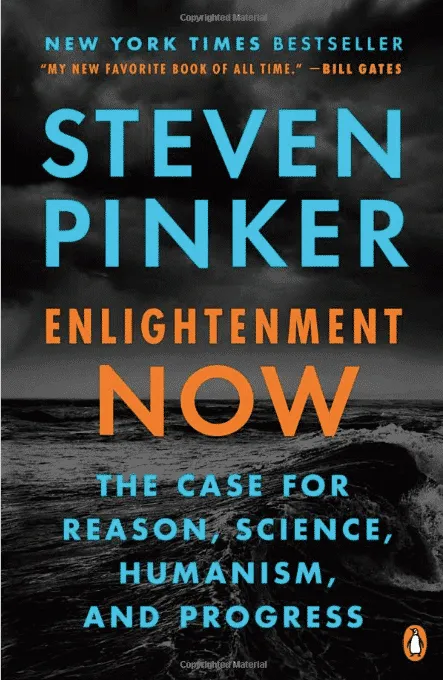
Instant New York Times best-seller. A New York Times notable book of 2018. One of The Economist's books of the year.
"My new favorite book of all time." (Bill Gates)
If you think the world is coming to an end, think again: People are living longer, healthier, freer, and happier lives, and while our problems are formidable, the solutions lie in the Enlightenment ideal of using reason and science.
Is the world really falling apart? Is the ideal of progress obsolete? In this elegant assessment of the human condition in the third millennium, cognitive scientist and public intellectual Steven Pinker urges us to step back from the gory headlines and prophecies of doom, which play to our psychological biases. Instead, follow the data: In seventy-five jaw-dropping graphs, Pinker shows that life, health, prosperity, safety, peace, knowledge, and happiness are on the rise, not just in the West, but worldwide. This progress is not the result of some cosmic force. It is a gift of the Enlightenment: the conviction that reason and science can enhance human flourishing.
Far from being a naïve hope, the Enlightenment, we now know, has worked. But more than ever, it needs a vigorous defense. The Enlightenment project swims against currents of human nature--tribalism, authoritarianism, demonization, magical thinking--which demagogues are all too willing to exploit. Many commentators, committed to political, religious, or romantic ideologies, fight a rearguard action against it. The result is a corrosive fatalism and a willingness to wreck the precious institutions of liberal democracy and global cooperation.
With intellectual depth and literary flair, Enlightenment Now makes the case for reason, science, and humanism: the ideals we need to confront our problems and continue our progress.
The narrative of decline is everywhere. Pick up a newspaper, scroll a social media feed, listen to any political speech from any point on the political spectrum, and the story is relentlessly consistent: things are getting worse. The world is more dangerous, more unequal, more dishonest, more broken than it used to be. Whatever the golden era was — the 1950s, the 1990s, the pre-industrial village, the early republic — we have fallen from it, and the trajectory is downward. This is not a fringe view. It is the ambient assumption of contemporary public discourse, shared across ideological lines in a rare display of consensus.
Steven Pinker thinks this narrative is wrong. Not slightly wrong. Comprehensively, demonstrably, empirically wrong — and dangerous in its wrongness because it produces the kind of despairing, all-or-nothing thinking that makes people susceptible to authoritarian promises of return to greatness, to the abandonment of the incremental, patient, evidence-based work that produced the actual progress the wrong narrative denies.
Enlightenment Now: The Case for Reason, Science, Humanism, and Progress is Pinker’s systematic attempt to replace the narrative of decline with the data of progress — not optimistic projections but actual measurements of the actual state of human well-being across dozens of dimensions over centuries and decades. The book is dense, data-rich, and deliberately provocative. It argues that the ideals of the Enlightenment — reason, science, humanism, and the belief that human conditions can be improved through the application of knowledge and cooperation — have produced more gains in human welfare in the past two centuries than all the preceding millennia of human history combined, and that understanding this accurately is not just intellectually correct but morally and practically important.
Pinker is a cognitive psychologist and linguist at Harvard, and the book draws on his expertise in how minds process information to explain why the narrative of decline is so cognitively compelling despite being empirically false. Understanding the psychology behind the misperception is as important as understanding the data that corrects it — because the misperception is not random noise. It is systematic, predictable, and produced by specific features of human cognition that have been well-characterized by behavioral economics and cognitive psychology. Knowing why you see the world as getting worse, when the data show it getting better across most dimensions, is the beginning of a more accurate and more useful relationship to reality.
The Data of Progress: What Has Actually Improved
The core of Enlightenment Now is an extended, heavily cited review of human progress across fifteen domains, each documented with data series going back as far as the historical record allows. Pinker is not cherry-picking favorable metrics. He is presenting what an honest accounting of human welfare looks like, across a range of dimensions that any reasonable person would agree matter. The cumulative picture is genuinely extraordinary.
Life expectancy is the most fundamental indicator, and the numbers are staggering. Global life expectancy at birth in 1800 was approximately thirty years — not because most people died young in adulthood, but because roughly half of all children died before age five, pulling the average down dramatically. The child mortality rate in England in 1800 was roughly thirty percent before the first birthday. Today, global child mortality is below five percent and falling, and global life expectancy has reached seventy-two years. More children will survive to adulthood in the next decade than in any comparable period in human history. This is not distributed equally — the gains in the developing world are the largest and most recent — but the direction and magnitude are unambiguous.
Extreme poverty has collapsed at a rate that development economists a generation ago would have considered utopian. In 1820, roughly ninety percent of the global population lived on less than two dollars per day in inflation-adjusted terms — the threshold below which basic nutritional and material needs are not met and life is characterized by chronic physical insecurity. By 2015, the proportion had fallen to ten percent. In the thirty years between 1990 and 2020, more than a billion people exited extreme poverty. The bulk of this reduction occurred in East and South Asia, particularly China and India, and it resulted from the combination of market integration, technological diffusion, and improved governance that Enlightenment institutions produce and sustain.
Violence — both interstate war and homicide — has declined dramatically over the long term. This is among Pinker’s most contested claims, but the data he presents (building on his earlier work in The Better Angels of Our Nature) are robust. The per-capita death rate from war in the twentieth century — which included two world wars, the Holocaust, and numerous genocides — was lower than the death rates from organized violence in the ancient world and many premodern societies, where raiding, tribal warfare, and political execution were endemic features of life. The homicide rate in Western Europe has fallen by roughly ninety-five percent since the medieval period. The United States homicide rate today, despite its genuine problems, is roughly half what it was in 1980. The world that feels more violent — because media reports every incident with immediacy and repetition — is statistically less violent than it has been at any prior point in human history for which we have data.
The list continues across domain after domain. Literacy, which in 1820 was achieved by less than twenty percent of the global population, is now over eighty-five percent. The proportion of people living under democratic governance has increased from almost none in 1800 to over half the world’s population today. Access to electricity, clean water, and modern sanitation — the infrastructure requirements for basic human health — has expanded to populations that had no access a generation ago. The incidence of famine has collapsed; where it persists, it is overwhelmingly the result of deliberate political interference with food distribution rather than inability to produce sufficient food. Air and water quality in developed countries, after a mid-twentieth century nadir, have improved dramatically. The ozone layer — damaged by CFCs in the mid-century — has been meaningfully repaired through international cooperation.
Why We Don’t Believe It: The Psychology of Pessimism
If the data are this clear — and Pinker documents them with the rigor of a scientist who has anticipated every objection — why does almost everyone believe the opposite? Why is the narrative of decline so compelling and so universal? Pinker’s account of the cognitive and media mechanisms that produce systematic pessimism is one of the most valuable sections of the book, because it explains not just why people are wrong about progress but why they will tend to stay wrong without deliberate correction.
The availability heuristic, identified by Daniel Kahneman and Amos Tversky as one of the most pervasive systematic errors in human judgment, is the primary mechanism. People assess the frequency or probability of events based on how easily examples come to mind — the availability of mental representations rather than the actual statistical prevalence. Events that are dramatic, emotionally resonant, recent, and widely reported are cognitively available; they feel common because they are vivid. Events that are gradual, undramatic, or diffuse — like the incremental improvement of millions of lives through declining child mortality or expanding literacy — are cognitively unavailable; they feel rare or nonexistent because they don’t produce the mental images that dramatic events do.
The news media, operating on an attention economy that rewards engagement and engagement that rewards threat and conflict over resolution and progress, systematically exploits the availability heuristic. The ten thousand children who didn’t die of a vaccine-preventable disease today are not a story. The one child who died of a disease in a dramatic and attributable circumstance is a story, especially if fault can be assigned and outrage generated. The ten million people who moved out of extreme poverty this year are not a story. The political conflict that may, at the margin, slow the rate of poverty reduction slightly is a story. The result is that consistent exposure to news produces a sample of events that is systematically unrepresentative of reality — heavily weighted toward the negative, the dramatic, and the recent, and largely absent of the gradual, cumulative, and global improvements that constitute the actual signal.
The negativity bias — the well-documented tendency for negative events to be processed more deeply, remembered more vividly, and weighted more heavily in judgment than positive events of equal magnitude — amplifies the availability heuristic’s effect. This bias is evolutionarily sensible: in an ancestral environment characterized by genuine physical threat, the cost of underweighting a negative signal (predator, enemy, spoiled food) was often death, while the cost of underweighting a positive signal was merely a missed opportunity. The bias toward negative information is hardwired into threat-detection systems that the modern informational environment now exploits constantly.
Progressive nostalgia — the tendency to remember the past as better than it actually was — adds another layer. The past’s suffering is abstract and statistical; the present’s suffering is vivid and reported. The past’s progress is unremarkable because it is the baseline; the present’s failures are newsworthy because they represent departure from an expectation that the baseline has made possible. People who live in a world where child mortality is below five percent experience a child death as a tragedy in a way that people in a world where child mortality was thirty percent did not — not because they are more emotional, but because their expectations have been appropriately updated. The progress creates the conditions for its own underappreciation.
The Enlightenment Project: What It Is and Why It Matters
The second major argument in Enlightenment Now — running alongside and underlying the data of progress — is a philosophical argument about the ideas that produced that progress and why those ideas deserve explicit defense in a cultural moment that is increasingly hostile to them from both the left and the right.
Pinker traces the Enlightenment to the seventeenth and eighteenth century intellectual movement — centered in Europe but with global intellectual influences and global consequences — that made several foundational commitments: that reason rather than tradition, authority, or revelation should be the basis for knowledge claims; that empirical investigation rather than armchair speculation should be the method for establishing facts about the world; that the improvement of human welfare in the present life rather than preparation for supernatural reward is a legitimate and primary human goal; and that the application of knowledge to human problems can and should improve the conditions of human existence.
These commitments, Pinker argues, are not culturally specific values that can be treated as one option among others in a pluralistic menu of worldviews. They are the methods that actually produce reliable knowledge and that actually generate the improvements in human welfare that the data document. Science — the systematic application of reason and empirical investigation to questions about the world — is not a Western cultural product that can be replaced by other epistemological traditions with equivalent results. It is a specific set of practices (hypothesis generation, controlled experiment, peer review, replication, the systematic correction of error through evidence) that produces reliable knowledge in a way that other epistemic practices do not. The diseases that killed half of all children who were born before their fifth birthday were not eliminated by tradition or religious authority. They were eliminated by the germ theory of disease, the development of vaccines, and the public health infrastructure that science enabled.
Humanism — the conviction that the reduction of human suffering and the expansion of human flourishing in this life are legitimate and primary moral goals — is the value orientation that directed the application of scientific knowledge toward human welfare rather than toward domination, exploitation, or indifferent abstraction. Pinker traces the expansion of the moral circle — the progressive extension of moral concern to people previously excluded from it by race, gender, class, nationality, and species — as itself a product of the humanist commitment to consistency: if suffering matters, it matters wherever it occurs, in whatever body it occurs, and the historical expansion of who counts morally has followed from the application of reason to the arbitrariness of the prior exclusions.
The Counter-Enlightenment: Threats from Left and Right
One of the most politically sensitive and most intellectually honest sections of Enlightenment Now is Pinker’s examination of the ideological threats to Enlightenment values — which he locates not only in the obvious places (authoritarian nationalism, religious fundamentalism) but in tendencies within progressivism itself that he argues represent a departure from the empirical, humanist, and reason-based commitments that produced the progress they seek to extend.
From the right, the threats Pinker identifies are familiar: nationalist romanticism that trades the cosmopolitan humanism of the Enlightenment for ethnic or national particularism, rejecting the universalist moral logic that drove the expansion of the moral circle; religious fundamentalism that replaces evidence-based knowledge with revealed authority; and the nostalgia politics of various “make great again” movements that locate virtue in a past that, by the data, was worse for almost everyone than the present.
From the left — and this is where the book generated its most heated criticism — Pinker identifies several tendencies that he argues undermine Enlightenment epistemology even as they pursue Enlightenment values. The critical theory tradition’s skepticism about objective knowledge and its treatment of scientific claims as power moves rather than truth-tracking propositions; the identity politics tendency to treat lived experience as a category of epistemic authority that trumps empirical evidence; the political correctness enforcement that imposes conformity of belief and suppresses heterodox inquiry; and the catastrophism that treats every problem, however genuine, as existential emergency rather than solvable challenge.
Pinker is careful to distinguish these tendencies from the legitimate concerns about inequality, discrimination, and systemic injustice that motivate progressive politics. His argument is not that these concerns are misguided but that the epistemological methods being applied to them — the rejection of evidence that doesn’t confirm preferred narratives, the elevation of anecdote over data, the treatment of skeptical questions as acts of hostility — are methods that undermine the capacity to actually solve the problems they seek to address. Progress requires accurate diagnosis, and accurate diagnosis requires the willingness to follow the evidence wherever it leads, including when it leads to conclusions that are uncomfortable.
Existential Risks: Where Pessimism Is Actually Warranted
Pinker is not uniformly optimistic, and one of the things that makes Enlightenment Now worth taking seriously as intellectual work rather than dismissing as naive boosterism is his treatment of the genuine risks to continued progress — risks that he takes seriously precisely because he takes the value of what has been achieved seriously.
Nuclear weapons remain, in Pinker’s assessment, the most immediate existential threat to human civilization — not because their use is inevitable or even probable, but because the consequences of even a limited nuclear exchange would be catastrophic and potentially irreversible, and the political and institutional systems designed to prevent their use have weaknesses that are not fully appreciated in a world that has gone seven decades without nuclear war and has begun to treat that as the natural order. The reduction of nuclear arsenals, the strengthening of non-proliferation regimes, and the development of stable deterrence frameworks are not technocratic housekeeping. They are among the highest-stakes human projects underway.
Climate change receives treatment that some critics have found insufficiently alarmed. Pinker accepts the scientific consensus on human-caused climate change fully and unreservedly. His argument is about the appropriate policy response and the framing of the problem. Treating climate change as existential catastrophe that makes all other progress irrelevant — a framing he associates with some strands of environmental activism — he argues is empirically wrong (the current trajectory, while genuinely harmful, does not lead to human extinction), strategically counterproductive (catastrophism produces despair and paralysis rather than the patient, sustained problem-solving that decarbonization requires), and intellectually dishonest (it requires ignoring the evidence for both the existing progress on emissions reduction in many countries and the technological possibilities for further reduction).
The artificial intelligence risk debate receives careful treatment. Pinker is skeptical of the arguments for near-term catastrophic AI risk, finding the reasoning for why superintelligent AI would necessarily be hostile to human values unconvincing. But he acknowledges the uncertainty in the domain and the importance of taking the question seriously rather than dismissing it. His broader point about existential risks is consistent: they are most effectively addressed by the same Enlightenment tools — reason, evidence, international cooperation, patient institutional development — that have addressed the existential risks of the past. The apocalyptic framing that treats current problems as uniquely unprecedented threats beyond the reach of human problem-solving capability is both empirically unsupported and instrumentally counterproductive.
“The world has made extraordinary progress by the measures that matter — lives saved, suffering reduced, knowledge accumulated, freedom expanded, poverty eliminated. Pretending otherwise, in the name of urgency or critique or tribal solidarity, is not just factually wrong. It is a form of ingratitude toward everyone who did the work, and a form of dishonesty toward everyone who needs accurate information to continue it.”
Happiness and the Paradox of Progress
One of the most challenging sections of Enlightenment Now is the chapter on happiness, because the data here are genuinely more complicated than in the other domains. Life expectancy, child mortality, extreme poverty, and violence all show clear directional trends over time. Reported well-being is more ambiguous, and Pinker’s treatment of it is honest about this ambiguity in a way that strengthens rather than weakens his overall argument.
The Easterlin Paradox — the observation that within countries, wealthier people report higher well-being, but across countries and over time, rising national income doesn’t reliably produce rising reported happiness — is a genuine puzzle that Pinker doesn’t explain away. His argument is that the measures typically used to assess happiness have significant limitations, that the hedonic treadmill (the tendency for happiness levels to return to baseline after both positive and negative events) makes subjective well-being resistant to objective improvement in ways that are psychologically real and not mere measurement error, and that the goal of progress is not to maximize reported happiness on survey instruments but to reduce suffering, expand freedom, and create the conditions for people to define and pursue their own conceptions of a good life.
This is an important philosophical point. The goal of the Enlightenment project, as Pinker frames it, is not to produce a world where everyone reports high happiness scores. It is to produce a world where people are not dying of preventable diseases, not living in material deprivation, not oppressed by political tyranny, not killed by organized violence — a world where the floor of human experience is raised high enough that the full range of human potential becomes available to everyone. That goal is being achieved, imperfectly but unmistakably, by the methods that Enlightenment values produce. The fact that people who are no longer dying of cholera at forty are still concerned about the meaning and quality of their lives is not evidence of failure. It is evidence of success — of having solved the problems that were so consuming that more fundamental questions about human flourishing could not be asked.
The Case for Engaged Optimism
Pinker closes Enlightenment Now with a distinction that is important and often missed by critics who read the book as complacent cheerleading: the difference between optimism and progress-acknowledging realism, and the difference between both of those and the moral and political passivity that critics assume progress-acknowledgment produces.
Acknowledging that the world has made extraordinary progress is not the same as being satisfied with the current state of affairs. The reduction in extreme poverty from ninety percent to ten percent is a genuine achievement — and the ten percent remaining in extreme poverty represents hundreds of millions of people experiencing levels of suffering that are entirely preventable with current knowledge and resources. The decline in violence is real — and the violence that remains is still an enormous source of preventable suffering. Progress doesn’t eliminate the case for more progress. It demonstrates that more progress is possible.
The practical argument Pinker makes is about what disposition toward reality is most likely to produce continued improvement. Catastrophism — the narrative that everything is terrible, getting worse, and approaching some terminal failure — produces despair, political radicalism, the willingness to accept authoritarian promises of emergency reversal, and the abandonment of the incremental institutions and processes that produced the progress being denied. It is psychologically and politically counterproductive in exact proportion to its empirical inaccuracy.
Progress-acknowledging realism — the disposition that says things have improved dramatically through specific mechanisms that we understand reasonably well, that significant problems remain and can be addressed through the same mechanisms, and that the appropriate response to the remaining problems is sustained, evidence-based work rather than apocalyptic alarm — is more likely to produce both the psychological resilience to continue and the accurate models of reality that effective problem-solving requires.
For men who have been formed, as most people in this media environment have been, to experience the world as in terminal decline — to approach current challenges with the background assumption that we are losing, that the direction is downward, that the forces of destruction are winning — Enlightenment Now is both a correction and a liberation. The accurate picture of human progress does not make the remaining problems less urgent. It makes them more tractable. And it makes the people engaged in solving them more capable of sustaining the patient, long-term, evidence-based effort that those problems actually require.
Key Propositions from Enlightenment Now
- Progress is real and documented across dozens of dimensions. Life expectancy, child mortality, extreme poverty, literacy, violence, democracy, and clean air and water have all improved dramatically over the past two centuries. This is not opinion or optimism. It is measurement.
- The narrative of decline is psychologically compelling and empirically false. The availability heuristic, negativity bias, and news media incentives systematically produce a cognitive picture of reality that is more pessimistic than the data support. Understanding this mechanism is essential for relating accurately to the world.
- The Enlightenment values of reason, science, and humanism are what produced the progress. Not tradition, not authority, not nationalist sentiment, not fatalism. The specific practices of reason-based, evidence-guided, humanist-motivated inquiry and cooperation are the mechanisms behind the improvement of human welfare, and understanding this matters for how we approach remaining problems.
- Existential risks are real and require serious attention. The progress so far does not make the future safe. Nuclear weapons, climate change, and emerging technological risks require the same sustained, international, reason-based cooperation that addressed past challenges — and catastrophism that treats them as beyond human problem-solving capability is as counterproductive as denial.
- Acknowledging progress does not mean complacency. The appropriate response to knowing that things have improved dramatically is not satisfaction but the recognition that more improvement is possible through the same means. Progress is not a destination; it is a process, and the process requires sustained engagement informed by accurate models of reality.
- Despair is not a virtue. The tendency to treat pessimism as moral seriousness and optimism as naivety has it backwards. The data-grounded recognition of genuine, documented progress — combined with realistic assessment of remaining problems — produces better thinking, better strategy, and better outcomes than the catastrophism it replaces.
The Moral Arc and the Expansion of Empathy
One of the most philosophically substantial threads running through Enlightenment Now is Pinker’s account of the expansion of the moral circle — the progressive extension of moral concern to people and beings previously excluded from it — and the mechanisms by which that expansion occurred. This is not simply a historical observation. It is an argument about what drives moral progress and what conditions sustain it.
The historian of moral progress faces an awkward fact: the people who lived through the worst atrocities of human history — institutionalized slavery, colonial genocide, the routine brutality of pre-modern justice systems — were not, in general, moral monsters by the standards of their own time. Many were thoughtful, educated, and by their lights conscientious people. The expansion of moral concern was not primarily produced by better people replacing worse ones. It was produced by changes in ideas, institutions, and information that made the previously excluded suffering of previously excluded people cognitively available and morally relevant in a way it had not been before.
Pinker draws on the work of psychologist Paul Bloom, the historian Lynn Hunt, and philosopher Peter Singer to argue that the expansion of empathy — the capacity to imaginatively inhabit another’s experience — is the proximate psychological mechanism of moral progress, and that literacy, narrative, and cross-cultural contact are the primary drivers of empathy expansion. The novel, in particular, gets significant credit: the historical emergence of the novel as a mass cultural form in the eighteenth century — coinciding precisely with the Enlightenment and the first sustained campaigns against slavery — created a technology for imaginative inhabitation of other lives that had no precedent at scale. When large numbers of people read first-person narratives of enslaved persons’ experience, the empathic access to that experience changed the moral calculation.
The mechanism generalizes. Every expansion of the moral circle in modern history — women’s rights, children’s rights, LGBTQ rights, animal welfare — has been preceded by an expansion of the available information about the inner experience of those being excluded and the costs they were bearing. The capacity to ignore suffering requires that the suffering not be vividly present to the moral imagination. When it becomes vividly present — through journalism, through narrative, through the direct testimony of the excluded — the moral calculus changes. Pinker’s argument is that the information environment of modernity, for all its pathologies, provides an unprecedented degree of access to the inner experience of people unlike us, and that this access is the engine of continued moral progress.
This does not make moral progress inevitable. It makes it contingent on the maintenance of the information flows and the institutional conditions that allow imaginative empathy to translate into political and legal change. The erosion of those conditions — through the tribalization of information, the filtering of news to confirm rather than expand existing sympathies, the retreat into homogeneous communities of cultural and political sameness — is a genuine threat to the continued expansion of the moral circle, and it is a threat that the book’s critics from all political directions should take seriously.
Why Intellectuals Resist the Progress Narrative
Pinker devotes a chapter to a question that his data make genuinely puzzling: if the evidence for human progress is as overwhelming as he presents, why do intellectuals — people who, by their own self-definition, are committed to evidence and reason — so consistently resist it? The answer he offers is as interesting as the data itself, because it implicates some of the deepest tendencies of the intellectual and creative cultures that shape how educated people think about the world.
The first factor is the intellectual and aesthetic association of pessimism with sophistication. In the dominant strands of twentieth-century intellectual culture — critical theory, postmodernism, literary modernism, much of the humanities — the posture of disillusionment and critique has been coded as evidence of depth, while the posture of progress-acknowledgment has been coded as naivety or complicity. To celebrate the achievements of liberal institutions is to miss their exclusions. To point to declining violence is to ignore its remaining forms. To note rising living standards is to miss the environmental cost. The intellectual who sees only the dark is profound; the intellectual who also sees the light is suspect.
This asymmetry produces a systematic bias in how intellectuals process and present information about the state of the world — one that is entirely independent of the actual evidence. The intellectual who publishes a paper documenting progress risks being seen as a cheerleader for the status quo, a tool of the powerful, or a naif who hasn’t read enough critical theory. The intellectual who publishes a paper documenting decline, inequality, or threat risks being seen as courageous, rigorous, and committed to the excluded. The incentive structure of intellectual culture produces pessimism for the same reason that the incentive structure of news media does — because the rewards flow in that direction.
The second factor is what Pinker calls “the moralization of progress-acknowledgment” — the conflation of empirical claims about whether things are improving with normative claims about whether they are improving fast enough or equitably enough. People committed to social change often resist the progress narrative because they fear that acknowledging progress will produce complacency — that if people know things have gotten better, they will stop working to make them better still. This is an understandable concern with an empirically weak foundation: the available evidence on what motivates sustained engagement with social problems suggests that people are more effectively motivated by the combination of “things have gotten better AND more improvement is possible” than by either pure catastrophism (which produces despair) or pure complacency (which produces inaction).
Pinker’s point is not that intellectuals should ignore problems, stop criticizing injustice, or pretend that progress has been uniform or complete. It is that the empirical truth about the direction and magnitude of change is not an obstacle to the project of continuing improvement — it is the foundation for an accurate assessment of what works and what doesn’t, what has been accomplished and what remains to be done. The alternative to progress-denying pessimism is not naive boosterism. It is honest measurement of where we have been, where we are, and what the most evidence-based paths forward look like.
Enlightenment Now will frustrate readers who want a comfortable confirmation of their preferred narrative, left or right. It confronts everyone with data that contradict some cherished assumption and demands that those assumptions be revised accordingly. That is precisely what makes it important. The world as it actually is — improving, imperfect, full of solvable problems and genuine risks — is a better object for human effort than the world of terminal crisis that the dominant narrative presents. Pinker’s book is an invitation to see it clearly, and then to engage with what you see.

