
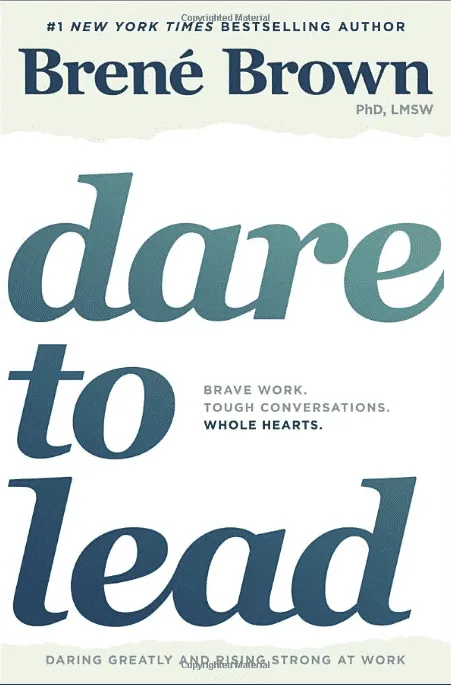
Number-one New York Times best-seller.
Brené Brown has taught us what it means to dare greatly, rise strong, and brave the wilderness. Now, based on new research conducted with leaders, change makers, and culture shifters, she’s showing us how to put those ideas into practice so we can step up and lead.
Named one of the best books of the year by Bloomberg.
Leadership is not about titles, status, and wielding power. A leader is anyone who takes responsibility for recognizing the potential in people and ideas and has the courage to develop that potential.
When we dare to lead, we don’t pretend to have the right answers; we stay curious and ask the right questions. We don’t see power as finite and hoard it; we know that power becomes infinite when we share it with others. We don’t avoid difficult conversations and situations; we lean into vulnerability when it's necessary to do good work.
But daring leadership in a culture that’s defined by scarcity, fear, and uncertainty requires skill-building around traits that are deeply and uniquely human. The irony is that we’re choosing not to invest in developing the hearts and minds of leaders at the exact same time as we’re scrambling to figure out what we have to offer that machines and AI can’t do better and faster. What can we do better? Empathy, connection, and courage, to start.
Brené Brown has spent the past two decades studying the emotions and experiences that give meaning to our lives, and the past seven years working with transformative leaders and teams spanning the globe. She found that leaders in organizations ranging from small entrepreneurial startups and family-owned businesses to nonprofits, civic organizations, and Fortune 50 companies all ask the same question:
How do you cultivate braver, more daring leaders, and how do you embed the value of courage in your culture?
In this new audiobook, Brown uses research, stories, and examples to answer these questions in the no-BS style that millions have come to expect and love. Brown writes, “One of the most important findings of my career is that daring leadership is a collection of four skill sets that are 100 percent teachable, observable, and measurable. It’s learning and unlearning that requires brave work, tough conversations, and showing up with your whole heart. Easy? No. Because choosing courage over comfort is not always our default. Worth it? Always. We want to be brave with our lives and our work. It’s why we’re here.”
Whether you’ve read Daring Greatly and Rising Strong or you’re new to Brené Brown’s work, this audiobook is for anyone who wants to step up and into brave leadership.
Tom was the kind of leader people wrote case studies about. His division consistently hit numbers. Turnover in his team was below the company average. In 360-degree reviews, people said he was fair, decisive, and effective. What they didn’t say — what they had no framework for saying — was that no one on his team ever brought him a real problem. They brought him polished presentations of manageable challenges with pre-approved solutions. The actual problems — the project that was silently failing, the team member who was struggling, the strategy that wasn’t working but no one wanted to be the one to surface — those went somewhere else. Into hallway conversations, into side channels, into the informal network of people processing what they couldn’t bring to Tom. Tom had built an efficient machine. He had also, without knowing it, built an information-insulated one. He didn’t know what was actually happening in his organization. He knew the version of what was happening that people felt safe telling him. The difference between those two things was eventually very expensive. Not in a dramatic way — no scandal, no failure. Just a slow erosion of performance, of talent retention, of the willingness of good people to stay in a system where they couldn’t tell the truth. When a consultant finally mapped the informal communication network and showed Tom the results — the routes information was taking to get around him — he was silent for a long time. “I thought being a strong leader meant having the answers,” he said. “I didn’t know it meant making it safe for other people to have them.” That’s the entire argument of Brené Brown’s Dare to Lead in a single moment of recognition.
Brené Brown spent two decades as a shame and vulnerability researcher at the University of Houston. Her TED talk on vulnerability is one of the most-watched ever given. Dare to Lead is her attempt to translate what the research says about human connection into a specific, practical framework for organizational leadership — because most leadership development, she argues, is teaching people to manage work while entirely ignoring the human dynamics that determine whether the work actually gets done well.
This review will engage honestly with both Brown’s real contributions and the places where her framework needs supplementation — because the legitimate critiques of her work (too soft, too feelings-focused, politically loaded) are worth examining clearly alongside the reasons why the research she’s drawing from is correct and important.
Key Takeaways
- Daring leaders are those who can operate courageously in uncertainty and discomfort — not those who project invulnerability or have all the answers.
- Psychological safety — the belief that you can speak up, challenge, and be wrong without being punished — is the single strongest predictor of team performance across multiple major research programs including Google’s Project Aristotle.
- Armor — the behaviors leaders use to avoid vulnerability — consistently undermines the conditions necessary for real performance: honesty, learning, risk-taking, and trust.
- Empathy is not a soft skill. It is the mechanism by which leaders get accurate information about reality from the people closest to it.
- The BRAVING framework (Boundaries, Reliability, Accountability, Vault, Integrity, Non-judgment, Generosity) is a behavioral checklist for what trust-building actually looks like in practice.
- Values-based leadership requires knowing your actual values (not your stated ones) and making decisions from them even when it’s costly.
- Clear is kind — vague feedback, hedged expectations, and unclear goals are not gentle. They are a different kind of harm that masquerades as consideration.
- Rumble — engaging honestly with difficult conversations rather than avoiding or bulldozing them — is the core leadership practice and the one most consistently avoided.
The Research Behind the Feelings: Why This Is Actually Hard Science
A common dismissal of Brown’s work goes roughly: “This is feelings stuff dressed up as leadership theory.” This is wrong, and it’s worth being specific about why, because the research base she’s drawing from is substantial and methodologically serious.
The centerpiece is Google’s Project Aristotle, a two-year study analyzing 180 teams at Google to determine what made teams effective. The research team went in expecting to find that team composition — the right mix of talent, skills, and experience — would be the dominant predictor of performance. What they found instead was that team composition mattered far less than team norms. Specifically, one variable explained more of the variance in team performance than everything else combined: psychological safety, as defined by Harvard Business School professor Amy Edmondson — the shared belief that the team is safe for interpersonal risk-taking, that speaking up, being wrong, or asking for help won’t result in punishment or humiliation.
Teams with high psychological safety learned faster, innovated more, made better decisions (because more relevant information surfaced), and retained talent more effectively. Teams with low psychological safety — even when staffed with high-talent individuals — underperformed consistently. The brilliant team where no one will surface problems is not actually a brilliant team. It is a collection of individuals performing competence theater while the real work gets done in spite of the official structure rather than because of it.
The mechanism Brown adds to Edmondson’s framework is the behavioral and emotional conditions that create or destroy psychological safety: specifically, how leaders signal through their own behavior whether truth-telling is safe. When leaders punish bad news, avoid difficult conversations, respond to challenge with defensiveness, or project invulnerability — these behaviors systematically signal that honesty is not safe, that the cost of surfacing problems exceeds the cost of hiding them. The team learns. Quickly. And behaves accordingly.
This is not soft. This is why Tom’s division was performing below its potential while generating reviews that said he was excellent. His armor — the projection of competence and control — was preventing the information flow necessary for the organization to function at its actual capacity.
The VAULT Framework: What Daring Leadership Actually Looks Like in Practice
Brown presents the BRAVING inventory as a trust assessment tool. Read carefully, it’s actually a framework for leadership behavior. I’ll adapt it as the VAULT Framework — five leadership behaviors that determine whether the organizational environment generates real performance or performance theater:
- Vulnerability in uncertainty. The leader who pretends to have more certainty than exists is not being strong — they’re generating false safety that makes real planning impossible. Daring leaders name what they don’t know, flag where they’re uncertain, and create space for the people closest to the work to contribute what they know. This requires tolerating the discomfort of appearing less than fully in command, which is why most leaders avoid it.
- Accountability without self-protection. Leaders who model accountability — who acknowledge mistakes clearly, without excessive self-flagellation and without deflection — create permission for others to do the same. Organizations where leaders protect themselves from accountability by blaming circumstances, subordinates, or external factors produce cultures where nothing is ever anyone’s fault, which means nothing ever gets fixed.
- Undivided presence in difficult conversations. The rumble — Brown’s term for honest engagement with difficult realities — requires being genuinely present rather than managing the conversation toward a predetermined outcome. Leaders who go into difficult conversations having already decided what they’ll hear, committed to a conclusion they’re performing the appearance of arriving at, kill trust more effectively than bluntness ever would. People can tell when they’re being managed rather than heard.
- Leanness toward positive intent. Brown’s “generosity” and “non-judgment” — the assumption that people are doing their best rather than the default assumption of bad intent — determines whether people will bring you their real problems or only their polished ones. Leaders who respond to mistakes with judgment get sanitized information. Leaders who respond with curiosity get the truth.
- Truth-telling as care. “Clear is kind. Unclear is unkind.” The most practically important single line in the book. Vague feedback, ambiguous expectations, and soft-pedaled bad news are experienced by their recipients as consideration but are functionally a form of withholding. People cannot improve from feedback they don’t receive. People cannot meet expectations that haven’t been stated. Kindness that prevents honest communication is not actually kindness. It is comfort-seeking disguised as consideration, and it is extraordinarily expensive at scale.
Armor: The Behaviors That Kill Teams While Looking Like Strength
Brown’s most practically useful concept is “armor” — the specific behaviors leaders deploy to avoid vulnerability, all of which are experienced by the people around them as strength or competence but which systematically undermine the conditions for real performance.
The foreboding joy armor. Leaders who can’t take in positive information without immediately scanning for the threat in it — “the quarter was great, but we need to be worried about Q3” — without completing the positive acknowledgment first. This armor systematically signals that satisfaction is never allowed, which produces teams running on anxiety rather than achievement.
The perfectionism armor. Perfectionism isn’t high standards. It’s the use of high standards as a defense against shame — the belief that if I do it well enough, no one can criticize me. Leaders who deploy perfectionism armor create cultures where people are afraid to iterate, ship early versions, or be wrong in public, which is fatal to innovation and learning.
The shield of cynicism and overpowering. Cynicism is armor against disappointment — if I expect nothing to work, I’m never disappointed. Overpowering is armor against uncertainty — if I control every element, nothing unexpected can happen. Both are comprehensively demonstrated in the research to produce worse outcomes than the things they’re protecting against. The leader who prevents surprises by controlling everything surprises no one — including themselves about how much talent has quietly left the building.
The “I don’t care what people think” armor. Brown distinguishes between the healthy version (I can differentiate between feedback worth taking in versus feedback that’s not) and the armored version (I have decided that emotional feedback is irrelevant, so I don’t have to process any of it). The healthy version is a boundary. The armored version is a wall, and behind it, the leader is flying blind on the human dimension of their organization.
The “stay cool” armor. The leader who models emotional suppression trains an organization where no one tells the truth about how they feel about the work — which is exactly the information that would allow the leader to address what’s actually wrong before it becomes what’s catastrophically wrong.
“Leaders who armor up are essentially saying: I will not accept the reality of my own human limitations. And that refusal doesn’t make them stronger. It makes them the most dangerous person in the room — because they’ve cut off access to the information that would allow them to actually lead.”
The Legitimate Critique: Where Brown Gets Sloppy or Incomplete
Intellectual honesty requires engaging with the real criticisms.
The political loading problem. Brown’s examples, illustrations, and some of her framing have a specific political valence that makes the work easier to dismiss in environments where that valence is unwelcome. This is not a fatal flaw in the research, but it is a genuine strategic failure — a book arguing for courage and bridge-building that alienates half its potential readers before they engage with the substance. The research doesn’t require the political framing. The book would be stronger without it.
The “feeling to fix it” confusion. Brown is careful to distinguish between processing emotion and wallowing in it, but some readers and many popular applications of her work conflate emotional acknowledgment with emotional indulgence. The research on psychological safety and vulnerability is about creating conditions for honesty and learning — not about creating therapeutic processing sessions in organizational contexts. The distinction matters practically.
Context sensitivity is underdeveloped. The vulnerability framework is more immediately applicable in certain organizational cultures and less applicable in others. Brown largely ignores the question of how to introduce vulnerability practices into cultures where the existing norms are deeply armored — which is most of the organizations that most need the change.
The power differential problem. Brown’s framework is most fully developed for leaders choosing to be vulnerable with their teams. It’s less developed for subordinates choosing to be honest with leaders who haven’t created the conditions for it — which is the situation most people actually face. Being vulnerable with your boss who hasn’t read this book is a different risk calculation than being vulnerable with your team once you have. The book doesn’t do enough with this.
None of these criticisms invalidate the core framework. They are limitations worth knowing going in.
Leadership principles — what separates great leaders from average ones
The Rumble: How to Have Difficult Conversations That Actually Resolve Things
The concept of the “rumble” is the most operationally useful thing in the book — and the thing most consistently avoided by most leaders. A rumble is a honest, engaged conversation about something difficult, held with the intention of arriving at truth rather than performing a predetermined outcome. Brown identifies the specific linguistic and behavioral practices that make rumbles productive versus destructive.
The most important: starting from curiosity rather than conviction. “Help me understand what happened here” rather than “Tell me why you did this wrong.” The difference is not semantic — it changes the information available in the conversation and the conditions for honest response.
Equally important: the SFD (shitty first draft) practice — explicitly naming that what you’re about to say is your current interpretation, not The Truth, and inviting correction. “Here’s my current read: it looks like you agreed to a timeline you didn’t believe in rather than push back — tell me if I’m wrong.” This practice does something remarkable: it models fallibility in real time, which makes it safe for the other person to do the same, which is when the actual information surfaces.
Rumbles are hard because they require tolerating the discomfort of not controlling the outcome. Most leaders avoid them not because they’re conflict-averse but because they’re uncertainty-averse — a rumble might surface something you don’t want to know, might end somewhere you didn’t plan, might expose something about your own contribution to the problem. The armor is specifically designed to prevent all of these outcomes. Daring leadership requires taking it off anyway.
Values-Based Leadership: Knowing What You Stand For When It’s Costly
Brown’s chapter on values is one of the book’s strongest, and one of the most uncomfortable. Her claim: most leaders have stated values they don’t actually lead from, and the gap between stated and operational values is one of the most corrosive forces in organizational culture.
The diagnostic is simple and devastating. Write down your top two values. Then examine your last ten decisions under genuine pressure — where something important was at stake and a choice had to be made. For each decision, ask: was this decision consistent with those values? The answer pattern is more revealing than any 360-degree review. Stated values that are not operational values are not values — they’re aspirations, and the gap between aspiration and operation is visible to everyone in the organization except the person generating it.
Values-based leadership requires something most leadership development never addresses: the capacity to make unpopular decisions with genuine conviction. The leader who holds firm on a principle because it’s right, even when the pressure to abandon it is significant, even when the political cost is real — this is what generates long-term trust. People forgive leaders for being wrong. They rarely forgive them for being inconsistent.
The corollary: the values have to be real, not performative. A leader who says courage is a core value and then avoids every difficult conversation isn’t leading from that value — they’re hiding behind a word. The accountability mirror applies to values as much as to performance.
Authentic leadership — why being real makes you more effective
Books Similar to Dare to Lead
- The Five Dysfunctions of a Team by Patrick Lencioni — the practical organizational framework that Brown’s research underpins. Together they form a complete picture of what kills teams and what builds them.
- Teaming by Amy Edmondson — the direct research source for psychological safety. More academic but essential for understanding the foundation Brown builds on.
- Radical Candor by Kim Scott — Brown’s “clear is kind” principle in full operational detail. How to give honest feedback that helps people rather than defending or damaging them.
- Extreme Ownership by Jocko Willink — the counterpoint tradition on leadership. Less emotionally warm, more operationally precise. The two frameworks complement each other more than they contradict.
- Multipliers by Liz Wiseman — research on how some leaders make people smarter and others accidentally suppress intelligence around them. The behavioral side of psychological safety.
- An Ordinary Man by Paul Rusesabagina — vulnerability and courage in the most extreme possible leadership context. Puts the corporate framework in full moral proportion.
FAQ
- Is vulnerability appropriate in all organizational contexts, or does it depend on the culture?
It depends on how it’s applied, not on the culture. Brown is careful to distinguish between emotional oversharing (unhelpful in most contexts) and strategic vulnerability — acknowledging uncertainty, modeling accountability, admitting mistakes. The latter is appropriate in virtually every organizational context because it’s not about feelings — it’s about accurate information flow and trust-building. The expression looks different in a military unit versus a creative agency, but the underlying principle applies broadly. - How do you practice daring leadership when your own boss rewards the armored behaviors?
This is the hardest application problem in the book. Brown’s honest answer is that you build trust with your own team first, model the practices within the sphere you control, and accept that you may not be able to change the organizational culture from below. Sometimes the most courageous leadership act is deciding that this culture isn’t one you can lead effectively in and finding one where you can. - The “clear is kind” principle feels harsh in practice. How do you deliver hard messages kindly?
Clarity and cruelty are different things. Clear feedback is specific, behavioral (what happened, not who is bad), forward-looking (what could be different), and delivered with genuine care for the person’s success. Cruelty uses feedback as punishment or performance of superiority. The clarity Brown advocates is the first kind. The confusion arises when people mistake vagueness for kindness — which is usually avoiding the discomfort of giving feedback, not actually considering the recipient. - Is the BRAVING framework just a list, or is there a priority order?
In practice, reliability tends to be the first trust-builder and the first trust-destroyer. People assess “can I count on you to do what you say?” before almost any other variable. Brown doesn’t rank them formally, but reliability and accountability (honoring commitments and owning failures) are the behavioral foundations that make all the others meaningful. - How do you handle team members who weaponize the vulnerability framework — using it to avoid accountability?
Brown addresses this: vulnerability is not a trump card that overrides accountability. Acknowledging that something was hard for you doesn’t exempt you from the responsibility to do it anyway. The vulnerability framework is about creating conditions for honest engagement with difficulty, not providing explanations for not engaging with it at all. A leader can hold both simultaneously: “I hear that this was hard. I also need you to do it.” - The book seems written for relatively progressive organizational cultures. What about traditional industries?
The research doesn’t have a political orientation. Psychological safety predicts performance across industries, cultures, and organizational types — it’s been studied in manufacturing, military, healthcare, financial services, and technology. The specific language and cultural markers Brown uses may land differently in different contexts, but the underlying behavioral principles (does my team believe it’s safe to surface problems?) are universal. Translate the vocabulary as needed. The principle doesn’t change. - Does the vulnerability approach work for individual contributors, or just for leaders?
Fully applicable to individuals at any level — the BRAVING framework for trust, the rumble practices for difficult conversations, the values inventory for personal integrity. Brown’s primary audience is leaders, but the human dynamics are not role-specific. - How long does it take to build psychological safety in a team that doesn’t have it?
Edmondson’s research suggests teams can develop meaningful psychological safety within months if leadership behavior changes consistently. The signal that creates psychological safety is primarily behavioral — what happens when someone surfaces a problem or makes a mistake? A leader who responds to those moments with curiosity and problem-solving rather than judgment will see the culture shift within a few months of consistent practice. - What’s the relationship between empathy and boundaries in this framework?
Brown is specific: empathy without limits is not empathy, it’s the absence of a self. Daring leaders practice empathy AND maintain clear expectations. The combination — genuine care for the person plus honest accountability for the work — is the definition of good management in this framework. Neither care alone (which becomes enabling) nor accountability alone (which becomes cold) achieves the performance outcomes the research shows are possible. - How do I know if I’m armored or just appropriately professional?
The diagnostic: do the people who work closely with you know what you don’t know? Do they bring you real problems or polished ones? Do they challenge your decisions or accept them? If you’re consistently getting agreement and polish, you’re probably armored — people have learned that honesty is costly and adapted accordingly. Tom’s story is the pattern: great reviews, information insulation, slow erosion of performance.
The Bottom Line on Brown’s Book
When that consultant showed Tom the informal communication map — the routes information took to avoid him — and he sat in silence, he was experiencing something rare: an honest accounting of the gap between the leader he thought he was and the organizational conditions he had actually created. That gap is the entire subject of Dare to Lead.
The book is not asking you to become emotionally available in ways that are professionally inappropriate. It is asking you to take seriously what the research shows: that the human dynamics you’ve been treating as secondary to the “real work” are the primary determinants of whether the real work gets done at the level it’s capable of. Psychological safety, honest communication, values-based decision-making — these are not soft alternatives to performance culture. They are, increasingly, the best available science on what performance culture actually requires.
Tom eventually rebuilt the culture of his division. It took two years, a significant behavioral change on his part, and several uncomfortable rumbles with people who had adapted to the old environment. His numbers improved. More importantly, the people closest to the work started bringing him the real version of what was happening. He finally knew what he was actually leading. The armor didn’t make him a stronger leader. Setting it down did.
Communication skills — how to say hard things effectively
Emotional intelligence — the skill that predicts success better than IQ
Trust Architecture: Building Psychological Safety from the Ground Up
The most common question leaders ask after reading Brown is: where do I actually start? The answer the research supports is behavioral, specific, and starts on Monday morning.
The first move is the simplest and the hardest: the next time someone on your team brings you bad news, respond with curiosity instead of problem-solving or judgment. “Tell me more about what happened” before “here’s what you should have done.” This single behavioral change — consistent across dozens of interactions over several months — does more to build psychological safety than any retreat, workshop, or values statement. People learn through behavior, not through declarations. They watch what happens when someone surfaces a problem. If the response is “thanks for telling me, let’s figure this out,” they learn that surfacing problems is safe. If the response is a rapid-fire problem-solving session that implicitly signals the problem was preventable and therefore a failure, they learn to filter.
The second move is the accountability moment. The next time you make a visible error — a decision that turns out wrong, a commitment you don’t keep, an assessment that proves incorrect — name it directly and publicly to the relevant people. Not dramatically, not with excessive self-criticism, but clearly: “I got this wrong. Here’s what I thought would happen and why, and here’s what I’m doing differently.” This single behavior, modeled by leaders, changes the entire cultural calculus around accountability. It shows that accountability is something you do, not something done to you — and it makes the same accountability from team members feel safe rather than threatening.
The third move is the rumble. Before the end of the week, identify one difficult conversation you’ve been avoiding — a performance issue, a strategic disagreement, an interpersonal conflict — and have it. Not perfectly. Not with the complete VAULT Framework fully internalized. Just have it, starting from genuine curiosity about what the other person thinks and intends, and see what you learn. The first rumble is always uncomfortable. The second is less so. By the tenth, you’ve built the most valuable leadership skill that most managers never develop: the capacity to get accurate information from the people closest to the work, even when that information is difficult to deliver and difficult to receive.
Brown’s book is ultimately a book about courage — specifically the courage required to lead from genuine connection rather than projected authority. Tom had authority. His numbers said so, his title said so, his 360-degree reviews said so. What he lacked was connection to the actual reality of his organization, and that connection only becomes available when the people in the organization believe it’s safe to tell you the truth. Building that belief is the work. It is also the highest-leverage work a leader can do. Everything else is downstream of whether the people closest to your challenges are willing to bring them to you before they become expensive.
How to build trust in relationships and teams
The Research on Leader Vulnerability: What the Data Actually Shows
A common objection to Brown’s framework goes: showing vulnerability as a leader signals weakness and reduces authority. This sounds plausible and is empirically incorrect. The research is consistent: leaders who demonstrate appropriate vulnerability — acknowledging uncertainty, owning mistakes, asking for input — are perceived as more trustworthy and generate more effective team performance than leaders who project invulnerability.
A meta-analysis by Fehr and colleagues found that leaders who model accountability and acknowledged imperfection produced teams with stronger psychological safety and better error-reporting — which is directly correlated with reduced catastrophic failures in high-stakes environments. This finding holds in healthcare, aviation, nuclear, and financial services — industries where the cost of unreported errors is existential. The hospitals where nurses feel safe telling doctors they’ve made a mistake have lower patient mortality rates. The aviation crews where co-pilots feel safe challenging captains have fewer crashes. Leader vulnerability — the signal that it’s safe to surface problems — is literally life-saving in high-stakes contexts.
The distinction that matters is between vulnerability as oversharing and vulnerability as strategic openness. Brown is not arguing that leaders should process their personal struggles with their teams, share emotional experiences indiscriminately, or blur professional and personal boundaries in ways that compromise their effectiveness. She is arguing that the specific forms of vulnerability that matter for leadership — acknowledging what you don’t know, naming when you’ve been wrong, asking for input on genuine uncertainty — are not weakness. They are the behaviors that generate the information flow and psychological safety that allow organizations to function at their actual capacity rather than at the capacity people feel safe performing in front of a leader who can’t acknowledge limits.
Tom’s eventual discovery of his information-insulated culture was not a leadership failure that he needed to shame himself about. It was the predictable result of a management style — competent, well-intentioned, armored — that the behavioral science had already predicted would produce exactly that outcome. Once he knew the mechanism, he could change the behavior. Once the behavior changed, the culture followed. The research said it would. It did. That’s not soft science. That’s reliable organizational psychology producing predictable results when its principles are applied with consistency and genuine intention.
Where to Go From Here
Brown ends Dare to Lead with a reminder that courage is a practice, not a trait — something you do over and over in ordinary moments, not something you discover in dramatic ones. The ordinary moments where daring leadership is built or abandoned are: how you respond when someone surfaces a problem, what you do when you’ve been wrong, whether you have the conversation you’ve been avoiding, whether your decisions reflect your stated values or your comfort level. The accumulation of those moments, over months and years, is the actual character of a leader. Not the speeches, not the vision statements, not the 360-degree review scores. The moments where armor would have been easier and you chose to take it off instead. That is what builds the organizations where people can tell the truth. And organizations where people can tell the truth are the ones that actually figure out what’s happening fast enough to do something about it. That is the competitive advantage. That is what Tom’s division eventually discovered. It was available the whole time. It just required someone willing to stop performing competence and start practicing courage.
Daring leadership is not a destination. It is a direction — a consistent orienting toward honesty, courage, and connection rather than away from the discomfort those things require. Brown’s research has given us the map. The territory is your team, your organization, your decisions under pressure, and the small moments every day where you choose whether to armor up or show up. That choice, made consistently enough, in the direction of showing up, is what transforms good enough into genuinely excellent. Not once. Not in a dramatic moment. In the accumulated practice of choosing courage in the ordinary moments that no one writes case studies about but that everyone who has worked in a genuinely great organization knows: something real was happening here. Something honest. Someone was willing to tell the truth, and someone was willing to hear it. That’s all it takes. It’s also everything it takes.

