
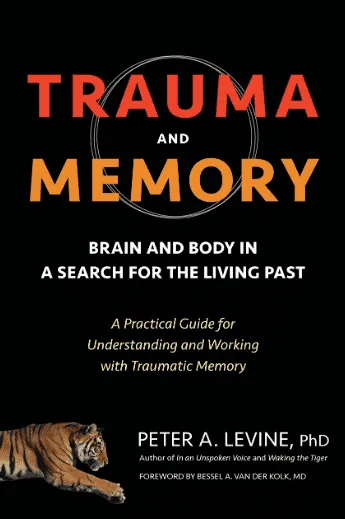
In Trauma and Memory, best-selling author Dr. Peter Levine (creator of the Somatic Experiencing approach) tackles one of the most difficult and controversial questions of PTSD/trauma therapy: Can we trust our memories? While some argue that traumatic memories are unreliable and not useful, others insist that we absolutely must rely on memory to make sense of past experience. Building on his 45 years of successful treatment of trauma and utilizing case studies from his own practice, Dr. Levine suggests that there are elements of truth in both camps. While acknowledging that memory can be trusted, he argues that the only truly useful memories are those that might initially seem to be the least reliable: memories stored in the body and not necessarily accessible by our conscious mind.
While much work has been done in the field of trauma studies to address "explicit" traumatic memories in the brain (such as intrusive thoughts or flashbacks), much less attention has been paid to how the body itself stores "implicit" memory and how much of what we think of as "memory" actually comes to us through our (often unconsciously accessed) felt sense. By learning how to better understand this complex interplay of past and present, brain and body, we can adjust our relationship to past trauma and move into a more balanced, relaxed state of being. Written for trauma sufferers as well as mental health care practitioners, Trauma and Memory is a groundbreaking look at how memory is constructed and how influential memories are on our present state of being.
Peter Levine has spent over forty years doing something most of his colleagues in psychiatry and psychology considered impossible: developing a reliable method for resolving trauma that doesn’t require patients to repeatedly relive their worst experiences. His approach, Somatic Experiencing, starts from a fundamentally different understanding of what trauma actually is — and that difference changes everything about how healing becomes possible.
Trauma and Memory: Brain and Body in a Search for the Living Past is not an introductory text. It is a sophisticated exploration of one of the most challenging problems in trauma therapy: the question of how traumatic memories are stored, accessed, and processed differently from ordinary autobiographical memories, and what that difference means for how we understand and treat trauma. If you want the accessible introduction to Levine’s work, Waking the Tiger is probably the better starting point. But if you’ve encountered his work before and want to understand the deeper theoretical and clinical foundations, this book rewards the investment.
The central thesis is both simple and radical: traumatic memories are not primarily narrative events stored in the brain’s declarative memory system. They are physiological states — patterns of activation in the body’s nervous system, the musculature, and the autonomic regulatory systems that persist long after the threatening event has ended. Healing trauma, therefore, is not primarily a matter of telling the story correctly or achieving cognitive insight. It is a matter of completing the physiological processes that were interrupted when the trauma occurred.
This changes almost everything about what effective trauma treatment looks like. And it has profound implications for anyone who carries unresolved trauma — which, as Levine argues, includes far more people than the clinical category of PTSD would suggest.
What Memory Actually Is
Before understanding Levine’s argument about traumatic memory specifically, it helps to understand his framework for memory generally — a framework that is grounded in neuroscience but extends well beyond what most people think of when they hear the word “memory.”
The memory system most people are familiar with is declarative memory — the ability to consciously recall events, facts, and autobiographical experiences. When someone asks “do you remember your first day of school?” the memory you access is declarative. You can describe it, place it in time, narrate it. Declarative memory is processed significantly through the hippocampus, requires conscious attention to encode and retrieve, and is inherently linguistic and narrative in character.
But declarative memory is only one of several distinct memory systems in the human brain, and it is not the most fundamental. Procedural memory — the memory for how to do things — is encoded differently, stored differently, and accessed differently. You don’t consciously remember how to ride a bike; you simply find that your body knows. Emotional memory — the associations between stimuli and emotional states — is processed primarily through the amygdala and operates largely outside conscious awareness. And what Levine calls somatic memory — the body’s encoded patterns of response to specific situations — is perhaps the most fundamental and certainly the most relevant to understanding trauma.
Levine argues that when we understand memory primarily as declarative — as story and narrative — we systematically miss the most important aspects of traumatic memory. The trauma survivor who says “I know it’s over, I know I’m safe, but I still feel terrified” is not being irrational. They are accurately reporting the state of their somatic memory system, which has a different relationship to time and context than their declarative system. The story says “it’s over.” The body says “it’s happening right now.”
The Nervous System Under Threat
To understand how trauma becomes embedded in the body, Levine walks through what happens in the nervous system during a threatening event — and what is supposed to happen afterward, when the threat has passed.
The autonomic nervous system — the system that regulates the body’s automatic functions including heart rate, breathing, digestion, and the stress response — operates according to a hierarchy of responses that Stephen Porges has described in his Polyvagal Theory. When the nervous system detects threat, it first attempts social engagement: calling for help, using facial expression and vocalization to signal distress and recruit support. If social engagement fails to resolve the threat, it mobilizes the sympathetic nervous system — the fight-or-flight response — flooding the body with adrenaline and cortisol, redirecting blood flow to the large muscles, and preparing the organism for vigorous defensive action. If fight or flight is unavailable or fails, the system activates the dorsal vagal freeze response: a state of immobility, dissociation, and metabolic shutdown that represents the organism’s last-resort survival strategy.
In animals, the resolution of a threat is typically followed by a spontaneous discharge of the activation that was mobilized: shaking, trembling, deep breathing, spontaneous movements. This discharge is the completion of the defensive response cycle. It returns the nervous system to baseline. Animals that complete this cycle show no lasting signs of trauma, even after extremely threatening experiences. The physiological activation is metabolized. The system resets.
In humans, this completion process is frequently interrupted. We freeze the trembling because it feels dangerous or shameful. We distract ourselves from the somatic experience with thought and narration. We receive well-meaning but counterproductive reassurance that short-circuits the physiological process before it completes. We don’t allow the body to finish what it started because we don’t understand that it needs to finish.
The result is that the activation mobilized during the threat remains in the system. Not as a narrative memory, but as a physiological state that is continuously active at some level — a persistent readiness for threat, a body that has never been told it’s safe to complete the defensive cycle. This is the core of what Levine means when he says trauma is stored in the body.
The Memory Reconsolidation Window
One of the most technically sophisticated aspects of Trauma and Memory is Levine’s treatment of memory reconsolidation — a relatively recent discovery in neuroscience that has significant implications for therapeutic practice.
For most of the twentieth century, the dominant model of memory consolidation held that once a memory was formed and consolidated, it was fixed — it could be retrieved and reexperienced, but not fundamentally altered in its neurological structure. This model suggested that traumatic memories, once formed, could only be managed — worked around, habituated to, overlaid with new associations — but not actually changed.
The discovery of reconsolidation changed this picture fundamentally. When a memory is retrieved — when the neural pattern corresponding to a memory is activated — it enters a labile state for a period of hours during which it can be altered before it reconsolidates. If a new experience occurs during this window that violates the predictions of the original memory, the reconsolidated memory reflects this new information. The memory literally changes.
This has profound implications for trauma therapy. If traumatic memories can be altered during the reconsolidation window, then therapeutic interventions that activate traumatic material and simultaneously provide disconfirming experiences — experiences that violate the nervous system’s predictions about what the trauma meant — can produce lasting changes in the traumatic memory itself, not merely in the behavioral and emotional responses to it.
Levine’s Somatic Experiencing approach can be understood partly in terms of reconsolidation: it carefully titrates the activation of traumatic material to remain within a window that allows processing rather than overwhelming the system, and simultaneously introduces somatic experiences of completion, safety, and mastery that disconfirm the nervous system’s threat predictions. The memory reconsolidates in a transformed form — one that no longer carries the same physiological activation, the same sense of present danger, or the same capacity to hijack current experience.
The Difference Between Remembering and Re-Experiencing
Central to Levine’s framework is a distinction that carries enormous practical significance: the difference between remembering a traumatic event and re-experiencing it. For most trauma survivors, these are indistinguishable — accessing any memory of the trauma immediately triggers the same physiological state as the original event. The memory is not experienced as a past event but as a present emergency.
This conflation of past memory and present experience is not a psychological weakness or a failure of rational processing. It reflects a specific feature of how somatic memory works: unlike declarative memory, which is tagged with contextual information that locates it in time and place, somatic memory is timelessly present. The body doesn’t know it’s remembering. It believes it’s responding to a current threat.
This understanding has significant implications for exposure-based therapies — approaches that ask trauma survivors to repeatedly narrate and relive their traumatic experiences in the belief that habituation will gradually reduce the emotional charge. Levine is critical of these approaches when they are applied without adequate attention to somatic stabilization, because they risk re-traumatizing rather than healing. If the nervous system is overwhelmed by the activation produced by accessing the traumatic memory, it doesn’t habituate — it re-encodes the experience as another trauma. The treatment becomes part of the problem.
The goal of effective trauma therapy, in Levine’s framework, is not to make the survivor relive the trauma in full detail but to guide them in carefully accessing the somatic memory with enough activation to allow processing and reconsolidation, while maintaining sufficient regulation to prevent re-traumatization. This requires clinical skill and careful attention to the nervous system’s signals — skills that take years to develop but that produce results that are qualitatively different from approaches that ignore the somatic dimension.
Implicit vs. Explicit Memory and the Therapeutic Relationship
The distinction between implicit and explicit memory — roughly equivalent to the distinction between somatic/procedural memory and declarative/narrative memory — has important implications for the therapeutic relationship itself, and Levine addresses this with nuance and care.
Many of the most significant trauma responses occur through implicit memory channels. When a trauma survivor becomes activated in a therapeutic session — when their nervous system reads something in the environment or the interaction as threatening — this activation is often not connected to any conscious narrative. They don’t think “this reminds me of my trauma.” They simply find themselves flooded, disconnected, rageful, or frozen, without knowing why.
This is why the therapeutic relationship itself can be either a vehicle for healing or a source of re-traumatization, depending on how the therapist works. A therapeutic relationship that activates the survivor’s implicit threat response — through a lack of attunement, through perceived power dynamics, through moving too fast or too directly into threatening material — can encode new trauma while claiming to treat old trauma. The same somatic sensitivity that makes the body a repository of traumatic memory also makes it sensitive to the quality of the relational field in which healing is attempted.
Levine’s emphasis on the therapeutic relationship as itself a corrective somatic experience — one that provides the relational safety and attunement that may have been absent when the original trauma occurred — is one of the most sophisticated aspects of his framework. It acknowledges that healing trauma is not primarily a technical procedure but a relational process, and that the quality of the relational container matters as much as the specific techniques employed within it.
Case Material and Clinical Illustration
Some of the most compelling material in Trauma and Memory is the clinical case examples that Levine uses to illustrate his theoretical framework. These cases are carefully chosen to demonstrate specific principles rather than to provide dramatic narratives of transformation, and they succeed in making abstract concepts concrete in ways that serve readers at every level of clinical sophistication.
One particularly instructive category of cases involves individuals who present with clear trauma symptoms — somatic complaints, emotional dysregulation, avoidance behaviors, relational difficulties — but who have no conscious narrative memory of a traumatic event. Either the trauma occurred in early childhood, before explicit memory consolidation was possible, or it occurred in circumstances that precluded the formation of declarative memory (severe dissociation, loss of consciousness, or simply the way that overwhelming experience forecloses narrative encoding).
These cases are theoretically significant because they demonstrate, beyond reasonable doubt, that traumatic memory is not primarily narrative. The body carries the wound even when the mind has no story to tell. The somatic symptoms — the patterns of tension, activation, dissociation, and dysregulation — are the memory. They don’t require a narrative to exist or to heal.
This understanding has practical implications for any reader who has tried and failed to resolve distressing emotional and somatic patterns through cognitive approaches alone — through trying to think differently about past events, or through narrative therapies that emphasize telling the story. If the wound is primarily somatic, cognitive approaches will be helpful but limited. They address the declarative system without touching the procedural and somatic systems where the core pattern lives.
Trauma, Shame, and the Social Self
One dimension of Levine’s framework that receives particular attention in this book is the intersection of trauma and shame. Shame is not a simple emotion — it is a complex psychobiological state involving the collapse of the social engagement system, a felt sense of fundamental unworthiness, and a defensive contraction that is clearly visible in the body’s posture and expression.
Shame is central to many traumatic experiences — particularly those involving interpersonal violation, where the human need for recognition and dignity is attacked rather than honored. And shame has a particular relationship to traumatic memory: it tends to block the completion of defensive responses, preventing the physiological discharge that would resolve the traumatic activation. The person who is ashamed of their fear cannot tremble. The person who is ashamed of their anger cannot express the aggressive energy that their nervous system mobilized in self-defense. The activation stays frozen in the body, protected from resolution by the shame that surrounds it.
This is one reason why the quality of the therapeutic relationship is so critical for trauma work. Shame, at its core, is a relational wound. It involves the experience of being seen in one’s most vulnerable state and found unworthy. It cannot be healed in isolation or through techniques that don’t address the relational dimension. What heals shame is the experience of being seen — truly seen, in one’s full reality including the painful parts — and received with dignity and care. When that experience occurs in the context of therapeutic work, it creates the relational safety that makes somatic processing possible.
Applications Beyond Clinical Trauma
While Trauma and Memory is written primarily for clinicians and serious practitioners, its framework has important implications for anyone who wants to understand their own behavioral and emotional patterns more deeply. The vast majority of people carry some degree of unresolved traumatic activation — not necessarily from the dramatic events we typically associate with trauma, but from the accumulated small violations, losses, and overwhelming experiences that are part of any human life.
Recognizing that these patterns are physiological rather than primarily psychological shifts the approach to them. Rather than trying to think your way out of habitual emotional responses, the question becomes: what does my body need to complete what it started? What defensive responses were mobilized and never discharged? What signals does my nervous system need to receive in order to update its prediction that threat is still present?
These questions don’t require clinical expertise to ask — and increasingly, the practices that help answer them are available outside formal therapeutic contexts. Somatic practices of many kinds — yoga, qi gong, martial arts, dance, specific forms of breathwork — can create the conditions for physiological processing when engaged with the right intention and awareness. The body wants to heal. It has mechanisms specifically designed for processing and discharging traumatic activation. What it needs is conditions that make those mechanisms available — safety, attunement, and patient attention to what is actually occurring in somatic experience.
The Living Past
The subtitle of Trauma and Memory — “Brain and Body in a Search for the Living Past” — captures something essential about Levine’s project. The past that trauma survivors carry is not a fixed historical artifact. It is a living process — continuously active, continuously shaping present experience, continuously generating the somatic signals that the nervous system interprets as current reality.
The therapeutic goal, as Levine articulates it, is not to eliminate or suppress this living past but to transform it — to complete the physiological processes that were interrupted, to update the nervous system’s predictions about safety and danger, and to integrate the traumatic material into a larger narrative in which it occupies the past rather than colonizing the present.
When this transformation occurs, something remarkable becomes possible. The energy that was bound in the traumatic activation — the physiological preparation for a threat that never resolved — becomes available for life. Former trauma survivors often describe emerging from effective trauma therapy with an aliveness, a capacity for presence and connection and pleasure, that had been absent since the traumatic event. This is not metaphor. It is the physiological reality of a nervous system that has finally completed what it needed to complete and can return to its baseline state of engaged, curious, connected readiness.
Levine’s life work is in service of that return. Trauma and Memory is one of the most sophisticated theoretical accounts of what that return requires and how it becomes possible. For anyone working in this territory — as clinician, as client, or as someone trying to understand their own living past — it is essential reading.
Developmental Trauma and the Complexity of Early Wounds
While much of trauma literature focuses on discrete shocking events — accidents, assaults, natural disasters — Levine’s framework in Trauma and Memory gives substantial attention to what is often called developmental or complex trauma: the wounds that accumulate not from single catastrophic events but from prolonged exposure to overwhelming or chronically inadequate relational conditions in early life.
The developing nervous system is exquisitely sensitive to its relational environment. The quality of early attachment relationships — the consistency and attunement of caregiving — literally shapes the neural architecture of the autonomic regulatory system. A child who grows up in an environment of consistent care and safety develops a nervous system calibrated for social engagement: flexible, resilient, capable of recovering from disruption and returning to baseline. A child who grows up in an environment of chronic threat, neglect, or unpredictable caregiving develops a nervous system calibrated for survival: hypervigilant, easily activated, slow to return to baseline, and fundamentally shaped by the expectation of threat.
These early calibrations are not conscious decisions. They are physiological adaptations — adjustments in the setpoint of the stress response system, in the default activation level of threat-detection circuits, in the baseline tone of the autonomic nervous system. They are not easily changed by cognitive insight alone because they were not formed by cognitive processes. They were formed by somatic experience — by the direct physiological impact of the relational environment on a developing nervous system.
This understanding has significant implications for therapeutic approach. Developmental trauma requires more than processing discrete traumatic memories. It requires building the regulatory capacity and relational safety that were not available in the original developmental context — creating, in the therapeutic relationship, the consistent attunement and responsive care that the nervous system never received and therefore never had the opportunity to organize around. This is longer, more complex work than single-incident trauma resolution. But it is work that is possible, and Levine’s framework provides a coherent account of why and how.
The Body Keeps Trying to Heal
One of the most hopeful aspects of Levine’s work, woven throughout Trauma and Memory but perhaps most clearly stated in this book’s closing sections, is the fundamental orientation toward the body’s innate capacity for healing. Levine does not treat trauma as a disease or a deficit to be corrected. He treats it as an interrupted process to be completed.
The nervous system, from this perspective, is not a damaged system but a system that is doing exactly what it was designed to do: protecting the organism from overwhelming threat and conserving the physiological resources to respond when conditions become safe enough to process what was overwhelming. The trauma survivor’s symptoms — the hypervigilance, the emotional volatility, the somatic complaints, the avoidance — are not failures of adaptation. They are adaptations to a perceived threat environment. They made sense when the threat was real. They persist because the nervous system has not received the signals that the threat has ended.
This reframing has profound implications for how trauma survivors understand themselves and their symptoms. The movement from “there is something wrong with me” to “my nervous system is doing exactly what it was designed to do in these circumstances” is not merely a cognitive reframing — it changes the relationship between the person and their own experience in ways that themselves contribute to healing. Self-compassion is not just psychologically valuable; it may be physiologically relevant, because the state of acceptance and curiosity toward one’s own experience creates conditions in the nervous system that are more conducive to processing than the state of shame and self-attack that is more typical of trauma survivors.
The body wants to heal. It has mechanisms — ancient, elegant, and powerful — specifically designed for metabolizing threatening experiences and restoring the system to baseline. What blocks those mechanisms is not a deficiency in the body but the absence of sufficient safety — relational, physiological, and psychological — to allow the completion process to proceed. Creating that safety is the therapeutic task. And it is a task that becomes more possible the more clearly we understand what we’re working with.
Integration with Contemporary Neuroscience
One of the distinguishing features of Levine’s work generally, and of Trauma and Memory specifically, is the seriousness with which he engages with contemporary neuroscience. His framework is not merely intuitive or observationally derived — it is grounded in a sophisticated understanding of neural architecture, autonomic regulation, and the neurobiology of memory and learning.
The research traditions that Levine draws on in this book include Porges’s Polyvagal Theory, which provides the most comprehensive contemporary account of how the autonomic nervous system regulates social engagement, defense, and shutdown; Kahneman’s dual-process theory of cognition, which illuminates the relationship between fast automatic processing and slow deliberate processing in ways that parallel the implicit-explicit memory distinction; and the emerging literature on memory reconsolidation, which provides a neurobiological mechanism for the kinds of therapeutic transformation that Levine and his colleagues have observed clinically.
This grounding in neuroscience matters for several reasons. It provides a biological account of phenomena that can otherwise seem mysterious or hard to operationalize. It creates bridges between the clinical tradition of somatic work and the research tradition of academic neuroscience that have historically been poorly connected. And it provides practitioners with a framework for understanding what they are doing mechanistically, which supports both more effective clinical work and more productive communication with colleagues from different training backgrounds.
The book is at its most technically demanding in these sections, and readers without background in neuroscience may need to work harder. But the effort is rewarded with a more robust understanding of why somatic approaches to trauma work — an understanding that holds up to scrutiny and that illuminates aspects of clinical practice that would otherwise remain in the domain of art rather than science.
Practical Implications for Practitioners and Survivors
For practitioners working with trauma, Trauma and Memory offers a sophisticated theoretical framework that should inform not just technique but the entire orientation to the therapeutic work. The most important shift it invites is from a narrative focus to a somatic focus — from attending primarily to the story the client tells to attending to the physiological state they are in as they tell it.
This shift in attention changes what you notice, what you respond to, and what interventions become available. The skilled somatic therapist is continuously attending to subtle signs of autonomic activation and regulation: the quality of the client’s breathing, the tone and posture of their body, the color and expressiveness of their face, the pace and prosody of their speech. These signals provide continuous real-time feedback about the state of the client’s nervous system — information that is often more clinically relevant than the content of what they’re saying.
For survivors — for people carrying unresolved trauma who may or may not be in formal therapeutic relationships — the framework offers a different but equally valuable gift: a way of understanding their own experience that makes it less confusing and more workable. The terror that seems to come from nowhere, the patterns of behavior that you can see clearly but can’t seem to change, the sense of being at the mercy of states that don’t respond to reason — these are not signs of being broken. They are signs of a nervous system that is carrying something that hasn’t yet had the conditions it needs to process and complete. That is a very different kind of problem, and it points toward a very different kind of solution.
The path forward is not through more analysis or more determined effort to control your responses. It is through creating the conditions — safety, attunement, patient somatic attention — that allow the body’s own healing mechanisms to do what they were designed to do. That path may require professional support. It may also be supported, to a meaningful degree, by somatic practices engaged with the right orientation and sufficient patience. In either case, understanding the territory clearly is the beginning of navigating it well.
Completing the Arc
Levine ends Trauma and Memory not with a tidy resolution but with an invitation — to take seriously the embodied nature of human experience, to honor the intelligence of the body’s responses, and to approach healing with the patience and respect that the complexity of the work requires. There is no quick fix for trauma. The wounds that run deepest take the most careful work to address. But the work is possible, and the outcome — a nervous system that knows it is safe, a body that can be inhabited without dread, a past that is actually past — is worth every bit of the effort it requires.
For anyone in the field of trauma work, this book is required reading. For anyone carrying their own living past into a life they want to be more fully present for, it is a map of the territory that makes the journey less bewildering. And for anyone who has ever wondered why knowing something isn’t the same as being free of it — why insight doesn’t automatically produce change — this book provides the clearest answer available: because the wound was never in the knowing. It was always in the body. And the body has its own path home.
Resilience as the Nervous System’s Natural State
A final thread worth pulling from Levine’s framework is the relationship between trauma resolution and resilience. In popular usage, resilience is often discussed as a capacity to endure hardship — a kind of toughness that allows people to keep functioning under adverse conditions. But Levine’s framework suggests a more precise understanding: resilience is the nervous system’s natural state when it is not burdened by unresolved traumatic activation.
The resilient nervous system is not one that has never been threatened. It is one that has been threatened, has activated defensive responses, and has completed those responses — returning to baseline with new information about its own capacity to handle difficulty. Every successfully resolved challenge expands the nervous system’s confidence in its own regulatory capacity. Every incompletely resolved challenge leaves a residue that subtly — or not so subtly — constricts it.
This reframes resilience not as a fixed trait that some people have and others don’t, but as a capacity that can be developed through the careful, patient work of resolving what has been left unresolved. It suggests that people who seem to lack resilience are not simply weaker than those who seem resilient — they are carrying more unresolved physiological activation, more incomplete defensive cycles, more nervous system burden that is consuming the regulatory capacity that would otherwise be available for navigating current challenges.
The implication is hopeful: resilience can be built. Not through self-improvement programs that try to add strength on top of unresolved trauma, but through the foundational work of addressing what the nervous system is still carrying. When that work is done — even partially, even incrementally — the natural resilience of the human organism begins to express itself in ways that no amount of motivational content or behavioral strategy can produce from the outside. The tree that grows toward the light does so not because it’s trying hard. It does so because that’s what trees do when the conditions are right. Human beings are no different.
Peter Levine’s contribution to understanding trauma is, at its core, a contribution to understanding what it means to be human. We are embodied beings. Our history lives in our tissues as much as in our minds. And the path to freedom from that history runs not through the intellect alone, but through the body — through patience, through safety, through the careful completion of what was once too overwhelming to complete. That is the message of Trauma and Memory, and it is a message that deserves the widest possible hearing.
The research will continue. The techniques will evolve. The specific language we use to describe these processes will be refined as our understanding deepens. But the fundamental insight — that trauma lives in the body, that it can be resolved through somatic processes, and that the resolution opens something genuinely new in the person who achieves it — is one of the most important contributions to human welfare of the past half-century. Understanding it is not optional for anyone serious about healing, about helping others heal, or about building the kind of resilient, fully inhabited life that is available on the other side of what we carry.

