
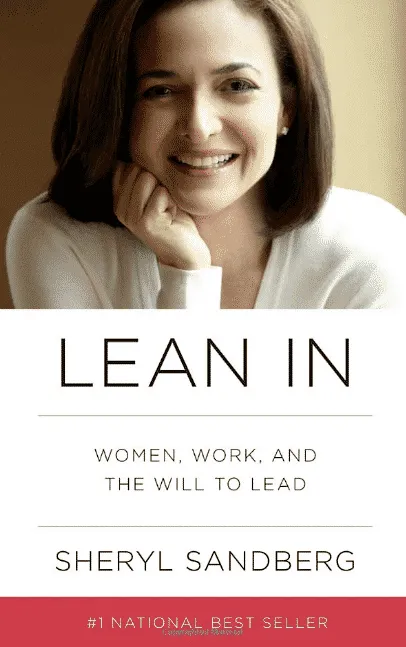
Sheryl Sandberg - Facebook COO, ranked eighth on Fortune's list of the 50 Most Powerful Women in Business - has become one of America's most galvanizing leaders, and an icon for millions of women juggling work and family. In Lean In, she urges women to take risks and seek new challenges, to find work that they love, and to remain passionately engaged with it at the highest levels throughout their lives.
Lean In - Sheryl Sandberg's provocative, inspiring book about women and power - grew out of an electrifying TED talk Sandberg gave in 2010, in which she expressed her concern that progress for women in achieving major leadership positions had stalled. The talk became a phenomenon and has since been viewed nearly 2,000,000 times. In Lean In, she fuses humorous personal anecdotes, singular lessons on confidence and leadership, and practical advice for women based on research, data, her own experiences, and the experiences of other women of all ages. Sandberg has an uncanny gift for cutting through layers of ambiguity that surround working women, and in Lean In she grapples, piercingly, with the great questions of modern life. Her message to women is overwhelmingly positive. She is a trailblazing model for the ideas she so passionately espouses, and she's on the pulse of a topic that has never been more relevant.
Sheryl Sandberg published Lean In: Women, Work, and the Will to Lead in 2013, and it became one of the most discussed, praised, and criticized books about work and gender published in the last two decades. The praise focused on its practical advice for ambitious women navigating male-dominated workplaces. The criticism focused on its limited frame — a framework of corporate advancement written from inside a corporate success story, by one of the most privileged women in the world, at a company that has since become a symbol of the worst tendencies in technology and media. Both the praise and the criticism contain important truths. Reading this book honestly in 2026 means holding them simultaneously.
Sandberg’s central argument is that women hold themselves back from leadership at least as much as external barriers hold them back. She identifies a set of internal obstacles — sitting on the periphery rather than at the table, declining to negotiate salaries, leaving jobs before leaving them, holding back from opportunities because of anticipated future family demands — and argues that women who want to lead need to address these internal patterns even as they work to change the external conditions that generate them. The “lean in” instruction is an instruction to act as though you belong in the room, to claim the seat at the table, to negotiate, to ask, to speak up, to take the risks that men take as a matter of social entitlement.
This is not wrong. It is incomplete. And understanding both the genuine insight and the genuine limitation of the framework is important for anyone who wants to think seriously about ambition, work, gender, and what a life well-lived might look like.
To engage seriously with Lean In requires neither the uncritical enthusiasm of its early advocates nor the reflexive dismissal of its critics. It requires reading it for what it is: a well-intentioned, research-grounded, practically useful book about a particular set of obstacles to women’s professional advancement, written from a particular vantage point, with particular blind spots that the author acknowledges some of and misses others of. Taking it seriously means extracting the genuine utility while being honest about where the frame breaks down and where it actively misleads.
The Genuine Contribution
The real contribution of Lean In is the naming and documenting of the internalized obstacles that many women face in professional settings. These are real phenomena, documented by research Sandberg marshals carefully and presents accessibly. Women are less likely to negotiate salary offers. Women are more likely to attribute their success to luck and others’ help and their failures to personal inadequacy — the opposite pattern from men, who typically do the reverse. Women who display the same behaviors as men in leadership contexts are rated less favorably, but women who internalize that double standard and pre-emptively soften their leadership style often end up leading less effectively and being promoted less frequently. These are genuine structural and psychological dynamics that have real effects on women’s careers.
Sandberg is also genuinely good on the specific tactics of navigating workplaces that are not designed with women in mind. Her advice about sitting at the table rather than against the wall, about not pre-emptively negotiating against yourself before you have even asked for something, about the myth of “having it all” as a standard that is applied to women in a way it is not applied to men — this is useful, specific, and well-grounded in both research and experience. For a woman navigating a corporate career in a male-dominated field, this advice is genuinely actionable and has probably helped a significant number of people.
The book also makes a serious point about the importance of women’s leadership that goes beyond individual career advancement. Sandberg argues that the underrepresentation of women in leadership positions is not just unfair to individual women — it produces systematically worse outcomes for organizations and for society. Diverse leadership teams make better decisions. Organizations that promote and retain talented women perform better financially. Policies that are made without women at the table tend not to reflect women’s interests and needs adequately. This is not just an equity argument. It is a quality argument, and the evidence for it, while contested in some particulars, is substantial.
The Problems with the Frame
The core problem with Lean In is the problem of the frame, not the advice within it. The frame is: corporate advancement is the goal, and the question is how women can achieve it more fully. This frame takes the corporate hierarchy — and the values embedded in it — largely for granted. It does not ask whether the goal itself is worth pursuing, or what it costs, or who is left out of it, or whether the game women are being invited to lean into is worth winning.
The most trenchant version of this criticism came from bell hooks, who described the book as a manifesto for corporate feminism that benefits primarily already-privileged women while leaving the structural conditions that disadvantage the vast majority of women entirely unaddressed. The woman who is most positioned to act on Sandberg’s advice is already highly educated, in a professional-track job, with a supportive partner and sufficient income to access childcare. For the majority of women — working hourly jobs, without paid family leave, without affordable childcare, without the protection against discrimination that comes with professional credentials and employer dependence — the primary obstacles are not internal. They are structural. And a feminism that addresses the internal obstacles while leaving the structural ones intact is a feminism that will produce more C-suite women while leaving most women’s lives unchanged.
This critique is important and largely correct. Sandberg does acknowledge structural barriers — discrimination, the motherhood penalty, inadequate family leave policies — but she addresses them relatively briefly and treats them as context for the primary project of individual internal change rather than as the primary site of intervention. The book is written by someone for whom the internal obstacles were the binding constraint, and she generalizes from that experience in a way that works well for women who share her circumstances and less well for women who do not.
Ambition and the Question of For What
The deepest question that Lean In does not ask is: lean in to what, exactly, and for what purpose? Sandberg treats ambition as an obvious good, as something that should be encouraged and unleashed rather than questioned. This reflects the values of a particular kind of high-achievement culture — the Silicon Valley meritocracy that Sandberg inhabited — that has its own assumptions about what makes a life well-lived that are not as universal as they are presented.
The implicit answer in the book is: lean in to corporate advancement. To leadership positions. To career success as conventionally measured. But the honest question for any reader, regardless of gender, is whether the conventional measures of career success are actually the ones worth caring about. Sandberg herself, in the revised preface she wrote after her husband’s death in 2015, gives some indication that the answer might be more complicated than the original book suggested. Grief and loss have a way of clarifying which ambitions were genuinely chosen and which were simply inherited from a culture that values achievement above almost everything else.
From the perspective we take throughout this site, the question of ambition is always the question of values first. What is the ambition in service of? Is it in service of something genuinely meaningful to you — contribution, mastery, the specific work that only you can do — or is it in service of external validation, social approval, the comfort of comparison-based superiority? The distinction matters because the first kind of ambition is sustainable and enriching, while the second is exhausting and empty however successfully it is pursued.
Sandberg’s “lean in” instruction is most valuable when applied to ambition of the first kind: when you have something genuinely worth contributing, a specific direction genuinely worth pursuing, and the only thing holding you back is internalized doubt or social expectation. In that context, the instruction to claim your seat, to negotiate, to push past the self-imposed glass ceiling, is genuinely useful and genuinely important. It is less valuable when applied to ambition that has not yet been subjected to this examination — when the leaning in is in service of a version of success that was chosen by cultural default rather than conscious reflection.
The Partner Question
The most practically important chapter in the book, and the one that holds up best against subsequent scrutiny, is the one about the importance of having an equal partner. Sandberg argues, with considerable research support, that the most important career decision a woman makes is who she chooses to partner with — because a partner who genuinely shares domestic and childcare responsibilities dramatically expands what is possible professionally. This is not a particularly revolutionary observation, but Sandberg makes it with unusual directness and specificity. She names the phenomenon: the fact that women disproportionately carry household management and childcare even in partnerships where both adults work full-time. She names the consequence: the invisible second shift that constrains what women can do professionally in ways that are rarely acknowledged openly. And she names the remedy: not just having a conversation about the division of domestic labor, but choosing, early and intentionally, partners who are genuinely committed to sharing it.
This is good practical advice, and it is also the point in the book where the structural limitations of the frame are most visible. For a woman without the financial resources to outsource substantial portions of childcare and household management, “choose an equal partner” remains necessary but insufficient advice. The structural conditions — the absence of affordable childcare, the lack of paid parental leave, the persistence of workplaces designed around the assumption of a stay-at-home spouse — matter enormously. The solution cannot be solely at the level of partnership choices. It requires policy change. This is where Sandberg’s analysis is thinnest and where the external critics have been most consistently right.
The Mentorship Myth and Sponsorship Reality
One of the more interesting observations in the book is Sandberg’s distinction between mentorship and sponsorship. Mentorship — the relationship in which an experienced person gives advice and guidance to someone less experienced — is widely celebrated and frequently recommended as the key to career advancement. It is genuinely valuable. But the research Sandberg cites suggests that the more powerful relationship is sponsorship: the relationship in which a senior person not just advises but actively advocates for someone — recommends them for opportunities, uses their own credibility to advance the sponsored person’s career.
The gender gap in sponsorship is significant. Women are mentored at approximately the same rates as men but sponsored at much lower rates. This matters because mentorship increases competence, while sponsorship increases opportunity. A mentor tells you how to navigate. A sponsor opens the door. For women in male-dominated fields, the scarcity of sponsors is a significant structural obstacle — one that cannot be addressed simply by women becoming more willing to ask for what they want, because the bottleneck is not in the asking but in the network of relationships that produces sponsorship opportunities in the first place.
This observation is one of the places where the book most directly addresses structural rather than individual obstacles, and it is correspondingly more useful for more people. The advice that follows — to seek out sponsors rather than just mentors, to be visible in ways that attract sponsorship, to do the work that earns advocacy — is practical and applies across many professional contexts, not just corporate ones.
Meta-Lesson: The Danger of Success Templates
Perhaps the most useful thing to take from Lean In — and from the debate it generated — is a broader lesson about success templates. Every successful person has a theory of how they got where they are, and those theories are inevitably shaped by their particular circumstances, particular advantages, and particular historical moment. When a successful person writes a book about what they did and recommends it as a template, there is a systematic risk that they will overgeneralize from their specific case — that the advice that genuinely worked for them, in their specific circumstances, will not generalize as cleanly as it appears to others with different circumstances.
This is not a reason to ignore successful people’s advice. It is a reason to read it carefully and ask: What conditions made this approach work? Which of those conditions apply to my situation? What is being taken for granted here that I cannot take for granted? Sandberg’s advice works best for women who already have significant educational and professional capital, who are in workplaces where formal advancement structures are accessible, and whose primary binding constraints are internal rather than structural. For women who fit this description, the book is genuinely valuable. For women who do not, it requires significant filtering and supplementation.
Imposter Syndrome and Its Costs
One of the book’s most valuable contributions is its detailed treatment of imposter syndrome — the experience of doubting your own competence and fearing that you will be exposed as less capable than others believe you to be. Research suggests that imposter syndrome is more prevalent among women than men in professional settings, and Sandberg explores the reasons for this asymmetry carefully. Women receive more mixed messages about competence and achievement from childhood onward. The social penalties for appearing too confident or too ambitious are higher for women than for men. Women who succeed in competitive environments often attribute that success to luck, to the generosity of others, to being in the right place at the right time — factors external to themselves — rather than to their own capability and effort.
The cost of this attributional pattern is significant. When you attribute success to luck rather than ability, you do not update your model of your own capabilities in response to evidence of success. Each new achievement remains a lucky accident rather than confirmation of genuine competence. You remain perpetually vulnerable to being found out, perpetually anxious that the next situation will reveal the inadequacy that the previous successes somehow concealed. This is exhausting and it is self-limiting. It prevents you from taking on challenges that your actual capabilities would support, because your model of your capabilities has been systematically discounted by the attributional pattern.
Sandberg’s prescription — to recognize imposter syndrome as a pattern, to keep a record of genuine accomplishments and the specific skills and efforts that produced them, to practice claiming competence rather than deflecting it — is practical and evidence-based. It will not work for everyone, and it will work more easily in environments where the double standards that generate imposter syndrome in women have already been partially addressed. But as an internal practice, it is genuinely useful and represents some of the book’s most actionable advice.
The Likability Trap
Sandberg engages extensively with what the research literature calls the “likability-competence tradeoff” for women in leadership. The core finding, replicated across dozens of studies, is that behaviors associated with leadership — assertiveness, directness, confidence, willingness to take credit for success — are evaluated positively in men and negatively in women. The woman who exhibits these behaviors is seen as competent but unlikable. The woman who does not exhibit them is liked but not taken seriously as a leader. This is a double bind with no clean solution within the existing social structures, and Sandberg is honest about that.
Her advice for navigating this trap — leading with warmth before showing competence, framing requests in collaborative terms, being aware of how you are coming across in a given social context — is realistic and has tactical value. But she is also clear that the burden should not be entirely on women to navigate a trap that men do not face. The longer-term solution requires changing the associations that generate the trap: through representation (seeing women in leadership positions normalizes female leadership behavior), through explicit awareness training in organizations, and through the kind of cultural shift that happens slowly and requires sustained effort at every level.
From our perspective, the likability trap also illuminates something important about external validation as a value. The woman who makes her professional decisions primarily based on whether they will make her liked is caught in the trap in a more profound way than the trap’s designers intended. The only sustainable navigation of this double bind requires a sufficient internal foundation that likability becomes one variable to manage rather than the primary goal. This requires exactly the kind of values clarity and self-trust that we emphasize throughout this site — the capacity to act from your own assessment of what matters rather than from the crowd’s shifting assessments of you.
When Women Lead Organizations
The research on women in organizational leadership is more nuanced than either enthusiastic promoters of gender diversity or skeptics tend to acknowledge. The evidence that gender-diverse leadership teams perform better on certain metrics is real. But the mechanism is not simply female presence — it is the diversity of perspective and the disruption of groupthink that diverse teams tend to produce, when the organizational culture is genuinely inclusive rather than nominally diverse. The woman who joins a male-dominated leadership team and adapts herself entirely to the norms of that team may add gender diversity in a demographic sense without adding the cognitive diversity that actually produces better outcomes.
This has implications for how the goal of “getting women into leadership” is pursued. If the goal is genuinely better organizational outcomes, then the question is not just how many women are in the room but what conditions allow them to bring their full perspective rather than a performance of the existing masculine leadership norm. Creating those conditions requires more than increasing the count of women in senior roles. It requires the kind of cultural change that makes genuine diversity of perspective welcome rather than merely tolerated — which is significantly harder work than hiring and promoting more women, and which Lean In somewhat underestimates.
The Ambition Question from the Outside
It is worth noting that the questions Sandberg raises about ambition — its sources, its obstacles, its proper direction — are not exclusively or even primarily gender-specific questions. Men also hold themselves back from what they genuinely want through internalized doubt, social fear, and the imposter syndrome of not believing they deserve what they are pursuing. Men also make career choices based on anticipated family demands, though they do so less frequently because the social expectation that they will is weaker. Men also navigate likability-competence tradeoffs, though the specific parameters of the tradeoff are different.
The broader lesson — that internalized self-limitation is a real force with real costs, that it can be named and examined and partially overcome through practice and awareness, and that the combination of internal work and external structural change is required to fully address it — applies across gender. What is specific to women in the context of this book is the particular form the self-limitation takes and the particular structural conditions that generate it. Understanding both the specific and the general is what makes the book most useful to the widest range of readers.
The Facebook Problem
Any honest reckoning with Lean In in 2026 must acknowledge the subsequent history of the company Sandberg led and what it reveals about the limits of the “women in leadership” argument as she made it. Sandberg served as COO of Facebook (later Meta) from 2008 to 2022. During her tenure, she was responsible for the advertising system and the revenue strategy that made the company extraordinarily profitable, and also for the aspects of the platform’s operation — the monetization of engagement, the spread of misinformation, the role in democratic processes around the world — that have made it extraordinarily controversial.
This is not an argument that Sandberg is uniquely responsible for Facebook’s harms or that a different gender configuration of leadership would necessarily have produced different outcomes. It is an argument that putting more women in corporate leadership does not automatically produce better corporate behavior — that the “diversity leads to better outcomes” argument, while supported by evidence in some domains, is not a guarantee that the outcomes will be better in the most important respects. The goal of feminism is not more female CEOs making the same decisions that male CEOs have been making. It is a transformation of the conditions under which all people work and live. Sandberg’s book makes a genuine contribution to a part of that project. It should not be mistaken for the whole of it.
The Bottom Line
The Grief Postscript and What It Reveals
In 2015, Sandberg’s husband Dave Goldberg died suddenly while they were on vacation. Sandberg wrote about the experience in a subsequent book, Option B, and in a widely-shared Facebook post that expressed her grief with a rawness and honesty that struck many people as more genuinely human than anything in Lean In. The contrast is telling. In grief, the performance dropped. The tight corporate voice relaxed. What came through was a person, not a success story. And paradoxically, many people found that they could connect with the grieving Sandberg in a way they could not connect with the leaning-in Sandberg.
This is worth reflecting on. The version of Sandberg that Lean In presents is, in some respects, an argument for a kind of invulnerability — the message that if you just act confidently enough, negotiate aggressively enough, and claim your seat firmly enough, you will succeed and the external world will reorganize itself around your ambition. Grief makes that argument impossible to sustain. The external world does not reorganize itself around your ambition. Loss is real. Fragility is real. The resilience that matters is not the resilience that prevents loss but the resilience that navigates it — and that is a different thing from anything in the original book.
The Sandberg of Option B is more interesting, more honest, and more useful than the Sandberg of Lean In in certain key respects. If you read the original book, reading the later one as well gives you a more complete picture of the human being behind the advice — and a more honest account of what ambition and achievement actually look like inside a life that includes, as all lives do, the things that ambition cannot control.
Redefining Ambition
The most useful reframe that a critical reading of Lean In produces is about the nature and purpose of ambition itself. Sandberg presents ambition as an obvious good that has been unfairly suppressed in women and that should be unleashed. This is true in a narrow sense. But the deeper question — what is the ambition for? — is one the book does not adequately ask. Ambition in service of meaningful contribution is very different from ambition in service of status and external validation, even though both may look identical from the outside. The woman who fights her way to the boardroom because she has something genuinely important to contribute is exercising a different faculty than the woman who fights her way to the boardroom because she has internalized the belief that prestige is worth any price.
The encouragement to “lean in” is most valuable when the thing you are leaning into is genuinely worth the leaning. When you have something specific to contribute, something you are uniquely positioned to do, a direction that reflects your genuine values rather than borrowed ones — then the internal obstacles that Sandberg describes are genuinely worth overcoming, and the tactics she offers are genuinely useful. When the ambition itself has not been subjected to this kind of examination, the book can inadvertently reinforce the idea that more corporate advancement is always better, which is a proposition that the evidence of many people’s lives does not support.
This is not an argument against ambition. It is an argument for directed ambition — ambition that knows its own why, that has been chosen rather than inherited, that serves something beyond the performance of success. The woman who has worked this out — who knows why she wants what she wants and can defend that why on reflection — should absolutely lean in. The woman who has not worked it out yet would be better served by doing that work first, before the leaning begins.
What Genuine Workplace Equity Requires
The most important things that need to change to produce genuine equity in workplaces are not captured in Sandberg’s framework and are not addressable at the individual level alone. Paid parental leave policies that apply equally to all parents, regardless of gender, would do more to address the career penalty women pay for having children than any amount of personal negotiation. Affordable, high-quality childcare infrastructure would expand the professional options of every parent who currently cannot access it. Pay transparency policies that require employers to disclose salary ranges would do more to close the gender pay gap than any individual woman learning to negotiate more aggressively. The pipeline of qualified women for leadership roles would benefit more from ending the discriminatory practices that filter women out at earlier career stages than from any amount of individual leaning in at the top.
These structural interventions are largely outside the scope of a book about individual professional strategy, and it would be unfair to fault Sandberg primarily for not writing a policy book. But the cumulative effect of her framing — in which the primary drivers of the gender gap in leadership are individual psychological patterns in women, rather than structural conditions in workplaces and society — is to understate the case for structural change and to imply, even unintentionally, that women who do not advance have failed to lean in hard enough. This is a conclusion that the evidence does not support and that does real harm to the people it falls most heavily on.
The Long View on Ambition
Any serious reader of this book eventually arrives at a question that the book does not resolve: what is ambition actually for? Sandberg’s implicit answer is advancement — more leadership, more seniority, more organizational power, more visible success. This is a legitimate goal for some people. But the evidence from the research on wellbeing and flourishing suggests that the correlation between organizational advancement and life satisfaction is considerably weaker than the achievement culture assumes. Many people who achieve senior leadership positions report that the achievement felt less meaningful than they expected and that the costs — in time, relationships, personal health, and inner life — were higher than they anticipated.
The question worth asking before you lean in is not whether you can lean in more effectively. It is whether the thing you are leaning into is worth the leaning. This is not a question about whether ambition is good or bad. It is a question about whether your specific ambition — the specific version of advancement you are pursuing — actually reflects your own most considered values, or whether it reflects the values of the culture around you absorbed without examination. The woman who has worked this out, who can say clearly why this particular direction matters to her and what it is in service of beyond external recognition, should absolutely lean in with everything she has. That is the fullest expression of the book’s best insight. The woman who has not worked it out yet is better served by doing that work before the leaning begins.
What Men Can Take from This Book
One of the things that is underappreciated about Lean In is how much of it applies directly to men, even though the book is written primarily for women. The internal obstacles Sandberg describes — imposter syndrome, the tendency to attribute success to luck rather than ability, the failure to negotiate, the habit of self-limiting before even asking — are not exclusively female phenomena. Men experience versions of all of them, with different specific flavors shaped by different social scripts.
More importantly, the book’s account of how gender dynamics play out in workplaces is valuable information for men who want to be better colleagues and better leaders. Understanding that women face a likability-competence double bind that men do not means you can notice when you are penalizing a female colleague for behavior you would reward in a male colleague. Understanding that women are less likely to negotiate does not mean taking advantage of that fact — it means building transparent, equitable structures that do not depend on individual negotiation skill to produce fair outcomes. Understanding that the second shift falls disproportionately on women means having an honest conversation with yourself about whether that dynamic is happening in your own household and what you are willing to do about it.
The book’s prescriptions for individual women are primarily for individual women. But its descriptions of how gender shapes workplace and domestic dynamics apply to everyone who operates in those environments, which is everyone. Reading it carefully as a man means reading it not for what you should do differently but for what you should see more clearly. That is a valuable use of the book that is rarely discussed.
Read Lean In for the specific practical insights about internal obstacles to ambition, negotiation, and career advancement that it documents carefully and presents clearly. Read it with full awareness that the framework is narrow — that it applies most directly to a particular kind of privileged professional woman and addresses a particular subset of the structural conditions that disadvantage women in workplaces and in life. Read it alongside critiques that expand the frame: bell hooks on the class dimensions of corporate feminism, Arlie Hochschild on the second shift, Anne-Marie Slaughter on the structural changes required to make ambitious careers genuinely compatible with engaged parenting for both men and women.
The ambition Sandberg celebrates is real and worth supporting. The structures she largely leaves intact are real and require challenge and change. Both things are true simultaneously, and the reader who can hold both of them will get more from the book than the reader who reads it either as a complete manifesto or as a document to be dismissed. Lean in — selectively, deliberately, in service of what genuinely matters to you, with eyes open to what the frame includes and what it leaves out. That is the instruction that this book, and the debate it generated, ultimately supports.

