
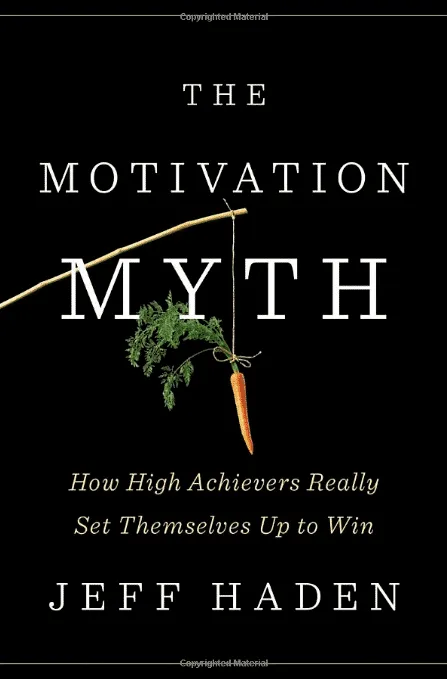
From Inc.com's most popular columnist, a counterintuitive - but highly practical - guide to finding and maintaining the motivation to achieve great things.
It's comforting to imagine that superstars in their fields were just born better equipped than the rest of us. When a co-worker loses 20 pounds, or a friend runs a marathon while completing a huge project at work, we assume they have more grit, more willpower, more innate talent, and above all, more motivation to see their goals through.
But that's not at actually true, as popular Inc.com columnist Jeff Haden proves. "Motivation" as we know it is a myth. Motivation isn't the special sauce that we require at the beginning of any major change. In fact, motivation is a result of process, not a cause. Understanding this will change the way you approach any obstacle or big goal.
Haden shows us how to reframe our thinking about the relationship of motivation to success. He meets us at our level - at the beginning of any big goal we have for our lives, a little anxious and unsure about our way forward, a little burned by self-help books and strategies that have failed us in the past - and offers practical advice that anyone can use to stop stalling and start working on those dreams.
Haden takes the mystery out of accomplishment, proving that success isn't about spiritual awakening or a lightning bolt of inspiration - as Tony Robbins and adherents of The Secret believe - but instead, about clear and repeatable processes. Using his own advice, Haden has consistently drawn two million views a month to his posts, completed a 107-mile long mountain bike race, and lost 10 pounds in a month.
Success isn't for the uniquely-qualified; it's possible for any person who understands the true nature of motivation. Jeff Haden can help you transcend average and make lasting positive change in your life.
Everyone has been told the same story about motivation. The story goes like this: first you get motivated, then you take action. You wait until you feel inspired, until the drive shows up, until you want it badly enough — and then you begin. This story is wrong. It is not just incorrect in some minor technical sense. It is backwards in a way that explains the majority of human underperformance, unfinished projects, and frustrated potential.
Jeff Haden’s The Motivation Myth: How High Achievers Really Set Themselves Up to Win is built on a simple but genuinely powerful inversion of this story: motivation is not the cause of action. It is the result of action. The feeling of being motivated — that energized, committed, this-is-actually-working state — follows from doing the work, not from some internal ignition that precedes it. And this inversion changes everything about how you should approach goals, discipline, habit, and the daily work of becoming better at anything.
Haden is a business writer and ghostwriter who has worked with many high-achieving executives and athletes. The Motivation Myth draws on those conversations and on a substantial body of research in psychology to make a case that is simultaneously counterintuitive and, once you see it, completely obvious in retrospect. The people who achieve extraordinary things are not more motivated than everyone else in the sense of having a stronger or more reliable internal drive. They have built systems — specific, practical, often unglamorous systems — that generate the experience of motivation through action rather than waiting for it to arrive on its own.
The Motivation Feedback Loop
The core mechanism Haden describes is a feedback loop: you take action, you experience small successes, those small successes generate a positive emotional state (what most people call “feeling motivated”), that positive emotional state makes the next action easier to take, which leads to more small successes, which generates more positive feeling, and so on. Motivation is not the starting point of this loop. It is one of the outputs — and an output that immediately becomes an input, feeding forward into more action.
This matters enormously because it changes the question you ask yourself when you’re trying to do something hard. The usual question — “do I feel motivated enough to do this?” — is the wrong question, because the answer will often be no, and the expected response to no is to wait until the motivation arrives. The right question is: “what is the smallest action I can take right now that will generate the first experience of success in this sequence?” Because that small action is the actual starting point of motivation, not the end point.
This is why high performers in any domain — athletes, artists, entrepreneurs, scientists — tend to have very consistent work habits that don’t depend on how they feel on any given day. They show up, they begin, they work through the initial resistance that precedes engagement, and they find that the motivation they were waiting for tends to arrive within the first ten or fifteen minutes of actually doing the thing. Not always. But reliably enough that the system produces consistent output even on the days when the motivation doesn’t show up strongly until well into the session.
The waiting-for-motivation strategy produces exactly the results it should: you wait, and while you wait, you neither generate motivation nor produce output. You might, over time, develop a narrative about yourself as someone who lacks discipline or drive. But the real problem was never insufficient motivation. It was insufficient understanding of where motivation actually comes from and how to reliably generate it.
The Problem with Goals
Haden’s critique of conventional goal-setting is sharp and, given the amount of energy the self-help industry has invested in goal-setting frameworks, somewhat refreshing in its directness. The problem is not that goals are bad. It is that goals are outcomes — things that will happen in the future, if everything goes well, as the result of a long sequence of actions not yet taken. As objects of motivation, outcomes are very poor drivers of daily behavior.
Consider the person who sets a goal of running a marathon. The marathon is months away. Running it will require hundreds of training sessions between now and then. On any given morning when the alarm goes off at 5:30 AM, the motivational pull of a race that is four months in the future is almost nonexistent. The goal is real, the desire to achieve it is real, but neither of those facts reliably generates the action of putting on running shoes and going out the door on a cold morning when the bed is warm and the body is tired.
What does reliably generate that action is a different kind of goal: a process goal rather than an outcome goal. Not “run a marathon in four months” but “run four days this week, including a long run on Sunday.” Not “become a successful writer” but “write 500 words before 9 AM every weekday.” Not “build a successful business” but “make five client calls before lunch on Monday, Tuesday, and Thursday.”
Process goals are motivationally superior to outcome goals for several reasons. They are within your direct control, unlike outcomes which depend partly on factors outside your control. They produce immediate feedback — you either ran four days this week or you didn’t, you either wrote 500 words before 9 or you didn’t. And they generate the small successes that feed the motivation loop, which outcome goals are too distant to provide in any given day.
The Success Experience as Motivational Currency
The concept of the “success experience” is central to Haden’s framework. A success experience is simply the feeling you get when you complete something — when you finish the set, write the paragraph, make the call, send the email, do the one thing you said you would do. It doesn’t have to be significant by any external measure. Its significance is entirely in the feeling it generates: I said I would do this, and I did it.
This feeling — small and private and unimpressive to anyone observing from the outside — is extraordinarily powerful as a motivational resource. It builds the sense of competence and self-efficacy that makes the next action feel possible. It strengthens the identity of someone who follows through on commitments. And it generates the positive emotional state that is what we usually mean when we say we “feel motivated.” The success experience is not the reward for motivation. It is the source of it.
This is why the architecture of your tasks matters so much. Tasks that are designed to be completable — that have a clear beginning and end, that are appropriately scoped for the time and energy available, that generate a clear signal of completion when finished — are motivationally superior to tasks that are vague, open-ended, or defined in terms of effort rather than output. “Work on my book” generates no completion signal and no success experience. “Write the first three paragraphs of chapter four” generates a clear completion signal and a genuine success experience.
Haden’s practical advice consistently returns to this principle: structure your work to generate success experiences as frequently as possible. Not by lowering your standards — by designing the work so that the standards are clear, the increments are completable, and the completion is recognized when it occurs. This is not the same as only doing easy work. It is the design of challenging work in units that generate the motivational fuel you need to keep going.
The Role of Process Over Outcome in Elite Performance
Haden draws on conversations with many high-performing athletes, musicians, and professionals to support his framework, and one theme that emerges consistently is the process orientation of people who achieve exceptional results. The athletes who perform best under pressure are not those who are most focused on winning. They are those who are most focused on executing their process — on doing each specific thing they need to do, as well as they can do it, in this moment. The outcome is the result of the process. The focus belongs on the process.
This is counterintuitive in a culture that is strongly outcome-oriented — that measures everything by results, that rewards winners and forgets processes, that asks “what did you achieve?” rather than “how did you work?” But the research on peak performance consistently supports the process focus as producing better outcomes, paradoxically, than outcome focus does. When you’re focused on outcomes, you’re focused on something that isn’t fully within your control, which generates anxiety that degrades performance. When you’re focused on process, you’re focused on what you can actually do right now, which produces the engaged, present-moment focus that is the psychological substrate of peak performance.
Nick Saban, the legendary Alabama football coach, is Haden’s most cited example of this principle in practice. Saban’s “process” coaching philosophy — his insistence on focusing on what needs to happen on this play, in this moment, rather than on the score or the championship — has produced results that speak for themselves. The results follow from the process. The process must come first.
Redefining Success Metrics
One of the most practically useful sections of The Motivation Myth concerns the design of meaningful success metrics — the specific, behavioral, within-your-control measures that provide the feedback necessary to generate the success experiences that fuel the motivation loop. This is where Haden gets most concrete, and where the book is most immediately actionable.
The principle is simple: for any goal you’re pursuing, identify the specific daily or weekly behaviors that will move you toward it. Then track those behaviors rather than tracking the outcome. If you’re trying to grow a business, track the number of meaningful client interactions, the number of new proposals sent, the number of follow-up calls made — behaviors entirely within your control. Don’t track revenue, which follows from behaviors but isn’t directly controllable. The behaviors generate the revenue eventually. The focus belongs on the behaviors.
If you’re trying to improve your fitness, track workouts completed, not weight lost or performance benchmarks. Weight and performance follow from training. Training is what you control. If you’re trying to develop a creative practice, track words written or hours practiced, not quality of output or external recognition. Quality and recognition follow from practice. Practice is within your control.
This shift from outcome metrics to behavior metrics is not just psychologically useful — it is also more informative. When outcomes aren’t moving, outcome metrics tell you nothing useful. Behavior metrics tell you whether the right things are being done consistently. If the behaviors are consistent and the outcomes aren’t moving, you know you need to change your approach. If the behaviors aren’t consistent, you know the problem. Outcome metrics, in the short term, can’t distinguish between these two very different situations.
The Myth of Willpower and the Reality of System Design
Haden’s framework overlaps significantly with James Clear’s work on atomic habits in its critique of willpower as the primary mechanism for behavior change. The popular model — that achieving goals requires wanting them enough and summoning sufficient willpower to overcome resistance — is inadequate to the experience of people who actually achieve extraordinary things consistently over time. High performers are not running on willpower. They have designed systems that make the right behaviors easy and automatic, and that generate the motivation to continue through the success experiences the system produces.
Willpower is a real but limited resource. Research on ego depletion — the finding that exercises of self-control draw on a finite resource that becomes depleted with use — has been contested in recent years, but the underlying experience it was trying to describe is real: making decisions and overcoming resistance consumes cognitive and emotional resources that are not unlimited. People who successfully maintain demanding disciplines over time have generally found ways to minimize the willpower required — through habits that are automatic rather than decided, through environments that remove the temptation rather than requiring resistance to it, and through the motivational fuel provided by consistent success experiences rather than through brute-force self-discipline.
The practical implication is that effort spent trying to increase your willpower is less well-spent than effort designing systems that require less willpower to maintain. The workout gear laid out the night before requires less willpower to use than the gear in the closet. The writing session scheduled at the same time every morning requires less willpower to show up for than the open-ended “I’ll write when I have time” commitment. The healthy food at eye level in the refrigerator requires less willpower to choose than the unhealthy food that requires active resistance. Design the system. Let the system do the work that willpower can’t reliably do.
The Compound Effect of Consistent Small Actions
Like Clear and many other behavior change writers, Haden emphasizes the extraordinary long-term power of consistent small actions — the compound effect that makes incremental daily improvement accumulate into extraordinary results over time. But he grounds this principle specifically in the motivation feedback loop in a way that adds a useful dimension to the familiar compounding argument.
The success experiences generated by consistent small actions don’t just accumulate in the direction of the goal. They accumulate in the direction of the identity. Every day that you show up and do the work — regardless of how far you are from the goal, regardless of what progress is visible in the short term — you cast a vote for being the kind of person who shows up and does the work. That vote, accumulated over weeks and months and years, builds an identity that becomes the most reliable motivational resource available. Not the goal, not the progress markers, but the settled sense of yourself as someone who does this thing, who is this kind of person, who follows through on commitments.
This is where Haden’s framework and Clear’s framework converge most productively: both identify identity as the deepest level at which motivation can be established. The motivation that comes from wanting an outcome is contingent and fragile. The motivation that comes from acting in accordance with who you understand yourself to be is robust and self-reinforcing. Building it is slow. Maintaining it, once built, is the easiest thing in the world.
Practical Daily Architecture
Haden is at his most useful when he gets very specific about the daily and weekly practices that high performers use to implement these principles in actual lives. The theoretical framework is compelling, but the implementation details are where books like this succeed or fail, and Haden succeeds here.
The practice of designing your day in units of completable tasks — rather than setting a general intention to “work hard” or “be productive” — is one of his most consistent recommendations. Each task should be specific enough that you know definitively when it is complete. Each should be scoped for the time and energy available. And each should be chosen because its completion moves you in the direction of a meaningful goal, not just because it will generate activity.
The practice of reviewing the previous day before planning the current one is another recommendation that may sound mundane but that produces significant practical benefits. What did you complete yesterday? What generated energy? What depleted it? What do you wish you had done differently? This brief review creates the feedback loop that allows your system to improve over time rather than simply repeating the same patterns indefinitely. It also generates recognition of the success experiences from the previous day, which is itself a motivational primer for the current one.
The practice of ending each day by identifying the single most important thing to accomplish the following day — and protecting time and energy for that thing first — is one of the oldest productivity practices in the literature, and Haden endorses it without apology. Its longevity reflects its effectiveness. Starting the day with your highest-priority task means that regardless of what else happens, the day produced something meaningful. This is itself a success experience that sets the motivational tone for everything that follows.
The Book’s Honest Limitations
Any honest review of The Motivation Myth should acknowledge that its framework works best for goal pursuit that is within normal human capacity — for the projects, habits, and ambitions that most motivated people encounter. It is less well-equipped to address the situations in which the motivation problem is not a problem of system design but a problem of underlying depression, trauma, chronic illness, or other conditions that affect the capacity for action in ways that can’t be addressed through better task architecture.
Haden’s framework assumes a person who has the basic energy, cognitive capacity, and psychological stability to engage in deliberate self-regulation. For many people in many circumstances, this assumption holds and the framework is directly applicable. For people in the grip of severe depression, or struggling with the cognitive and energetic consequences of chronic illness, or dealing with trauma responses that make consistent daily action extremely difficult — the framework needs adaptation or supplementation with professional support.
This is not a fatal limitation. It is simply an honest acknowledgment of scope. The book is about one thing — the role of small successes in generating motivation, and the design of systems that reliably produce small successes — and it is very good at that one thing. It is not a book about clinical mental health, and it doesn’t pretend to be.
What You Actually Take Away
The lasting takeaway from The Motivation Myth is a fundamental reorientation to the question of where motivation comes from and what to do when you don’t have it. The answer to that question is now clear: you don’t wait for it. You do something small. You generate a success experience. And you use that success experience as the fuel for the next action, and the next, and the next, until you find yourself — at some point that was impossible to predict from the starting position — deeply, genuinely, sustainably motivated by the work itself.
This is not a guarantee. Some projects don’t generate motivation however you pursue them, which is useful information about whether they’re worth pursuing. Some days the loop doesn’t close no matter how small you make the starting action. But as a reliable first move when you’re stuck, when you don’t feel like it, when the goal is distant and the bed is warm — doing something small and specific, completing it, and noticing the completion is a consistently better strategy than waiting for a feeling that is trying to follow you rather than lead you.
Jeff Haden has written a book that, at its core, gives you permission to begin even when you don’t feel ready. That permission is more valuable than any amount of inspiring content about the size of your dreams or the strength of your desire. Begin. Begin small. Begin now. The motivation will follow. It always does.
Fear, Resistance, and the First Five Minutes
One of the less-discussed but critically important dimensions of the motivation myth is its relationship to fear. Much of what we experience as lack of motivation is, when examined closely, actually fear wearing motivation’s clothes. The writer who doesn’t feel motivated to sit down and write is often not actually unmotivated — they are afraid. Afraid that what they write won’t be good enough. Afraid that the project will fail. Afraid that starting will make the gap between aspiration and current reality inescapably visible.
Haden doesn’t spend a lot of time on the psychology of fear directly, but his framework addresses it indirectly and effectively. The instruction to start small — to take the tiniest possible action, the one that is almost too small to be worth doing — is partly a strategy for defeating fear. It is very hard to be afraid of writing a single paragraph, or running to the end of the driveway, or making one phone call. The smallness makes the fear response disproportionate to the action, and the disproportionality makes it easier to override.
The first five minutes are almost always the hardest. This is not metaphor — it is neurological reality. The brain’s resistance to initiating effortful tasks is highest before the task has started, when the cost-benefit calculation is being made without the benefit of engagement-generated reward. Once you’ve been doing something for five or ten minutes — once the action has begun generating its own internal rewards through interest, competence, and progress — the resistance typically drops significantly. The path to getting through the first five minutes is making them as easy as possible to begin.
This means the architecture of beginning matters enormously. The workspace that is already set up, with yesterday’s work visible and the next task already identified, requires less cognitive and emotional effort to enter than the workspace that has to be assembled fresh each time. The workout that starts with one thing you enjoy, before the harder intervals, is easier to begin than the workout that starts with the hardest thing. The smallest possible action that gets you into the work is not a concession to weakness — it is intelligent engineering of the most difficult transition in any productive endeavor.
Social Motivation and the Power of the Committed Group
Haden addresses the social dimension of motivation in ways that add meaningfully to his individual-focused framework. Human beings are deeply social creatures, and our motivation is powerfully influenced by the social contexts in which we work. The person pursuing a challenging goal in isolation faces a motivational environment that is significantly less supportive than the person pursuing the same goal in the company of others who share the commitment.
The mechanisms are multiple. Social commitment — telling others what you intend to do — adds social stakes to personal commitment, creating additional motivation to follow through that doesn’t depend on internal resources alone. Community accountability — regular check-ins with others who are pursuing similar goals — provides both the external pressure to report progress and the emotional support of knowing others understand the difficulty of what you’re attempting. And the observation of others succeeding — seeing that the goal you’re pursuing is actually achievable, by people like you — is one of the most powerful motivational inputs available.
This social dimension also helps explain the enormous success of group fitness programs, mastermind groups, writing groups, and other collective accountability structures. They work not primarily by providing information or resources that individuals couldn’t access on their own, but by creating social contexts that generate motivation through the mechanisms Haden describes: small successes recognized by peers, accountability that makes avoidance costly, and the motivational contagion of being around people who are consistently doing the thing you’re trying to do.
The practical implication is to actively seek out or build the social contexts that support the goals you’re pursuing. Don’t try to be the lone wolf who succeeds through sheer internal drive. Instead, find your people — the ones who are working on the same things, who understand the difficulty, and who will both celebrate your successes and call you on your avoidance. The motivation they help generate is not less yours because it has a social dimension. It is simply more reliable because it’s drawing on more than one source.
Reframing Failure in the Motivation Framework
The motivation framework in this book also has important implications for how you relate to failure and setback — inevitable components of any serious pursuit. The person who understands motivation as the cause of action tends to interpret failure as evidence that they lacked sufficient motivation — that they didn’t want it enough, that they weren’t disciplined enough, that there is something fundamentally insufficient about their drive. This interpretation is demoralizing and, worse, it points toward no productive action. You can’t make yourself want something more by trying harder to want it.
The person who understands motivation as the result of action relates to failure completely differently. A failed attempt is not evidence of insufficient motivation — it is a disruption in the feedback loop, an interruption in the sequence of small successes that generates the motivational fuel. The question after failure is not “how do I want this more?” but “how do I restart the success sequence?” What is the smallest action available? What can I complete right now that will generate the first success experience of the next attempt?
This reframe is not about minimizing the disappointment of failure. That disappointment is real and shouldn’t be bypassed. It is about having a clear path forward once the disappointment has been acknowledged — a path that starts with something small, something completable, something that will generate the first tiny spark of forward movement that can be fanned into renewed momentum. The reframe makes failure less final and more actionable. That is an enormous practical advantage in any domain where progress is not linear and setbacks are inevitable.
Why This Book Matters Now
We live in a moment of extraordinary motivational noise. Social media is saturated with inspirational content — quotes, videos, stories of triumph and transformation designed to generate the feeling of motivation through vicarious exposure to other people’s success. This content is not entirely without value. But it is, at best, a minor input to actual motivation and, at worst, a substitute for it — a way of feeling motivated without doing anything that would generate the real thing.
The person who spends an hour watching motivational content and then wonders why they don’t feel motivated enough to begin their project has fundamentally misunderstood what motivation is and where it comes from. The content generated a feeling. The feeling produced no action. The action that would have generated real, sustained motivation never happened. The gap between feeling inspired and doing the work has, if anything, widened.
Haden’s book is a corrective to this dynamic. It insists that the path to motivation runs through action, not through consumption of content about action. It is deeply unfashionable in the attention economy to make this argument, because the argument undermines the entire business model of motivational content production. But it is honest, and it is useful, and it gives readers something the inspirational content never can: a clear first step that will actually move them in the direction they want to go.
Put the book down. Do one small thing. Notice that you did it. That small noticing is the beginning of everything else.
Long-Term Motivation and the Evolution of Purpose
Haden addresses a question that shorter-horizon behavior change frameworks often miss: what sustains motivation not just over weeks and months but over years and decades? The small-success feedback loop explains short-to-medium-term motivation well. But the people who sustain extraordinary effort over genuinely long periods — the artists who work for thirty years, the scientists who pursue a single question for a career, the athletes who compete into their forties — what drives them when the success experiences have become routine and the newness has worn off?
The answer, consistent with what appears across much of the peak performance literature, is something that functions like purpose — a relationship to the work that transcends any particular outcome or success experience, that is rooted in the meaning of the work itself rather than in its consequences. This purpose is typically not present at the beginning of a pursuit. It develops through sustained engagement with the work, through the accumulation of successes and failures and deep familiarity with the domain, through the relationships formed with others who share the commitment, and through the gradually deepening understanding of why this particular work matters.
The practical implication is that early motivation — the motivation to begin and sustain a practice through its early, difficult, progress-is-slow phase — need not come from purpose. It comes from the small-success feedback loop Haden describes. But as the practice deepens, purpose tends to emerge naturally, if it is the right practice for the person pursuing it. You discover what it means to you by doing it long enough to understand what you’re actually doing. The meaning is not an input to the work. It is an output — one that then becomes the most durable and reliable motivational resource available.
The Simple Truth at the Center
The Motivation Myth is a short, accessible book about a simple but important idea. The idea is this: you are not waiting for motivation. Motivation is waiting for you — on the other side of starting. Every person who has ever achieved anything meaningful started before they felt fully ready, before the motivation was fully present, before they were certain it would work. They started, and the starting generated what the waiting could never have produced.
This is not a comfortable message. It removes the comfortable excuse of insufficient motivation and replaces it with the less comfortable reality of available action. But discomfort in service of clarity is exactly what the best books on human performance provide. Haden provides it, without pretension and without self-help gloss. The book is what it says it is: a myth exposed and a better understanding offered in its place.
Read it. Then begin. The motivation will follow. It always does, for the people who understand where it actually comes from.
High achievement is not a mystery. It is a pattern. And the pattern begins with action — not with waiting, not with wanting, not with consuming more content about what others have achieved. It begins with you, today, choosing the one small thing that you can complete before anything else, completing it, and noticing the small and genuine satisfaction of having done so. That satisfaction is the seed of everything else. Plant it consistently, and what grows will surprise you.
Jeff Haden’s contribution to the motivation literature is deceptively modest in its claims and genuinely significant in its implications. He has not invented a new science or revealed a previously unknown mechanism. He has taken something that high performers know through experience — that the work creates the will rather than waiting for it — and made it legible to anyone who hasn’t yet learned it the hard way. That clarity, delivered accessibly and without unnecessary complexity, is exactly what a good practical book should provide. And this one does.

