
Emotional intelligence is the difference between a man who reacts and a man who responds. Between a leader people follow out of fear and one they follow because they trust him with their lives. Between the version of a man that burns every bridge when the pressure gets high and the version that holds steady when everyone else is losing their composure.
Every man reading this has stood inside a moment where his emotions made the call. Anger wrote the email. Pride burned the bridge. Insecurity killed the deal before it started. That isn’t weakness — that’s what happens when nobody ever taught you to work with the single most powerful force running inside you.

Emotional intelligence isn’t soft. It’s the hardest skill anyone will ever develop because it demands sitting with feelings every instinct says to run from, suppress, or weaponize. The men who master it don’t become gentle. They become precise. Dangerous in a different way. The kind of dangerous that builds things instead of burning them.
These 75 quotes are organized into seven themes: self-awareness, empathy, emotional regulation, social intelligence, resilience, leadership, and emotional mastery as true strength. Read them slowly. The ones that create discomfort are probably the ones most needed. That discomfort is pointing at something.
Self-Awareness: Knowing What You Feel Before It Runs You
Self-awareness is the foundational skill. Not the most glamorous, not the one that looks impressive in the room — but the one that makes everything else possible. Without it, nobody’s navigating their life. They’re being navigated by it. Every reactive decision, every repeated mistake, every relationship that keeps ending the same way traces back to a gap in self-knowledge. These quotes are diagnostic tools. Use them.
“Until you make the unconscious conscious, it will direct your life and you will call it fate.” — Carl Jung
Most men are running programs they never chose — fear responses dressed as confidence, wounds dressed as toughness, avoidance dressed as discipline. Jung understood that the first act of real power is seeing the machinery inside yourself. Not to fix it, but to stop being operated by it. Fate is just the word men use for patterns never examined.
“Knowing yourself is the beginning of all wisdom.” — Aristotle
Not knowing the world. Not knowing your enemy. Knowing yourself. Aristotle placed this above all other knowledge for a reason: every strategic failure begins with a man who didn’t understand his own motives. The general who charges into battle without knowing his own weaknesses doesn’t lose because of the enemy — he loses because of himself.
“The greatest thing in the world is to know how to belong to oneself.” — Michel de Montaigne
Belonging to yourself means your emotional state isn’t rented out to whoever walks into the room. Nobody can destabilize you by withholding approval, delivering criticism, or refusing to behave the way you need them to. The terrain has already been mapped. The tripwires are known.
“He who knows others is wise; he who knows himself is enlightened.” — Lao Tzu
Reading other people is intelligence. Reading yourself is power. Most men spend their entire lives studying everyone around them — their competition, their partners, their bosses — while remaining strangers to themselves. The insight here is hierarchical: self-knowledge is the higher form. Without it, the read of everyone else is distorted by unexamined assumptions.
“There is no greater agony than bearing an untold story inside you.” — Maya Angelou
Emotions refused acknowledgment don’t disappear. They metastasize. They become the tension in the jaw, the short fuse with the kids, the drink needed to decompress, the work used as a hiding place. Angelou understood that what goes unnamed goes unhealed — and what goes unhealed keeps finding its way to the surface through the cracks.
“Emotional self-awareness is the building block of the next fundamental emotional intelligence: being able to shake off a bad mood.” — Daniel Goleman
Goleman built the modern framework for emotional intelligence, and the first floor is this: nothing gets regulated that isn’t first named. Unnamed anger just makes a man someone making bad decisions and blaming everyone around him for the wreckage. Emotional intelligence starts with that first act of recognition — seeing the state before it speaks for you.
“The unexamined life is not worth living.” — Socrates
Socrates didn’t say the unexamined life is less efficient or less pleasant. He said it’s not worth living. Not hyperbole. He understood that unconscious existence — moving through days driven by impulse, habit, and unquestioned assumption — is a form of death while still breathing. The trial that killed him proved his point.
“We don’t see things as they are, we see them as we are.” — Anaïs Nin
Every conflict is filtered through unresolved material nobody wants to look at. Until that’s understood, the world isn’t being seen clearly. Wounds are getting reflected back and mistaken for reality. The man who’s done the work of self-awareness can finally see other people as they actually are — not as screens for his projections.
“Your visions will become clear only when you can look into your own heart. Who looks outside, dreams; who looks inside, awakes.” — Carl Jung
Most men are sleepwalking through their emotional life. The same patterns repeat — the same fights, the same failures, the same disconnection — because the work of looking inward never happened. The ones who wake up aren’t softer for it. They’re sharper. They stop being surprised by themselves.
“Self-awareness is not self-centeredness, and spirituality is not narcissism. Know thyself is not a narcissistic pursuit.” — Marianne Williamson
Men have been handed a false dichotomy: either outwardly focused and strong, or introspective and weak. This lie keeps you reactive, controllable, and emotionally illiterate. Self-awareness isn’t navel-gazing. It’s operational intelligence applied to the system inhabited every second of every day. The battle within requires knowing the battlefield.
“Most of our tensions and frustrations stem from compulsive needs to act the role of someone we are not.” — Hans Selye
Selye spent his career studying stress. One of his core discoveries: performing a self never chosen is profoundly expensive. The energy consumed by the performance leaves nothing for actual growth. Men who know who they are carry less weight.
Empathy: The Weapon Most Men Never Learn to Wield
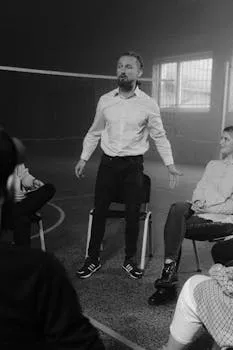
“When you show deep empathy toward others, their defensive energy goes down, and positive energy replaces it.” — Stephen Covey
Covey spent decades studying people who got exceptional results. The ones who moved mountains weren’t the most aggressive or the most technically skilled. They were the ones who could make someone feel genuinely heard. Feeling heard ends the defending. Collaboration starts instead. That’s the mechanical reality of empathy — it dissolves resistance.
“Empathy is about finding echoes of another person in yourself.” — Mohsin Hamid
Agreement isn’t required to understand someone. What’s required is honesty enough to find the part of the self that could have ended up exactly where they are, given their history and circumstances. That honesty isn’t weakness — it’s accuracy. And accuracy is the foundation of effective action.
“I think we all have empathy. We may not have enough courage to display it.” — Maya Angelou
Empathy isn’t something anyone lacks. It’s something learned to conceal because showing it felt exposed, vulnerable, or unmasculine. The courage isn’t in feeling it — it’s in acting on it while being seen. The strongest relationships are built on that courage.
“The highest form of knowledge is empathy.” — Bill Bullard
An IQ of 160 can still destroy every relationship it touches. Knowledge without empathy is just data stored in a container that keeps everyone at arm’s length. Empathy turns data into understanding — and understanding is the only currency that actually moves people.
“Could a greater miracle take place than for us to look through each other’s eyes for an instant?” — Henry David Thoreau
Thoreau understood that most human suffering — most conflict, most alienation, most cruelty — comes from the unexamined assumption that other people see the world the same way. They don’t. Their context is completely different. Grasping that turns disagreement from a character attack into information.
“Whenever you feel like criticizing anyone, just remember that all the people in this world haven’t had the advantages that you’ve had.” — F. Scott Fitzgerald
Not an argument for excusing failure or tolerating mediocrity. An argument against lazy judgment. Judging without understanding context isn’t discernment — it’s intellectual laziness. Context doesn’t remove accountability. It makes accountability accurate instead of self-righteous.
“If you judge people, you have no time to love them.” — Mother Teresa
Judgment is the mental equivalent of fast food — satisfying in the moment, corrosive over time. The men who build lasting bonds across decades are the ones who traded the verdict reflex for the understanding reflex. Not because standards disappeared. Because relationship got chosen over superiority.
“Empathy is simply listening, holding space, withholding judgment, emotionally connecting, and communicating that incredibly healing message of you’re not alone.” — Brené Brown
Brown stripped empathy down to its mechanical components. Not magic or mysticism. Presence. Focused, intentional presence. Most men have never been in a room where someone gave them that. Which is exactly why they don’t know how to give it — and why the man who learns to give it becomes irreplaceable to the people around him.
“No one cares how much you know, until they know how much you care.” — Theodore Roosevelt
Roosevelt wasn’t a gentle man. He charged up San Juan Hill. He managed the Panama Canal. He ran the most powerful nation on earth. And he understood that the ability to make people feel valued isn’t a soft trait — it’s a force multiplier. Expertise is worthless to people who don’t trust that you’re on their side.
“Attention is the rarest and purest form of generosity.” — Simone Weil
In an era of permanent distraction, the man who gives someone his full, undivided, phone-down attention is doing something almost radical. That’s empathy in its simplest, most actionable form. No need to know what to say. Just genuinely show up for what’s being said. The men who master this command rooms without raising their voice.
Emotional Regulation: The Art of Choosing Your Response
The gap between stimulus and response is where a life gets decided. Not in the big moments — in the thousands of small ones. The email that arrives with the wrong tone. The meeting where a man is challenged in front of his team. The argument that starts at midnight and threatens to spiral. Emotional regulation is the skill of expanding that gap and making a deliberate choice instead of firing off a reflex. These quotes map the territory.
“Between stimulus and response there is a space. In that space is our freedom and our power to choose our response.” — Viktor Frankl
Frankl learned this principle inside a Nazi concentration camp. If he could find the space between horror and his response to it — stripped of everything, watching people die, with no control over his physical reality — the space between someone cutting you off in traffic and losing your composure is findable too. His discovery is the bedrock of emotional discipline as a practice.
“Anyone can become angry — that is easy. But to be angry with the right person, to the right degree, at the right time, for the right purpose, and in the right way — that is not easy.” — Aristotle
This is the most sophisticated definition of emotional regulation ever written. The goal isn’t eliminating anger. The goal is deploying it with surgical precision. Unfocused anger is a liability. Focused anger is a force. The difference is regulation — the ability to direct a feeling instead of being directed by it.
“He who angers you conquers you.” — Elizabeth Kenny
Every lost temper hands the remote control of the nervous system to someone else. That’s not strength wearing a face of intensity. That’s surrender wearing the mask of strength. A man who can’t be made to lose his composure can’t be made to lose his edge. Anger transformed is power; anger uncontrolled is a weapon pointed at yourself.
“The greatest weapon against stress is our ability to choose one thought over another.” — William James
James, the father of American psychology, understood something most men spend their lives missing: thoughts aren’t commands, they’re suggestions. The stressed mind presents its catastrophic narrative as fact. But which thoughts get fed is a choice. The man who learns that skill has found the most potent stress management tool available without a prescription.
“You will not be punished for your anger, you will be punished by your anger.” — Attributed to the Buddha
Unregulated emotion doesn’t hurt the person it’s aimed at. It poisons the person carrying it. It corrodes relationships, clouds judgment, degrades decision-making, and eventually dismantles health. The punishment is the state itself — maintained at personal expense, often long after the person who triggered it has moved on entirely.
“When you react, you let others control you. When you respond, you are in control.” — Bohdi Sanders
Reaction is involuntary. Response is chosen. The gap between the two is exactly where emotional intelligence lives — and that gap can be trained like any other skill. Tactical breathing is one entry point. Naming the emotion before acting on it is another. The practice matters less than the consistency of the practice.
“The sign of an intelligent people is their ability to control their emotions by the application of reason.” — Marya Mannes
Not about suppressing emotion. About running it through a filter before it reaches the mouth, the fists, or the keyboard. Reason doesn’t kill feeling — it gives feeling a direction. The man who feels intensely AND thinks clearly under pressure is operating at a level most people never reach.
“It is not what happens to you, but how you react to it that matters.” — Epictetus, as outlined in the Stanford Encyclopedia of Philosophy on Stoic philosophy
A man born into slavery who became one of history’s most influential philosophers. Epictetus had every reason to be bitter, reactive, and broken. Instead he spent his life teaching that the response is the only thing anyone actually owns. The Stoics didn’t teach emotional suppression — they taught emotional sovereignty. A profound difference.
“Holding on to anger is like grasping a hot coal with the intent of throwing it at someone else; you are the one who gets burned.” — Attributed to the Buddha
That grudge feels like protection, or like punishment aimed outward. It’s consuming energy that could be building something instead. Let it go not because the other person deserves forgiveness, but because freedom is worth more than interest paid on a debt that was never yours to carry.
“What we achieve inwardly will change outer reality.” — Plutarch
The inner world dictates outer results. Chaos left unregulated internally leaks into every conversation, every decision, every relationship it touches. Fix the internal disorder and the external results begin to organize themselves. Not mysticism. Basic cause and effect — observable in every high performer who’s ever done the work.
Social Intelligence: Reading the Room and Moving Through It

“You can make more friends in two months by becoming interested in other people than you can in two years by trying to get other people interested in you.” — Dale Carnegie
Carnegie built an empire on this insight. The man walking into a room asking “what can I learn about these people” will always outperform the man asking “do these people like me.” One posture generates connection. The other generates anxiety. The socially intelligent man is perpetually curious about others — and that curiosity is magnetic.
“The most important thing in communication is hearing what isn’t said.” — Peter Drucker
Drucker ran organizations worth billions. And this is what he identified as the most critical communication skill: hearing beneath the surface. The words people say are the facade. The emotionally intelligent man hears the fear underneath the bravado, the hurt underneath the aggression, the need underneath the demand. That’s where the real conversation lives.
“People will forget what you said, people will forget what you did, but people will never forget how you made them feel.” — Maya Angelou
This is the single most operational insight in social intelligence. Impact on others isn’t measured in accomplishments or clever words — it’s measured in the emotional residue left behind. Understand this and the loyalty built outlasts titles, success, and presence in the room.
“Tact is the ability to describe others as they see themselves.” — Abraham Lincoln
Lincoln held a nation together through its most destructive war while managing a cabinet containing multiple men who believed they should be president instead of him. His primary weapon wasn’t strategy — it was the ability to make people feel understood even when he was overruling them. Psychological safety is built through exactly this kind of tact.
“To handle yourself, use your head; to handle others, use your heart.” — Eleanor Roosevelt
Self-management is cerebral — it requires the rational mind to govern the emotional one. People management is fundamentally emotional — it requires understanding what moves people, what they fear, what they need. The leader who tries to manage people with pure logic will always wonder why nobody follows him with any genuine conviction.
“In a gentle way, you can shake the world.” — Mahatma Gandhi
Gandhi toppled an empire without firing a shot, without an army, without conventional power. Gentleness wielded with complete clarity of purpose isn’t weakness — it’s a strategic choice most men are too insecure to make because they’ve confused volume with authority.
“The only way to change someone’s mind is to connect with them from the heart.” — Rasheed Ogunlaru
Logic wins arguments at the surface level. Emotional connection wins people at the level where decisions actually get made. Changing behavior — in a team, a partner, children, clients — requires reaching the heart before the mind will follow.
“Treat people as if they were what they ought to be and you help them become what they are capable of being.” — Johann Wolfgang von Goethe
Goethe understood something most managers never grasp: how you see someone shapes how they perform. Perception of another person isn’t passive observation — it’s an active force. Seeing potential calls it forward. Seeing deficiency reinforces it. This is one of the most powerful levers in team leadership.
“One of the most sincere forms of respect is actually listening to what another has to say.” — Bryant H. McGill
Most men listen to respond — already building their counterpoint before the other person has finished speaking. Emotionally intelligent men listen to understand — the counterpoint can wait. The difference between these two postures is visible in every relationship built, and in every room entered.
“Speak only if it improves upon the silence.” — Mahatma Gandhi
The most underrated social skill in every high-stakes environment is knowing when not to speak. The man who can sit in silence without filling it compulsively, without needing to be heard, without performing competence — that man commands more attention when he does speak than any man who fills every available moment with noise.
Emotional Intelligence and Resilience
Resilience isn’t stubbornness. It isn’t refusing to feel the hit. It’s the capacity to absorb impact, process it correctly, extract what’s useful, and re-engage — usually stronger than before. Emotional intelligence is the mechanism that makes real resilience possible. Without it, what looks like resilience is just suppression, and suppression has a shelf life. These quotes trace the difference.
“Life doesn’t get easier or more forgiving, we get stronger and more resilient.” — Steve Maraboli
The world will not soften for anyone. It will not lower the difficulty setting, extend the timeline, or spare the losses. The capacity to absorb impact and keep building — that’s the only variable actually within control. And emotional intelligence is what makes that capacity expandable rather than fixed.
“The oak fought the wind and was broken, the willow bent when it must and survived.” — Robert Jordan
Rigidity looks like strength. Flexibility is strength. The emotionally intelligent man knows when to stand firm and when to adapt — and that judgment is what keeps him standing across decades. The men who refuse to bend tend to snap at exactly the wrong moment. The unbreakable man bends with intention.
“Our greatest glory is not in never falling, but in rising every time we fall.” — Confucius
Emotional intelligence doesn’t prevent failure. Nothing does. It changes the relationship with failure — it transforms a collapse into information. And information, unlike defeat, can be used to rebuild stronger. The man who can fall without shame and rise without bravado has found the resilience that actually compounds over time.
“Resilience is not what happens to you. It’s how you react to, respond to, and recover from what happens to you.” — Jeffrey Gitomer
Three stages: reaction, response, recovery. Emotional intelligence operates at all three simultaneously. It shortens the reaction time, improves the quality of the response, accelerates the recovery. Each stage is a skill. Each skill is trainable. Post-traumatic growth is what happens when all three are working.
“You may have to fight a battle more than once to win it.” — Margaret Thatcher
Thatcher understood that most victories aren’t won in a single decisive engagement. They accumulate across repeated attempts, each one informed by the last. The man who can take a hit, process the pain without drowning in it, extract the lesson, and re-engage — he’s the one who eventually wins the long game.
“Turn your wounds into wisdom.” — Oprah Winfrey
Every wound carries information. The emotionally intelligent man doesn’t just survive his pain — he mines it for everything it can teach. That’s the alchemy of resilience: not the avoidance of suffering, but the conversion of suffering into something useful. The men who master this become genuinely dangerous to whatever opposes them.
“The world breaks everyone, and afterward, many are strong at the broken places.” — Ernest Hemingway
Hemingway wasn’t being sentimental. He was stating a biological fact. Bones that break and heal properly are denser at the fracture point. Emotional wounds work the same way — but only if processed instead of buried. Burial preserves the wound. Processing transforms it.
“Rock bottom became the solid foundation on which I rebuilt my life.” — J.K. Rowling
Rowling wrote this from lived experience — a single mother on welfare, manuscript rejected by multiple publishers, by all conventional metrics a failure. The bottom isn’t the end. It’s bedrock. And the man who can sit in that darkness without losing himself, without blaming the world, without abandoning his vision — that man has found something most people never will.
“Emotional intelligence is the ability to sense, understand, and effectively apply the power and acumen of emotions as a source of human energy, information, connection, and influence.” — Robert K. Cooper
Cooper nailed it: emotions aren’t obstacles to clear on the way to clear thinking. They’re energy. They’re information. The question is never whether to have them. The question is whether that energy gets wasted in reactivity or invested in building something that matters. Nervous system regulation is how that choice gets made consistently.
“What lies behind us and what lies before us are tiny matters compared to what lies within us.” — Ralph Waldo Emerson
The past doesn’t define anyone, and the future isn’t guaranteed. The only thing immediately real is internal capacity right now — the ability to see clearly, feel accurately, regulate intelligently, and act decisively. That capacity grows every time awareness gets chosen over autopilot.
Emotional Intelligence in Leadership
“A leader is best when people barely know he exists, when his work is done, his aim fulfilled, they will say: we did it ourselves.” — Lao Tzu
The highest expression of emotionally intelligent leadership is making yourself invisible in the success of others. Create the conditions. Build the capability. Hold the direction. Then get out of the way. Ego wants credit. Mastery wants the result. The man who can genuinely celebrate when his team outperforms him has reached something rare.
“Leadership is not about being in charge. It is about taking care of those in your charge.” — Simon Sinek
Sinek identified what most managers spend their entire careers missing: authority isn’t leadership. Authority can be conferred. Leadership has to be earned, repeatedly, through demonstrated commitment to the people who trust you with their time, their effort, and their careers. That commitment is fundamentally emotional.
“The supreme quality for leadership is unquestionably integrity.” — Dwight D. Eisenhower
Eisenhower commanded Operation Overlord — the largest coordinated military invasion in human history. He had access to every quality he could desire in a leader. And he put integrity above all of them. Not tactical brilliance. Not physical toughness. Not strategic genius. Integrity. Because without it, none of the other qualities can be trusted.
“The challenge of leadership is to be strong, but not rude; be kind, but not weak; be bold, but not a bully; be thoughtful, but not lazy; be humble, but not timid; be proud, but not arrogant.” — Jim Rohn
Rohn mapped the tightropes every emotionally intelligent leader must walk. Every virtue has a shadow that mimics it — and the shadow is where untrained emotion lives. The leader who can’t distinguish his strength from cruelty, or his confidence from arrogance, is dangerous to everyone in his orbit.
“Management is doing things right; leadership is doing the right things.” — Peter Drucker
Doing things right is a technical question. Doing the right things is a judgment question. And judgment requires emotional clarity — the ability to weigh competing values, sit with ambiguity, and make calls that won’t always be popular. The leader who can’t manage his own inner turbulence will consistently choose the politically safe option over the right one.
“In the long run, the sharpest weapon of all is a kind and gentle spirit.” — Anne Frank
Written by a teenager hiding from genocide in a concealed annex. If she could identify the strategic long-term value of kindness under those conditions, there’s no excuse for confusing cruelty with strength in ordinary daily interactions. The harsh manager doesn’t build the best teams. He builds the most compliant ones — which is not the same thing at all.
“The key to successful leadership today is influence, not authority.” — Ken Blanchard
Authority can compel compliance. Influence generates genuine commitment — the kind where people bring more than what’s required because they actually believe in what’s being built. Influence is constructed entirely on emotional intelligence: understanding what people need, what they fear, what they value, and making them feel that their contribution matters.
“Nearly all men can stand adversity, but if you want to test a man’s character, give him power.” — Abraham Lincoln
Power doesn’t corrupt — it reveals what was already there. The man with high emotional intelligence uses power to elevate others, to build systems that outlast his tenure, to solve problems that matter. The man without it uses power to protect his ego and punish anyone who challenges his fragile sense of control. The warrior’s code is a framework for wielding power with integrity.
“Emotional intelligence, more than any other factor, more than IQ or expertise, accounts for 85% to 90% of success at work.” — Warren Bennis
Bennis studied leaders across decades and industries. The finding is consistent: technical skill gets you past the door. Emotional intelligence determines how far you go once inside, and whether something lasting gets built or everything handed over gets quietly dismantled, a pattern well-documented by the American Psychological Association’s research on workplace performance.
“What makes a good leader? The ability to inspire confidence in those above you and the ability to motivate those below you.” — Colin Powell
Powell operated in environments where emotional miscalculation cost lives. His formula is deceptively elegant: confidence flows up, motivation flows down. Both require emotional intelligence — the ability to read what each group needs and deliver it with authenticity rather than performance.
Emotional Mastery and True Strength
The final section is the most important because it addresses the fundamental lie that’s kept generations of men emotionally underdeveloped: the idea that mastering your emotions makes you weaker. The men represented in these quotes — philosophers, warriors, psychologists, leaders who’ve faced things most people never will — understood the exact opposite. Emotional mastery is the capstone of real power. Not performance. Not suppression. Mastery. These quotes define what that looks like.
“Mastering others is strength. Mastering yourself is true power.” — Lao Tzu
The man who can dominate others but not himself is a tyrant running from his own shadow. Every external conquest is a distraction from the internal one he cannot face. True power starts inside. The external accomplishments of the man who’s done that internal work carry a different weight — built on something that doesn’t collapse under pressure.
“The strongest people are not those who show strength in front of us, but those who win battles we know nothing about.” — Jonathan Harnisch
The quiet battles — the ones fought at 3 AM when no one’s watching, when there’s no audience to perform for and no social reward for getting it right — those are where real strength is either built or abandoned. Emotional intelligence is what determines the outcome of those invisible wars.
“There can be no transforming of darkness into light and of apathy into movement without emotion.” — Carl Jung
Emotion isn’t the enemy of action. It’s the fuel. The man who cuts himself off from feeling doesn’t become more capable — he becomes immovable. The volatility of emotion gets traded for the paralysis of numbness. Neither serves him. The goal is to keep the fuel and learn to direct it with precision.
“Any person capable of angering you becomes your master.” — Epictetus
Sit with that. Anyone who can reliably provoke a loss of composure owns that moment. They’ve demonstrated a lever that moves you without consent. Emotional mastery isn’t about suppression — it’s about sovereignty. Understanding why certain triggers hit is the first step toward removing them.
“The best fighter is never angry.” — Lao Tzu
Anger clouds tactical judgment. The truly dangerous man is calm, clear-eyed, and fully present. He engages with precision rather than rage. He hits the target instead of venting energy in all directions. This applies to the boardroom, the negotiating table, the marriage, and every arena where the stakes are high enough to matter.
“Courage is what it takes to stand up and speak; courage is also what it takes to sit down and listen.” — Winston Churchill
Churchill demonstrated both kinds of courage. He spoke when the entire establishment wanted silence — and he listened when listening required humility he hadn’t always been famous for. The man who can speak when it’s hard and listen when it’s harder has emotional intelligence that changes rooms and outcomes.
“Emotional intelligence is not the opposite of intelligence, it is not the triumph of heart over head — it is the unique intersection of both.” — David Caruso
Caruso co-developed the MSCEIT — the most rigorous validated measure of EQ currently available, documented in the peer-reviewed Journal of Personality and Social Psychology. His core insight dismantles the false dichotomy that keeps men stuck: thinking vs. feeling. The best decisions happen when both systems are functioning and communicating with each other. Cutting off one doesn’t strengthen the other — it impairs the whole system.
“Real integrity is doing the right thing, knowing that nobody’s going to know whether you did it or not.” — Oprah Winfrey
Emotional integrity — honesty with yourself about what’s actually felt and why — is the foundation of everything else. It doesn’t require an audience. In fact, the need for an audience is often what corrupts it. The man who behaves consistently whether or not he’s being observed has found a version of integrity most people only approximate.
“The emotionally intelligent person is skilled in four areas: identifying emotions, using emotions, understanding emotions, and regulating emotions.” — John Mayer and Peter Salovey
Mayer and Salovey coined the term emotional intelligence in the early 1990s before Goleman popularized it. Their four-branch model remains the most scientifically rigorous framework available. The critical detail: regulation is the last branch, not the first. Nothing gets regulated that hasn’t first been identified, used, and understood. Every man who tries to skip to regulation without doing the earlier work is building the house from the roof down.
“Never react emotionally to criticism. Analyze yourself to determine whether it is justified. If it is, correct yourself. If it is not, forget it.” — Norman Vincent Peale
Peale mapped the decision tree for handling criticism in three clean steps: pause, evaluate, act or discard. That pause is the whole game. That one-second decision not to respond immediately is where emotional intelligence either shows up or doesn’t. Working the problem instead of reacting to it is a discipline built on exactly that pause.
“It takes something more than intelligence to act intelligently.” — Fyodor Dostoyevsky
Dostoyevsky understood the human soul better than most psychologists who came after him. His insight is precise: intelligence alone produces nothing useful. It takes emotional awareness to convert knowledge into wise action. Without that bridge, intelligence becomes a sophisticated engine for rationalization — building elaborate justifications for whatever the unexamined emotion was going to do anyway.
“In a very real sense we have two minds, one that thinks and one that feels.” — Daniel Goleman
Goleman’s central insight: the thinking mind and the feeling mind are two distinct systems operating simultaneously. Neither is optional. Neither is primary. Using only one means running at half capacity while wondering why the outcomes keep disappointing. Building both systems together is how something that actually holds gets built.
“Feelings are not supposed to be logical. Dangerous is the man who has rationalized his emotions.” — David Borenstein
The man who rationalizes his emotions isn’t managing them — he’s constructing an elaborate intellectual architecture to justify doing what he was going to do anyway. This isn’t emotional intelligence. It’s emotional camouflage. Real EQ starts with accepting that feelings have their own internal logic, and that logic deserves honest examination — not explanation that serves the conclusion already reached.
“The best and most beautiful things in the world cannot be seen or even touched — they must be felt with the heart.” — Helen Keller
Keller experienced the world without sight or hearing from the age of nineteen months. She still understood that the most important things in a human life are felt, not measured. The man who’s closed himself off from feeling hasn’t made himself more rational or more effective — he’s cut himself off from the deepest intelligence available to him.
Reader Questions About Emotional Intelligence Quotes
What is emotional intelligence and why does it matter for men? Emotional intelligence is the ability to identify, understand, and manage your own emotions while recognizing and influencing the emotions of others. For men, it matters because most of the damage in life — broken relationships, career stalls, chronic health problems, deepening isolation — traces directly back to emotional mismanagement. EQ isn’t therapy-speak. It’s operational awareness applied to the most powerful force running inside every man at every moment.
Can emotional intelligence be developed, or are you born with it? It can absolutely be developed. Research from Goleman, Mayer, and Salovey consistently demonstrates that EQ is a learnable skill set. Unlike IQ, which remains relatively stable across a lifetime, emotional intelligence responds to deliberate practice — particularly in self-awareness, active listening, and emotional regulation techniques. The neuroplasticity evidence supporting this is solid and growing.
Is emotional intelligence more important than IQ? In most real-world contexts, yes. The research consistently shows that EQ predicts job performance, leadership effectiveness, and relationship quality more reliably than IQ alone. Intelligence gets you into the room. Emotional intelligence determines what gets built while you’re there — and whether the people around you help build it or quietly work against you.
How do I start building emotional intelligence today? Start with naming. Feeling something — anger, anxiety, frustration, contempt, shame — name it with specificity. Not “I feel bad” but “I feel disrespected” or “I feel afraid of being seen as incompetent.” This practice of emotional granularity literally rewires the prefrontal cortex’s ability to regulate those states. Research on affect labeling shows measurable changes in neural activity within weeks. Try it for thirty days before evaluating whether it’s working.
Does being emotionally intelligent make you weak or soft? The opposite. Emotional intelligence makes a man harder to manipulate, more precise under pressure, better at reading rooms and people, and more resilient across sustained adversity. The man who suppresses emotion isn’t strong — he’s a pressure cooker with no release valve. The man who understands and channels emotion has access to a power source most people waste their entire lives. That is not softness — that is an edge most men never develop.
Which emotional intelligence skill should a man develop first? Self-awareness. Everything else is downstream from it. Nothing gets regulated that isn’t first named. Empathy can’t be accurate when personal emotional projections are distorting the read of others. Leadership can’t happen with integrity when a man doesn’t know his own motives. Self-awareness is the first floor. Build it first, build it honestly, and everything above it becomes possible.
Why These Words Hit Different
Quotes endure not because they are clever, but because they compress hard-won wisdom into a form that can be carried. Each one in this collection represents thousands of hours of lived experience, failure, loss, recovery, and eventual clarity — compressed into a sentence absorbed in three seconds and carried for a decade.
A quote that hits in the chest deserves attention. That response isn’t random. The brain’s pattern-recognition systems have identified something in those words that maps directly onto an unresolved tension in the reader’s own life. The quotes that move most are diagnostic — pointing at the thing that needs work, the truth being avoided, or the permission being waited for.
Reading quotes isn’t the same as internalizing them. And internalizing them isn’t the same as acting on them. The difference between motivation and transformation isn’t intensity of feeling — it’s what happens after the feeling fades. That’s where emotional intelligence is actually built: in the gap between being moved by an idea and letting that idea move behavior.
From Words to Action: The Implementation Protocol
Most people consume quotes the way they consume social media — a brief flash of recognition followed by nothing changed. Turning any of these 75 quotes into actual behavior change requires a system that converts insight into practice.
Select one quote. One that created discomfort, not one that felt validating. Write it on a card and put it somewhere unavoidable — bathroom mirror, car dashboard, the lock screen of a phone. At the end of each day for the next fourteen days, ask one question: did that principle get lived today, or just admired from a distance?
The honest answer to that question — tracked consistently over two weeks — is more valuable than anything found in a self-help book. It converts the abstract into the behavioral. It reveals not just what’s believed but what actually happens when the pressure is on and no one’s watching. That gap between belief and behavior is the map. Emotional intelligence is the work of closing it.
The quotes from Frankl, Epictetus, and Jung point toward the same practice from different angles: see the machinery, expand the gap, choose the response. That’s the protocol. That’s the work. Deliberate practice applied to emotional intelligence is no different from deliberate practice applied to any other skill — it requires honest feedback, consistent repetition, and the willingness to be a beginner longer than feels comfortable.
Start with the quote that caused the most discomfort. That one matters most.
Related: Oprah Winfrey's Discipline Routine: What She Does Daily
Related: Andrew Carnegie's Discipline Routine: What He Did Daily
Related: Carol Dweck's Discipline Routine: What She Does Daily