
Somewhere in the last five years, cold exposure went from “thing Navy SEALs and Finnish grandmothers do” to a stainless-steel tub in every gym bag ad on Instagram. Which means the actual physiology got buried under a pile of thumbnails of men screaming into 39-degree water. This page skips the screaming. It is the version meant to be read once, acted on for thirty days, and returned to only when something stops making sense.
What Cold Exposure Actually Is (And What the Marketing Gets Wrong)
Cold exposure is the deliberate, short-term application of cold — water, air, or both — to a body that is otherwise warm and comfortable. That is the whole definition. Everything else is packaging. The mechanism underneath it has a name most beginners never hear: hormesis. A low dose of a stressor that would be harmful at a high dose instead produces an adaptive, strengthening response. Exercise is hormesis. Fasting is hormesis. Sun exposure, in modest doses, is hormesis.
Cold is just the version you can do in a bathtub.
The term itself has an odd history. Toxicologist Edward Calabrese spent much of his career arguing that twentieth-century pharmacology and regulatory science largely ignored hormetic dose-response curves in favor of a simpler “linear no-threshold” model — the assumption that if a large dose of something is bad, any dose is proportionally bad (Calabrese and Baldwin, Annual Review of Pharmacology and Toxicology, 2003). That assumption is wrong for a long list of stressors, cold among them. A deeper account of how that happened, and why it took decades to correct, is worth reading once the basics are down — the full history is here.
Here is what the marketing gets wrong, specifically. It sells cold exposure as a mood hack — a thirty-second dopamine vending machine you use like a pre-workout. There is a real dopamine effect, covered below, and it’s a big one. But the actual value of cold exposure has almost nothing to do with the three minutes in the water. It’s what happens in the twenty-three hours and fifty-seven minutes around it. Learning to enter a genuinely uncomfortable, controllable stressor on purpose, breathe through the first sixty seconds of your nervous system screaming at you to get out, and stay anyway — that skill transfers. Not metaphorically. Mechanistically, the same prefrontal-cortex-over-amygdala override you train in a cold tub is the one a man needs in a hard conversation, a business setback, a training max he’s afraid to attempt. The tub is a cheap, repeatable rehearsal space for staying calm on purpose. That’s the actual product.
The ice is just the delivery vehicle.
One more thing the marketing gets wrong: it implies cold exposure is a Wim Hof invention, or a biohacker invention, or something that started with a podcast. It didn’t. Finnish culture has paired sauna heat with lake or snow cold for centuries. Russian banya tradition does the same. Japanese misogi waterfall practice predates all of it by a long stretch. The tub industry is new. The practice is not. For a longer treatment of what in the current wave is genuine and what is repackaged folk wisdom sold at a markup, this breakdown of voluntary hardship claims is a good next stop — it separates the studied effects from the ones riding on vibes alone.
What Actually Matters (the 20% Doing 80% of the Work)
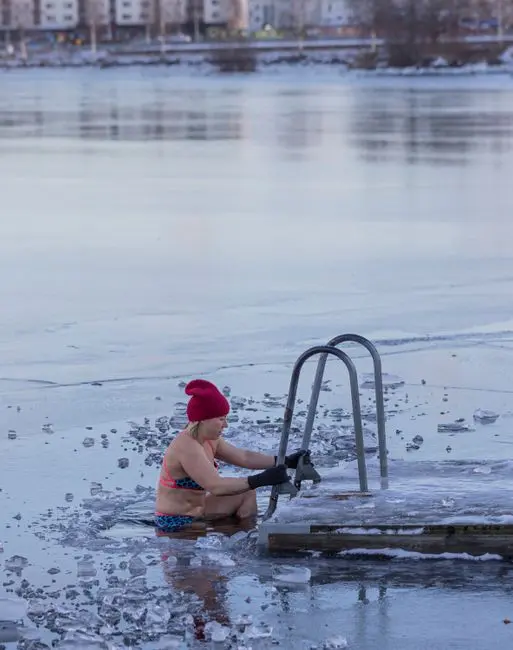
- Temperature relative to your baseline, not an absolute number. A man who grew up doing polar bear swims and a man who has never been below 65-degree water are not doing the same protocol at “50 degrees.” What matters is that the water is cold enough to trigger a genuine stress response — gasp reflex, racing heart, the urge to leave — but not so cold that you can’t think clearly or control your breathing. For most untrained men that’s somewhere between 50 and 59°F (10–15°C) to start. Colder isn’t automatically better. It’s just colder.
- Duration, and it’s shorter than people assume. The research most commonly cited for a minimum effective dose comes from Stanford neuroscientist Andrew Huberman’s public breakdown of the cold-exposure literature: roughly eleven cumulative minutes of deliberately uncomfortable cold per week, spread across two to four sessions, is enough to produce measurable adaptation. That’s it. Not an hour. Not daily hour-long soaks. Eleven minutes, total, across a week — split however you like. A protocol built specifically around that framework is worth reading in full once the fundamentals click: the complete Huberman cold-exposure protocol.
- The dopamine mechanism, because it explains why this is addictive in a good way. A frequently cited study by Šrámek and colleagues found that whole-body immersion in 14°C water raised circulating dopamine by roughly 250 percent and noradrenaline by over 500 percent — and, notably, kept dopamine elevated for hours afterward, not just during the immersion (Šrámek et al., European Journal of Applied Physiology, 2000). Compare that to the dopamine spike from, say, a sugary breakfast, which is smaller and crashes fast. Cold gives a bigger spike with a slower comedown and no metabolic cost. It’s one of the few genuinely “free” dopamine sources available, which is worth sitting with for a second, because most things that feel that good come with a bill. The full breakdown of the dose-response curve and why the effect plateaus at a certain point is here: the 250 percent spike, explained.
- Consistency over intensity. Three minutes at 55°F, four times a week, for a month beats one heroic fifteen-minute ice-bath stunt filmed for social media and never repeated. Obvious when it’s written down. Constantly ignored in practice, because the stunt version is the one that gets attention and the boring version is the one that produces adaptation. Pick one.
A digression, briefly. There’s a fifth factor people ask about constantly that doesn’t belong on this list: brown fat activation and metabolic “cold-induced weight loss.” It’s real — a well-known 2009 study found that cold exposure activates brown adipose tissue in most healthy adults, and that BAT activity correlates inversely with body mass index (van Marken Lichtenbelt et al., New England Journal of Medicine, 2009). But the magnitude of calories burned through BAT activation in a normal 3-minute plunge is small relative to what diet and training move. Anyone doing cold exposure specifically as a fat-loss strategy is optimizing the wrong lever first. The mechanism itself, and where its real limits are, matters far less for week one than getting the ramp right — it’s covered in the reading path below for anyone curious. Anyway. Back to what actually matters for week one.
Your First 30 Days
This is not a suggestion to figure out the right protocol eventually. This is the protocol. Follow it in order.
- Week 1 — cold showers only. No ice, no tub, no chiller. End every regular shower with 30 to 60 seconds of the coldest tap water available. Not a gradual taper — full cold, all at once, at the end. Breathe through the nose if possible, slow the exhale, and stay standing under it instead of flinching to the side. Do this daily. The goal in week one is not physiological adaptation — 30 to 60 seconds of tap-cold water barely qualifies as a dose. The goal is building the specific skill of staying present in discomfort instead of white-knuckling through it while mentally somewhere else. That skill is the actual prerequisite for everything that follows. Skip it and week 2 becomes miserable for no reason.
- Week 2 — extend the shower, introduce a real cold source once. Push the cold-water portion of the shower to 90 seconds to 2 minutes, still daily. Separately, once this week, get access to something genuinely cold — a lake, an unheated pool, a bag of ice in a tub, whatever is available — and do a single 2 to 3 minute immersion at a temperature in the 50–59°F range. Get in slowly enough to control the breath, then hold still. Do not chase a colder temperature than that yet. The point of week 2 is confirming the shower-built skill transfers to full immersion, which is a bigger jump than it sounds like the first time.
- Weeks 3–4 — build toward the eleven-minute weekly target. Three to four sessions per week, 2 to 4 minutes each, cold enough that the first 30 seconds are genuinely unpleasant every single time. That “every single time” part matters — full habituation to a fixed temperature over weeks means the stimulus is fading and the dose needs to shift, either colder or longer, within reason. By the end of week 4 a man following this should be comfortably hitting 11+ cumulative minutes weekly without dread setting in beforehand. If dread is still constant by week 4, the fix usually isn’t more willpower. It’s better pacing.
A structured, day-by-day version of exactly this ramp exists already, laid out with specific durations for every session, and is worth following literally rather than improvising. There’s also a shower-only variant for anyone without tub or lake access at all, covering the same four-week arc with nothing but a bathroom faucet. Both are linked in the reading path below.
A note on timing within the day, since it changes outcomes and almost nobody mentions it early enough. Morning cold exposure pairs well with the natural cortisol and norepinephrine rhythm and tends to produce the clearest alertness effect. Cold exposure in the hour immediately after a heavy resistance-training session is a different story — one worth its own section below, because it’s the single most common mistake on this list.
Mistakes That Waste a Year
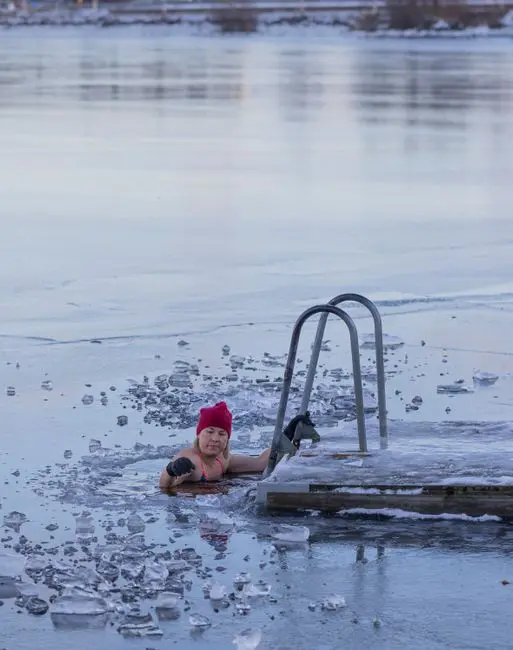
- Starting too cold, too long, in week one. Take a guy we’ll call Marcus, 34, who watched one video, filled a tub with ice to 39°F, and got in for what he planned as five minutes. He lasted forty seconds, hyperventilated, scrambled out shaking, and didn’t touch cold water again for two months out of something close to fear. The mechanism failure here is simple: an untrained nervous system hit with a maximal cold-shock response produces gasping, panic, and a genuine risk of cardiac strain in anyone with undiagnosed heart issues — and it teaches the brain that cold equals emergency, which is exactly the wrong lesson to encode first. The fix is the week-1 shower ramp above. Every time. No exceptions for men who are “already in good shape,” because cardiovascular fitness doesn’t inoculate against cold shock response — it’s a separate reflex.
- Cold immediately after strength training, expecting it to speed recovery. It might reduce next-day soreness. It will also blunt the muscle-building signal from that session. A controlled study found that post-exercise cold water immersion attenuated the acute anabolic signaling pathways and reduced long-term strength and hypertrophy gains compared to active recovery without cold, in men doing structured resistance training over 12 weeks (Roberts et al., The Journal of Physiology, 2015). The mechanism: the same inflammatory and cellular-stress signaling that produces soreness is also the trigger for the adaptation itself. Blunt one, blunt both. The fix isn’t avoiding cold exposure around training entirely — it’s separating them by several hours, or reserving cold for cardio and skill days instead of the day’s the priority is building muscle or strength. The full protocol-timing breakdown for athletes is here: cold plunge after workout, timing done right.
- Treating temperature as the only lever. Duration and frequency matter as much as how cold the water is, and men chasing an ever-lower number while doing shorter, less frequent sessions are optimizing the wrong variable. A rigorous side-by-side of what the actual literature says about intensity versus consistency is worth reading before spending money on a chiller — it’s linked in the reading path below.
- Turning it into a performance instead of a practice. Filming every session, checking a stopwatch obsessively, posting the time to a group chat. None of that is inherently wrong, but for a meaningful subset of men it converts a nervous-system practice into an ego project, and the moment the practice stops feeding the ego — a bad session, a plateau, an injury that sidelines it — the whole thing gets dropped. The habit that survives a bad week is the private one.
- Skipping the breath work and just gritting teeth. White-knuckling through cold water without controlling the exhale keeps the sympathetic nervous system maxed out for the entire session instead of down-shifting after the initial shock passes. Slow, controlled nasal breathing with an extended exhale — four counts in, six or eight counts out — is what actually teaches the parasympathetic system to re-engage under stress, which is the whole point. Gritting teeth just teaches a man he can suffer. Useful in small doses. Not the skill being built here.
How to Know It’s Working
Nobody needs a lab panel to run this. But there are real markers, on real timelines, and knowing them prevents quitting right before the payoff shows up.
- Week 2: the anticipatory dread starts shrinking. Not gone — shrinking. Getting in still isn’t pleasant, but the thirty seconds beforehand stop feeling like walking to an execution. That’s the earliest reliable signal the nervous system is recalibrating.
- Week 3–4: post-session mental clarity becomes noticeable and repeatable rather than occasional. A lot of men describe it as the closest thing to a reset button they’ve found — sharper focus for an hour or two afterward, which tracks with the sustained dopamine and norepinephrine elevation covered above. If it’s not showing up by week 4, check duration and temperature against the protocol above before assuming it doesn’t work for you personally; underdosing is the far more common explanation.
- Month 2–3: sleep is the marker worth tracking most closely, and it cuts both ways depending on timing. Morning or midday cold exposure tends to support sleep quality over weeks by reinforcing a stronger circadian temperature rhythm — a bigger gap between daytime alertness and the evening core-temperature drop that helps trigger sleep onset. Cold exposure late at night, close to bed, tends to do the opposite for a meaningful share of men, because it spikes sympathetic activity right when the body is supposed to be winding that down. The full relationship between timing, temperature, and sleep architecture is worth reading for anyone using cold exposure as part of a broader recovery stack: cold plunge and sleep, the temperature-timing tradeoff.
Consider a case with a setback in it, because the clean version is a lie. A man in his forties, call him Dorian, tracked resting heart rate through a fitness watch for three months of consistent cold exposure and plateaued around week six — no further improvement, mild fatigue creeping in, the cold sessions starting to feel like a chore instead of a reset. He assumed the cold exposure had stopped working. It hadn’t. He was accumulating a sleep debt from an unrelated stretch of late nights, and cold exposure doesn’t fix a sleep deficit — it can’t compensate for one. Once sleep normalized, the resting-heart-rate trend resumed within two weeks. The lesson isn’t about cold exposure specifically. It’s that a hormetic stressor layered on top of an already depleted system reads as diminishing returns when the actual problem is somewhere else entirely.
For men doing structured training alongside cold exposure — not instead of, alongside — recovery markers worth watching include next-day soreness trend, grip strength consistency session to session, and subjective readiness before a lifting session. A full framework built specifically for athletes layering cold into a training block, including where it helps and where it interferes, is here: cold exposure for athletes: the recovery guide.
Your Reading Path

Start here
- Cold Plunge for Beginners: 30-Day Protocol — the day-by-day version of the four-week arc outlined above, for anyone who wants it fully mapped out rather than self-paced.
- Cold Shower Challenge: 30 Days of Cold Exposure — the no-equipment version, for anyone starting with nothing but a shower head.
Go deeper
- Cold Showers vs. Cold Plunge: What the Science Says — for once the basics are boring and the question becomes whether upgrading equipment actually matters.
- Brown Fat Activation: How Cold Triggers Fat Burning — the metabolic mechanism underneath the habit, and where its real limits are.
Advanced
- Building a Home Cold Plunge: DIY vs Buy — for anyone past the trial phase and ready to build a permanent setup instead of relying on a gym or a lake.
- Cold Plunge Tubs: 2026 Buying Guide — the buy-not-build path through the same decision, for comparing actual products once DIY is ruled out.
Questions Beginners Ask
Is it dangerous to do a cold plunge with no medical supervision? For most healthy adults, a properly ramped protocol — shower first, brief immersion second, gradual increases — carries low risk. The real danger zone is the mistake covered above: an untrained man jumping straight into water cold enough to trigger a maximal gasp reflex, which can cause involuntary inhalation of water or, in someone with undiagnosed cardiac issues, added strain during the initial shock phase. Ramping over weeks rather than days is the actual safety mechanism, not a piece of legal boilerplate tacked on at the end.
Does it actually build “mental toughness,” or is that just marketing language? The phrase gets overused, but the underlying claim has real mechanism behind it: repeatedly choosing to enter and stay in a controllable stressor trains the same prefrontal regulation of the amygdala’s threat response used in unrelated high-stress situations. It’s not mystical. It’s closer to a specific, transferable skill than a vague personality trait, and the neuroscience behind why it transfers is worth reading in full for anyone skeptical of the claim.
How cold does the water actually need to be? Cold enough to trigger a genuine stress response in the first 30 to 60 seconds — racing heart, urge to leave, real discomfort. For most untrained men that’s 50–59°F to start. There’s no evidence that dropping to 39°F produces meaningfully better adaptation than a well-executed session at 55°F; it mostly produces a worse first experience and a higher quit rate.
Can this replace a hard training session for building discipline? No, and it isn’t trying to. Cold exposure is a short, repeatable rehearsal of staying calm under a stressor — a few minutes, a few times a week. Strength training, conditioning work, and skill practice build different capacities over longer timelines and can’t be substituted with a cold tub. They stack. Neither replaces the other.
Why do some mornings feel unbearable even after a month of consistent practice? Usually one of three things: poor sleep the night before, dehydration, or a genuinely colder water temperature than usual without adjusting expectations. The nervous system’s baseline stress tolerance moves around day to day for reasons that have nothing to do with cold exposure specifically. A single hard morning after weeks of easier ones isn’t regression. It’s a data point about that morning, not the practice.
Is there a point of diminishing returns — can a man do too much cold exposure? Past a certain volume, yes, particularly for anyone also doing heavy strength training, where excess cold exposure around workouts actively works against the adaptation being trained. Eleven-ish minutes weekly is a reasonable target for most men, not a floor to build upward from indefinitely. More is not automatically better past that point, and for men layering cold onto an already demanding training schedule, less is often the correction that’s needed.
What’s the fastest way to quit and never come back? Do the ice-bath-on-day-one version. Every single time, that’s the one that ends the habit before it starts. The slow version — showers first — feels almost embarrassingly unimpressive in week one. It’s also the one still running in month six.