
Take a guy we’ll call Dan. His son was three, and one Saturday morning he walked into the kitchen still half-asleep, poured coffee he hadn’t earned yet, and heard the boy in the living room trying to open the front door. Couldn’t reach the deadbolt. Working the handle with both hands, muttering something unintelligible. Dan stood in the doorway watching. The kid turned around, saw him, and said: “Daddy, I going outside.” Not a question. A statement of intent. He’d watched his father say that phrase a hundred mornings — putting on boots, grabbing keys, heading out — and decided, at thirty-six months and forty-two pounds, that he was ready to do the same.
Dan thought about that moment for a week afterward. Not because it was cute, though it was. Because he realized his son was already learning from him constantly, fluently, automatically — and he hadn’t been nearly deliberate enough about what the lessons were. The boy watched how his father left. He’d also been watching how he came back. Whether the phone got put down. Whether the voice got raised. Whether Dad moved through the house like a man with somewhere important to be, or like a man who was present and accounted for.
The kid didn’t know the word discipline. He just knew Dad, and “Dad” was becoming a curriculum.
That’s the thing about fatherhood that nobody prepares you for: there’s no opting out of teaching. The only question is whether the lessons being taught are the intended ones. Every father is running a discipline program with his children — either one he designed consciously, or one his own upbringing installed in him by default, or some half-assembled hybrid of both. The default program is rarely the one anyone would choose if handed a blank sheet of paper and told: design the man your son will become. The conscious version requires something most men haven’t been asked to develop in the specific context of fatherhood: discipline about discipline. Not enforcement. Not rules. Not punishment protocols. The quiet daily work of being the kind of man your kids can actually learn from.
Dan’s own father never talked about discipline. He just did things. Showed up to the same job for thirty-seven years. Was at every game, every recital, every science fair. Put food on the table, kept the lights on, and never once treated any of it as heroic. It was just the job. You were a father. You did the job.
Dan didn’t understand until he became one himself: his father wasn’t operating on autopilot. He was operating on a discipline practice so embedded in his identity that it looked effortless. He was tired. He was stressed. He had his own deferred dreams and swallowed frustrations. He probably had mornings he wanted to walk out and keep walking. He didn’t. Not because he was superhuman — because he’d decided, a long time ago, who he was going to be. And then he became that person every day for twenty years while his kids were watching.
This article is about that. Not the Instagram version of fatherhood discipline — the morning routines and father-son workout posts and curated family photos. The real version. The unglamorous, grinding, sometimes thankless work of being the man children need their father to be, day after day, for decades. This is about the discipline of a man’s life applied to its most consequential theater.
What Fatherhood Discipline Actually Is (And What It Isn’t)
Discipline for fathers doesn’t mean what most men think it means when they first become fathers. Most men come into fatherhood with a vague mental model borrowed from their own upbringing and whatever movies and books they’ve absorbed: discipline is enforcement. It’s rules and consequences. It’s the stern voice, the grounding, the lecture at the kitchen table. The father as authority figure, the children as subjects who need to be managed.
That’s not wrong exactly. It’s just about twenty percent of the job, with the other eighty percent ignored.
The full picture looks like this: fatherhood discipline is the practice of becoming, consistently and publicly, the kind of man you want your children to become. It’s the discipline you impose on yourself — on your habits, your emotional responses, your relationship with work and money and time — that becomes the invisible architecture your children build their own lives inside. The rules you enforce matter. The man you are when you’re not enforcing rules matters more.
Call it the Visible Architecture — the central idea this article is built on. Children don’t primarily learn from what you tell them. They learn from what they watch you do, particularly in unguarded moments: how you handle frustration, whether you follow through on things you said you’d do, how you treat your partner when you think no one’s paying close attention. Your Visible Architecture is the sum of those moments. And it’s being constructed every day whether you’re building it intentionally or not.
The Visible Architecture shifts how you think about fatherhood discipline entirely. Instead of asking “what rules should I enforce?” the question becomes “what kind of man is worth watching?” And that question is both harder and more productive, because it locates the work where it actually needs to happen: inside you, not in management strategies aimed at your children.
The Science: What Research Actually Shows About Fathers and Discipline

Ross Parke, a developmental psychologist at the University of California Riverside, spent forty years studying father-child interaction. His 2002 meta-analysis in Annual Review of Psychology found that the quality of father-child relationships independently predicted children’s academic performance, peer competence, and psychological adjustment — even after controlling for maternal influence and socioeconomic status. The father’s contribution wasn’t redundant. It was additive. Kids with engaged, disciplined fathers weren’t just getting more of the same thing mothers provide. They were getting something categorically different.
Specifically, Parke’s work identified what fathers uniquely contribute: activation. Where maternal interaction tends toward comfort and regulation, paternal interaction tends toward stimulation, challenge, and calculated risk. Fathers roughhouse. They push kids slightly past their comfort zone. They let go of the bicycle before the child feels ready. This “activation function” — Parke’s term — is associated in longitudinal studies with higher frustration tolerance, better stress regulation, and stronger executive function in children, precisely because it provides repeated low-stakes experiences of being uncomfortable and managing it.
This is the Visible Architecture in action at the neurological level. When a father models tolerating discomfort — staying calm in traffic, continuing difficult work, not quitting when things get hard — and when he provides controlled doses of challenge to his children, he’s literally shaping the development of the prefrontal cortex, the part of the brain responsible for impulse control, planning, and emotional regulation. This isn’t metaphor. This is neuroscience with clinical implications.
Michael Lamb at the National Institute of Child Health and Human Development tracked the same cohort for twenty-three years and found that paternal involvement — specifically, time spent engaged, not just physically present — predicted adult outcomes including income, relationship quality, and self-reported life satisfaction. The effect was dose-dependent: more engaged fathering, better adult outcomes. But critically, engagement was not equivalent to permissiveness. The fathers whose children showed the best outcomes combined high engagement with high structure — present AND consistent in their expectations. Neither alone was sufficient.
This maps onto what Diana Baumrind at UC Berkeley identified as authoritative parenting in her landmark 1966 research, refined over subsequent decades. Her three-category model remains the most replicated finding in developmental psychology: authoritarian parenting (high control, low warmth) produces compliance without internalization; permissive parenting (low control, high warmth) produces poor frustration tolerance and difficulty with authority; authoritative parenting (high control, high warmth) produces the outcomes every father is actually trying to produce — children who internalize standards rather than simply obeying them, who are capable of self-direction, who handle adversity without falling apart. The warm part gets discussed constantly in modern parenting culture. The control part — consistent expectations, maintained structure, real consequences — gets quietly minimized. Both are load-bearing.
The emotional regulation piece has its own dedicated research base. James Gross at Stanford’s Emotion and Neuroscience Laboratory has spent three decades studying how emotional regulation is transmitted across generations. His findings, published across multiple studies in Psychological Science and Journal of Personality and Social Psychology, are unambiguous: children develop emotional regulation strategies primarily by observing their parents. Not through instruction. Through observation. A father who regularly demonstrates suppression (pushing emotions down and acting as if they don’t exist) tends to raise children with high physiological stress reactivity and poor interpersonal skill. A father who demonstrates cognitive reappraisal — visibly reconsidering a frustrating situation and choosing a response rather than just reacting — tends to raise children with stronger emotional management and better relationship outcomes.
This is where emotional discipline and fatherhood intersect directly. Emotional responses are being watched and catalogued. The practice of moving from reactive to responsive isn’t just personal development — it’s the curriculum the children are enrolled in whether they know it or not.
One more thread worth pulling: Bruce Ellis at the University of Arizona, drawing on evolutionary developmental psychology, has studied what happens to children’s stress systems in environments with absent or disengaged fathers. His work found that paternal absence accelerates pubertal timing in daughters and is associated with higher cortisol reactivity and more aggressive risk-taking in sons — effects that emerged through observed behavior, not genetics, because adopted children showed the same patterns. The biological father’s genes didn’t determine the outcome. The presence or absence of a consistent, structured, engaged male caregiver did. This is the Visible Architecture at the population level: when it isn’t built, the nervous system fills the gap with hypervigilance, and hypervigilance is a very expensive way to move through the world. The research on nervous system regulation confirms this downstream.
The Visible Architecture Method: Six Practices That Actually Build It
The science points in one clear direction: children are learning from watching their fathers, and the qualities they’re developing — frustration tolerance, emotional regulation, internal standards, executive function — are determined more by the man he consistently is than by the rules he consistently enforces. The method that follows is built entirely around that reality.
-
Regulate first, respond second — always, publicly. The single highest-use discipline practice a father can implement has nothing to do with his children and everything to do with his own nervous system. When something frustrating happens — the traffic, the broken thing, the conversation that goes sideways, the kid who just spilled the entire dinner — there is a gap between stimulus and response. That gap is the classroom. Taking a breath, physically slowing down, choosing the response rather than firing the first reaction, does two things simultaneously: it models exactly the executive function children need to develop, and it trains the father’s own nervous system to do it more automatically. This is self-discipline at its most direct. Children who watch their fathers regulate visibly and repeatedly develop the same neurological capacity, because the mirror neuron system in the developing brain is literally copying the regulation pattern it observes. No explaining required. No announcing required. Just doing it in front of them.
-
Keep your word at a rate of at least ninety-five percent. Tell your son you’ll throw the ball around Saturday morning — throw the ball around Saturday morning. Tell your daughter you’ll read her the next chapter tonight — read it tonight. Not because breaking small promises is catastrophic — it isn’t — but because your word is the foundation of your Visible Architecture, and children are tracking reliability with a precision that would embarrass most adults. Research by trust psychologist Robert Cialdini shows that reliability perceptions form through pattern recognition: no credit is given for the ninety-five times a father followed through. He gets defined by the five times he didn’t. The discipline here is in making promises that can actually be kept (which means being conservative about what gets committed to) and in treating follow-through as non-negotiable. Children are building a model of whether people can be trusted, and a father is the primary data set. Build a trustworthy one.
-
Let them watch you do hard things without quitting. Not the dramatic hard things — the daily ones. Getting up early consistently. Finishing the project that got started. Going to the gym on the day it doesn’t feel good. Continuing a difficult conversation until it’s actually resolved instead of tabling it until everyone pretends it’s fine. Children need to watch their fathers encounter resistance and continue. Not cheerfully. Not pretending it’s easy. Actually continuing, visibly, in front of the resistance. This is the no-zero-days principle made visible, and it installs something no amount of motivational conversation can install: the understanding that hard things get done not because they feel good but because a decision was made to do them. That understanding is one of the most protective factors in adolescent development, associated with lower dropout rates, lower substance use, and better career outcomes in longitudinal research.
-
Enforce your standards consistently and with explanation. The “with explanation” part is what most discipline advice leaves out. Rules without reasoning teach obedience. Rules with reasoning teach judgment, which is the actual goal. “We don’t hit because hitting hurts people, and we don’t hurt people in this family” is more useful than “we don’t hit because I said so,” not because it’s gentler but because it gives the child the reasoning they’ll need when the father isn’t in the room. As children age, the explanation should shift from “here’s the rule because I established it” to “here’s the principle behind the rule — what do you think it should look like in this situation?” That progression is the discipline of teaching without controlling: building the internal decision-making framework rather than just enforcing external compliance. The rule-enforcer becomes unnecessary. The reasoning-instiller is carried forward for life. Related: deliberate practice in any domain follows this same logic — principles get internalized until they become automatic.
-
Be physically and emotionally present at the hard moments, not just the easy ones. Most fathers can manage presence when things are good — the vacation, the birthday, the win. The Visible Architecture is built during the hard moments: when a child is scared, when they’ve failed at something, when they’re in a conflict they can’t resolve, when they’re angry and not sure what to do with it. Showing up at those moments — not to fix everything, not to minimize the experience, but to be present and regulated and available — is what creates what developmental psychologists call secure attachment, and secure attachment is the strongest single predictor of adult relationship quality, occupational success, and psychological resilience in the longitudinal record. Parke’s research, Lamb’s research, and Bowlby’s original attachment theory all converge on this: the child who knows their father will show up when things are genuinely hard develops a nervous system that can tolerate challenge. The child who’s not sure develops a nervous system that braces against everything.
-
Build and maintain your own physical and mental health — visibly. This one gets left off every fatherhood advice list because it sounds selfish. It isn’t. Health is infrastructure. A depleted, dysregulated, chronically exhausted father cannot provide consistent warmth, cannot regulate his own responses, cannot follow through reliably, cannot be present at the hard moments. He runs on fumes and deficit spending, and deficit spending produces the irritability, inconsistency, and emotional volatility that erode the Visible Architecture faster than almost anything else. The discipline of protecting sleep, moving the body, managing stress, and keeping one’s own relationships intact is not selfishness. It’s maintenance on the most important machine in a family’s life. And children are watching whether their father treats himself like a machine to be exploited or an organism that requires care. They’re building their own relationship with their health from that model.
Long-Term Discipline Fathers Man Strategy: What Twenty Years of Fatherhood Discipline Produces
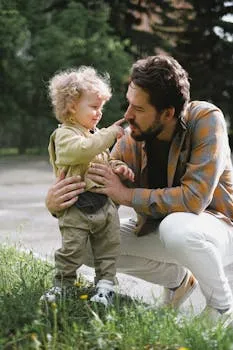
This is what makes fatherhood the ultimate test of discipline. Every other discipline practice offers relatively fast feedback. Train consistently for two months and the body changes. Write every day for six months and there’s a manuscript. Build a skill for a year and the improvement is measurable. Fatherhood? The data doesn’t arrive for two decades. And when it finally does, it arrives not as a report card but as a person: the human being a child has become, shaped by ten thousand moments barely remembered in the performing.
What those moments add up to, when they’re built on the Visible Architecture, is documented in the longitudinal research. The Harvard Study of Adult Development — the longest-running study of human flourishing ever conducted, tracking 268 men from their college years through their eighties — found that the quality of childhood relationships, particularly with fathers, was among the strongest predictors of life satisfaction, physical health, and mental health in old age. Not income. Not professional achievement. Not education. Relationships. The men whose fathers were present, consistent, warm, and engaged aged better by virtually every measure the researchers tracked.
Robert Waldinger, the current director of the Harvard study, summarized decades of findings simply: “The people who were most satisfied in their relationships at age 50 were the healthiest at age 80.” The relationship patterns learned in childhood — including the relationship to one’s own standards and commitments, patterns established by watching a disciplined father — echo forward through an entire life. This is the long game. And the long game is worth playing.
There’s also a specific outcome worth naming that rarely makes it into fatherhood literature: the discipline modeled gives children permission to hold themselves to a standard. A surprising number of adults with high capacity and low self-belief trace that gap back to a childhood without a consistent male model of disciplined effort — not because they were abused or neglected, but because nobody in their formative years demonstrated that showing up every day regardless of how you feel is simply what responsible people do. When that model is present and consistent, it becomes an internal standard the child carries forward. When it’s absent, the child has to construct that standard from scratch as an adult, which is harder and takes much longer.
The long game of fatherhood discipline also requires what’s worth calling transfer of authority — the gradual, intentional transfer of decision-making power from father to child as the child demonstrates the capacity to handle it. A three-year-old needs firm, immediate, simple structure. A thirteen-year-old needs broader guidelines with explained reasoning. A seventeen-year-old needs near-full autonomy with an open door. The discipline failure isn’t in giving a teenager rules appropriate for a toddler. It’s in failing to notice that the rules need to evolve as the child evolves — treating a fifteen-year-old like a seven-year-old produces a twenty-five-year-old who can’t function without external structure, which is the opposite of everything the Visible Architecture is meant to build.
Proof: What Sustained Fatherhood Discipline Looks Like in Practice
In 2003, the Adverse Childhood Experiences (ACE) study — the most comprehensive research into childhood trauma and adult health ever conducted, drawing on 17,337 participants through Kaiser Permanente and the CDC — published findings that reframed how medicine understood the impact of early family environments. The study measured ten categories of adverse childhood experience (abuse, neglect, household dysfunction including parental absence and substance abuse) and tracked health outcomes across a lifetime.
The findings were stark: every additional ACE score point was associated with substantially higher risk of depression, heart disease, cancer, diabetes, substance abuse, suicide attempts, and early death. An ACE score of 4 or higher — four adverse categories — was associated with a 1,220% increase in attempted suicide compared to a score of zero. These weren’t marginal effects. They were large, dose-dependent, and replicated across subsequent studies in multiple countries.
But the ACE research is frequently misread as a study of damage. It’s equally a study of protection. The children with ACE scores of zero — who grew up in households with consistent, present, engaged parenting — showed a fundamentally different physiological and psychological profile. And critically, the research on resilience factors consistently identifies the same protective element: a consistent, warm, predictable relationship with at least one stable adult caregiver. Not wealth. Not neighborhood. Not school quality. A person who showed up every day and was reliably there.
The practical version of this is playing out in families across the country right now, in ways that don’t make headlines because quiet consistency never does. The father who eats breakfast with his kids every morning before school — not scrolling, not distracted, just present for twenty minutes — is providing what researchers at the National Center on Addiction and Substance Abuse found reduces teen drug use by fifty percent compared to families with no regular shared meals. Not lecture. Not drug education. Just a father at a table, five mornings a week, for years.
The father who does what he said he would do — who follows through on commitments, keeps appointments, delivers on promises with the same reliability whether anyone is watching or not — is demonstrating to his children that integrity isn’t situational. That lesson, repeated across fifteen years of daily observation, produces adults who keep their word because they saw what that looked like, because it was normalized, because the man who raised them treated it as the baseline, not the exception.
None of this is dramatic. None of it photographs well. It’s the aggregate of a million ordinary mornings, and the aggregate is what shapes a human being.
The Traps: How Disciplined Fathers Still Get This Wrong

Trap 1: Confusing your standards with their path. The disciplined father who built a career through grinding effort is in genuine danger of imposing that path onto children who might be wired entirely differently. His Visible Architecture communicates: this is what effort looks like. That’s valuable. The trap is when it becomes: therefore you should pursue what I pursued, in the way I pursued it. Children who are creative, introverted, artistic, or academically gifted in areas their father never valued need to watch him succeed at his path while being genuinely curious about theirs. The discipline is in staying interested without colonizing. This is harder than it sounds, especially for men whose identity is strongly tied to what they built.
Trap 2: Using financial provision as a substitute for presence. This one is culturally endorsed and quietly devastating. The father who works sixty-five hours a week and provides abundantly for his family has done something real and important. He has also missed most of the moments that constitute childhood. “I’m doing this for my family” is sometimes true. It’s also sometimes the story that allows a man to avoid the more uncomfortable work of actually being in the room. The research is consistent: children rate feeling known by their father — understood, seen, paid attention to — as more important than any material provision. A father can provide every advantage money can buy and still fail to build the Visible Architecture, because the architecture is built in presence, not provision. Financial discipline — living below your means so you’re not enslaved to your income — is what creates the flexibility to be present. Living below your means isn’t just about money. It’s about buying freedom.
Trap 3: The performance of discipline versus its practice. Social media has created a new category of fatherhood failure: the father who posts about his morning routine with his kids, who talks constantly about the man he’s trying to be, who has strong opinions about parenting philosophy — and who is primarily engaged in performing fatherhood rather than practicing it. The Visible Architecture is not built for an audience. It’s built in the moments nobody sees: how a man speaks to his partner when he’s tired, whether he keeps the promise made to his five-year-old on a Tuesday when nobody’s watching, how he handles the boring middle portion of a difficult situation before the resolution that would make a good story. His children are the audience that matters. They’re watching all of it, including the gap between what he says and what he does.
Trap 4: Waiting to be a better father until you’re a better man. The version of this that plays out in real life sounds like: “I need to get the business to a certain point before I can really be present.” “Once I sort out my own stuff, I’ll be in a better place to show up for them.” “When things calm down a bit.” This is the perfectionist’s version of fatherhood, and it produces the same outcome perfectionism always produces: paralysis dressed up as preparation. Children don’t need a father to arrive fully formed. They need him to show up, keep working on himself, and let them watch the process. The man who is visibly trying to improve — who acknowledges mistakes and corrects course, who is clearly working on something about himself — is teaching his children something more valuable than any finished version of himself could teach: that growth is a practice, not a destination. The distinction between excellence and perfectionism matters here. Excellence keeps you in the game. Perfectionism keeps you on the sidelines waiting for conditions that never fully arrive.
The Contrarian Take: The Most Important Fatherhood Discipline Has Nothing to Do with Your Kids

The Visible Architecture isn’t built only during family hours. It’s built continuously, through the entire fabric of how a man operates. The man he is at work — how he handles frustration, whether he does what he said he’d do, how he treats people who have no power over him — is part of the architecture his children will eventually learn about and either confirm or contradict their earlier model. The man he is in his marriage, or in how he handles being alone, or in how he responds to failure when there’s no audience — that man is the foundation the architecture stands on.
This means the most impactful fatherhood work often looks like it has nothing to do with fatherhood. Getting sleep sorted to be less chronically reactive. Building a skill practice that demonstrates ongoing effort. Working on anger — not as a performance for the family, but because walking through the world as a man who handles his anger well is different at a cellular level from walking through it managing the appearance of anger. Processing the stuff from one’s own childhood that got installed without consent, not as a therapeutic project but as a practical one: those patterns are being transmitted to children right now through the Visible Architecture, and if they weren’t chosen, something different can be. The capacity to rewrite old patterns is one of the most important things a father can develop — not for himself, but because every pattern he breaks is one his children don’t inherit.
The conventional wisdom says: be present with your children. The deeper truth is: become a man worth being present with. The former is a scheduling problem. The latter is a character project, and character projects take years, and the returns compound in ways that simple presence never does.
Integration: How Fatherhood Discipline Connects to the Full Framework
The Visible Architecture is built from tools across the full resilience system. Self-discipline and physiological health are the fuel — a depleted man cannot consistently build the architecture. Emotional discipline is the most visible component — the regulation children are directly copying. Working the problem is what children watch their father do with difficulty: systematic and forward-moving, not circular and complaint-driven.
The long game of fatherhood connects directly to the discipline of a man’s life as a whole — work, money, relationships, self — because children observe that integration. They see whether the disciplines connect or contradict each other. And they are building their model of adulthood from what they observe. Build something worth observing.
Discipline Fathers Man: Your Questions Answered: Discipline for Fathers
What does discipline as a father actually look like on a daily basis? More than anything else, it looks like consistency in small things: showing up at the times promised, following through on commitments, managing emotional reactions before responding to children, being physically present without being mentally elsewhere. The Visible Architecture is built from accumulated ordinary moments, not dramatic ones. A father who eats breakfast with his kids five mornings a week without a phone present, maintains the same bedtime routine across two hundred consecutive nights, and handles frustration without raising his voice is doing more fatherhood discipline work than a father who takes one spectacular family vacation a year and is otherwise absent or reactive. The research from Michael Lamb’s twenty-three-year longitudinal study confirmed that engaged daily presence, not the quality of peak experiences, predicted the best adult outcomes in children.
How do I discipline my kids effectively without damaging our relationship? The authoritative parenting research from Diana Baumrind’s decades of work at UC Berkeley answers this directly: the combination of high warmth and high structure produces the best outcomes, not because it’s softer but because warmth makes structure legible. When a child knows their father is on their side, expectations get heard as care rather than control. Practically: enforce standards clearly and consistently; explain the reasoning behind the rule rather than relying purely on authority; repair quickly after conflicts by acknowledging your part without abandoning the standard; and let children see that the same discipline they’re held to applies to their father as well. Children don’t resent standards. They resent arbitrary, inconsistent, or hypocritical standards.
I didn’t have a good father. How do I build fatherhood discipline without a model? The same way any capacity gets built without a head start: more deliberately. A father’s absence or failure doesn’t define the ceiling — it defines the starting point, and starting points are just information. What the research on intergenerational transmission (particularly work by attachment researchers like Mary Main at UC Berkeley) shows is that fathers who have consciously processed their own childhood — who understand what they didn’t receive and have built an intentional framework to provide something different — can and do break the transmission pattern. The key word is conscious. The pattern doesn’t break through general good intentions. It breaks through specific, deliberate practice: understanding the Visible Architecture one’s own father built (or didn’t), identifying what to build differently, and rehearsing the new patterns enough that they become more automatic than the inherited ones. Consider also that children need to watch a father pursue growth without a map, which teaches something a man with an excellent father model can’t teach: that you can build forward from almost anywhere.
How do I stay disciplined as a father when I’m burned out from work? By accepting that excellence at everything simultaneously isn’t possible, and building a tiered system accordingly. Identify the non-negotiables — the handful of fatherhood practices protected even during high-pressure periods. For most fathers, these include: bedtime routine, phone-free meals, and following through on the specific commitments made to each child that week. Everything else can flex. Communicate to children (age-appropriately) when going through a hard season — not to make them responsible for a parent’s wellbeing, but because watching a father acknowledge difficulty and continue is itself valuable fatherhood discipline work. And set a hard end date on intense work periods. “This project ends on the 15th and then I’m back to full presence” is information. “I’m just busy right now” is an open-ended blank check that tends to roll forward indefinitely. The discipline here is honest self-assessment: chronic stress that becomes permanent mode isn’t work intensity — it’s a life design problem that needs solving at the root.
At what age should I start thinking seriously about fatherhood discipline? Birth. But what that discipline looks like in the first two years is almost entirely about the father, not the infant. The fatherhood discipline practices that matter most: regulating sleep deprivation without becoming cruel; building the physical attunement (holding, playing, roughhousing) that Parke’s research identified as foundational to the activation function; and establishing a partnership with the child’s mother that demonstrates collaborative, respectful adult relationship. An infant is not learning rules. They’re developing a baseline sense of whether the world is safe and whether the people in it are reliable. Those early attachment patterns, established primarily through consistent responsive caregiving, shape the nervous system template a child will carry into every relationship and challenge for the rest of their life. The Visible Architecture can start building from day one. It can also take damage from day one. The work starts early, it starts with the father, and it doesn’t stop.
How do I handle it when my partner and I disagree about discipline approaches? Two things matter here: alignment in the room children can see, and productive disagreement in the room they can’t. Children experiencing parents who openly contradict each other’s authority face a specific form of confusion — not just about the rule, but about whether authority itself is consistent or can be arbitraged. Resolve disagreements privately, present unified decisions publicly, and treat the disagreement itself as information worth examining: sometimes one parent’s instinct is tracking something real about a specific child’s needs that the other is missing, and the point isn’t to win the argument but to find the approach most likely to actually work. Schedule regular parenting conversations — thirty minutes a week of deliberate alignment — rather than trying to negotiate discipline philosophy in the middle of an incident. The discipline of working through disagreement constructively is itself a piece of Visible Architecture children are watching.
References