
The short answer
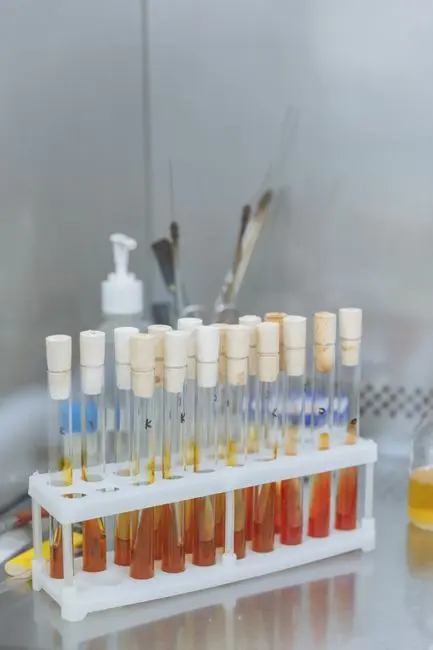
A full hormone panel means testing total testosterone, free testosterone, SHBG, estradiol, LH, FSH, prolactin, DHEA-S, and a thyroid set — TSH, free T4, free T3 — plus fasting cortisol and vitamin D. Most men never see this list. They get a total testosterone number from a routine physical, hear “you’re in range,” and leave with nothing. That’s not a panel. That’s one data point pretending to be an answer.
The order matters more than people think. Draw blood between 7 and 9 a.m., fasted, before any exercise that morning — testosterone swings on a daily rhythm and an afternoon draw will underestimate it by a meaningful margin. If a first test comes back low or borderline, get a second draw on a different morning before acting on it. One low number is a data point.
Two low numbers on separate mornings are a pattern.
Beyond the blood draw, there’s a second decision: standard serum panel, or a urine-based test like the DUTCH test, which maps hormone metabolites instead of a single snapshot. They’re not competing tools. They answer different questions, and which one a person needs first depends on what the standard panel already shows. More on that below. For now: the short version is testosterone plus SHBG plus a thyroid panel plus vitamin D, drawn fasted in the morning, repeated once before anyone changes anything based on it.
Why this works
SHBG itself moves for reasons that have nothing to do with the testes. Liver function, thyroid status, insulin sensitivity, and estrogen exposure all push it up or down. High thyroid hormone raises SHBG. Insulin resistance lowers it. That’s part of why a hormone panel that stops at testosterone is really only testing one gear in a machine with six or seven moving parts — the panel needs to include the parts that regulate the part you actually care about.
Then there’s the feedback loop most men never hear explained. The hypothalamus releases GnRH, which tells the pituitary to release LH and FSH, which tell the testes to produce testosterone and sperm. It’s a thermostat system — when testosterone is high, the brain dials back LH; when it’s low, the brain should dial LH up to compensate. Reading LH and FSH alongside testosterone tells you where in that chain the problem actually sits. Low testosterone with low LH points upstream, toward the pituitary or hypothalamus. Low testosterone with high LH points at the testes themselves, straining to respond to a signal they can’t follow. Same symptom, opposite cause, completely different next step. Testosterone and estrogen run this whole system in tension with each other, not as enemies but as two ends of a see-saw that has to stay roughly balanced for either one to work right.
Anyway. Thyroid gets bundled into “hormone panel” for a reason that surprises people: hypothyroidism produces a symptom list — fatigue, low libido, weight gain, brain fog — that overlaps almost completely with low testosterone. Test one without the other and there’s a real chance of chasing the wrong hormone for months. TSH alone isn’t enough either; a TSH sitting at 4.2 mIU/L can still come with a free T4 and free T3 that are dragging, and TSH-only testing misses that combination routinely. A proper thyroid panel checks TSH, free T4, and free T3 together, because TSH is a pituitary signal, not a direct measurement of what’s circulating.
Vitamin D deserves its own line here, mostly because it keeps getting left off. It behaves more like a hormone than a vitamin — it has a receptor in testicular tissue, and low vitamin D status correlates with lower testosterone in multiple observational studies. Correlation isn’t causation, and nobody should expect a supplement to fix a hormone problem on its own. But testing 25-hydroxyvitamin D is cheap, it’s usually included on the same blood draw, and a level under 30 ng/mL is common enough in men who work indoors that it’s worth ruling out before assuming the problem is something more complicated.
And why do standard physicals skip most of this? Cost, mostly, and a diagnostic threshold built around disease, not optimization. Insurance-driven medicine flags a marker only when it’s abnormal enough to justify treatment — a testosterone of 320 ng/dL might get flagged, but 420 ng/dL sails through as “normal” even though it’s low-normal and might be dragging someone down. The reference range is built from a population that includes plenty of unhealthy, sedentary, aging men. Falling inside that range doesn’t mean a level is optimal. It means it’s not catastrophic.
The protocol
Here’s the actual sequence, step by step, in the order to run it.
- Pick the morning. Schedule the blood draw for 7-9 a.m. Fast for 8-12 hours beforehand — water is fine, food and coffee are not. Skip strenuous exercise the morning of the draw; heavy lifting or a hard cardio session can temporarily shift cortisol and testosterone readings.
- Order the core panel. Total testosterone, free testosterone (or calculated free testosterone using total T, SHBG, and albumin), SHBG, estradiol (sensitive assay, not the standard immunoassay if it’s available — standard assays are unreliable at the low end in men), LH, FSH, and prolactin.
- Add the thyroid set. TSH, free T4, free T3. Skip a TSH-only order if the lab defaults to it; ask specifically for the free hormones to be included, since many standard panels quietly drop them to save cost.
- Add DHEA-S and fasting cortisol. DHEA-S is an adrenal androgen that tends to decline with age and chronic stress; fasting morning cortisol (drawn in that same 7-9 a.m. window, since cortisol also runs on a daily rhythm) gives a rough read on adrenal output.
- Add 25-hydroxyvitamin D and a basic metabolic panel. Vitamin D because of the testicular receptor connection above, and a metabolic panel because insulin resistance and liver values both move SHBG.
- Read the results against optimal ranges, not just the lab’s flagged range. A lab report flags “abnormal” only outside the reference interval — it won’t flag a free testosterone in the bottom 10% of that range as a problem, even when it functions like one.
- Repeat the core testosterone-SHBG-LH-FSH set on a second morning within 2-4 weeks if anything came back low or borderline. Same fasting rules, same time window. One low draw could be a bad night’s sleep or an unusually stressful week. Two low draws are a baseline.
- If the standard panel raises more questions than it answers — normal total T but persistent symptoms, or a pattern that doesn’t fit the LH/FSH logic cleanly — consider a DUTCH test as the next layer, not the first one. It measures hormone metabolites in dried urine over 24 hours, which shows how the body is processing and clearing hormones, not just how much is circulating at one moment.
- Track the numbers over time. Keep a simple log — date, time of draw, fasting status, and every value. A single panel is a photograph. Three panels over a year are a film, and the film is what actually tells a person something.
That’s the whole list. Nine steps, none of them exotic, most of them just a matter of asking the lab for tests that don’t come standard.
What does not work, and why

Testing once and treating that as permanent. Hormones move. Sleep debt, a bad month at work, a training block that ran too hot, a bout of illness — any of these can knock testosterone down temporarily, and a single low draw taken during one of those windows isn’t a diagnosis. It’s a snapshot of a bad week.
Testing in the afternoon. Testosterone follows a circadian rhythm and drops through the day — an afternoon draw can read 20-30% lower than the same man’s morning value, which is exactly the kind of gap that turns a normal result into a false alarm, or a genuinely low result into something that looks borderline instead.
Assuming a home finger-prick test replaces a venous draw. Some at-home kits are reasonably accurate for total testosterone as a rough screen. None of them reliably measure free testosterone, SHBG, or the pituitary hormones with the precision needed to make sense of the whole picture. Fine for a first look. Not a substitute for a real panel.
Ignoring ongoing exposure while testing. Plastics, certain pesticides, and some personal care product ingredients act as endocrine disruptors that interfere with hormone signaling independent of what a single blood draw shows. A man who retests every six months while microwaving food in plastic containers and drinking from the same water bottle all day is treating the symptom of exposure without touching the source, and wondering why the numbers won’t move.
And skipping the DUTCH test entirely because a doctor never mentioned it. It’s not covered by most insurance and it doesn’t come up in a standard fifteen-minute appointment, so most men never hear it’s an option. That’s an access problem, not a signal that it isn’t useful. It answers a different question than a standard panel does — not “how much hormone is present” but “how is the body metabolizing and clearing it” — and for some symptom patterns, that second question is the one that actually matters.
What to expect
Week one: the results come back, usually within 2-5 business days depending on the lab. This is the part that surprises people — the numbers themselves don’t change anything yet. A panel is diagnostic, not therapeutic. Getting the data is the whole win at this stage. Resist the urge to overreact to one flagged marker on day one.
Weeks two through four: the second confirmatory draw, if the first one came back low or ambiguous. This is also the window to start correcting anything obvious and low-risk — a vitamin D level under 30 ng/mL, a sleep schedule that’s been averaging five hours, a training load that’s been running at redline for three months straight. None of that requires a prescription. All of it moves the next panel.
Month two to three: if lifestyle factors were the driver — sleep debt, chronic stress, a body composition that’s carrying more visceral fat than it should, which raises aromatase activity and converts more testosterone to estrogen — this is roughly when a retest starts to show movement. Not always. Sometimes it takes longer, and being honest about that matters more than promising a fast fix. A man whose SHBG was elevated because of an undiagnosed thyroid issue won’t see his free testosterone normalize until the thyroid itself is addressed, and thyroid correction on its own can take three to six months to fully stabilize on repeat labs.
Six months and beyond: this is the realistic window for anyone whose numbers were driven by years of accumulated factors rather than one isolated cause. Bodies that took years to drift don’t snap back in six weeks. Anyone promising otherwise is selling something.
When it is not working

Problem one: SHBG never got ordered. This happens constantly — a lab or physician runs total testosterone and calls it a panel. Without SHBG there’s no way to calculate free testosterone, and free testosterone is the number that actually correlates with symptoms. The fix is simple and annoying: go back and specifically request SHBG and either free testosterone or the inputs to calculate it, because most labs won’t add it automatically.
Problem two: the draw happened, but the timing drifted. Derek’s second draw, three weeks later, got pushed to 11 a.m. because of a work meeting. The number came back lower than his first draw, and for a minute he thought things were getting worse. They weren’t. The draw window had moved. Keep the second draw inside the same 7-9 a.m. band as the first, every time, or the comparison means nothing.
Problem three: thyroid got tested with TSH only. Derek’s TSH sat at 3.1 mIU/L — inside range, technically fine. But nobody checked free T3, and when he finally pushed for it, his free T3 was sitting at the low end. Low-normal thyroid function raises SHBG and can suppress free testosterone even when total testosterone and TSH both look unremarkable. This is the single most common stall point, and it’s invisible unless someone specifically asks for the free hormones.
Problem four, less common but worth naming: the panel is complete and genuinely fine, and the symptoms have a different cause entirely — sleep apnea, alcohol intake, a medication side effect, depression that isn’t primarily hormonal. A full hormone panel rules hormones in or out. It isn’t a universal explanation for every symptom a man is carrying, and treating it as one just delays finding the actual answer.
Common questions
Can this be done without going through a doctor? In most states, yes — direct-to-consumer lab companies let a person order their own panel and get results sent straight to them, no referral required. A handful of states restrict this. The tradeoff is context: reading a lab report without any framework for what’s optimal versus merely “in range” is where most of the value gets lost, which is the whole reason to build that literacy before ordering rather than after.
How much does a full panel cost out of pocket? Direct-to-consumer pricing for the core set — testosterone, free T, SHBG, estradiol, LH, FSH, thyroid panel, vitamin D — typically runs somewhere in the low-to-mid hundreds of dollars, depending on the lab and how many markers get bundled. A DUTCH test runs separately and generally costs more than the standard panel because of the specialized processing involved.
Does time of month or cycle matter for men? Not in the way it does for women, but time of day matters enormously, and season can shift testosterone slightly too — some data shows testosterone runs marginally higher in fall and winter than summer in certain populations. Time of day is the variable actually worth controlling for.
Is fasting really necessary, or is that overkill? It matters more for the metabolic panel and lipids than for testosterone itself, but eating a large meal beforehand can shift insulin and, downstream, SHBG. Fasting removes one more variable from the comparison between draws, and since the whole point is a clean comparison over time, it’s worth doing even if the effect on testosterone specifically is modest.
What if total testosterone is normal but free testosterone is low? This is the exact scenario the whole panel exists to catch. It usually means SHBG is elevated, binding up more testosterone than usual and leaving less of it free to act. The next step is figuring out why SHBG is high — thyroid function, liver health, and insulin sensitivity are the three most common drivers, and each one points toward a different piece to investigate next.
Should estradiol be tested too, and why does it matter for men? Yes. Testosterone converts to estradiol via an enzyme called aromatase, and men need some estradiol for bone density, joint health, and cognitive function — the goal isn’t zero, it’s balance. Estradiol that’s too high relative to free testosterone can produce symptoms that get misattributed to low T alone, which is part of why the two numbers need to be read together, not separately.
How often should the full panel get repeated after the first two confirmatory draws? Every 6-12 months is reasonable for someone tracking a known issue or a lifestyle intervention; annually is enough for someone whose numbers came back solid and who just wants a baseline check going forward. More frequent testing than that mostly adds noise without adding useful signal, since most of these markers don’t shift meaningfully month to month absent a real change in health, training, or stress load.