
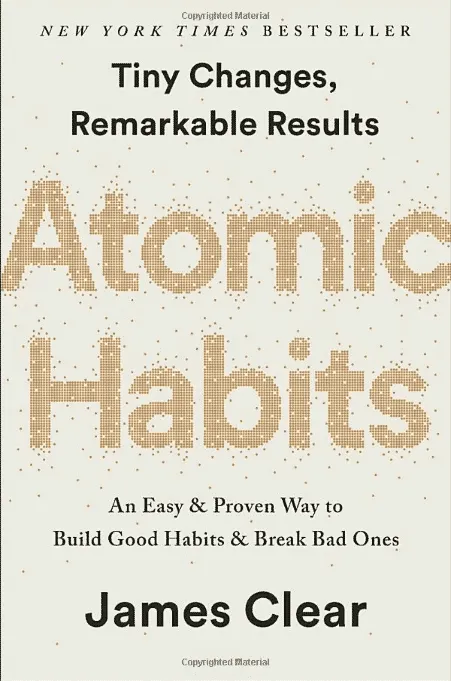
The instant New York Times best-seller.
Tiny changes, remarkable results
No matter your goals, Atomic Habits offers a proven framework for improving - every day. James Clear, one of the world's leading experts on habit formation, reveals practical strategies that will teach you exactly how to form good habits, break bad ones, and master the tiny behaviors that lead to remarkable results.
If you're having trouble changing your habits, the problem isn't you. The problem is your system. Bad habits repeat themselves again and again not because you don't want to change, but because you have the wrong system for change. You do not rise to the level of your goals. You fall to the level of your systems. Here, you'll get a proven system that can take you to new heights.
Clear is known for his ability to distill complex topics into simple behaviors that can be easily applied to daily life and work. Here, he draws on the most proven ideas from biology, psychology, and neuroscience to create an easy-to-understand guide for making good habits inevitable and bad habits impossible. Along the way, listeners will be inspired and entertained with true stories from Olympic gold medalists, award-winning artists, business leaders, life-saving physicians, and star comedians who have used the science of small habits to master their craft and vault to the top of their field.
Learn how to:
- Make time for new habits (even when life gets crazy)
- Overcome a lack of motivation and willpower
- Design your environment to make success easier
- Get back on track when you fall off course
- And much more
Atomic Habits will reshape the way you think about progress and success and give you the tools and strategies you need to transform your habits - whether you are a team looking to win a championship, an organization hoping to redefine an industry, or simply an individual who wishes to quit smoking, lose weight, reduce stress, or achieve any other goal.
James Clear’s Atomic Habits arrived at exactly the right moment. Self-help culture had long been saturated with motivational content — books, podcasts, and speakers urging people to want things more badly, to visualize harder, to push through resistance with greater will. And yet the research on behavior change was accumulating evidence that pointed in an entirely different direction: motivation is unreliable, willpower is a limited resource, and the people who most consistently achieve their goals are not the ones who try the hardest. They are the ones who have designed their environment and their systems to make the right behaviors easy and automatic.
Clear synthesized this research — from behavioral psychology, neuroscience, and the study of human performance — into one of the most practically useful books on behavior change ever written. Atomic Habits is not about trying harder. It is about designing smarter. It is about understanding how habits actually work at the neurological and behavioral level, and using that understanding to build a systematic approach to becoming the person you want to be — through tiny, consistent, compounding changes that are almost trivially small in any given moment and transformatively large over time.
The book’s central metaphor is the 1% improvement: if you improve by 1% each day for a year, you end up 37 times better than you started. If you decline by 1% each day for a year, you decline to nearly zero. The direction you’re trending matters far more than where you start. And the direction is determined not by occasional heroic effort but by the tiny, daily, incremental choices that make up the texture of your actual life.
The Four Laws of Behavior Change
Clear organizes his framework around four laws of behavior change — four levers that determine whether a habit forms, maintains, and strengthens over time. Understanding these four laws, and knowing how to manipulate them deliberately, is the practical core of the book.
The First Law: Make it obvious. Habits are triggered by cues in the environment. The cue for a habit can be a time, a place, a person, an emotional state, or any preceding behavior that the habit has been associated with through repetition. The most reliable way to establish a new habit is to make its cue unmistakably obvious — to design the environment so that the trigger is unavoidable. Conversely, the most effective way to break a bad habit is to make its cues invisible: remove the candy from the counter, delete the apps from the phone, put the cigarettes where you can’t see them.
The Second Law: Make it attractive. Habits with rewarding associations are repeated more readily than habits that feel neutral or aversive. This law explains why bad habits are often so persistent — they are associated with immediate, reliable pleasure, even when their long-term consequences are clearly negative. Using this law in service of good habits involves strategies like temptation bundling — pairing a habit you want to establish with something you already enjoy — and joining communities where the desired behavior is normal and valued.
The Third Law: Make it easy. The more friction there is between you and a behavior, the less likely you are to do it. Conversely, reducing friction to near zero dramatically increases the likelihood of the behavior occurring. This is the principle behind the two-minute rule: any new habit should begin with a version that takes two minutes or less to complete. Not because two minutes is sufficient to produce the desired outcome, but because the most important thing is to show up — to reinforce the identity of being someone who does this thing. You can always do more once you’ve started. But starting is the critical step, and friction is the enemy of starting.
The Fourth Law: Make it satisfying. Habits that are immediately rewarding are repeated. Habits that are immediately punishing are avoided. The challenge with many of the most valuable habits is that their rewards are delayed — you don’t feel the benefits of exercise for days or weeks, you don’t see the results of saving for years. Bridging this gap requires finding ways to make the good feeling immediate: habit tracking creates a visual record of progress that provides its own satisfaction, celebrating small wins reinforces the positive identity association, and sharing progress with an accountability partner adds social reward to the behavioral reward.
Identity: The Hidden Engine of Lasting Change
The most conceptually important contribution of Atomic Habits — the insight that distinguishes it from most habit books — is Clear’s framework for identity-based change. Most approaches to behavior change focus on outcomes (I want to lose twenty pounds) or processes (I will exercise three times a week). Clear argues that these are the wrong levels to focus on. The most powerful and durable changes begin at the level of identity: who do you believe yourself to be?
The word “identity” comes from the Latin identitas, which is related to idem — “the same.” Your identity is the story you tell yourself about who you are, and the behaviors that are consistent with that story are the ones that require the least effort to sustain. You don’t have to convince yourself to do things that are simply what people like you do. The effort is in the convincing. When the identity is secure, the behavior follows naturally.
This has enormous practical implications. The person who says “I’m trying to quit smoking” has a different identity than the person who says “I’m not a smoker.” When someone offers the first person a cigarette, they have to exercise willpower to refuse. When someone offers the second person a cigarette, refusal is simply consistent with who they are. The identity does the work that willpower would otherwise have to do.
Clear’s key insight is that identity is not a fixed thing you discover about yourself — it is something you construct through your behavior. Every action you take is a vote for or against a particular identity. Do something once, and it’s an anomaly. Do it repeatedly, and it becomes evidence about who you are. The accumulation of these votes, over time, builds the identity that then generates the behavior that adds more votes. This is a positive feedback loop that can work for you or against you, depending on which behaviors you’re repeating.
The starting question, then, is not “what do I want to achieve?” but “who do I want to become?” The habits that will take you from here to there are the ones that are consistent with that identity — that cast votes for the person you’re trying to be. This reframing changes the emotional valence of the effort involved. Habits pursued in service of an identity feel different from habits pursued in service of an outcome. They feel like self-expression rather than self-improvement, and that difference matters enormously for sustainability.
The Habit Loop and the Role of Cravings
Every habit operates through a loop that Clear describes as consisting of four stages: cue, craving, response, and reward. Understanding each stage creates the ability to intervene in the loop at multiple points, which is the foundation of systematic habit design.
The cue is the trigger that initiates the habit. It can be anything the nervous system has learned to associate with the upcoming reward: a time of day, a physical location, an emotional state, the presence of particular people, or the completion of another behavior. Cues are the entry points to automatic behavior — the moments at which the habit system takes over from deliberate decision-making.
The craving is the motivational force that the cue generates — the felt desire for the reward that the habit delivers. Crucially, what you crave is not the habit itself but the state change the habit produces. The smoker doesn’t crave cigarettes; they crave relief from stress, or a social connection, or simply the familiar physiological state the cigarette produces. Understanding what you actually crave when a habit cue appears gives you the information you need to satisfy that craving through different means if necessary.
The response is the actual behavior — the habit itself. The likelihood of the response occurring depends on how much motivation the craving generates and how much friction stands between the motivation and the behavior. High friction defeats even high motivation, which is why the simplicity principle is so critical.
The reward is what the behavior delivers — the state change that satisfies the craving and signals to the brain that this sequence deserves to be remembered and repeated. Rewards strengthen the association between cue and response, reinforcing the habit loop. They also provide the feedback that the brain uses to evaluate whether the effort was worth it. Understanding what actually constitutes a reward — what actually changes the state in the desired direction — is important for designing habits that will stick.
The Environment as Architecture
One of the most practically important sections of Atomic Habits concerns the role of environment design in behavior change. Clear draws on decades of research in behavioral psychology and environmental design to make a compelling case that most of our daily behavior is far more influenced by our environment than by our intentions.
Anne Thorndike’s study of hospital cafeteria choices is one of Clear’s favorite examples: simply rearranging the food layout in a cafeteria — placing water bottles in visible locations, removing soda from easy reach — produced significant changes in the purchasing choices of thousands of people who never explicitly thought about changing their behavior. No one lectured them about nutrition. No one appealed to their motivation to be healthy. The environment did the work.
This principle extends to every domain of habit formation. The book you keep on your nightstand gets read more than the book in your bag. The guitar leaning against the wall gets played more than the guitar in the case. The healthy food at eye level in the refrigerator gets eaten more than the unhealthy food in the back of the drawer. None of this requires motivation or willpower. It is simply friction engineering: make the desired behavior visible, accessible, and easy; make the undesired behavior invisible, inaccessible, and effortful.
Clear is careful to emphasize that environment design works in both directions. Destructive habits persist partly because their cues are everywhere — triggers that fire the craving at unexpected moments and rely on moment-by-moment willpower resistance that inevitably fails sometimes. The person who is trying to reduce alcohol consumption but keeps a well-stocked bar in their kitchen is fighting the environment every evening. The better strategy is to restructure the environment so that the battle doesn’t have to be fought at all.
Compounding: The Mathematics of Incremental Change
The “atomic” in Atomic Habits has two meanings that Clear uses deliberately. The first is smallness: atomic habits are tiny habits, almost imperceptibly small in any given instance. The second is power: atoms are the source of extraordinary energy, and tiny habits are the source of extraordinary change over time — not because of what they produce today, but because of what they compound into over months and years.
The mathematics of compounding are counterintuitive to human psychology. We are wired for immediate feedback — for noticing the results of our actions quickly, responding to what’s in front of us rather than what’s around the horizon. Compounding operates on a timeline that our intuitions are poorly calibrated for. Small consistent changes produce almost no visible result for extended periods, then produce dramatic results as the accumulated effect crosses some threshold of visibility. This is the “plateau of latent potential” that Clear describes — the long flat section of the growth curve where nothing seems to be happening, which is actually when the foundation for exponential growth is being laid.
Most habit change fails during this plateau. The person starts a new exercise program and notices no visible improvement after two weeks. Their internal narrative says “this isn’t working” and they quit — not because the habit was failing but because their time horizon was too short to observe its effects. Understanding compounding changes the relationship to this early period. The work is working. The investment is accumulating. The absence of visible results is not evidence of failure but simply evidence that you are still in the compounding phase, and the compounding phase always precedes the results phase.
This understanding is itself a habit worth building: the habit of playing long games with patient confidence in the compounding process. Clear cites Warren Buffett’s wealth as the most dramatic example — the vast majority of his net worth was accumulated after his fiftieth birthday, because compounding takes time to produce its most dramatic effects. The same principle applies to the compounding of physical fitness, of expertise, of relationships, of reputation. Everything that compounds becomes extraordinary eventually. The question is whether you’ll stay consistent long enough to let it.
Tracking, Streaks, and the Danger of Breaking the Chain
Habit tracking is one of Clear’s most emphasized practical recommendations, and the research on its effectiveness is strong. Tracking creates a visual record of progress that provides its own form of reward — the satisfaction of maintaining a streak becomes a motivational force that reinforces the habit independently of its original purpose. Jerry Seinfeld’s “don’t break the chain” method, which involves marking a calendar every day you complete a desired behavior, is the classic example. The streak becomes the goal, and the goal is simple enough that it can be pursued even on days when motivation is absent.
Clear adds an important nuance to this principle: the goal is never to maintain a perfect streak but to never miss twice. Missing once is an accident. Missing twice is the start of a new habit. The rule that matters most is getting back on track as quickly as possible after any deviation — not berating yourself for the miss, not using it as evidence that the habit has failed, but simply returning to it at the next opportunity with as little drama as possible.
This principle — never miss twice — is one of the most practically important ideas in the book. It shifts the focus from perfection to resilience, from maintaining an unblemished record to recovering quickly from inevitable disruptions. The person who never misses twice will, over the course of a year, accumulate a habit record that is remarkably consistent — not because they were perfect but because they were resilient. And consistency, accumulated over time, is what produces the results that motivation and intention cannot.
The Goldilocks Rule and the Edge of Ability
One of the most interesting insights in Atomic Habits concerns the conditions under which habits and practices generate the intrinsic motivation to continue. Clear’s observation — drawing on research in psychology and the literature on flow — is that humans are most motivated when they are working at the edge of their current ability: tasks that are too easy produce boredom, tasks that are too difficult produce anxiety, and tasks that are precisely at the boundary of current capability produce engagement, focus, and the internal drive to continue.
This is the Goldilocks Rule: challenges should be neither too hot nor too cold, but just right. In the context of habit formation and skill development, this means that practices should be progressively adjusted as capability improves — staying in the zone of optimal challenge where the effort required is neither trivial nor overwhelming. Athletes call this progressive overload. Musicians call it deliberate practice. The principle is the same: growth requires constant calibration of the challenge to slightly exceed current capability.
The practical implication for habit maintenance is that habits that have become completely automatic — fully below the level of challenge — need to be leveled up if they are to remain engaging and growth-producing. The person who started with ten minutes of daily meditation and found it beneficial should not continue with ten minutes indefinitely. As the practice develops, ten minutes becomes too easy; the appropriate challenge at that point might be twenty minutes with a more demanding technique. Continuously recalibrating the challenge is how habits that begin as instruments of change continue producing change rather than merely maintaining a comfortable status quo.
Genes, Talent, and the Role of Fit
Clear devotes a chapter to the question of how individual differences — genetics, natural inclinations, personality — interact with habit formation and skill development. This is an important corrective to any reading of the book that might suggest that anyone can achieve anything through sufficiently good habits. Clear is too honest and too well-read for that kind of optimistic oversimplification.
The research on genetics and skill is clear: natural inclinations exist, they matter, and they interact with deliberate practice to determine ultimate levels of achievement. The person who is naturally inclined toward a domain — who has the cognitive architecture, the temperament, and the physical attributes that make it relatively natural — will develop faster, reach higher levels, and find the work more intrinsically enjoyable than someone who lacks those natural advantages but works equally hard.
Clear’s point is not that habits are everything and genes are irrelevant. It is that within the domains where your natural inclinations give you an advantage, excellent habits compound the advantage dramatically. And the most important habit for anyone is the one of finding the domains where your natural inclinations make the work feel almost effortless by comparison to those who lack those inclinations. Habits work best when they are aligned with who you already are rather than fighting against your natural grain.
This suggests that self-knowledge — honest, empirically grounded understanding of what you’re naturally good at, what you find intrinsically engaging, and where you have demonstrated above-average ability relative to effort invested — is one of the most important inputs to effective habit design. The wrong habits, applied with maximum diligence, will still produce suboptimal results. The right habits, applied consistently, compound whatever natural advantages you have into something remarkable.
The Lasting Framework
Atomic Habits is, at its best, a book about becoming. Not about achieving specific outcomes but about becoming a specific kind of person — and about the practical mechanisms through which that becoming is possible. Clear’s framework is comprehensive without being complicated, evidence-based without being inaccessible, and practical without being superficial.
The four laws of behavior change give you a systematic toolkit for designing habits that will stick. The identity framework gives you the foundational orientation that makes the toolkit worth using. The compounding principle gives you the patience to stay with the work through the plateau before the results become visible. And the Goldilocks Rule gives you the calibration mechanism to keep the work growing rather than stagnating.
What Clear understands, and what makes this book genuinely important rather than merely useful, is that the quality of your life is largely the product of your habits — not your intentions, not your genetics, not your circumstances, but the accumulated daily choices that have become automatic responses to the situations you encounter. Change those automatic responses, and you change your life. The mechanism for changing them is not willpower or motivation. It is design — patient, systematic, evidence-informed design of the conditions under which the behaviors you want become the behaviors that are easy and obvious and deeply tied to who you understand yourself to be.
That is a genuinely powerful idea. And this is a genuinely important book.
Systems vs. Goals: The Most Counterintuitive Shift
Perhaps the most provocative claim in Atomic Habits is the one that Clear makes about goals. In a culture that is obsessively goal-oriented — that treats specific, measurable, time-bound objectives as the foundation of any serious achievement program — Clear argues that goals are largely overrated as drivers of lasting change. Winners and losers often have the same goals. The difference is their systems.
This seems counterintuitive at first. Surely having a clear goal is necessary to know what you’re working toward? Clear doesn’t dispute this. His point is more nuanced: goals are useful for setting direction, but systems are what determine whether you actually travel in that direction. The person who wants to run a marathon and the person who simply wants to become a runner will pursue the same training in the short term, but the second person is more likely to still be running five years after the marathon. The goal-oriented person has no reason to continue once the goal is achieved (or has given up on achieving). The systems-oriented person has built an identity and a set of practices that exist independent of any specific objective.
There is also a deep problem with goal-orientation that Clear identifies clearly: goals postpone satisfaction to a future moment that may or may not arrive. The goal-oriented person is implicitly telling themselves that they will be happy when they achieve the goal. The systems-oriented person builds satisfaction into the process itself — into the daily practice that is already expressing who they are, already producing its own internal reward. This is not just philosophically preferable. It is practically superior, because the person who finds satisfaction in the process shows up more consistently and with more creative engagement than the person who is simply enduring the process to reach a destination.
Clear’s most important advice, then, is this: fall in love with the process. Not with the idea of the outcome, not with the fantasy of the result, but with the actual daily practice that moves you toward it. The outcome will come, or it won’t come, or it will come differently than you expected. What is within your control is the quality of your engagement with your systems. And a life of high-quality engagement with good systems is, by itself, a rich and meaningful life — independent of any particular outcome it produces.
Habit Stacking and the Architecture of Implementation
One of the most immediately practical techniques in Atomic Habits is what Clear calls habit stacking — the practice of linking a new habit to an existing one as a strategy for reliable implementation. The formula is simple: “After I [CURRENT HABIT], I will [NEW HABIT].” After I pour my morning coffee, I will meditate for five minutes. After I sit down at my desk, I will write three sentences. After I put on my running shoes, I will walk out the front door.
The power of habit stacking is that it leverages the cue-routine-reward cycle of an existing habit to trigger a new one. The existing habit already has a reliable cue in your environment and a reliable place in your behavioral sequence. Attaching a new habit to it gives the new habit the benefit of an established trigger without requiring you to engineer a new one from scratch. Over time, the stack deepens — behaviors chain together, each one cueing the next, until an entire morning routine runs automatically through a sequence that was deliberately designed rather than accidentally accumulated.
Implementation intentions — the research behind habit stacking — show consistent effects across dozens of studies. People who specify exactly when, where, and how they will perform a new behavior are far more likely to actually perform it than people who commit to the behavior in the abstract. The specificity of “After I pour my morning coffee, I will meditate for five minutes at the kitchen table” is qualitatively different from “I will meditate more.” The former is an implementation plan. The latter is an aspiration. Only one of them reliably produces behavior change.
Accountability Partners and Social Reinforcement
Clear’s final major practical recommendation concerns the social dimension of habit formation — the use of accountability partners, commitment devices, and community to reinforce desired behaviors and make undesired behaviors more costly. This is grounded in a simple but powerful fact about human psychology: we are intensely social creatures, and social approval and disapproval are among the most powerful reinforcers and punishers available.
The accountability partner adds social stakes to behavior. When someone else knows about your commitment and will ask about it, the cost of not following through includes not just the internal cost of breaking a promise to yourself — which is often low, especially when the habit is new and fragile — but the social cost of having to explain to someone else why you didn’t do what you said you would. For most people, this social cost is a significantly stronger motivator than the internal cost alone.
Joining communities where the desired behavior is normal and celebrated is even more powerful, because it changes the identity layer. When the people around you are doing what you’re trying to do — when it’s simply what members of your group do — the behavior stops requiring effort to maintain and starts requiring effort to abandon. You’re no longer swimming against the current of your social environment. You’re swimming with it. And the current of social norms is among the most powerful forces in human behavior.
This is why environment design extends beyond the physical to include the social. Who you spend time with is one of the most powerful determinants of what behaviors become automatic for you. Choose your environments — physical and social — with the understanding that you will gradually become the behaviors that those environments make easy and normal.
That is the ultimate message of Atomic Habits: you are not fighting your habits. You are designing them. The fight is over before it begins if the design is right. And the design begins with understanding, which this book provides in abundance.
Practical Starting Points
The best books on behavior change don’t just explain principles — they give you somewhere to start. Clear provides multiple entry points, but the most universally applicable is this: pick one habit, make it tiny (two minutes or less), attach it to something you already do, and do it every day for two weeks before adding anything else.
The specifics matter less than the act of beginning. The habit you start is less important than the practice of habit formation itself — the meta-habit of noticing your cues, designing your responses, and building the identity of someone who follows through on commitments to yourself. Once that meta-habit is established, you can apply it to anything.
The people who transform their lives through the principles in this book are not those who read it and feel inspired. They are those who read it, choose one concrete starting point, and do the same small thing tomorrow morning that they did this morning. Then again the day after. And the day after that. Until one day they look up and notice that the person looking back from the mirror is different from the person who picked up this book — not because of any single dramatic moment, but because of ten thousand tiny, consistent, accumulating choices that added up to something that no single moment could have produced.
That is the atomic promise. It is entirely within reach. The only question is whether you’re willing to start small enough to actually begin.
The Full Picture
Reading Atomic Habits alongside the broader literature on behavior change and human performance reveals just how well-positioned Clear’s framework is. The four laws correspond to well-established principles in behavioral psychology. The identity-based approach aligns with research on the self-concept and its role in regulating behavior. The compounding metaphor is not just motivationally useful — it accurately describes the empirical relationship between consistent practice and outcomes across almost every domain of human development.
What Clear adds to the existing literature is synthesis and accessibility. He has taken a body of research that was distributed across academic psychology, behavioral economics, neuroscience, and the study of elite performance, and rendered it in a form that is clear enough for a general audience and specific enough to be genuinely useful. This is a significant contribution. Most people don’t read the primary research. They need someone to do the synthesis honestly and convey it accessibly. That is what Atomic Habits does, and it does it remarkably well.
The criticism sometimes leveled at self-help books — that they tell people what they want to hear rather than what they need to hear — doesn’t really apply here. Clear is not telling you that change is easy. He is telling you that change is possible if you understand the mechanisms and design the conditions rather than relying on motivation and willpower alone. That is a more honest and more useful message than most books in this genre deliver. It respects the intelligence of the reader and trusts them with the actual complexity of behavior change rather than papering over it with inspirational language.
The bottom line is straightforward: if you want to understand how behavior change actually works, and you want a practical framework for designing a life that moves systematically in the direction you want it to go, Atomic Habits is one of the best single resources available. Read it slowly. Take notes. Apply one thing. Then another. The compounding will take care of the rest.
James Clear’s Atomic Habits is, in the end, a book about freedom — the freedom that comes from understanding your own behavior well enough to design it deliberately rather than being carried along by patterns you didn’t choose and can’t explain. That freedom is available to anyone willing to do the patient, systematic, unglamorous work of building better defaults one small habit at a time. It is among the most durable investments a person can make. And the dividends, if you stay consistent long enough to let them compound, are extraordinary.
Every habit you build today is an investment in the person you’ll be in five years. Every habit you neglect today is a vote for remaining who you’ve always been. The math is simple. The commitment is the hard part. And the commitment, as Clear shows with characteristic clarity, is most reliably made not through heroic acts of willpower but through systems thoughtfully designed to make the right path the path of least resistance.

