
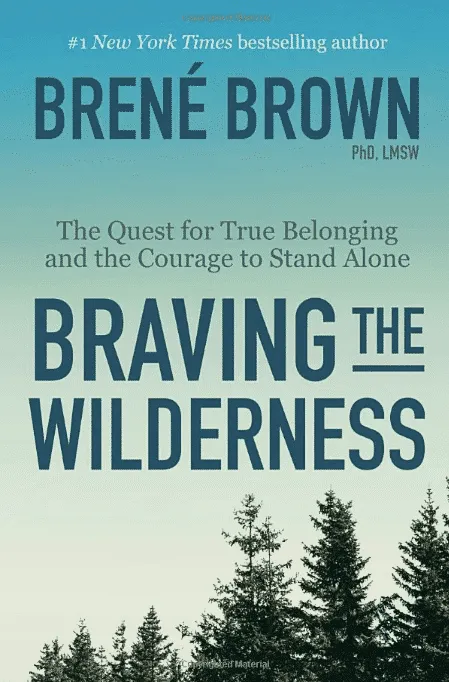
Number-one New York Times best seller
A timely and important new audiobook that challenges everything we think we know about cultivating true belonging in our communities, organizations, and culture, from the number one best-selling author of Rising Strong, Daring Greatly, and The Gifts of Imperfection.
Hello Sunshine book club pick
“True belonging doesn’t require us to change who we are. It requires us to be who we are.” Social scientist Brené Brown, PhD, LMSW, has sparked a global conversation about the experiences that bring meaning to our lives - experiences of courage, vulnerability, love, belonging, shame, and empathy. In Braving the Wilderness, Brown redefines what it means to truly belong in an age of increased polarization. With her trademark mix of research, storytelling, and honesty, Brown will again change the cultural conversation while mapping a clear path to true belonging.
Brown argues that we’re experiencing a spiritual crisis of disconnection, and introduces four practices of true belonging that challenge everything we believe about ourselves and each other. She writes, “True belonging requires us to believe in and belong to ourselves so fully that we can find sacredness both in being a part of something and in standing alone when necessary. But in a culture that’s rife with perfectionism and pleasing, and with the erosion of civility, it’s easy to stay quiet, hide in our ideological bunkers, or fit in rather than show up as our true selves and brave the wilderness of uncertainty and criticism. But true belonging is not something we negotiate or accomplish with others; it’s a daily practice that demands integrity and authenticity. It’s a personal commitment that we carry in our hearts.”
Brown offers us the clarity and courage we need to find our way back to ourselves and to each other. And that path cuts right through the wilderness. Brown writes, “The wilderness is an untamed, unpredictable place of solitude and searching. It is a place as dangerous as it is breathtaking, a place as sought after as it is feared. But it turns out to be the place of true belonging, and it’s the bravest and most sacred place you will ever stand.”
There is a particular kind of loneliness that comes not from being alone, but from being surrounded by people and still feeling like you do not belong. Brené Brown has spent decades studying vulnerability, shame, and human connection. In Braving the Wilderness, she turns her lens toward something even more elusive than connection: true belonging. Not the counterfeit version where you shrink yourself to fit in, not the performance of belonging that requires you to abandon your own truth, but the fierce, independent kind of belonging that begins inside you and radiates outward. This is a book about courage in the deepest sense — the courage to stand alone, the courage to disagree publicly and remain in relationship, the courage to be fully human in a world that increasingly rewards tribalism and punishes nuance.
Brown opens with a paradox that most of us have felt but never named: the more we seek belonging, the less of it we find. When belonging becomes conditional — when it requires agreement, performance, or silence — it stops being belonging at all. It becomes belonging-shaped loneliness. The research she presents is sobering. Rates of loneliness have doubled in the United States since the 1980s. More people report having no close friends today than at any measured point in recent history. Community structures that once anchored identity — churches, labor unions, neighborhood associations, civic organizations — have eroded with startling speed. And into that vacuum has rushed social media, offering the appearance of connection while quietly intensifying the very disconnection it pretends to solve.
The book is not abstract. Brown roots her arguments in specific research, in stories gathered from thousands of interviews over many years, and in her own biography as someone who has experienced both the seduction of tribal belonging and the harder, more sustaining rewards of the wilderness. She is not writing from a position of having solved this problem. She is writing as someone who is still working it out, which is part of what makes the book trustworthy. The hard-won quality of her insights is evident on every page.
The Wilderness as Metaphor and Reality
The central metaphor of this book is the wilderness — not as a place of punishment or exile, but as a place of truth. Brown draws on the image across spiritual and literary traditions: the desert fathers who went out from cities to find themselves in solitude, Thoreau at Walden Pond seeking the essential facts of life stripped of social convention, the hero’s journey into the unknown that appears in every culture’s mythology. In all these traditions, the wilderness is where transformation happens. It is where you discover who you are when the usual social scaffolding falls away. It is uncomfortable. It can be terrifying. But it is also where genuine selfhood becomes possible, perhaps for the first time.
The people Brown identifies as “wilderness walkers” are those who have stopped outsourcing their sense of belonging to groups, ideologies, or approval. They have an internal compass rather than an external GPS. They can hold complexity without rushing to resolve it into false clarity. They can sit with uncertainty without numbing it through ideology or certainty-performance. They can be in a room full of people who disagree with them and still feel rooted in themselves. This is not the same as not caring what others think. It is not indifference or stoicism performed as armor. It is something richer: a deep enough sense of self that external validation, while pleasant, is not structurally necessary for functioning and for flourishing.
This resonates deeply with the kind of resilience we explore throughout this site. True psychological strength is never about being unaffected by others. It is not about achieving some impossible hermetic self-sufficiency. It is about not being destabilized by the absence of approval. The wilderness walker is not cold. She is not detached from the human world. She is simply grounded in something the crowd cannot give or take away, and that groundedness is what allows her to engage with the crowd fully and honestly rather than spending her energy managing its impressions of her.
Brown traces her own wilderness experience through a period of professional and personal upheaval following a vulnerability research talk that went unexpectedly viral. Suddenly receiving vast amounts of public attention — both adoring and hostile — she found herself confronted with a choice that many people never face as acutely: whose opinion of you actually matters? Not in the abstract, but in practice, when you have to decide whether to publish the next book, make the next statement, take the next risk. The crowd cannot be the answer. The crowd is too large, too contradictory, too ready to turn. But if not the crowd, then what? Her answer is the wilderness: the practice of becoming enough of a self that the crowd becomes interesting rather than defining.
Fitting In Is the Opposite of Belonging
One of Brown’s most clarifying and counterintuitive distinctions is between fitting in and belonging. Fitting in, she argues, is not a path to belonging. It is the greatest barrier to it. Fitting in requires assessment: What does this group believe? What do they value? What do they despise? Who do they consider an enemy? What signals of loyalty do they require? Then it requires adjustment: modify yourself to match, hide what does not fit, amplify what will be rewarded. The problem is not just that this process is exhausting, though it is profoundly exhausting over time. The problem is that it is a form of self-abandonment. And when you have abandoned yourself to gain acceptance, you know — somewhere beneath the surface, in the place that cannot be fooled — that the acceptance is not for you. It is for the performance of you. This is the precise mechanism behind belonging-shaped loneliness. You are surrounded by people who like your performance, and you are utterly alone.
Belonging, by contrast, requires showing up as yourself and being received. Not the performance of yourself — not the edited, optimized, crowd-calibrated version — but the actual you, with your actual opinions, your actual doubts, your actual history, your actual ambivalence. This requires real risk, not the simulated risk of controlled vulnerability performed for social reward. You might show up as yourself and be rejected. The people you have been performing for might not want the actual you. This is the paradox that Brown returns to throughout the book: the path to genuine belonging runs directly through the territory of possible rejection. There is no route around it. You cannot be truly accepted unless you are truly seen, and being truly seen always involves the possibility of being truly dismissed.
Brown spent years watching people try to resolve this paradox through group identity. They found belonging in political tribes, in ideological movements, in religious communities organized around certainty, in fandom cultures, in any group defined clearly enough by shared beliefs and shared enemies that membership felt like safety. The problem is that this kind of belonging is always conditional on continued loyalty. The belonging is to the group, not to you as an individual. Stray from the tribe’s positions on any significant issue and you will feel the withdrawal of that warmth immediately and completely. Tribal belonging is not really belonging at all. It is compliance with a continuous loyalty test, dressed up in the language of community and solidarity.
The particularly insidious feature of tribal belonging is that it gets harder to leave the longer you stay. The longer you have performed agreement, the more your actual views have been shaped by that performance. The psychological literature on cognitive dissonance shows that we tend to bring our beliefs into alignment with our stated positions over time. If you have been performing certainty about a set of beliefs for years, the performance begins to feel like genuine conviction. The cost of leaving the tribe escalates because leaving now means admitting not just to having been wrong about the beliefs, but about having spent years in self-deception. Most people find that price too high, and so they perform harder, believe more aggressively, and become more hostile to anyone who might remind them that alternatives exist outside the tribal frame.
The Four Practices of True Belonging
Brown identifies four practices that define the wilderness walkers — people who have moved toward true belonging rather than its various counterfeits. She presents these not as personality traits you either have or lack, not as fixed features of character, but as learnable practices. This framing matters enormously. It shifts the frame from identity to behavior. You are not either a brave person or a coward. You are not either someone who belongs or someone who does not. You are someone who sometimes practices courage and sometimes practices avoidance, someone who sometimes practices belonging and sometimes practices performance. The question is which you choose to practice more consistently, and whether you are honest with yourself about which you are doing at any given moment.
The first practice is people are hard to hate close up — move in. This is about the mechanics of dehumanization and the corrective of proximity. Brown argues that dehumanization — the reduction of actual complex human beings to categories, stereotypes, threats, and enemies — is always a failure of imagination. Specifically, it is the failure to imagine another person’s interior life: the full complexity of their history, their fears, their loves, their reasoning, however flawed that reasoning might be. The solution she proposes is not to argue against dehumanization abstractly, which rarely works because it does not address the underlying cognitive and emotional mechanisms. The solution is to move closer to actual human beings. To listen to individual stories rather than consuming group summaries. To let the specific displace the categorical. This is not naive. It is not an instruction to have warm feelings for everyone or to pretend that harmful beliefs are not harmful. It is the recognition that hatred at scale requires distance, and that distance is always partly a choice, even when it is a choice made under social pressure.
The second practice is speak truth to bullshit, be civil. This cuts against two dominant cultural currents simultaneously, which is part of what makes it worth paying close attention to. On one side is the culture of conflict avoidance — the niceness that lets bad ideas go unchallenged in the name of keeping the peace, the politeness that silences genuine disagreement in favor of performed harmony. This is not civility. It is cowardice wearing civility’s clothes. On the other side is the culture of performative outrage — the cruelty that mistakes volume for honesty and contempt for conviction, that treats vicious personal attack as the highest form of social engagement. Brown argues for the harder middle path: honest disagreement conducted without contempt. You can tell someone their argument is wrong without treating them as less than human. You can name what is false, call out what is harmful, refuse to pretend that everything is fine — while doing so in a way that preserves the possibility of continued relationship and continued dialogue. This requires more skill than either capitulation or assault. It requires self-regulation under pressure, which is one of the hardest skills a human being can develop.
The third practice is hold hands with strangers. This is about what Brown calls “common humanity moments” — experiences that crack open the private isolation of modern life by making visible, in the most immediate and visceral way, that your suffering and your joy are not unique, that you are not alone in feeling what you feel. Collective experiences of grief, collective celebration, the shared experience of witnessing something extraordinary together — these can produce a felt sense of connection that no individual relationship, however deep, can fully replicate. They remind us that we are part of something larger, that the thread of our individual life is woven into a fabric that extends well beyond our personal networks. Brown is careful not to collapse this into sentimentality. The claim is not that strangers are secretly all wonderful. The claim is that shared humanity, directly experienced, is one of the most powerful antidotes to the tribalism that makes us treat strangers as threats to be managed rather than humans to be known.
The fourth practice is strong back, soft front, wild heart. This is perhaps the most personal and most powerful of the four. Strong back means the clarity and groundedness that comes from knowing your values clearly and living in accordance with them consistently. It is not rigidity — the kind of brittle hardness that shatters under pressure. It is a flexible strength that allows you to move and bend without losing your center. Soft front means staying emotionally open, refusing to close yourself off from life’s impact, being willing to be moved by what is moving and to be genuinely vulnerable to what is genuinely risky. The common failure Brown observes is that when people feel the need for a strong back — when they face criticism, conflict, or the need to hold their ground under pressure — they close their front as well. They armor up completely. They mistake hardness for strength, emotional unavailability for composure. The wilderness walker knows that you can be simultaneously strong and open. The wild heart is the capacity that holds this paradox together: the capacity to be fully human, to be alive to both the beauty and the pain of existence, to refuse the false choice between safety and aliveness.
The Loneliness Epidemic: Data and Causes
Brown dedicates substantial space to the loneliness epidemic, and the data she marshals is genuinely alarming. Former U.S. Surgeon General Vivek Murthy declared loneliness a public health epidemic. The research of John Cacioppo, who spent decades studying loneliness at the University of Chicago, shows that chronic loneliness is as damaging to physical health as smoking fifteen cigarettes a day. Lonely people show elevated cortisol levels, disrupted sleep architecture, suppressed immune function, accelerated cognitive decline, and dramatically elevated mortality risk compared to well-connected people. The body, it turns out, treats social disconnection as a physical threat — which makes evolutionary sense, since for most of human history, exclusion from the group was effectively a death sentence. The problem is that we have built a society that systematically produces this felt threat in a large and growing fraction of its population, and then treats the resulting health crisis as a personal failing rather than a collective one.
What is driving this epidemic? Brown identifies several forces, and she is careful not to reduce them to a single villain. Social media is the most obvious target and the most complicated one. The research she surveys is more nuanced than popular discourse suggests. Social media is not uniformly destructive to human connection. The question is how it is used. Passive consumption — scrolling through feeds, comparing your interior life to others’ highlight reels, watching others’ curated presentations of happiness and success — consistently increases loneliness and decreases wellbeing. Active use — reaching out to specific people you know, engaging in genuine back-and-forth exchange, using platforms as a tool to deepen existing relationships rather than as a substitute for them — can actually support connection. The problem is that passive consumption is precisely what the platforms are designed to maximize, because it generates more advertising revenue than active connection does. The incentive structure of the platforms is systematically misaligned with the wellbeing of the people using them.
But the loneliness epidemic precedes social media, and its causes run deeper than any single technology. Brown points to a broader cultural crisis: the systematic dismantling of the conditions that make genuine community possible. Geographic mobility for work has increased dramatically, which means people routinely sever the community roots that take years to grow. Urban design has optimized for automobiles and away from the pedestrian environments where casual, repeated contact with neighbors gradually builds the social infrastructure of belonging. Work hours have expanded and leisure time has contracted, leaving less space for the unprofitable activities — conversation, volunteering, religious participation, simple leisure in public spaces — that generate social capital. And perhaps most fundamentally, the cultural story we tell about the good life has become increasingly individualistic: the goal is personal success, personal fulfillment, personal achievement. The commons — what we share, what we owe to one another, what we can only create together — has become an afterthought in a culture that celebrates the self-made individual above all.
Spiritual Crisis and the Hunger for Meaning
Brown makes a move that is relatively unusual in the business-psychology genre: she takes the spiritual dimension of human experience seriously as a genuine dimension of belonging. She uses the word “spirituality” carefully, defining it not in a sectarian religious sense but as the recognition of what she calls “inextricable connection” — the felt sense that you are part of something larger than yourself, that your life is not a sealed unit but a thread in a larger fabric, that other people’s suffering and joy are not entirely separate from your own. This is not a claim about theology. It is a claim about a category of human experience that is both real and important, and that modern secular culture has largely failed to provide adequate language for or adequate substitutes to.
The loss of this sense of inextricable connection, Brown argues, is part of what drives both the loneliness epidemic and the tribalism that attempts to compensate for it. When people feel cut off from any sense of larger meaning — when life feels like a purely individual project of survival, consumption, and status competition — they are vulnerable to ideologies and movements that offer dramatic substitutes. Belonging to a movement, to a cause, to a crusade gives life a significance that ordinary disconnected life cannot provide. The enemy gives you clarity of purpose. The tribe gives you identity. The struggle gives you meaning. The problem is not the hunger for meaning and purpose — that hunger is legitimate and important. The problem is when that hunger gets channeled into forms that require enemies, that require dehumanization, that produce cohesion through contempt rather than through genuine connection and genuine love.
The alternative Brown suggests is to find meaning and connection in ways that do not require enemies. In service to specific people whose faces you can see. In creative work that requires your full presence and rewards genuine attention. In genuine relationships that survive disagreement and deepen through honesty. In the practice of paying careful attention to what is actually happening, in your own life and in the world, rather than to the story your tribe tells about it. This is quieter than crusading. It is less urgent, less vivid, less intoxicating. But it is also more durable, more honest, and more genuinely nourishing over the long term.
Courage as Practice: The BRAVING Inventory
The word “braving” in the title is a gerund, a present participle — an ongoing action, not a completed state. You do not arrive at bravery and then possess it forever. You practice it, repeatedly, in specific situations, with specific people, at specific costs. Brown identifies what she calls the BRAVING inventory — a framework for understanding trust-based relationships that doubles as a map of the internal relationship we have with ourselves.
The seven elements of BRAVING are Boundaries — being clear about what is acceptable and what is not, and honoring your own limits even when it is inconvenient; Reliability — doing what you say you will do, consistently and without exception; Accountability — owning your mistakes, apologizing genuinely, and making amends without excessive self-flagellation; Vault — keeping confidences, not sharing what was shared in trust, not using others’ vulnerabilities against them; Integrity — choosing what is right over what is comfortable, practicing your values rather than just professing them; Non-judgment — being able to ask for and receive help without judgment, and offering others the same freedom; and Generosity — extending the most generous possible interpretation to others’ intentions and actions before assuming the worst of them.
What makes this framework powerful in the context of this book is Brown’s argument that the most important trust relationship you have is the one with yourself. If you routinely violate your own values, make commitments you do not keep, treat your own pain with contempt, and extend to yourself the harshest rather than the most generous interpretation — then you are structurally unable to receive genuine belonging from others. Not because you are unworthy, but because the story you tell yourself about yourself will undermine every experience of connection. You will deflect compliments. You will distrust kindness. You will interpret acceptance as evidence of the other person’s poor judgment rather than as evidence of your worth. You will perform rather than show up, because showing up feels too dangerous when you do not trust yourself to survive the exposure. Self-trust is not narcissism. It is the prerequisite for relational trust, and it is built through the same practices that build any other kind of trust: small consistent actions, honestly taken and honestly evaluated.
The Political Dimension: Belonging and Democracy
Brown does not shy away from the political implications of her research, though she navigates them carefully and without partisan allegiance. The rise of dehumanizing political discourse — present on all sides of the political spectrum, though expressed in different vocabularies — is not, she argues, simply the result of bad people making bad choices. It is the predictable consequence of a society in which genuine belonging has become so scarce that tribal belonging has become the primary substitute available to large numbers of people. When belonging requires enemies, politics becomes a site of belonging by proxy. The political tribe becomes the primary community, and maintaining the tribe’s coherence and emotional intensity becomes more important than truth, more important than the actual wellbeing of the people the tribe claims to represent.
The diagnosis implies a different set of remedies than those usually proposed. If the root problem is a loneliness epidemic that makes people hungry for the intensity of tribal belonging, then the solution is not primarily arguing better on social media or finding more effective messaging. It is rebuilding the conditions for genuine community: the institutions, the physical spaces, the temporal rhythms, the cultural values that make everyday human connection possible. This is both a personal project and a political one. At the personal level, it means prioritizing connection over convenience, investing time in relationships and community in ways that do not have immediate productivity payoffs. At the structural level, it means taking seriously the infrastructure of community as a matter of public health rather than soft sentiment.
What This Means for How You Live
The practical implications of Brown’s research for ordinary life are substantial and specific. The first is to take your own loneliness seriously as a health issue rather than a character flaw. If you are chronically lonely, you are not failing at life. You are experiencing the predictable consequence of living in a society that has systematically dismantled many of the conditions for genuine connection. This framing is not an excuse for passivity. It is a reframe that removes shame from the equation, making constructive action more possible. Shame paralyzes. Understanding mobilizes.
The second implication is to become rigorously honest about which of your current senses of belonging are genuine and which are performances. Not to blow them all up immediately, but to see them clearly for what they are. Where are you fitting in rather than belonging? Where are you performing agreement rather than expressing actual views? Where are you accepting conditional acceptance as a substitute for the real thing? This kind of honest inventory is uncomfortable. Most people prefer not to do it. But the discomfort of clear seeing is always preferable to the ongoing dull pain of performed belonging that never quite fills the hunger it pretends to satisfy.
The third implication is to practice the courage of honest disagreement with people you know. Not the cheap courage of anonymous online contempt — that costs nothing and produces nothing useful. The genuine courage of saying what you actually think to someone who knows you, in a way that respects their humanity while not pretending to agreement you do not feel. This is where most people fail, in one direction or the other. Most people are either too conflict-avoidant to disagree, or too contemptuous when they do. The skill being asked for is disagreement conducted with both honesty and care, both clarity and respect. It is genuinely hard. It requires sustained practice. It is also one of the most important things you can do for the health of any relationship you actually value.
The fourth implication, perhaps the most important, is to invest in the interior work that makes the external work possible. This means developing a relationship with yourself that is honest, compassionate, and grounded in actual values rather than performed values. It means knowing what you actually believe, what you actually need, what actually matters to you — and then living in accordance with that knowledge even when it means standing alone. Not as a performance of independence, not to be contrarian for its own sake, but because the alternative is the particular hollowness of a life shaped entirely by others’ expectations and calibrated entirely to their approval. That hollowness is the first domino in the cascade that ends in belonging-shaped loneliness. Stop it there, at the source, and you have a chance at something real.
What the Framework Misses
Brown’s work is consistently valuable, and this book is no exception. But honest engagement requires naming where the frame has limitations. The emphasis on individual practices of courage and belonging, while necessary and true, can obscure the structural conditions that make belonging harder for some people than for others. For a person who belongs to a marginalized group, the wilderness that Brown describes as a path to self-knowledge involves real risks that her framework does not fully account for. The cost of showing up as yourself is not the same for everyone. The person whose authentic self is legible to the dominant culture pays a different price for authenticity than the person whose authentic self is likely to be met with hostility, erasure, or worse. Brown acknowledges this, but the acknowledgment feels somewhat glancing given the weight of the evidence about how unequally the costs of authenticity are distributed.
There is also a tension in the book between the call for individual courage and the recognition that this courage is only possible under certain conditions. Brown notes that belonging requires vulnerability, that vulnerability requires safety, and that safety is not equally available to everyone. This does not invalidate her framework, but it does suggest that the work of creating conditions for genuine belonging is not only individual interior work but also structural work — political, economic, and social in character. The wilderness may be where individuals find themselves, but the conditions that make the wilderness survivable are collective achievements that require collective effort to maintain and extend to more people.
These are not fatal objections. They are the objections of a reader who takes the book seriously enough to push against it. Brown is not writing a political manifesto, and it would be unfair to fault her for not writing one. She is writing about what individuals can do, right now, in their own lives and relationships, to move toward more genuine belonging and more authentic existence. On those terms, the book is very good indeed.
The Bottom Line
Belonging is not something that happens to you. It is not a gift bestowed by the right group or the right social circumstances. It is something you practice, from the inside out, with courage as the primary instrument and honesty as the fuel. The wilderness — that place of solitude, uncertainty, and self-confrontation — is not the obstacle to belonging. It is the prerequisite. Until you know who you are when no one is watching, when no crowd is affirming you, when the performance is over and only you remain, you cannot offer yourself genuinely enough to be genuinely received by anyone else.
Brown’s gift in this book is making that difficult truth feel not like a sentence but like an invitation. The wilderness is not where you go when you fail at belonging. It is where you go to discover that you were always enough to belong anywhere — not because you are exceptional, but because you are human, and humanity itself is the only credential that matters in the deepest sense. What is required is not to become someone else, someone better, someone more worthy of love and connection. What is required is to stop hiding the one you already are. That is the whole of the practice. The difficulty and the beauty of it are the same: it never ends, it is always available, and every single moment is a new opportunity to begin.
For anyone who has felt the specific loneliness of a life lived for external approval — the exhaustion of performance, the emptiness of acceptance earned through self-betrayal, the strange isolation of being surrounded by people who like your character but have never actually met you — this book is both mirror and map. The mirror shows you what is happening with unflinching clarity. The map suggests where to walk next. The walking, as always, is yours to do. But it helps enormously to know that the direction you are headed is not away from belonging but toward it, through the only territory where genuine belonging has ever actually been found: the honest, undefended interior of your own life.

