
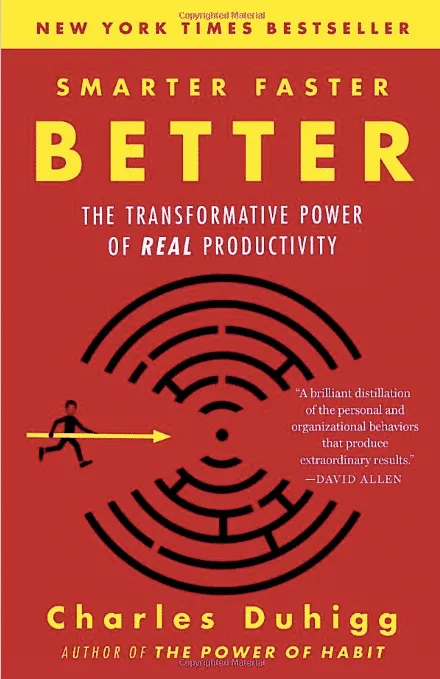
New York Times best seller
From the author of The Power of Habit comes a fascinating book that explores the science of productivity, and why managing how you think is more important than what you think - with an appendix of real-world lessons to apply to your life. At the core of Smarter Faster Better are eight key productivity concepts - from motivation and goal setting to focus and decision making - that explain why some people and companies get so much done.
Drawing on the latest findings in neuroscience, psychology, and behavioral economics - as well as the experiences of CEOs, educational reformers, four-star generals, FBI agents, airplane pilots, and Broadway songwriters - this painstakingly researched book explains that the most productive people, companies, and organizations don’t merely act differently. They view the world, and their choices, in profoundly different ways.
A young woman drops out of a PhD program and starts playing poker. By training herself to envision contradictory futures, she learns to anticipate her opponents’ missteps - and becomes one of the most successful players in the world. A group of data scientists at Google embark on a four-year study of how the best teams function, and find that how a group interacts is more important than who is in the group - a principle, it turns out, that also helps explain why Saturday Night Live became a hit. A Marine Corps general, faced with low morale among recruits, reimagines boot camp - and discovers that instilling a “bias toward action” can turn even the most directionless teenagers into self-motivating achievers.
The filmmakers behind Disney’s Frozen are nearly out of time and on the brink of catastrophe - until they shake up their team in just the right way, spurring a creative breakthrough that leads to one of the highest-grossing movies of all time. What do these people have in common? They know that productivity relies on making certain choices.
The way we frame our daily decisions; the big ambitions we embrace and the easy goals we ignore; the cultures we establish as leaders to drive innovation; the way we interact with data: These are the things that separate the merely busy from the genuinely productive. In The Power of Habit, Pulitzer Prize-winning journalist Charles Duhigg explained why we do what we do.
In Smarter Faster Better, he applies the same relentless curiosity, deep reporting, and rich storytelling to explain how we can improve at the things we do. It’s a groundbreaking exploration of the science of productivity, one that can help anyone learn to succeed with less stress and struggle, and to get more done without sacrificing what we care about most - to become smarter, faster, and better at everything we do.
Charles Duhigg spent four years investigating why some people, teams, and organizations are dramatically more productive than others. Not in the self-help sense of “productive” — getting more tasks done per hour — but in the deeper sense: why some people consistently produce work that matters, solve problems that others cannot solve, make better decisions under uncertainty, and sustain high performance across long periods without burning out, while others with comparable intelligence, comparable resources, and comparable effort produce consistently mediocre results.
The answer he found was not a set of time management techniques or a morning routine protocol. It was a set of cognitive habits — specific ways of engaging with information, making decisions, managing attention, and constructing mental models — that determine whether the effort a person invests in their work produces the results that effort deserves. Smarter Faster Better: The Secrets of Being Productive in Life and Business is the documentation of those cognitive habits, built on research across fields as different as military command, animated film production, acute care nursing, and professional gambling.
The book follows the model Duhigg established in The Power of Habit: each chapter anchors the research in a specific story — a cockpit crisis, a hospital patient’s near-death, a failed Pixar project, the build-up to a military disaster — and uses that story to illustrate a principle that is then developed through the underlying science. The result is a book that reads like a collection of well-crafted narrative essays, each of which delivers a research-grounded insight that the narrative makes viscerally real in a way that abstract argument cannot.
Smarter Faster Better is not primarily about doing more. It is about doing what matters, more effectively. The distinction is important and underappreciated. Busyness is not productivity. Activity is not achievement. The person who works seventy hours a week and produces very little output is not less productive than they could be because they need better time management. They are less productive because they are not engaging with their work in the ways that convert effort into genuine output. Duhigg’s research identifies what those ways are — and why they are rarer than they should be.
Motivation: The Internal Locus
The first and most fundamental element of productivity that Duhigg examines is motivation — specifically, the question of why some people sustain high performance motivation across long periods while others struggle to maintain engagement even with work they have chosen and ostensibly enjoy. The answer comes from research on what psychologists call the locus of control.
Locus of control refers to the degree to which a person believes that their actions determine their outcomes. People with an internal locus of control believe that what they do matters — that their choices, their effort, and their decisions have a meaningful influence on the results they produce. People with an external locus of control believe that outcomes are primarily determined by factors outside their control — luck, other people’s decisions, the system, the market. The research on locus of control and productivity is unambiguous: internal locus of control is strongly associated with higher performance, greater persistence through difficulty, better decision-making under uncertainty, and higher long-term achievement across virtually every domain studied.
The mechanism is straightforward. If you believe your actions matter, you invest more effort in making better choices, because the quality of your choices has consequences. If you believe outcomes are primarily determined by factors outside your control, the rational strategy is to minimize effort and manage your expectations, because investment does not improve outcomes. Internal locus of control creates the motivational structure for genuine productivity. External locus of control creates a learned helplessness that progressively undermines it.
But Duhigg adds a critical nuance that the standard locus of control literature often misses: internal locus of control is not simply a stable personality trait that people either have or lack. It is a cognitive habit that can be strengthened or weakened by specific experiences, specific framings of situations, and specific choices about how to interpret the relationship between action and outcome. The most important of these is what Duhigg calls the “self-motivation” practice: deliberately looking for ways in which the decisions made within a task — however constrained the overall task may be — are genuine choices made by the person doing the work.
The research Duhigg cites is striking. When Marine recruits at Parris Island are taught to frame their training as a series of choices they are making — rather than as a series of orders they are following — their long-term training performance and post-training effectiveness improve significantly. The content of the training does not change. The degree of external constraint does not change. What changes is the recruit’s cognitive relationship to the work: they shift from experiencing themselves as objects of a process to experiencing themselves as agents within it. That shift has measurable consequences for motivation and performance.
Teams: Why Psychological Safety Is the Variable That Matters
Duhigg’s chapter on team productivity, anchored in Google’s landmark Project Aristotle research, is perhaps the most important section of the book for anyone who works in or leads organizational teams — which is to say, for almost everyone with a professional career.
Google spent several years trying to understand why some of its teams dramatically outperformed others. They had data on hundreds of teams, and they examined every variable they could measure: team composition by personality, educational background, and professional experience; the frequency and quality of social interaction between team members outside of work; the communication patterns within team meetings; the distribution of task specializations; the team size and structure. None of these variables predicted team performance with any consistency.
What ultimately explained the variance was a concept they borrowed from the research of Harvard Business School professor Amy Edmondson: psychological safety. Teams that outperformed were teams in which members felt safe to take interpersonal risks — to ask questions without fear of appearing incompetent, to propose ideas without fear of ridicule, to admit mistakes without fear of punishment, to disagree with the prevailing view without fear of social exclusion. Teams where these risks were present systematically underperformed, regardless of the individual talent of their members.
The mechanism is not complicated. The cognitive capacity that individuals can bring to a team task is fixed. But the proportion of that cognitive capacity that is actually available for the task depends on how much of it is being consumed by social management — by monitoring for signs of disapproval, by calibrating speech to avoid judgment, by managing the anxiety of operating in an environment where errors have social consequences. In high psychological safety environments, most of the team’s cognitive capacity is directed at the problem. In low psychological safety environments, a significant proportion of it is directed at managing the social environment. The result is a systematic performance difference that has nothing to do with individual intelligence or effort.
The practical implications are significant. Psychological safety is not primarily determined by team composition — by whether the right personalities were assembled. It is primarily determined by the behavioral norms that develop through the team’s interaction, and those norms are heavily influenced by the behavior of the team leader. Leaders who model intellectual humility — who ask questions, acknowledge uncertainty, and treat disagreement as information rather than challenge — create norms that allow psychological safety to develop. Leaders who perform certainty, punish errors, and respond to challenge defensively create norms that systematically destroy it, regardless of the individual capability of the people they are leading.
Focus: The Construction of Mental Models
The focus chapter in Smarter Faster Better addresses one of the most practically important cognitive skills for knowledge work: the ability to maintain effective attention in the presence of the specific kind of distraction that cognitive neuroscience calls “attentional tunneling” — the failure mode in which intense focus on a specific task causes the mind to miss crucial information that exists at the periphery of that task.
Duhigg illustrates this through the investigation of Air France Flight 447, which crashed into the Atlantic Ocean in 2009, killing all 228 people on board, despite having an experienced crew and functioning aircraft. The technical cause of the crash was a brief sensor failure that caused the autopilot to disengage. But the operational cause — the reason the crew was unable to recover the plane during the four minutes between the autopilot disengagement and the crash — was attentional tunneling: the pilot flying the plane became so focused on the specific problem indicated by the cockpit warnings that he failed to process the broader picture of what was happening to the aircraft. He responded to the most immediate alarm without maintaining the larger situational awareness that would have revealed the simple aerodynamic error at the root of the crisis.
The cognitive science of attentional tunneling is well established. When a situation generates high anxiety or high urgency, attention narrows. The processing capacity that would normally be available for broader situational awareness gets concentrated on the most immediate and most alarming element of the situation. This is adaptive in some contexts — genuine emergencies sometimes require tunnel focus on a single critical action. But in complex systems where multiple variables interact — cockpits, emergency rooms, trading floors, operating theaters — it produces the specific failure mode of missing crucial information that was present and visible but not in the focus of the tunnel.
The solution Duhigg identifies, drawn from research on high-performing pilots, nurses, and military commanders, is the practice of building and maintaining a detailed mental model of the situation — a comprehensive picture of the current state of the system that is actively updated as conditions change. Pilots who survive emergencies that kill crews with equivalent training and experience are not primarily distinguished by their technical skill. They are distinguished by the habit of maintaining an active, detailed situational model — of continuously asking themselves what the current state is, what the next critical event will be, and what their plan is for each possible development.
The same habit is what distinguishes the best nurses, the best emergency physicians, the best military commanders, and — Duhigg argues — the most effective knowledge workers. The productive person is not simply the one who works hard on their current task. They are the one who maintains an active, continuously updated model of where their current task fits in the larger context of their project, their priorities, and their organization — and who uses that model to direct their attention to the most consequential elements of the work rather than the most immediately urgent ones.
Goal Setting: Stretch Goals and the SMART Trap
The goal-setting chapter delivers one of the book’s most practically useful and genuinely counterintuitive insights. The SMART goal framework — Specific, Measurable, Achievable, Realistic, Time-bound — is one of the most widely taught and widely used frameworks in organizational management and personal productivity. It is also, Duhigg argues, fundamentally incomplete in a way that causes significant performance problems when used without modification.
The research on stretch goals — goals that are large enough to be genuinely challenging, that require significant capability development or creative problem-solving to achieve, and that exceed what the current approach can deliver — shows consistently that stretch goals outperform SMART goals in producing genuine breakthrough performance. A team given a 10% improvement target typically achieves approximately 10% improvement by optimizing the current approach. A team given a 40% improvement target — one that is too large to be achieved through optimization of the current approach — is forced to rethink the approach entirely, which sometimes produces the breakthrough needed to achieve the goal and sometimes produces a learning failure that still advances the team’s capability more than the incremental success would have.
The problem is that stretch goals without SMART subgoals produce either paralysis or recklessness. The goal of “become world-class at X” — without specific near-term milestones and feedback mechanisms — is motivating in the abstract but produces no actionable daily direction. The solution Duhigg identifies is a hierarchical combination: stretch goals at the level of ultimate ambition, SMART goals at the level of specific near-term actions. The stretch goal provides the direction and the aspiration. The SMART goals provide the traction — the specific, measurable, achievable, time-bound actions that make progress toward the stretch goal concrete and actionable on a daily basis.
This two-tier structure is what Angela Duckworth’s goal hierarchy describes, what organizational theorists call “big hairy audacious goals” combined with quarterly operational objectives, and what any high performer who has thought carefully about how they set goals has arrived at through experience. Duhigg’s contribution is the research foundation that explains why this structure works: the stretch goal activates the cognitive and motivational resources needed for genuine breakthrough; the SMART subgoals provide the specific, feedback-rich practice that makes progress possible day to day.
Managing Others: Trusting Teams With Autonomy
The chapter on managing others addresses what organizational research consistently identifies as one of the most consequential variables in organizational performance: the degree to which employees have genuine autonomy — real decision-making authority over their work, not the performative autonomy of being told they have latitude while having every significant decision reviewed and revised by management.
Duhigg profiles the General Motors NUMMI plant — a joint venture with Toyota in Fremont, California, that took the same workforce that had been the worst-performing in the GM system and transformed it into one of the best-performing manufacturing operations in the country. The workers did not change. The facility did not change. What changed was the management system: Toyota’s production system gave individual workers the authority to stop the entire production line when they identified a quality problem, and to participate in teams that had genuine decision-making power over how their work was organized and executed.
The psychological effect of genuine autonomy on performance is now well-documented. People who have real authority over their work invest more fully in it — because it is genuinely theirs, because the quality of their decisions has real consequences, and because the experience of agency is intrinsically motivating in a way that externally directed work cannot be. The NUMMI workers who had spent years as disengaged clock-watchers in the old GM management system became active problem-solvers and quality advocates in the Toyota system — not because their personalities changed, but because the system gave them a genuine stake in the outcomes of their decisions.
The management practice that Duhigg derives from this research is demanding in a specific way. Trusting teams with genuine autonomy requires managers to tolerate the discomfort of watching people make decisions that the manager would have made differently — and to provide support and guidance without substituting their own judgment for the team’s judgment except in genuine emergencies. This is harder than it sounds. The manager who believes they would have made a better decision has to resist the pull to override, because the long-term cost of overriding — the erosion of the team’s sense of genuine ownership — is higher than the short-term cost of the suboptimal decision.
Decision Making: Probabilistic Thinking
The decision-making chapter, anchored in the story of professional poker player Annie Duke and the research program of a team of intelligence analysts at the CIA and the Good Judgment Project, addresses the cognitive skill that most separates effective decision-makers from ineffective ones: the ability to think probabilistically about uncertain outcomes.
Most people make decisions as if the outcomes they are choosing between are binary: this will work or it won’t, this is true or it isn’t, this person is trustworthy or they aren’t. This binary framing is cognitively efficient but consistently misleading. Almost all the decisions that matter in professional and personal life involve outcomes that are uncertain, with probabilities that range across a spectrum rather than collapsing to zero or one. The decision-maker who thinks about these outcomes in binary terms is systematically failing to use the information available to them.
The Good Judgment Project, a research program that recruited thousands of forecasters to make predictions on geopolitical events, identified a small group of “superforecasters” — people whose predictions consistently outperformed intelligence analysts with access to classified information, professional experts in the relevant domains, and the general population. What distinguished the superforecasters was not superior domain knowledge or access to better information. It was a specific cognitive habit: they thought about their predictions in explicit probability terms, they updated those probability estimates regularly as new information arrived, and they maintained a detailed record of their predictions and outcomes that allowed them to calibrate their confidence levels against their actual accuracy rates over time.
The application of this cognitive habit to everyday professional decision-making is what Duhigg calls “probabilistic thinking,” and it is one of the most practically transformative practices in the book. Instead of asking “will this work?” ask “what is the probability this will work, and what is my confidence in that estimate?” Instead of planning for a single outcome, plan for a distribution of outcomes and identify in advance what you will do if the less likely outcomes materialize. Instead of evaluating decisions based on their outcomes — which introduces the hindsight bias that corrupts most organizational learning — evaluate them based on whether the reasoning that produced them was sound given the information available at the time.
Innovation: Absorbing Creativity
Duhigg’s chapter on innovation uses the near-failure and eventual triumph of Pixar’s Frozen (actually Frozen was Disney; the Pixar project was a different production) and the story of the Broadway musical West Side Story as windows into the cognitive conditions that enable genuine creative breakthrough — as distinct from the incremental improvement that structured process produces.
The research on creative insight, drawn from the work of cognitive psychologist Mark Jung-Beeman and others, shows that creative breakthroughs are not primarily produced by sustained focused effort. They are produced by a specific alternation between focused effort and diffuse processing — the same basic pattern that Kotler identifies in the flow literature. The focused effort loads the problem. The diffuse processing — which occurs during walks, showers, sleep, and any activity that reduces the focused engagement with the problem — produces the associative connections that appear as insight.
What productive innovators do differently, Duhigg argues, is manage this alternation deliberately. They invest intensely in the problem during focused work, ensuring that the loading is deep enough to give the subconscious processing system substantial material to work with. They then deliberately disengage — creating space for diffuse processing rather than grinding continuously in focused effort. And they capture the outputs of diffuse processing when they occur, treating the random-seeming ideas that arise during walks and showers as potential creative resources rather than distractions. The system for capturing these insights — the notepad by the bed, the voice memo on the phone, the habit of writing down ideas before they evaporate — is not a trivial productivity tip. It is the operational practice that makes the diffuse processing phase productive rather than invisible.
The Integrated Picture of Productivity
Smarter Faster Better is not a book of tips. It is a book about the cognitive infrastructure of high performance — the specific mental habits that determine whether the effort a person invests in their work produces outcomes proportional to that investment. The eight elements Duhigg identifies — motivation through internal locus of control, team performance through psychological safety, focus through active mental modeling, goal-setting through the combination of stretch goals and SMART subgoals, managing others through genuine autonomy, decision-making through probabilistic thinking, innovation through managed alternation between focus and diffusion, and absorbing data through active processing rather than passive reception — are not independent tips to be applied one at a time.
They are components of an integrated cognitive approach to work. The person who has cultivated all eight is not simply better at each element separately. They are qualitatively different in their relationship to difficult work — more capable of engaging with complexity, more resilient in the face of uncertainty, more effective at converting effort into output, and more sustainable over long periods because their work is organized around genuine engagement rather than anxious busyness.
The gap between that person and the average knowledge worker is not a gap of intelligence or talent. It is a gap of cognitive habit — of the specific practices of mental engagement that determine how much of a person’s capability is available for the work they are trying to do. Smarter Faster Better is a map of those habits. The territory is your work, your decisions, your teams, your goals. The map is more useful than it looks.
Absorbing Data: Why More Information Does Not Mean Better Decisions
One of the most counterintuitive chapters in Smarter Faster Better addresses the relationship between data access and decision quality — and finds that more data consistently fails to produce better decisions unless the person processing that data has specific habits for active engagement that transform raw information into actionable insight.
The research Duhigg cites, drawn from studies of nurses, military commanders, and financial analysts, consistently shows that passive reception of data — reading reports, attending briefings, monitoring dashboards — produces far worse decision outcomes than active engagement with data: specifically asking questions before receiving information, forming hypotheses that the data will either confirm or challenge, and deliberately comparing new data against prior mental models to identify the discrepancies that indicate something important is happening.
The most striking illustration is from a study of intensive care unit nurses. The nurses who best predicted adverse patient events — who called for physician intervention at the right time rather than too late — were not the ones who collected the most data. They were the ones who, before entering a patient’s room, would stop and think about what they expected to see, then actively compared what they observed to what they had predicted. When there was a discrepancy — when the patient’s oxygen saturation was slightly lower than expected, or their temperature was trending in an unexpected direction — they treated it as a signal worthy of investigation rather than random variation to be ignored. The nurses who passively received data — who observed without prediction — were less likely to notice the early warnings, even though they were looking at exactly the same information.
This is the cognitive habit Duhigg calls “data absorption” — the practice of engaging with information as an active participant rather than a passive recipient. Before reading a report, ask what you expect it to say. Before a meeting, form hypotheses about what the key issues will be. Before analyzing data, predict what the analysis will show. These predictions do not need to be correct. Their function is to set up the conditions for surprise — to create a mental baseline against which new information can be compared and discrepancies can be detected. The person who approaches data with an active hypothesis is far more likely to notice the important anomaly than the person who approaches it as a blank slate looking for whatever the data reveals.
The organizational implications of this finding are significant. Most information systems — dashboards, reports, briefings — are designed to make information accessible. They are not designed to make it absorbed. The best briefing in the world fails if the recipient receives it passively, without the active engagement that converts information into understanding. Designing organizational communication to include the elements that support active data absorption — explicit framing of what the audience is expected to predict, deliberate attention to discrepancies between expectations and findings, structured opportunities to surface the anomalies that passive reception would miss — is one of the highest-leverage changes available to any organization that wants to improve its collective decision quality.
The Duhigg Framework in Practice
The practical application of Smarter Faster Better requires more than simply reading and remembering the eight principles. It requires the deliberate development of the cognitive habits that instantiate those principles in the specific texture of daily work. Habits, as Duhigg knows better than most, do not form from information alone. They form from repeated practice in specific situations, driven by specific cues, producing specific rewards. The cognitive habits of highly productive people are not simply things those people know. They are things those people do — automatically, routinely, in response to the specific kinds of challenges that their work regularly presents.
The most important habit to develop first, according to the structure of Duhigg’s argument, is the internal locus of control habit — the practice of identifying, in any situation, the specific choices you have genuine authority over, and treating those choices as genuinely consequential. This habit is foundational because it generates the motivational substrate on which everything else is built. Without the experience of genuine agency in your work, the cognitive tools for improving decision quality, team performance, and creative output are interesting but unmotivating. With it, they become instruments for amplifying an agency you already feel.
The second habit to develop is active mental modeling — the practice of, before beginning any significant task or meeting or review session, explicitly articulating what you expect to happen, what the current state of the relevant system is, and what you plan to do if things develop differently than expected. This habit is quick to establish (it requires perhaps thirty seconds of reflection before each work session) and produces significant returns in attentional quality almost immediately, because it sets up the conditions for noticing the discrepancies and anomalies that passive engagement misses.
The third habit — and the one that most people find most difficult — is the probabilistic framing of decisions. Every time you make a significant choice, try to express your expectations as probabilities rather than binary predictions. Not “this will work” but “I estimate a 70% probability this will work, contingent on the following assumptions.” Not “this person is reliable” but “my current assessment of their reliability has about 80% confidence, based on these three data points.” The precision does not need to be meaningful at first — the cognitive neuroscience of calibration shows that explicit probability training improves over time as predictions are compared against outcomes. The habit of making the uncertainty explicit is what matters initially, because it creates the mental structure for updating estimates as new information arrives rather than defending initial positions.
What This Book Means for Your Career
The most important insight in Smarter Faster Better for anyone who cares about doing significant work over a significant career is the finding that productivity — in the deep sense of producing outcomes that matter — is primarily a function of cognitive habits rather than effort, intelligence, or circumstance. The highly productive people Duhigg profiles are not primarily harder-working or more intelligent than the people around them. They are operating with a different cognitive operating system — one that directs their effort more accurately, engages their attention more fully, uses information more effectively, and organizes their goals in ways that make sustained progress possible rather than grinding and exhausting.
The good news is that cognitive habits are learnable. The research on habit formation, the research on cognitive skill development, and the research on expertise all converge on the same finding: the mental practices of highly productive people are not innate personality traits. They are trained behaviors that most people can develop with deliberate practice and the right environment. The cognitive operating system of the superforecaster, the psychologically safe team leader, the situational-awareness-maintaining pilot can be built by anyone who understands what the target behaviors are and is willing to practice them consistently in the contexts where they matter.
The bad news — and Duhigg is honest about this — is that developing these habits requires exactly the kind of deliberate, uncomfortable, feedback-rich practice that Ericsson’s research identifies as the driver of expertise development. Reading about probabilistic thinking does not make you a probabilistic thinker. Reading about psychological safety does not make you a psychologically safe leader. The cognitive habits that distinguish the most productive people become automatic only through repeated practice in real situations, with real feedback, over time. The book is the map. The practice is the territory. And the territory, as always, is harder than the map makes it look.
The Missing Variable Most Productivity Books Ignore
There is something that makes Smarter Faster Better different from most of the productivity literature it superficially resembles, and it is worth stating explicitly: Duhigg is interested in why people produce work that matters, not just in why they produce more work faster. The productivity he is investigating is not the productivity of the inbox-zero devotee or the four-hour workweek optimizer. It is the productivity of the surgeon who catches the complication others missed, the engineer who finds the solution her team had declared impossible, the team that produced a creative breakthrough that its organization had given up hoping for.
That kind of productivity is not produced by efficiency techniques. It is produced by the quality of engagement — by the depth of attention, the accuracy of mental models, the calibration of uncertainty, the genuine agency of the people doing the work. It is produced, ultimately, by people who are not just working hard but working in a state of genuine cognitive engagement with the problems in front of them — and who have developed the habits that make that state of engagement both more accessible and more durable.
The standard productivity literature — the calendar blocking, the email management, the task batching — addresses the context in which work happens. Duhigg addresses how work is done at the level of cognition and consciousness. Both matter. But the latter is more foundational, and it is the one that fewer books are equipped to address with the combination of research rigor and narrative clarity that makes it actually usable. That is the specific value of Smarter Faster Better: it takes the question of productivity seriously enough to look past the surface of technique into the deeper cognitive habits that determine whether technique translates into genuine output. That look produces insights that are worth every hour of the read.

