
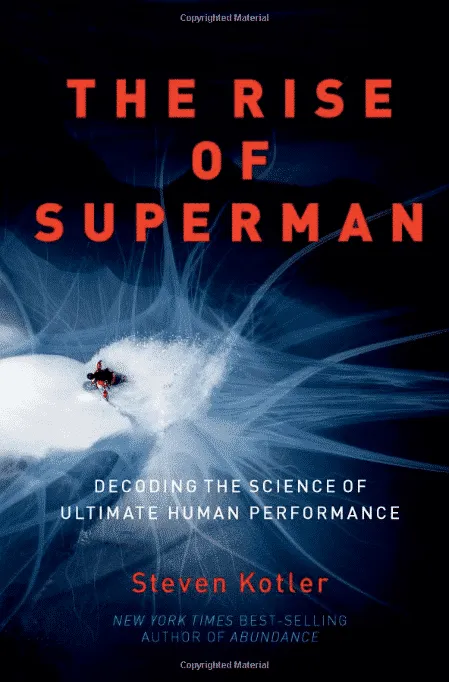
In this groundbreaking audiobook, New York Times best-selling author Steven Kotler decodes the mystery of ultimate human performance. Drawing on over a decade of research and first-hand reporting with dozens of top action and adventure sports athletes like big wave legend Laird Hamilton, big mountain snowboarder Jeremy Jones, and skateboarding pioneer Danny Way, Kotler explores the frontier science of “flow”, an optimal state of consciousness in which we perform and feel our best.
Building a bridge between the extreme and the mainstream, The Rise of Superman explains how these athletes are using flow to do the impossible and how we can use this information to radically accelerate performance in our own lives.
At its core, this is an audiobook about profound possibility; about what is actually possible for our species; about where - if anywhere - our limits lie.
In the first decade of the twenty-first century, something unprecedented happened in extreme sports. Athletes began routinely performing feats that had been considered physically impossible as recently as the 1990s — not by marginal improvements at the edges of human performance, but by leaps so large that they challenged the foundational assumptions of sports science about what human bodies could do. Surfers rode waves that were thought to be unsurvivable. Snowboarders executed aerial sequences that could not have been imagined a decade earlier. Wingsuit pilots flew so close to cliff faces that single feet of clearance became a competitive discipline. Big mountain skiers descended lines that the previous generation of experts had looked at and simply turned around.
The improvement was not gradual. It was discontinuous. And it happened across disciplines simultaneously, which meant that athlete-specific factors — better equipment, more skilled individual athletes, improvements in physical conditioning — could not fully account for it. Something was happening at the level of consciousness, not just capability. Something was changing about the psychological state athletes were achieving during their best performances, and that change was driving performance improvements that physical training alone could not explain.
Steven Kotler spent seven years embedded in the extreme sports community trying to understand what that something was. The result is The Rise of Superman: Decoding the Science of Ultimate Human Performance, the most rigorous examination of flow state as a driver of human achievement yet written — a book that synthesizes neuroscience, cognitive psychology, and the lived experience of the world’s most extreme athletes into a framework that has implications not just for performance sports but for any human endeavor that requires operating at the edge of capability.
The answer Kotler found was flow. Not flow in the casual sense of being absorbed in work. Flow in the specific technical sense defined by psychologist Mihaly Csikszentmihalyi — the state of optimal experience characterized by total absorption, effortless concentration, the loss of self-consciousness, altered time perception, and intrinsic reward — had become, in the extreme sports community, not a rare bonus state but a systematically pursued performance technology. The athletes who were rewriting the history books were not just fitter or more skilled than their predecessors. They were better at accessing and sustaining the neurological state that unlocks the highest levels of human capability.
What Flow Actually Is: The Neuroscience
Csikszentmihalyi first described flow in his 1990 book of the same name, drawing on decades of research with chess players, surgeons, rock climbers, and artists. His initial definition — the state in which people are so fully absorbed in a challenging activity that everything else falls away — captured the phenomenology of the experience but said relatively little about the underlying neuroscience. What Kotler brings to The Rise of Superman is a detailed account of what is actually happening in the brain during flow, drawing on the neuroimaging research that has accumulated over the two decades since Csikszentmihalyi’s original work.
The most striking finding from flow neuroscience is what researchers call transient hypofrontality. During flow, large portions of the prefrontal cortex — the region responsible for self-monitoring, critical evaluation, worry, second-guessing, and the inner critic that second-guesses every decision — go temporarily offline. This is not a flaw in the system. It is a feature. The prefrontal cortex consumes enormous amounts of metabolic energy and processes information relatively slowly. When the demands of a situation exceed what conscious processing can handle in real time, the brain shifts processing to faster, more automatic systems — and the result is the paradox at the heart of flow: that we perform best when we stop thinking about performing.
Neurochemically, flow involves a cascade of performance-enhancing molecules. Norepinephrine and dopamine sharpen focus and increase pattern recognition. Anandamide — the brain’s endogenous cannabis-like compound — expands lateral thinking, allowing the mind to make connections between disparate pieces of information that would not be accessible in ordinary consciousness. Serotonin contributes to the sense of well-being that makes flow intrinsically rewarding. Endorphins and norepinephrine reduce the perception of pain and effort. The combination produces what Kotler describes as the most powerful cocktail of neurochemicals the brain can produce — and it is produced in response to specific environmental and psychological conditions that the extreme sports community has, through trial and error over decades, learned to reliably trigger.
The performance implications of this neurochemical state are profound. Reaction times improve. Pattern recognition sharpens. The processing speed of automatic systems — which handle most of the computation required for complex physical skill — increases. The inner critic that normally slows decision-making by demanding excessive deliberation goes quiet. The result is a state in which the practitioner can respond to rapidly changing conditions faster, more accurately, and with less cognitive overhead than ordinary consciousness allows. For a surfer riding a fifty-foot wave, or a wingsuit pilot navigating a mountain face at 150 miles per hour, this is not a luxury. It is a survival requirement.
The Flow Triggers: How Athletes Engineer the State
One of the most important contributions of The Rise of Superman is Kotler’s identification and analysis of the flow triggers — the specific environmental, psychological, and social conditions that reliably push the brain toward the flow state. Understanding these triggers transforms flow from something that happens to you into something you can engineer.
The most foundational trigger is what Kotler calls the challenge-skills balance: the ratio between the difficulty of the task and the capability of the performer. Csikszentmihalyi’s original research identified this balance as the central driver of flow, but the extreme sports community has pushed the understanding of it further. The optimal challenge level for triggering flow, Kotler reports, is approximately 4% beyond current capability — enough challenge to require full attention and stretch existing skill, but not so much challenge that the gap between what is demanded and what is available produces panic.
This 4% zone is not accidental or metaphorical. It reflects the specific neurological conditions under which the brain shifts from deliberate, effortful processing to the automatic, integrated processing characteristic of flow. At 0% challenge, the skilled athlete is bored and likely to experience mind-wandering. At 10% beyond current capability, the athlete is overwhelmed, anxiety-driven, and unable to achieve the relaxed concentration that flow requires. In the narrow band in between, the brain is optimally stressed — challenged enough to require all available resources, but not so challenged that the system collapses into panic.
The extreme sports community engineered this trigger through a process of progressive escalation. Athletes would approach the edge of their current capability, spend months developing the skill required to make what had been terrifying routine, and then push to the next level of the edge. Each cycle of escalation expanded the flow zone — because the conditions that had previously produced panic became the conditions that produced flow as skill developed. This is the mechanism by which extreme sports athletes have been able to pursue progressively more extreme performances without proportionally increasing the psychological cost: the envelope of normalcy expands as mastery develops, and what was once paralyzing becomes the precondition for the optimal state.
The second major flow trigger Kotler identifies is deep embodiment — the integration of intense physical sensation into the performance experience. Flow is not primarily a mental state. It is a whole-body state, and the extreme physical demands of extreme sports — the force of a large wave, the G-forces of aerial maneuvers, the wind resistance of a wingsuit — provide the intense sensory input that pulls attention fully into the present moment and out of the abstraction and self-monitoring that block flow in less physically demanding activities. The body becomes an anchor to the present, and presence is the precondition for flow.
High consequences are the third trigger — and the most obviously dramatic. When the cost of failure is injury or death, the brain has no option but to mobilize every available resource and direct full attention to the present task. This is the extreme sports version of what psychologists call “arousal optimization” — the phenomenon where moderate stress improves performance. In extreme sports, the stakes ensure that arousal is always sufficient to trigger full attentional engagement. The challenge-skills balance provides the upper limit. The consequences provide the floor. The flow zone exists between them.
The Group Flow Dimension
One of the most surprising findings in The Rise of Superman concerns the role of social dynamics in flow. Individual flow — the absorption of a single practitioner in a single task — is the state most commonly discussed in the psychological literature. But Kotler identifies a distinct variant, group flow, that is in some ways even more powerful than individual flow — and that has been systematically cultivated in the extreme sports community.
Group flow occurs when a team of people is so fully synchronized in their attention, their communication, and their pursuit of a shared goal that the neurochemistry of flow is triggered collectively. The experience is described by athletes who have achieved it as qualitatively different from individual flow — a sense of complete merger with the group, of communication that seems to bypass explicit language, of shared prediction and anticipation that allows team members to respond to each other’s movements before those movements are consciously intended.
The research on group flow identifies specific triggers that parallel the individual flow triggers but operate at the group level. Shared risk — the sense that every member of the group is equally exposed to the consequences of the collective performance — creates the attentional alignment that group flow requires. Complete concentration on a task is as much a group norm in the extreme sports community as an individual practice. Familiarity and trust among group members allows communication to become abbreviated and implicit. Close listening — the skill of genuine attentiveness to others’ signals — becomes automatic rather than deliberate. When these conditions are present simultaneously, the group can achieve a level of coordinated performance that exceeds what the sum of individual capabilities would predict.
The practical implications of group flow extend well beyond extreme sports. Team performance in any collaborative endeavor — surgery, jazz improvisation, military operations, basketball — depends on the ability to achieve the aligned attention and implicit communication that characterize group flow. Organizations that want to improve team performance are, at some level, trying to build the conditions for group flow — shared risk, shared purpose, deep familiarity, complete concentration on the shared task. The extreme sports community’s organic development of these conditions provides a model that organizational psychologists are only beginning to study systematically.
The Dark Side: Flow’s Addictive Pull
Kotler does not present flow as an unambiguous good. One of the most important chapters in The Rise of Superman addresses what he calls the dark side of flow — the addictive quality of the state that has driven extreme sports athletes to pursue progressively more dangerous conditions, sometimes to fatal consequences.
The neurochemical cocktail of flow is, by any measure, one of the most rewarding experiences available to the human brain. The combination of dopamine, norepinephrine, anandamide, serotonin, and endorphins produces a state that people who have experienced it describe as unlike anything else — deeper than ordinary pleasure, more total than ordinary concentration, more meaningful than ordinary accomplishment. The brain, which learns through reward signals, registers flow as extraordinarily rewarding and begins to create motivational states that drive people back toward the conditions that produced it.
In extreme sports, this creates a specific and sometimes deadly dynamic. Athletes who have experienced the flow state in extreme conditions — riding a fifty-foot wave, executing a perfect jump on dangerous terrain — find that the conditions required to trigger flow escalate over time. As capability develops and the previously extreme becomes the new normal, the challenge-skills balance requires higher levels of challenge to produce the same degree of stretch. Athletes can find themselves in a relentless escalation, pursuing ever-more-extreme conditions not because they rationally calculated that the risk was worth the reward, but because the neurological pull of the flow state created a motivational structure that made ordinary experience feel flat and insufficient.
The extreme sports community has accumulated a significant death toll among its most talented practitioners — people who were not reckless or unintelligent, who understood the risks they were taking, but who were caught in the escalating logic of flow addiction. Kotler is honest about this. The same neurological system that produces extraordinary performance also produces extraordinary risk tolerance — and the intrinsic reward of the flow state can override the rational risk assessment that would otherwise constrain behavior. This is not a reason to avoid seeking flow. It is a reason to pursue it with an understanding of its dynamics and with the deliberate management of the challenge-skills ratio that prevents escalation from becoming fatal.
The Transfer Problem: From Extreme Sports to Everyday Life
The central challenge The Rise of Superman poses for the non-extreme-sports reader is the transfer problem: how do you apply insights from people who access flow by risking their lives to situations where the stakes are a deadline or a difficult conversation? Kotler addresses this directly, and his answer is more satisfying than it might initially appear.
The flow triggers are not specific to extreme sports. They are universal features of how the human nervous system responds to certain environmental and psychological conditions. The challenge-skills balance is as relevant to a programmer solving a difficult algorithm as it is to a surfer reading a wave. Deep embodiment — the integration of physical sensation — is available through any activity that engages the body fully, from martial arts to rock climbing to intensive physical labor. High consequences, in the context of creative and intellectual work, translate to genuine stakes: work that actually matters, that will be evaluated by people whose opinion you respect, that has real consequences if it falls short.
Kotler identifies three practical principles for engineering flow in everyday contexts. The first is ruthless management of the challenge-skills balance — deliberately choosing work that stretches current capability rather than work that can be done comfortably, and resisting the organizational pressures that pull toward work that is merely competent rather than maximally challenging. The second is the elimination of distraction. Flow requires complete concentration, and the modern environment of notifications, open offices, and constant connectivity is almost perfectly designed to prevent the sustained uninterrupted attention that flow requires. The third is the cultivation of what Kotler calls flow rituals — consistent pre-performance routines that signal to the nervous system that conditions are right for the flow state, reducing the amount of time and cognitive overhead required to enter it.
The extreme sports community’s most important lesson for the rest of us is not about risk tolerance or physical courage. It is about what becomes possible when you treat the pursuit of your optimal state as a technology — something to be understood, engineered, and consistently deployed — rather than a happy accident. The athletes profiled in The Rise of Superman are not superhuman because they were born different. They are superhuman because they have systematically learned to access a state that makes all of us more than we ordinarily are. The technology is available. The question is whether you are willing to engineer the conditions to use it.
The Implications for Performance Science
Kotler positions The Rise of Superman as the beginning of a larger project — the application of flow science to human performance across domains. The book is explicitly a manifesto for what he calls “the flow genome project,” an ongoing research effort to map the triggers, the neurochemical profile, and the performance implications of flow states in populations beyond extreme athletes.
The implications for corporate performance, educational design, and athletic training are significant. If flow is the state in which human performance is maximized, and if the conditions that trigger flow are understood and reproducible, then the design of work environments, educational curricula, and training programs can be optimized around flow-triggering conditions. The research suggests that organizations which succeed in this optimization will not just be more productive — they will be more attractive to the most capable people, because high performers are intrinsically motivated by the experience of working at their optimal level, and they will seek environments that allow them to access that state.
The educational implications are perhaps the most significant of all. Traditional educational design — lecture-based, assessment-oriented, organized around the transmission of information rather than the development of capability — is almost perfectly structured to prevent flow. The challenge levels are standardized rather than individualized, which means most students are either bored (challenge below skill) or overwhelmed (challenge above skill), but rarely in the optimal zone. The feedback is delayed (grades weeks after work is submitted) rather than immediate. The relevance to long-term purpose is often unclear. The result is an educational system that systematically fails to engage students at their highest cognitive and motivational level — and that produces graduates who have spent years being habituated to performing below the state that would allow them to achieve most.
Kotler’s vision — and it is a genuinely radical one — is that the systematic application of flow science could change this. Not by making education more entertaining, but by making it more demanding in the right way: calibrated to the individual challenge-skills balance, providing immediate and actionable feedback, embedded in contexts that make the stakes of genuine performance clear. The extreme sports community did not create its extraordinary performers by making training easier or more comfortable. It created them by engineering conditions that consistently placed athletes in their optimal performance state. That is the model. That is what The Rise of Superman ultimately argues for: a science of human performance that takes the optimal state seriously and builds the conditions for it deliberately.
What to Take From This Book
The Rise of Superman is one of the few books about peak performance that takes the question seriously enough to go beyond the inspirational anecdote. Kotler does not simply profile exceptional athletes and invite the reader to be more like them. He identifies the neurological mechanisms that make exceptional performance possible, the specific conditions that trigger those mechanisms, and the practical principles for engineering those conditions in any domain of human endeavor.
The core takeaway is deceptively simple: flow is not a bonus state that arrives as a reward for good work. It is the condition under which the best work becomes possible. The people who perform at the highest levels in the most demanding fields are not performing in ordinary consciousness with extraordinary effort. They are performing in an altered neurological state that makes the effort feel effortless, the impossible feel achievable, and the ceiling of human capability feel, at least in the moment, like a horizon rather than a wall. Accessing that state deliberately — by understanding its triggers, managing its requirements, and engineering the conditions that produce it — is the most important performance technology available to anyone who wants to do genuinely significant work. That is what extreme sports figured out first. That is what the rest of us can now apply.
The Specific Histories That Drove the Revolution
Kotler builds much of the book around specific case studies of athletes whose performances marked genuine discontinuities in human capability — moments that were not incremental improvements but sudden leaps that changed what the entire field understood to be possible. These case studies are not included as inspiration. They are included as data — specific instances in which the flow state can be seen operating as a direct driver of performance that exceeded prior expectations.
Kelly Slater is perhaps the central figure — the surfer who has won more World Surf League championships than any other athlete in the sport’s history, and who has been doing so across four decades of professional competition. What distinguishes Slater is not simply his ability. Dozens of surfers in each generation possess comparable physical gifts. What distinguishes him is his ability to sustain, across an extraordinary career span, the flow-seeking orientation that keeps him at the challenge-skills edge rather than coasting on accumulated mastery. Slater has been explicit in interviews about his deliberate pursuit of the flow state — about his practice of choosing waves that challenge rather than waves that are comfortable, of seeking out conditions that require full engagement rather than conditions that permit relaxed performance.
Dean Potter was the wingsuit pilot and free solo climber who, before his death in a wingsuit flight in 2015, had pushed the boundaries of human performance in multiple disciplines simultaneously. Kotler profiles Potter as perhaps the clearest example of the flow addiction dynamic — a man who pursued the flow state with the systematic intensity of a scientist and the risk tolerance of someone for whom ordinary consciousness had become insufficient. Potter’s performances — free soloing routes that most climbers wouldn’t attempt with ropes, flying wingsuits through gaps barely wider than his body — were made possible by his ability to achieve and sustain flow states in conditions of extreme danger. His death was also, in some sense, the consequence of the same dynamic: the challenge-skills ratio that had previously produced flow eventually demanded a margin too narrow to survive.
Laird Hamilton — the big wave surfer who pioneered tow-in surfing and rode waves at Teahupoo that were considered impossible — represents a different archetype: the innovator who expands what is possible not just by being better but by imagining differently. Hamilton’s contribution to surfing was not just the performance of previously impossible rides. It was the systematic redesign of the technology and the training methodology that made those rides accessible. He understood, intuitively if not scientifically, that accessing flow in conditions of extreme challenge required specific physical and mental preparation, and he built training systems — cross-training in multiple disciplines, specific breath work, the development of proprioceptive sensitivity — that were, in effect, flow preparation systems decades before that language existed.
The Cultural Context: Why Extreme Sports Led the Way
One of the questions The Rise of Superman implicitly raises is: why did the extreme sports community arrive at the systematic pursuit of flow before almost any other performance domain? Why not elite military units, or competitive chess, or professional basketball, or the highest levels of academic research? What was it about extreme sports that produced this specific insight?
Kotler’s answer is instructive. Extreme sports created a specific cultural environment — characterized by flat hierarchies, experimental orientation, outsider status relative to established sporting institutions, and the enforcement of brutal honesty by high physical consequences — that was particularly conducive to the kind of systematic experimentation that flow-seeking requires. In traditional sports, the institutional structures of coaching, scouting, and competitive evaluation created pressure toward conformity — toward the currently accepted best practices rather than toward experimental approaches. In extreme sports, there were no academies, no established coaching methodologies, no institutional stakeholders invested in the current approach. There was only the mountain, the wave, the terrain — and the simple, brutal feedback of whether what you tried worked or didn’t.
This created a culture of relentless experimentation that parallels the most innovative scientific and entrepreneurial environments. Athletes tried things that no tradition told them to try, because there was no tradition. They shared information across disciplines in ways that formal sporting structures rarely permit, because there were no competitive institutions to protect. They were willing to fail spectacularly — and sometimes fatally — in the pursuit of new capabilities, because the alternative was to accept a ceiling on human performance that nothing in their experience suggested was real.
The result was what Kotler calls an “innovation cluster” — a community that produced rapid advancement not through the deliberate management of an institution but through the organic interaction of highly motivated individuals pursuing the same edge from different directions. The Silicon Valley of human performance. The lessons for any community trying to innovate rapidly are embedded in this culture: flat hierarchies that allow ideas to move freely, brutal honesty about what works enforced by real consequences, a shared commitment to a clear purpose (the next impossible thing), and the freedom to fail without institutional consequences.
Flow and Creativity: The Artistic Dimension
Kotler extends the flow analysis beyond physical performance to address the role of flow in creative work — and this extension is one of the most important sections of the book for readers who are not athletes. The same neurological state that allows a surfer to process a fifty-foot wave faster than conscious thought can manage allows a programmer to see an elegant solution to a complex problem, a writer to find the sentence that was eluding them, a musician to improvise in a way that surprises them as much as the audience.
Anandamide — the endogenous cannabinoid released during flow — is particularly important for understanding the creativity dimension. Anandamide increases what psychologists call “remote associations” — the ability to perceive connections between concepts that are distantly related. This is the neurological substrate of creative insight: the sudden perception of a connection that was not visible before, the “aha moment” that represents the integration of information that had been held separately. Flow states dramatically increase the frequency and quality of remote associations, which is why the most productive creative periods most practitioners can identify — the writing sessions where the chapter poured out, the compositions that seemed to write themselves — are typically flow states rather than grinding effortful work.
The implications for anyone in a creative profession are substantial. If flow is the state in which creative work is most productive — not just more enjoyable but genuinely more productive, producing higher-quality output at higher speeds — then the management of your flow conditions is not a luxury for when everything else is in order. It is the primary management task. The writer who protects four hours of uninterrupted morning work is not indulging a preference. They are protecting the conditions required for the neurological state in which their best work is possible. The programmer who wears headphones in an open office is not antisocial. They are engineering the attentional conditions that flow requires. The musician who insists on specific environmental conditions for creative work is not being precious. They are managing the external variables that influence an internal state that they have learned, through experience, is the precondition for their best performance.
The Four Stages of Flow
Kotler introduces Csikszentmihalyi’s four-stage model of the flow cycle, which is essential for understanding how to manage the state over time rather than simply hoping it arrives. The four stages are struggle, release, flow, and recovery — and each stage has specific characteristics and specific management requirements.
The struggle phase is the loading phase — the period of intense preparation, information gathering, and deliberate effort that precedes the flow state. Struggle is cognitively demanding and often frustrating. It involves working at the edge of capability in a way that feels effortful, not effortless. This is the phase that most people mistake for failure — the period before the breakthrough when the work is hard and the progress is invisible. The struggle phase is essential: it loads the subconscious processing systems with the information and the challenge that the flow state then processes automatically. Attempting to shortcut the struggle phase — to reach flow without the prior loading of deep engagement — typically fails. The state requires the preparation that struggle provides.
The release phase is the transition between struggle and flow — the moment of deliberate disengagement from the effortful processing of the struggle phase. In extreme sports, this sometimes happens naturally at the moment of commitment: the surfer drops into the wave and the analytical processing that characterized the paddle-out gives way to pure automatic response. In creative and intellectual work, release often requires deliberate steps — a walk, a brief period of non-demanding activity, the shift from focused attention to diffuse attention — that allow the subconscious processing initiated in the struggle phase to complete without the interference of continued deliberate effort. This is the neurological basis of the classic creative-breakthrough-in-the-shower phenomenon: the release phase, properly managed, is when the subconscious delivers the integration that the struggle phase prepared.
The flow phase is the state itself — the period of optimal performance characterized by effortless concentration, altered time perception, intrinsic reward, and expanded capability. The management task during flow is primarily protective: eliminating interruptions, maintaining the challenge level in the optimal zone, and resisting the temptation to shift into reflection or self-monitoring that breaks the state.
Recovery is the least appreciated stage, but Kotler is insistent about its necessity. The neurochemical resources consumed by the flow state are substantial, and the recovery phase — which can last hours or days depending on the depth and duration of the preceding flow period — is when those resources are replenished. Athletes who ignore the recovery phase and attempt to force flow states in rapid succession find that the state becomes inaccessible: the neurochemical substrates required for it have been depleted. The management of recovery — through sleep, physical activity, nutrition, and deliberate disengagement from demanding work — is not downtime. It is the investment in the neurological capacity for the next flow state.
The four-stage cycle has a time scale as well as a structural logic. Most practitioners who study their own flow patterns find that the full cycle — struggle through recovery — tends to run on a ninety-minute to two-hour rhythm within a single session, and a larger cycle of two to four weeks across sustained creative or training efforts. Managing the cycle deliberately — scheduling deep work sessions that provide sufficient time for the full struggle-release-flow sequence, building recovery days into training programs, resisting the pressure to produce flow on demand — is the operational practice that separates people who access flow occasionally from people who access it consistently.

