
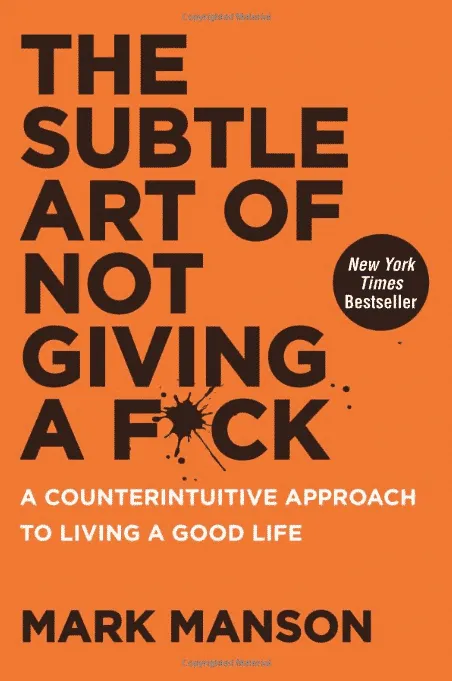
In this generation-defining self-help guide, a superstar blogger cuts through the crap to show us how to stop trying to be positive all the time so that we can truly become better, happier people.
For decades we've been told that positive thinking is the key to a happy, rich life. "F*ck positivity," Mark Manson says. "Let's be honest, shit is f*cked, and we have to live with it." In his wildly popular Internet blog, Manson doesn't sugarcoat or equivocate. He tells it like it is - a dose of raw, refreshing, honest truth that is sorely lacking today. The Subtle Art of Not Giving a F*ck is his antidote to the coddling, let's-all-feel-good mind-set that has infected modern society and spoiled a generation, rewarding them with gold medals just for showing up.
Manson makes the argument, backed by both academic research and well-timed poop jokes, that improving our lives hinges not on our ability to turn lemons into lemonade but on learning to stomach lemons better. Human beings are flawed and limited - "not everybody can be extraordinary; there are winners and losers in society, and some of it is not fair or your fault". Manson advises us to get to know our limitations and accept them. Once we embrace our fears, faults, and uncertainties, once we stop running and avoiding and start confronting painful truths, we can begin to find the courage, perseverance, honesty, responsibility, curiosity, and forgiveness we seek.
There are only so many things we can give a f*ck about, so we need to figure out which ones really matter, Manson makes clear. While money is nice, caring about what you do with your life is better, because true wealth is about experience. A much-needed grab-you-by-the-shoulders-and-look-you-in-the-eye moment of real talk, filled with entertaining stories and profane, ruthless humor, The Subtle Art of Not Giving a F*ck is a refreshing slap for a generation to help them lead contented, grounded lives.
There are self-help books that make you feel better, and then there are self-help books that tell you why you have been feeling terrible and what to do about it. Mark Manson’s The Subtle Art of Not Giving a F*ck belongs resolutely in the second category. Strip away the profanity and the irreverent tone — both of which are deliberate and functional, not gratuitous — and what you have is a serious, philosophically grounded argument about values, responsibility, and the particular forms of suffering that modern Western culture has manufactured for itself. It is not a book that will soothe you. It is a book that will irritate you with its accuracy.
The subtitle — “A Counterintuitive Approach to Living a Good Life” — is important. Manson is not arguing for nihilism or apathy. He is not saying that nothing matters. He is saying something more precise and more useful: that you have a finite amount of attention and energy, and what you choose to care about — what you choose to give your limited number of f*cks to — determines the quality of your life far more than the circumstances you were dealt. The person who gives f*cks about everything, who is perpetually disturbed by every slight, every failure, every piece of bad news, every deviation from what they expected — this person is not more engaged with life. They are less capable of living it well. The person who chooses deliberately and wisely what to care about deeply — who reserves their serious engagement for things that genuinely warrant it — this person is not indifferent. They are free.
Manson writes from a place of self-aware failure. He spent much of his twenties chasing conventional markers of success — achievement, status, sexual conquest, experience — and found them consistently unsatisfying. Not because they were not achieved, but because he was chasing them for the wrong reasons, with the wrong values underneath the pursuit. The book is in large part an account of how he came to understand this and what happened when he changed what he cared about. This autobiographical honesty is part of what distinguishes the book from the typical self-help genre, which tends to present the author as someone who has solved the problem rather than someone who is still working on it.
The Feedback Loop from Hell
One of Manson’s most useful early observations is what he calls the “feedback loop from hell.” The premise: modern Western culture has decided, largely without examination, that positive emotions are good and should be maximized, while negative emotions are bad and should be minimized or eliminated. This seems obvious. It is deeply counterproductive. When you decide that anxiety is always bad and should be gotten rid of, you generate anxiety about being anxious — the second-order problem. When you decide that anger is always bad, you get angry about feeling angry. When you decide that sadness is bad, you feel guilty for being sad. The original emotion, whatever it was, becomes surrounded by a meta-level of judgment about it that doubles or triples the suffering without doing anything to address the original signal.
The alternative Manson proposes is not to cultivate relentless positivity — the toxic positivity that self-help culture often defaults to, the insistence that you can think your way to happiness, that your attitude determines your reality, that feeling bad means you are doing it wrong. The alternative is to accept that negative emotions are not failures. They are information. Anxiety tells you that something you care about is at risk. Anger tells you that something you value has been violated. Grief tells you that something you loved was real. These are not problems to be solved. They are signals to be understood, within a framework of values that helps you interpret what they are pointing at.
This is a direct application of what Manson identifies as the core problem: not the emotions themselves but the values that underlie them. If you value others’ approval above your own judgment, then every social interaction becomes a potential source of anxiety. If you value certainty above growth, then every challenge threatens your sense of self. If you value being right above learning, then every disagreement is an attack to be repelled. The negative emotions in these cases are not irrational. They are perfectly rational responses to genuinely held values. But the values are bad — they produce suffering and constrain growth rather than supporting the kind of life worth living.
The Deceptive Comfort of Good Values versus Bad Values
The center of the book is Manson’s analysis of values — specifically, the distinction between good values and bad values, and the argument that most of the unnecessary suffering in modern life comes from pursuing bad values rather than from insufficient achievement of good ones. This is a crucial inversion. Most people, when they feel bad about their lives, diagnose the problem as insufficient achievement: not successful enough, not attractive enough, not wealthy enough, not respected enough. The solution, in this diagnosis, is to get more — more success, more beauty, more wealth, more respect. This produces the treadmill of striving that many people spend their entire lives on, perpetually arriving at new destinations and perpetually discovering that they do not contain what was promised.
Manson’s diagnosis is different: the problem is the values, not the achievement level. Bad values are ones that are immediate, controllable-seeming, social, and ultimately empty: approval from others, pleasure-seeking, always being right, staying comfortable, being exceptional. Good values are ones that are internally grounded, reality-based, and oriented toward genuine engagement with life: honesty, creativity, contribution, courage, full engagement with experience including its difficult parts. The key distinction is whether the value depends on others or circumstances — and therefore is never fully within your control — or whether it depends on your own choices and actions, which are always at least partially within your control.
This maps directly onto the Stoic tradition — specifically onto the Stoic distinction between what is “up to us” and what is not. Epictetus, a formerly enslaved philosopher who understood at a visceral level what it means to have no control over your external circumstances, built his entire philosophical system on this distinction. What is up to us is our own judgments, intentions, and responses. What is not up to us is everything else — others’ behavior, circumstances, outcomes, reputation. The person who builds their happiness on what is up to them is free. The person who builds their happiness on what is not up to them is perpetually at the mercy of circumstances, which means perpetually suffering.
The Problem with the Pursuit of Positivity
Manson’s sharpest cultural critique is directed at what he identifies as the “cult of exceptionalism” that pervades modern Western culture, particularly in the United States. The message — delivered through social media, advertising, motivational culture, and the entire genre of self-improvement — is that everyone is special, everyone has unique gifts, everyone deserves to be exceptional, and the goal of life is to realize that exceptionalism. This message is, he argues, deeply destructive for several reasons.
The first is mathematical: in any distribution of human achievement, most people are by definition average. Not because they are failures, but because that is what “average” means. A culture that defines ordinariness as failure and exceptionalism as the minimum acceptable outcome has committed itself to manufacturing mass dissatisfaction on an industrial scale. Most people will fail to be exceptional — not because they did not try, not because they did not want it badly enough, but because the distribution simply does not support that outcome for most people. The cultural message that says otherwise is lying, and the suffering generated by the gap between the promise and the reality is real and preventable.
The second problem with the cult of exceptionalism is that it focuses people on outcomes rather than processes, on achievements rather than values. The person who is focused on becoming exceptional — on the outcome of status and recognition — is necessarily measuring themselves against others, which means their sense of worth is perpetually contingent on how they compare. The person who is focused on living in accordance with their own values — on the process of choosing and acting with integrity — has a fundamentally more stable foundation for wellbeing, because that process is within their control regardless of how they compare to others.
The third problem is perhaps the most insidious: the relentless positivity of exceptionalism culture requires the suppression of negative experience, failure, and limitation. If you are special and destined for greatness, then failure is a disconfirmation of your identity — it must be explained away, denied, or spun rather than honestly engaged with. If you are simply a person trying to live well, then failure is information: it tells you something about what needs to improve, what assumptions were wrong, what skills need development. The person who can fail well — who can engage with failure honestly, extract the learning, and continue — has an enormous advantage over the person who cannot afford to fail because their identity depends on not failing.
You Are Not Special — And That Is Liberating
Manson’s “you are not special” argument is intended to be liberating rather than deflating, though it takes some work to receive it that way. The argument is not that you are worthless or that your life does not matter. It is that the specialness framework — the belief that you are a uniquely gifted individual whose destiny is to achieve great things and be recognized for them — is a burden, not a gift. It generates constant anxiety about whether you are living up to your exceptional destiny. It makes every ordinary moment feel like a failure. It makes comparison with others feel desperately important. And it is, in the end, based on a false premise: that the value of a life is determined by how exceptional it appears from the outside.
The alternative is not to be ordinary in the sense of not caring about anything. It is to be ordinary in the sense of accepting that you are a human being among human beings, with the full range of human limitations, making the best choices available to you with the tools you have. This acceptance is the foundation of genuine self-respect rather than the performance of self-esteem. It is what allows you to engage with challenge without your identity riding on the outcome. It is what makes sustained effort over years possible, because you are no longer dependent on exceptional results at every stage to maintain your sense of worth.
Responsibility versus Blame
One of the most important and most easily misunderstood chapters in the book concerns the distinction between fault and responsibility. Manson argues that while many things that happen to us are not our fault — we did not choose our genetics, our family of origin, our early experiences, the systems of power that shaped our opportunities — they are still our responsibility in the sense that we are the only ones who can decide how to respond to them. This is not victim-blaming. It is a statement about where effective action is possible.
The person who was abused in childhood did not ask for that. It was not their fault. But how they choose to relate to that experience as an adult — whether they continue to be controlled by it, whether they seek help, whether they do the work of healing, whether they build a life that is larger than the damage — is their responsibility, in the sense that no one else can do it for them. Taking responsibility in this sense is not accepting blame. It is claiming agency. It is the recognition that the power to change your experience is located where you are, not where the person or system that hurt you is.
This distinction matters enormously for resilience. The person who attributes all their difficulties to external causes — who stays in the position of victim of their circumstances — is not wrong that those circumstances were real and harmful. But they are giving the circumstances the power to determine their future as well as their past. The person who takes responsibility without denying the reality of what happened to them claims a different relationship to their own life: one in which what happens next is not simply the continuation of what has already happened, but a genuine response to it.
The Importance of Saying No
Manson devotes substantial attention to the skill of rejection — saying no to options, relationships, experiences, and paths in order to commit fully to others. This is harder than it sounds in a culture that treats optionality as a supreme value and commitment as a constraint on freedom. But the ability to say no — to choose, to commit, to close off alternatives — is not a limitation on freedom. It is the exercise of freedom in its most meaningful form. You are not defined by the options you keep open. You are defined by the choices you make and sustain.
This applies to relationships as much as to any other domain. Genuine intimacy requires the willingness to be vulnerable — to allow another person to see you fully, which means they also have the ability to hurt you fully. The person who maintains maximal optionality in their relationships — who never quite commits, who keeps an emotional back door open, who refuses the full risk of genuine attachment — is not protecting their freedom. They are protecting themselves from the only kind of connection that actually satisfies the deep human need for belonging and love. The depth of a relationship is proportional to the depth of the commitment, which is proportional to the depth of the vulnerability. There is no route around this.
Entitlement and Victimhood as Mirror Images
One of the more provocative observations in the book concerns what Manson identifies as two mirror-image problems in modern life: entitlement and victimhood. On the surface, these seem like opposite failures. Entitlement is the belief that you deserve more than you have earned, that the world owes you something, that obstacles are unfair impositions rather than inevitable features of a life worth living. Victimhood is the belief that your circumstances are entirely outside your control, that you are defined by what has happened to you, that agency is illusory and responsibility is irrelevant.
Manson argues that these are not opposites but expressions of the same underlying structure: the refusal to take full ownership of your own experience. The entitled person refuses ownership of their failures and limitations. The victim refuses ownership of their responses to their circumstances. Both are seductive because both provide exemption from the difficult work of honest self-assessment and genuine effort. The entitled person never has to grapple with inadequacy. The victim never has to grapple with agency. Both avoid the discomfort that genuine growth requires.
This is a psychologically useful framing, with the same caveats that apply to any discussion of victimhood and responsibility. Some people’s circumstances are genuinely constrained by forces outside their control in ways that go far beyond individual attitude. The prescription to take responsibility is most useful when applied to responses rather than to circumstances — when it is an invitation to claim agency over how you engage with what happens rather than a denial that what happens matters. Within that framing, Manson’s point about the mirror-image nature of entitlement and victimhood is genuinely clarifying and worth taking seriously.
Mortality as the Final Teacher
The book closes with a meditation on death that is more earnest and more philosophically serious than anything else in it. Manson argues, following in a long tradition from the Stoics through Montaigne to contemporary existential psychology, that keeping death in view is not morbid but clarifying. It is the awareness that the time is finite that makes the choices about what to care about urgent and important. When you pretend that you have unlimited time, you default to whatever the culture around you treats as important. When you remember that you do not, you are forced to ask what actually matters to you, independent of what everyone else is doing.
The Stoic practice of memento mori — remember you will die — is not about cultivating dread. It is about using the awareness of mortality as a focusing lens. What would you want to have done? What would you want to have been? What matters enough to claim your finite f*cks? The answers to these questions, honestly sought and honestly faced, are the map of a life worth living. Everything else is noise.
The Paradox of Problems and the Happiness Trap
One of Manson’s most clarifying insights is that problems never go away. Solving a problem does not produce a problem-free life. It produces a new problem. This is not pessimism. It is an accurate description of the structure of human life, and understanding it changes everything about how you relate to the challenges in front of you. The person who is waiting for their problems to be solved before they start really living is waiting for something that will never arrive. The goal is not a life without problems. The goal is better problems. Problems that are worth having because they are connected to things you genuinely care about, problems that demand and develop the best of what you are capable of.
This reframe has profound implications for motivation and endurance. The question is not “How do I get rid of the pain?” but “What pain is worth it to me? What suffering makes sense given what I value?” The aspiring musician who suffers through years of practice is suffering in a way that makes sense given what they love. The entrepreneur who loses sleep over a startup is suffering in a way that reflects genuine commitment to something that matters to them. The athlete who pushes through discomfort is suffering in service of growth they have chosen to pursue. This suffering is not the same as the suffering of the person who is miserable in a career they chose for money or status or parental approval, because the latter is suffering in service of someone else’s values rather than their own.
Manson’s formulation — “What are you willing to struggle for?” rather than “What do you want?” — cuts through a great deal of self-deception. Everyone wants to be fit, wealthy, in a great relationship, respected, and fulfilled. The question is what you are willing to do consistently, in the ordinary unglamorous grind of daily effort, in service of those outcomes. Most people discover, when they answer this question honestly, that the gap between what they want and what they are willing to do for it is large. This is useful information. It either motivates genuine change in behavior, or it recalibrates expectations to something more consistent with actual investment, which is also useful. What it does not do is sustain the comfortable delusion that wanting something is the same as working for it.
Identity and the Fixed Self
Manson’s analysis of identity deserves particular attention. He observes that many people have their identity so tightly bound to particular beliefs, abilities, or roles that any challenge to those beliefs feels like an existential threat. The person who has identified themselves as “someone who is good at X” cannot easily acknowledge being bad at something related to X, because to do so is to threaten the identity. The person who has identified themselves as “someone who holds belief Y” cannot easily examine evidence against Y, because disconfirming evidence is not just a logical problem — it is a self-annihilation.
This dynamic is the enemy of growth. You cannot improve what you cannot honestly assess. You cannot update beliefs when updating them feels like dying. The solution Manson offers is the loosening of identity — holding your views and abilities more lightly, as things you currently believe or currently have rather than as things you are. This is the same move that Carol Dweck’s growth mindset research identifies as the foundation of learning and resilience, arrived at through a completely different route. When your identity is invested in your views rather than in the quality of your thinking, you stop being able to think well about anything that touches your identity, which over time becomes more and more territory.
The person who can say “I was wrong” without experiencing it as a profound defeat is not weaker than the person who cannot. They are stronger, because they have retained access to the full range of information rather than only the information that confirms who they have decided to be. This capacity — sometimes called epistemic humility, sometimes intellectual honesty, sometimes just maturity — is one of the most important skills for navigating a complex world that does not care about your identity needs and will not restructure itself to accommodate them.
What the Book Gets Right and Where It Is Incomplete
Manson’s book is significantly better than its marketing suggests. The provocative title and the casual voice attract readers who might not pick up a philosophy book, and deliver to them genuinely important insights about values, responsibility, and the sources of unnecessary suffering. This is a real service. The Stoic and existentialist traditions that Manson is drawing on — largely without attribution, though some references appear — contain some of the most practically useful philosophy ever developed, and making it accessible to a broad contemporary audience is valuable work.
The limitations are real too. The book is aimed primarily at the comfortable, the achievement-focused, the people whose main problem is an excess of striving and a deficit of clarity about what they are striving toward, rather than an insufficiency of material resources. Its analysis of how bad values create suffering is sharp, but it does not adequately engage with the ways in which structural conditions — poverty, discrimination, lack of access to opportunity — impose forms of suffering that cannot be addressed simply by upgrading your values. The person living in genuine scarcity does not need to hear that they should stop caring so much about what other people think. They need material conditions that make the kind of values-based flourishing Manson describes genuinely available to them.
This is not a fatal flaw. It is a scoping limitation. Manson is writing for a particular audience about a particular set of problems, and for that audience and those problems, his prescriptions are genuinely useful. The mistake would be to treat the framework as a complete account of why people suffer and what to do about it, which it is not and does not claim to be.
The Bottom Line
Choosing What to Measure
One of the more practically actionable threads in the book is Manson’s argument about metrics — specifically, about the danger of measuring the wrong things. Whatever you measure consistently becomes what you optimize for, whether you intend that or not. If you measure your worth by the number of people who approve of you, you will optimize for approval, which means you will make decisions based on what is most likely to be approved rather than what is most aligned with your values. If you measure your success by wealth alone, you will optimize for wealth, which means you will make trade-offs against health, relationships, and integrity that you may deeply regret. The metrics you choose are not neutral. They are, in a real sense, the values you have operationalized — the theory of the good life made into a number.
This insight has a direct application to the way most people use social media. Social media is, among other things, a metric-generation machine: likes, followers, shares, views. These numbers are compelling because numbers feel objective, feel like reality. But they are measuring something that, for most people, has very little to do with what actually makes their lives meaningful or satisfying. The person who has decided to measure their creative success by likes is setting themselves up for a particular kind of demoralization, because the metrics of social media are determined by dynamics that have almost nothing to do with the quality of the work. What goes viral is not the same as what is good. What gets liked is not the same as what matters. When you use someone else’s measurement system to evaluate your own life, you are, in effect, letting someone else define what success means for you. Manson’s prescription is to choose your own metrics — metrics that are genuinely connected to the values you actually hold, that measure something you actually care about, and that are within your actual sphere of influence.
Acting in the Absence of Motivation
One of the most practically useful insights in the book is Manson’s inversion of the motivation-action relationship. Most people believe that motivation precedes action — that you first feel motivated, and then you act. This is why people wait to feel motivated before starting things that matter to them, and why they are often waiting for a very long time. Manson argues that the causal relationship runs the other way: action precedes motivation. You do not wait until you feel like doing the work and then do it. You do the work, and the doing generates the motivation to continue. Inspiration follows engagement rather than preceding it.
This inversion has enormous practical consequences. It means that “I don’t feel motivated” is never a valid reason for not starting. It means that the quality of the initial action is less important than the fact of beginning, because beginning is what generates the momentum that makes subsequent action easier and more energized. It means that the discipline of starting, every day, regardless of emotional state, is the foundational skill that underlies every other kind of accomplishment. This is not a new insight — it appears in some form in virtually every serious treatment of creative and productive work. But Manson states it with particular clarity and places it within the larger values framework in a way that makes it more actionable than the usual “just start” advice.
The Practical Path Forward
The question any reader of this book eventually faces is: given all this, what do I actually do? Manson’s framework is philosophically coherent but deliberately unsystematic — he gives you lenses rather than a program, principles rather than a protocol. This is a deliberate choice and a defensible one. The work of values clarification is necessarily personal; no generic twelve-step program can do it for you. But for readers who want some practical structure, the following synthesis of the book’s main insights provides a starting point.
Start by examining what you actually give your f*cks to — not what you say you value, but where your anxiety, your time, your attention, and your energy actually go. What keeps you up at night? What do you monitor obsessively? What does your behavior reveal about your operating values, regardless of your stated ones? This inventory, done honestly over several weeks of observation rather than a single afternoon of reflection, will tell you more about your actual values than any amount of introspective theorizing. The gap between stated values and operating values is where the work needs to happen.
Next, subject those operating values to Manson’s quality test: are they internally grounded and process-based, or are they contingent on others’ behavior and outcomes? The value of honesty is internal and process-based — you can live in accordance with it regardless of what others do. The value of being respected is contingent and outcome-based — it depends on what others do and therefore cannot be under your control. The more of your f*cks are invested in contingent values, the more of your wellbeing is hostage to circumstances you cannot control. Gradually shifting the investment toward grounded values is not a one-time decision but a continuous practice, the same kind of deliberate practice that Manson identifies as the foundation of any genuine improvement.
The core insight of The Subtle Art of Not Giving a F*ck is simple, demanding, and worth taking seriously: you become what you choose to care about. The values you hold — consciously or not — determine what you find threatening, what you find rewarding, what suffering you can endure and what suffering breaks you, what kind of person you become over time. Most people have never seriously examined their values. They have simply absorbed the values of their culture, their family, and their peer group, and then suffered the consequences of those values without understanding why. They feel vaguely dissatisfied without being able to name the dissatisfaction. They work hard at things that do not seem to produce the fulfillment they were promised. They achieve milestones and feel the hollow thud of arrival. The problem was never insufficient achievement. The problem was always the values — the measuring system — that determined what counted as achievement in the first place.
The invitation in this book is to examine them. To ask honestly: What am I actually giving my f*cks to? Are those the things I would choose, on reflection, to give them to? What would I give them to instead, if I were choosing deliberately? The examination itself is more valuable than any particular answer, because it is the act of choosing — of taking responsibility for what you care about rather than defaulting to whatever the culture around you cares about — that produces the kind of life that feels genuinely yours rather than a life you accidentally fell into while trying to impress people you barely know.

