
Derek had tried meditation twice. First time, he sat cross-legged on a yoga mat his girlfriend bought him, downloaded an app with a British woman’s voice, and lasted four minutes before checking his phone. Second time he made it to seven minutes. Spent most of them thinking about lunch, whether he was doing it wrong, and whether meditation was just something people said they did to seem put-together.
He concluded meditation was not for him. Too restless. Too impatient. Too wired. His brain didn’t do quiet.
That conclusion, which most men reach at some point, rests on a fundamental misunderstanding of what meditation actually is and what it’s supposed to accomplish. Derek had rejected a practice that could have genuinely changed his stress response — not because the practice didn’t work, but because nobody had explained it correctly.

The Lie You’ve Been Told About Meditation
The meditation industry — and it is an industry, generating over $2 billion annually in the U.S. alone — has managed to weld a basic neurological practice to a specific cultural aesthetic. Incense. Cushions. Apps with ambient music. Retreats in Bali. The language of “awakening” and “presence” and “stillness.”
That aesthetic is not the practice. It’s a wrapper, and for a lot of men, it’s a wrapper that makes the practice inaccessible before they’ve even tried it.
Here’s what meditation actually is: deliberate, repeated attention training. Direct your attention somewhere. It wanders — inevitable, normal, happens to everyone. You notice it wandered. You return it to where you pointed it. Repeat.
That’s it. The noticing-and-returning is the practice. Every time attention has wandered and gets brought back, that’s a mental rep. It strengthens the prefrontal-cingulate circuitry responsible for executive control of attention. It builds the neural hardware for stress regulation.
The goal is not to empty the mind. Not to achieve a state of blissful calm. Not to stop having thoughts. Those are descriptions of what occasionally happens as a byproduct of consistent practice. They are not the practice itself.
Anyone trying to empty their mind and failing has been trying to do the wrong thing. The fact that the mind wanders and gets noticed wandering — that’s success. That’s the practice working.
Meditation Men Who: What The Evidence Reveals
In 2014, Madhav Goyal and colleagues published a landmark meta-analysis in JAMA Internal Medicine examining the evidence for mindfulness meditation across 47 randomized controlled trials involving 3,515 participants. The findings were more measured than the meditation industry would like anyone to believe — and more compelling than the skeptics would admit.
The meta-analysis found moderate evidence that mindfulness meditation reduces anxiety, depression, and pain. Specifically, effect sizes around 0.38 for anxiety and 0.30 for depression — comparable to what antidepressants produce in many studies, without side effects. Insufficient evidence turned up for meditation improving other areas like attention, substance use, or sleep, though more recent research has strengthened some of those.
The word “moderate” is doing real work here. Goyal’s team was not concluding that meditation is a miracle. They were concluding that it has real, measurable effects on anxiety and mood — effects that hold up under rigorous methodological scrutiny. For a lifestyle practice that costs nothing and takes five minutes, “moderate evidence” is actually a very high bar of support.
Subsequent research has added specificity. A 2018 study in the journal Psychiatry Research found that 8 weeks of Mindfulness-Based Stress Reduction (MBSR) measurably reduced the size of the amygdala — the brain’s fear and threat detection center — as measured by MRI. A 2017 study in NeuroImage found that experienced meditators showed stronger connectivity between the prefrontal cortex and amygdala, meaning the rational brain maintained better regulatory control over the emotional brain.
A 2021 study in PNAS found that even brief mindfulness training — 13 minutes of guided meditation daily for 8 weeks — significantly reduced anxiety, improved mood, and improved working memory capacity compared to a control group that listened to podcasts for the same duration.
The mechanisms are real. The only real question is how to access them without the baggage of how meditation is usually sold.
Why the Nervous System Angle Changes Everything
Most meditation marketing positions the practice as a route to calm or happiness. That framing fails men because it implies the goal is passive — that the aim is emotional softness.
The accurate framing: meditation is nervous system training. Building hardware for stress regulation.
Here’s the physiology. The autonomic nervous system — the automatic regulator of heart rate, breathing, digestion, and stress response — has two main branches. The sympathetic branch activates under stress. The parasympathetic branch, largely mediated by the vagus nerve, produces recovery and regulation.
Most men in high-stress modern environments run chronically high sympathetic tone. Shows up as baseline tension, poor sleep, difficulty recovering from stressors, emotional reactivity, and the low-level exhaustion that comes from never fully downregulating.
Meditation — specifically, slow diaphragmatic breathing paired with attention training — is one of the most effective ways to activate the parasympathetic branch and build what researchers call “vagal tone.” Vagal tone is essentially the nervous system’s capacity for recovery and regulation. Higher vagal tone correlates with lower anxiety, better emotional regulation, improved cardiovascular health, better sleep, and greater stress resilience.
Nobody is training to be calm. This is training the nervous system’s recovery capacity. Completely different goal — and one that makes intuitive sense to anyone who takes physical training seriously.
The No-BS Meditation Protocol
This is the framework. Five minutes. No app required. No special posture required.
The Setup
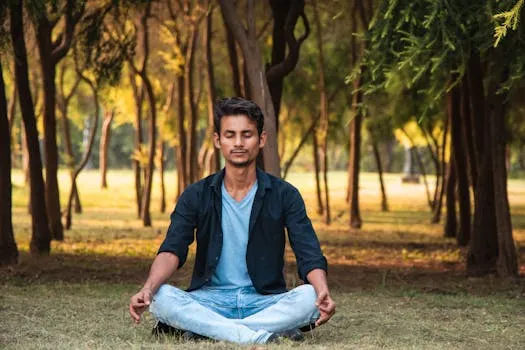
Sit somewhere reasonably comfortable. A chair works fine — no need to sit on the floor. Feet flat on the ground. Spine reasonably upright, not rigid. Hands on the thighs or loosely clasped. Eyes closed, or gaze dropped to a neutral point on the floor.
Set a timer for five minutes. A timer removes the urge to check the time, which is one of the main disruptions in early practice. Five minutes is the starting target because it’s achievable before resistance builds. Most men discover they can extend it naturally after 2-3 weeks.
The Body Scan (Minute 1-2)
Start at the top of the head, move attention slowly down the body. Not analyzing anything — just noticing. Tension in the jaw? Shoulders? Chest? Gut? Hands?
This serves two purposes. First, it orients attention to physical sensation rather than abstract thought, which is easier to sustain for beginners. Second, it actually identifies where tension is being held — and most people are holding significant tension they’ve stopped noticing because it’s become their baseline.
Find a tense area, exhale slowly, deliberately relax it. Doesn’t need to be fully relaxed — just 20-30% less tight. Practically useful (less tense after two minutes) and it doubles as attention training. Noticing, returning, noticing, returning.
The Breath Anchor (Minute 2-5)
After the body scan, attention moves to breathing. Specifically, the physical sensation of breath — air moving in through the nostrils, the rise and fall of chest or belly, the slight pause between exhale and the next inhale.
Breathe slowly. Inhale for 4-5 seconds. Exhale for 6-8 seconds. Slightly longer exhales than inhales activate the parasympathetic nervous system via the respiratory sinus arrhythmia pathway — not mysticism, this is the physiological mechanism underlying the calming effect of slow breathing.
When attention wanders — and it will, constantly at first — note it (“thinking”) and return to the breath. Don’t judge the wandering. Don’t try to suppress thoughts. Just return. The noticing-and-returning is the training. Each return is a rep.
What You’re Training
The prefrontal cortex — particularly the anterior cingulate cortex — is the brain’s executive control center. It monitors for when attention has drifted and initiates the reorientation. Meditation is essentially targeted exercise for this circuitry. The same circuitry strengthened by five minutes of breath-focus is what helps a person stay calm under pressure, interrupt anxiety spirals before they escalate, and make rational decisions under stress rather than reactive ones.
Why Your Mind Wanders (And Why That’s the Practice)
The default mode network (DMN) is a set of brain regions that activate when the mind is not focused on an external task. Responsible for daydreaming, autobiographical memory, future planning, self-referential thought. In evolutionary terms it was useful — mental simulation of scenarios, planning, and social cognition served survival.
In the modern context, chronic DMN activity is associated with anxiety, depression, and rumination. When the mind “wanders” during meditation, it’s usually into DMN activity — replaying past events, worrying about future ones, constructing narratives about self and others.
Meditation trains the ability to disengage from the DMN and redirect to present-moment focus. Research shows experienced meditators show reduced DMN activation and better regulatory control over it. Directly relevant to anxiety: anxiety is largely runaway DMN activity, the mind simulating threats that aren’t present.
Every time the mind wanders into DMN rumination and gets returned to the breath, that’s the specific cognitive operation of disengaging from the DMN being practiced. Building the reflex to step out of the thought-spiral rather than being carried by it.
Which is why “the mind wandered and it got noticed” is success, not failure. The wandering is the opportunity. The noticing is the practice.
The Five Objections and What They Actually Mean
Nobody stops thinking. Nobody, ever. The goal is not to stop thoughts but to change the relationship to them — to notice them without being swept away. Noticing thoughts means the practice is being done correctly.
“I don’t have time.”
Five minutes. More than five minutes go into a phone every day without intention. The real question is whether five of those minutes are worth spending on something with measurable neurological benefits. “I don’t have time for five minutes” usually translates to “I don’t want to prioritize this” — which is a different and more honest statement.
“It doesn’t feel like it’s doing anything.”
Neurological changes from meditation are cumulative, not immediately perceptible. Nobody feels their heart getting stronger mid-set — the downstream effects show up over weeks and months. Same principle here. Track anxiety levels, reactivity to stress, sleep quality over weeks, not minutes.
“It’s too woo-woo.”
Electrical activity patterns in the brain, prefrontal-amygdala connectivity, vagal tone, anterior cingulate cortex activation — these are the actual mechanisms at work. The cultural presentation got captured by a demographic that favors crystals and journaling. The underlying neuroscience doesn’t care about the packaging.
“I tried it and it made my anxiety worse.”
Happens. For some people — particularly those with significant trauma histories or panic disorder — turning attention inward can amplify rather than reduce distress. If meditation consistently makes things worse, that’s worth noting. Open-monitoring practices (eyes open, attention to external sounds and sensations rather than internal experience) are often better tolerated. Exercise-based mindfulness — the sustained, rhythmic attention required in running, rowing, or lifting — may be more accessible.
Building the Habit Without Relying on Motivation
Motivation is not a reliable foundation for a practice. Motivation is weather — comes and goes based on how a person feels. Habit is infrastructure. Runs without requiring a decision each day.
The single most important variable in meditation habit formation is consistency of context. Same time, same location, same basic setup, every day. The context cues become the trigger. After several weeks, sitting in that chair at that time creates a kind of preparatory state — the nervous system begins to anticipate what comes next.
Morning, immediately after waking, before checking the phone, is the most defensible slot for most men. No competing demands yet. The practice sets a regulatory tone for the day. And the phone-check — which typically activates the stress response within minutes via news, emails, social media — gets delayed long enough to complete the practice.
Link the meditation to a behavior that already happens reliably. Coffee’s brewing — five minutes of meditation before drinking it. Just showered — five minutes before getting dressed. Habit stacking: anchoring a new behavior to an existing reliable one.
Don’t judge the quality of individual sessions. A session where the mind wandered 200 times is not worse than one where it wandered 20 — that’s 200 returns versus 20. More wandering with consistent noticing is a harder workout, not a failure.
Advanced Variations Once the Baseline Is Built
After 30 days of consistent practice, consider adding these variations based on what’s being targeted.
For acute stress: Box breathing
Four counts in, four counts hold, four counts out, four counts hold. Used by Navy SEALs, emergency physicians, and tactical athletes for acute stress regulation. The consistent rhythm activates parasympathetic tone and reduces cortisol. Use before high-stakes situations — presentations, difficult conversations, competitive events.
For sleep: Body scan before bed
Longer version of the opening body scan — 10-15 minutes, lying down, systematically moving attention through the body from feet to head with deliberate muscle relaxation at each area. Essentially progressive muscle relaxation combined with meditation, and one of the most evidence-based sleep induction practices available.
For focus: Single-point concentration
Rather than the breath, use a single visual point — a dot on the wall, a candle flame. The visual anchor tends to be easier to maintain than breath for people who struggle with attention, and the practice builds the same prefrontal control circuits. Ten minutes of visual concentration practice has been shown to improve sustained attention scores in cognitive testing.
For resilience: Open monitoring
Once the basics are solid, practice sitting with awareness fully open — not anchored to breath or body, but attending to whatever arises (sounds, sensations, thoughts) without fixating on or pushing away anything. Harder and more demanding than anchored practice, but it builds equanimity — the capacity to be with experience without reactive grasping or aversion.
Meditation vs. Other Tools: The Honest Stack
Meditation is not the most effective nervous system tool in isolation. Works best as part of a stack.
Exercise remains the gold standard for mood regulation and anxiety reduction based on current evidence. Choosing between five minutes of meditation and 30 minutes of exercise for mental health benefits — choose exercise. But nobody has to choose. The two are synergistic.
Cold showers, as covered in this cluster, provide acute norepinephrine and endorphin elevation. Meditation provides cumulative vagal tone and executive control training. Cold showers are the sharp tool; meditation is the slow renovation. Both have a role.
Sleep is upstream of everything. Poor sleep degrades prefrontal function, making meditation harder and the benefits harder to notice. Someone sleeping five hours will get more psychological benefit from fixing sleep than from meditation alone. Meditation can help sleep quality — the MBSR research shows consistent sleep improvements — but it’s not a substitute for adequate sleep duration.
Breathwork — dedicated slow breathing practice — produces many of the same acute nervous system effects as meditation. For acute stress, breathwork is faster and more direct. Meditation builds the long-term regulatory hardware. The two are complementary — breathwork is the intervention, meditation is the training.
What Consistent Practitioners Actually Report
Derek, from the opening, got pushed into trying again by a colleague who described meditation in terms of nervous system training rather than spiritual practice. He dropped the app, ignored the British-voiced guided sessions, started with five minutes of the body scan and breath protocol described above.
Three months later, what he noticed was not dramatic calm or enlightenment. He noticed that when his boss delivered bad news in a meeting, there was a half-second pause before reacting — a brief window of awareness that hadn’t been there before. In that window he could choose his response rather than getting swept into one. He noticed he was sleeping better without having changed anything else in his routine. He noticed the chronic background noise of worry had, not disappeared, but decreased in volume.
None of it was the glossy transformation the meditation industry sells. It was something more valuable: a small but measurable improvement in how well he could regulate himself under pressure.
That’s the honest return on five minutes a day. Modest, consistent, cumulative, real.
Meditation Men Who Q&A
- Do I need an app or guided meditation to start? No. Apps are useful for some people as a starting scaffold, but they’re not necessary and can become a crutch. The protocol above requires only a timer. Guided audio helps some people get started — fine, use it — but aim to practice without guidance within a few weeks, so the self-directed attention skill gets built rather than just following instructions.
- How long before I see results? The Goyal 2014 meta-analysis and most meditation research uses 8-week programs. Measurable changes in anxiety, mood, and neural structure appear in that timeframe. Subjectively, many people notice improved stress reactivity within 2-4 weeks. Consistent daily practice matters more than session length — five minutes daily outperforms 35 minutes twice a week for building the habit and the neurological changes.
- Should I use a mantra or just focus on breath? Breath focus is the most researched and accessible approach for beginners. Mantra-based practices (TM and similar) have their own evidence base and work through slightly different mechanisms — the repetitive vocalization activates different neural circuits. Either works. Start with breath — simpler, free, well-evidenced.
- What’s the difference between mindfulness meditation and other types? The main types: focused attention (what this article describes — anchoring attention to a single object, usually breath), open monitoring (awareness without a specific object, watching experience arise and pass), and loving-kindness (directing warm regard toward self and others). The Goyal 2014 analysis included multiple types. Focused attention is the best starting point for stress and anxiety because it’s most concrete and the skills transfer directly to everyday stress regulation.
- Can meditation help with anger? Yes, and this is one of the stronger findings. Research on meditators consistently shows improved emotional regulation, reduced amygdala reactivity, and better prefrontal modulation of emotional responses. Anger is largely amygdala-driven reactivity — the prefrontal-amygdala regulatory pathway that meditation strengthens is directly relevant. The half-second pause Derek noticed is the practical expression of improved anger regulation.
- What if I fall asleep? Happens, especially in the early weeks, especially if sleep-deprived. Consistently falling asleep means it’s time to move practice to a more alert window (after morning coffee rather than immediately before), sit upright rather than lying down, practice eyes half-open rather than closed. Falling asleep occasionally isn’t a problem — the body needed the rest.
- Is 5 minutes enough or do I need 20+? Five minutes produces measurable benefits and is sufficient for many people’s goals. The research on optimal duration isn’t definitive — longer practice produces larger effects but diminishing returns appear around 20-30 minutes for most outcomes. For stress regulation and anxiety reduction, 10-15 minutes daily appears to be a practical sweet spot with strong supporting evidence. Start with five, extend to ten when it feels natural, don’t worry about longer unless aiming for significant contemplative depth.
The No-BS Meditation Protocol isn’t asking you to become a different kind of person. It’s asking you to sit still for five minutes and notice your breathing. The fact that this simple act has measurable neurological effects — on anxiety, mood, emotional regulation, and cognitive function — says something interesting about how hungry the modern nervous system is for intentional quiet. You don’t have to believe in anything. You just have to show up.
The Default Mode Network and Rumination: What Meditation Disrupts

The DMN is not the enemy. It’s necessary for planning, creativity, self-awareness, and social processing. The problem is that in modern stressed brains, DMN activation has become synonymous with anxiety-producing rumination — replaying past failures, projecting future catastrophes, constructing narratives of inadequacy. Research using experience sampling (interrupting people throughout the day to ask what they’re thinking) found that the majority of waking hours are spent in DMN-driven mind wandering, and that this mind wandering is associated with lower happiness ratings compared to the same activities performed with focused attention.
A landmark 2011 paper by Judson Brewer and colleagues published in PNAS showed that experienced meditators demonstrated significantly reduced DMN activation during meditation compared to novices, and that the DMN’s “resting” activity was also lower in meditators compared to matched controls. More importantly, meditators showed stronger connectivity between the DMN and the prefrontal regions responsible for detecting and interrupting mind wandering — a more efficient “mental braking” system.
This finding has direct anxiety implications. Anxiety largely involves runaway DMN activity — the mental simulation engine running threat scenarios without a good off switch. Meditation trains the regulatory circuitry that puts the brakes on this process. Each time the mind wanders during meditation and gets brought back, that’s the prefrontal-cingulate circuit doing the noticing getting strengthened. Same circuit that gives the capacity to notice an anxious thought and choose not to follow it down the spiral.
Which is why even beginning meditators often notice that their relationship to anxious thoughts changes after a few weeks — not that the thoughts stop coming, but that there’s a slightly increased capacity to notice them as thoughts rather than facts. This shift in perspective — technically called “metacognitive awareness” — is arguably the core mechanism of mindfulness-based anxiety reduction, and it’s directly trained by the basic attention-return practice described earlier.
Exercise Versus Meditation: Understanding the Complementary Roles
A question that comes up frequently: if exercise has better evidence for anxiety and depression than meditation, why bother meditating?
Because they target different components of the same problem, and the combination beats either alone.
Exercise primarily works through: acute norepinephrine and endorphin elevation (same mechanism as cold showers, different delivery); chronic BDNF (brain-derived neurotrophic factor) increase that supports neuroplasticity and new neuron formation in the hippocampus; HPA axis calibration through repeated acute stress-and-recovery cycles; and anti-inflammatory effects via muscle-derived myokines that reduce the chronic inflammatory burden associated with mood disorders.
Exercise is a powerful bottom-up intervention — it works on the chemistry and physiology first, and psychological benefits flow from that. Fast, reliable, effects within a single session.
Meditation works primarily through: top-down prefrontal regulation of the limbic system (particularly the amygdala); structural changes in attentional and regulatory circuits; DMN deactivation training; and the development of metacognitive awareness. Repeated cognitive training that gradually reshapes neural circuits — slow, cumulative, effects accumulating over months.
The synergy: exercise provides the neurochemical environment that makes meditation easier and more effective — elevated BDNF enhances neuroplasticity, meaning the structural changes from meditation practice occur more readily after regular exercise. Meditation provides the cognitive and regulatory tools that make the benefits of exercise more sustainable — better able to apply the stress-recovery skills in real-life situations rather than just during the workout.
People who add meditation to an existing exercise habit tend to report qualitative improvements in anxiety management that exercise alone doesn’t provide — specifically, the ability to interrupt anxiety cycles in non-exercise contexts, observe stressors with more equanimity, recover more quickly from emotional disruptions. Distinct skills that exercise doesn’t directly train.
The Specific Brain Structures That Change With Meditation
For skeptics who need mechanistic evidence before committing to a practice, the neuroimaging research on meditation provides something unusual in the behavioral health space: visible, measurable structural and functional brain changes from a behavioral practice.
The amygdala changes: Britta Hölzel and colleagues (2011) published a widely-cited NeuroImage paper showing that 8 weeks of MBSR produced a significant reduction in gray matter density in the right basolateral amygdala — and that this reduction correlated with reductions in perceived stress. The amygdala is the brain’s threat and fear processing center. Reduced density in this region following meditation practice suggests a structural downregulation of the threat detection system — less gray matter, less threat detection reactivity.
The prefrontal cortex: multiple published data sets show increased cortical thickness in the dorsolateral prefrontal cortex (dlPFC) in long-term meditators compared to matched controls. The dlPFC is the executive control region — the part of the brain responsible for deliberate cognitive control, planning, and emotional regulation. More cortical thickness here means more regulatory capacity.
The insula: long-term meditators show increased insula activation and thickness. The insula processes interoceptive signals — information from the body about its current state. Enhanced insula function means better body awareness, which is associated with better emotional regulation. Hard to regulate emotions that can’t be recognized, and interoceptive accuracy is one component of recognizing emotional states.
The hippocampus: MBSR increases hippocampal gray matter concentration (Hölzel 2011 again). The hippocampus is critical for contextual memory processing and the modulation of the amygdala’s fear response. More hippocampal gray matter means better capacity to put threatening stimuli in context — to distinguish between a genuine threat and a familiar but harmless stimulus. Directly relevant to anxiety, where the amygdala responds to non-threatening stimuli as though they were threats.
These structural changes aren’t acquired only by decades-long practitioners. The Hölzel study used 8 weeks of MBSR at 27 minutes of practice per day. Meaningful structural changes within 8 weeks of regular practice suggests the brain’s responsiveness to this type of training is faster than previously believed.
Making It Last: The 90-Day Commitment That Changes the Habit
Most people who “try meditation” and stop do so within the first two to three weeks — before the neurological changes have begun to accumulate meaningfully, and before the practice has become automatic enough to not require willpower to sustain.
Habit research, most influentially summarized by Phillippa Lally’s 2010 study in the European Journal of Social Psychology, found that habit formation takes an average of 66 days to reach automaticity — with a range from 18 to 254 days depending on the behavior’s complexity and the individual. A 21-day “habit challenge” is dramatically undershooting what behavior change research suggests is necessary for automaticity.
The 90-day commitment matters specifically because the neurological benefits need time to accumulate (structural brain changes in the Hölzel research occurred over 8 weeks of daily practice); the relationship between practice quality and outcomes needs time to develop (early sessions are effortful and cognitively demanding, later sessions become more natural); and the subjective benefit becomes sufficiently noticeable at the 4-8 week mark to provide intrinsic motivation that supplements the initial extrinsic motivation of “trying to meditate.”
A practical structure for the 90-day commitment: weeks 1-4 at 5 minutes daily (pure habit formation, no quality expectations); weeks 5-8 at 10 minutes daily (begin to consolidate the practice and develop the subjective sense of benefit); weeks 9-12 at 15 minutes daily (where most people begin to notice the downstream effects in real-life stress situations). After 90 days, the decision about whether to continue should be easy — by then, either enough benefit has shown up to want to continue, or the practice has genuinely not worked and there’s accurate information to try a different approach.
The Practical Framework: Applying Meditation Men Who Hate In Real Life
The Neuroscience of Why Stillness Feels Threatening to Certain Men
For men who have built their identity around action, production, and problem-solving, the instruction to sit quietly and observe thoughts without acting on them triggers a genuine neurological discomfort that is not weakness or inadequacy — it’s a predictable response from a nervous system trained to equate stillness with danger. The brain’s default mode network (DMN) — the neural network most active during rest and undirected thought — is the same network associated with rumination, self-referential processing, and anticipatory anxiety. For men whose sympathetic nervous systems are chronically activated by work, competition, or stress, deliberately activating the DMN via meditation initially surfaces whatever the sympathetic arousal was suppressing: worries, grief, unresolved conflicts, existential questions that action keeps at bay.
This is the actual explanation for why the first two to four weeks of meditation feel worse, not better, for some men. They are not meditating incorrectly — they are accurately accessing the mental content their busyness had been avoiding. The practice is working. The discomfort is the evidence that suppression was occurring. Understanding this reframe prevents the common error of interpreting early-stage discomfort as evidence that “meditation isn’t for me,” when it’s actually evidence that the nervous system is beginning to shift.
Research from Judson Brewer’s lab at Brown University has mapped this dynamic directly using neuroimaging. Experienced meditators show decreased DMN activity during meditation relative to novices, indicating that the rumination-associated circuitry genuinely quiets with sustained practice — not because the meditator is suppressing thought, but because they’ve trained a different relationship with thought that doesn’t activate self-referential worry loops. This quieting doesn’t happen in two sessions. It happens over weeks of consistent practice, which is why the early discomfort has to be endured rather than avoided for the neurological benefit to manifest.
The practical implication for men who hate meditation is to reframe what success looks like in the early weeks. Success is not a blank mind or a calm feeling. Success is sitting for the prescribed time without reaching for the phone. Success is noticing the urge to stop and choosing not to. Success is staying present with the discomfort long enough to complete the session. This is already training the prefrontal cortex’s executive control over the limbic system — even when it doesn’t feel meditative.
Meditation Variants That Work Better for Action-Oriented Men
The stereotypical seated mindfulness meditation — eyes closed, focusing on breath, observing thoughts — is one delivery mechanism for a physiological process. Not the only one. For men who find traditional seated meditation genuinely unworkable, several evidence-based variants activate the same parasympathetic nervous system response and build similar prefrontal cortical control without requiring stillness.
Walking meditation, formalized in Buddhist practice and validated in contemporary research, involves slow deliberate walking with attention anchored to the physical sensations of movement — the foot contacting the ground, the shift of weight, the rhythm of breath coordinated with steps. A 2018 study in Complementary Therapies in Medicine found that walking meditation produced comparable reductions in anxiety and improvements in well-being to seated meditation in stressed adults, with better compliance in participants who reported difficulty with stillness. The movement provides a concrete anchor for attention that breathing alone may not supply for highly kinesthetic individuals.
Body scan meditation — lying down and systematically directing attention through each body region from feet to head — engages proprioceptive awareness rather than pure cognitive observation. Widely used in MBSR programs, with a substantial evidence base for reducing physiological stress markers including cortisol and inflammatory cytokines. For men who are athletes or have high body awareness, the body scan often feels more accessible than breath-focused sitting because attention has a physical, tangible target to track rather than the more abstract experience of observing thoughts.
Cold exposure combined with deliberate breath control — practices associated with the Wim Hof Method — activates many of the same autonomic nervous system pathways as formal meditation while providing the physical intensity that action-oriented men respond to. The research here is less mature than the mindfulness literature, but a 2014 study in PNAS documented voluntary control of autonomic nervous system response in trained practitioners, and subsequent controlled trials have found reductions in inflammatory markers and improved stress responses. Not a substitute for the cognitive benefits of formal mindfulness practice, but it may serve as an entry point for men who are otherwise unable to sustain traditional seated practice.
The underlying principle across all variants is the same: deliberately directing attention to a chosen anchor, noticing when the mind wanders, returning attention to the anchor without judgment. The anchor can be breath, footfall, body sensation, or cold exposure. The cognitive exercise is identical regardless of the vehicle — and it’s the cognitive exercise that produces the neurological adaptation.
Integrating Meditation Into a Performance-Focused Life Without Adding Another Obligation
The objection that men who hate meditation most frequently raise is not philosophical — it’s logistical. “I don’t have time.” “It’s one more thing on the list.” “Every minute spent sitting is a minute not getting something done.” These objections are valid when meditation is framed as a separate activity added to an already full schedule. They dissolve when meditation is understood as a transition tool embedded within the schedule that already exists.
Transition meditation — brief 2–5 minute mindfulness practice at natural transition points in the day — requires no additional time allocation because the transitions already exist. Five minutes before a high-stakes meeting, using slow breath focus to reduce cortisol-driven reactivity, directly improves the quality of that meeting. Five minutes in the car before entering the house after work, transitioning the nervous system from work mode to present mode, directly improves the quality of family interactions. Ten minutes before sleep, using a body scan to discharge residual sympathetic activation, directly improves sleep quality. Not additions to the schedule — optimizations of transitions that happen regardless.
The performance framing matters most for the men most resistant to meditation. Presenting mindfulness as spiritual practice or self-care — framing that many action-oriented men reject culturally — consistently produces lower adoption than presenting it as cognitive performance enhancement, framing the same men readily accept. The neuroscience supports the performance framing — the prefrontal cortex improvements documented in meditation research translate directly to decision quality, impulse control, and emotional regulation under pressure, all performance variables in professional, athletic, and leadership contexts. The practice isn’t fundamentally different. The frame determines whether it gets adopted.
Elite military units, professional sports organizations, and Fortune 100 executive teams have incorporated mindfulness training not as a wellness initiative but as a performance protocol — because the evidence that it improves high-stakes performance is compelling enough to have reached organizations whose culture actively resists anything that resembles softness. If the Navy SEALs and the Seattle Seahawks have found it worth the investment, the argument that it’s incompatible with a performance-oriented identity has a structural problem. The practice isn’t what its cultural caricature suggests. It’s a cognitive training tool with better research support than most training tools high-performing men already use without question.
References
Editorial StandardsCorrectionsMedical DisclaimerAbout Our ContentAffiliate DisclosureSite Map