
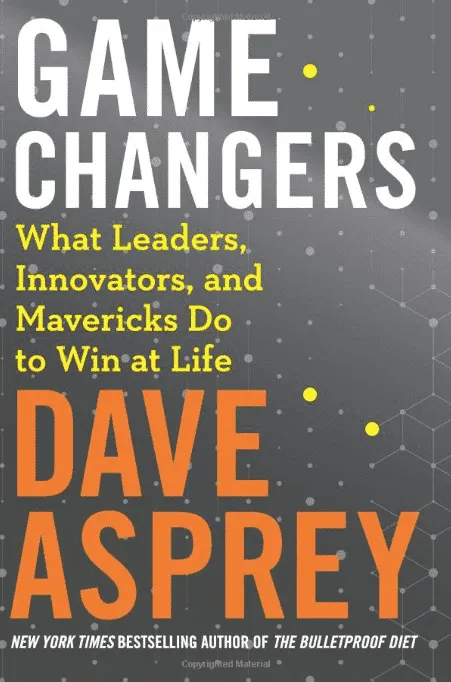
The best-selling author of Head Strong and The Bulletproof Diet answers the question, “How can I kick more ass at life?” by culling the wisdom of world-class thought leaders, maverick scientists, and disruptive entrepreneurs to provide proven techniques for becoming happier, healthier, and smarter.
When Dave Asprey started his Bulletproof Radio podcast more than five years ago, he sought out influencers in an array of disciplines, from biochemists toiling in unknown laboratories to business leaders changing the world to mediation masters discovering inner peace. His guests were some of the top performing humans in the world, people who had changed their areas of study or even pioneered entirely new fields. Dave wanted to know: What did they have in common? What mattered most to them? What made them so successful - and what made them tick? At the end of each interview, Dave asked the same question: “What are your top three recommendations for people who want to perform better at being human?”
After performing a statistical analysis of the answers, he found that the wisdom gleaned from these highly successful people could be distilled into three main objectives: finding ways to become smarter, faster, and happier. Game Changers is the culmination of Dave’s years-long immersion in these conversations, offering 46 science-backed, high performance “laws” that are a virtual playbook for how to get better at life.
With anecdotes from game changers like Dr. Daniel Amen, Gabby Bernstein, Dr. David Perlmutter, Arianna Huffington, Esther Perel, and Tim Ferris as well as examples from Dave’s own life, Game Changers offers listeners practical advice they can put into action to reap immediate rewards. From taming fear and anxiety to making better decisions, establishing high-performance habits, and practicing gratitude and mindfulness, Dave brings together the wisdom of today’s game-changers to help everyone kick more ass at life.
Dave Asprey built his career on an obsession most people wouldn’t admit to having: he wanted to be smarter, faster, stronger, and more energized than biology would naturally allow. Not just a little better — dramatically, measurably, systematically better. Starting from a position of chronic illness, obesity, and cognitive fog in his twenties, he became one of the most prominent figures in the biohacking movement, the founder of Bulletproof, and the author of multiple bestselling books. Game Changers: What Leaders, Innovators, and Mavericks Do to Win at Life is his attempt to extract the common principles from interviews with over 450 world-class performers in fields ranging from neuroscience to martial arts, business to spirituality.
The premise is compelling. Asprey spent years interviewing exceptional performers on his podcast Bulletproof Radio — now Upgrade Collective — asking each of them variations of the same question: what advice would you give to someone who wants to perform at the highest level? Game Changers synthesizes those conversations into what Asprey identifies as the core principles that show up repeatedly across radically different domains of human excellence.
The result is dense, opinionated, and extremely practical. Whether you agree with every position Asprey takes — and many readers won’t — the book delivers an enormous amount of actionable information about optimizing human performance. It rewards careful reading and selective application by anyone serious about operating at a high level.
The Three Laws of Being Human
Asprey organizes the book’s insights around what he identifies as the three laws that govern human biology and behavior: the drive to not die, the drive to not be alone, and the drive to not be weak. Understanding these three drives, and learning to work with them rather than against them, is the central thesis of the book.
These drives are ancient — they predate civilization by hundreds of thousands of years. They evolved to keep our ancestors alive on the savanna, where predators were real, social exclusion meant death, and physical weakness had direct survival consequences. The problem is that we are now using these Paleolithic drives to navigate a world of office politics, social media, processed food, and artificial light — and the mismatch is enormously costly.
The drive not to die manifests today as food cravings, risk aversion, and the stress response that gets triggered by emails rather than predators. The drive not to be alone manifests as social anxiety, status competition, and the compulsive checking of notifications that makes a slot machine out of your smartphone. The drive not to be weak manifests as ego defensiveness, the inability to admit mistakes, and the constant competitive comparisons that drain energy from actual performance.
The high performers Asprey interviewed had, in one way or another, learned to recognize these drives operating in their own behavior and developed strategies to override or redirect them. This is the fundamental biohacking insight: you are running ancient software on modern hardware in a modern environment, and the bugs are everywhere. Identifying them is the first step to fixing them.
Mastering the Mind
A significant portion of the book addresses cognitive performance — how to think better, focus more effectively, manage mental energy, and develop the metacognitive awareness to recognize and correct your own errors in real time. This is an area where Asprey’s synthesis of his interviews yields particularly rich material.
One of the most consistent patterns across his high-performer interviews was the practice of meditation or some form of systematic mind training. Not as a spiritual practice (though for some it was that too) but as a performance tool — a way to develop the ability to observe your own thoughts without being controlled by them, to choose where you direct your attention, and to access states of focused concentration that are unavailable to the untrained mind.
Asprey himself practices neurofeedback — a technology that provides real-time feedback on brainwave patterns, allowing you to train specific mental states through operant conditioning. He credits it with producing significant changes in his cognitive function and emotional regulation. But he’s careful to note that simpler practices can produce similar effects for most people. The technology is an accelerant, not a prerequisite.
The concept of fear — specifically, the fear-based thinking patterns that prevent peak performance — gets substantial attention. Asprey draws on conversations with several neuroscientists and performance psychologists to describe how fear hijacks cognition: narrowing attention, reducing creativity, triggering defensive behaviors that optimize for avoiding loss rather than pursuing gain. The performers who consistently operate at the highest level have developed systematic ways to work with fear rather than being controlled by it.
Gratitude practice appears repeatedly in this section, somewhat surprisingly for a book focused on hard-edged performance optimization. The research supports its inclusion. Gratitude has measurable effects on the stress response, on cognitive function, and on interpersonal relationships. Multiple performers in fields as different as military special operations and venture capital identified gratitude practice as a core element of their mental performance system. Asprey doesn’t ask you to take this on faith — he points to the mechanisms.
Energy and the Physical Foundation
This being a Dave Asprey book, the physical and biological dimensions of performance receive comprehensive attention. His core argument here is one he has made across all his books: the quality of your physical biology — your mitochondrial function, your hormonal balance, your sleep quality, your gut microbiome — directly determines the quality of your cognitive and emotional performance. You cannot think your way out of a bad biology.
Mitochondria are central to this framework. These cellular organelles — originally bacteria that became incorporated into our cells over a billion years ago — produce the ATP that powers every cellular function in your body. They also play critical roles in regulating inflammation, hormone production, and the signaling pathways that determine how you respond to stress. When mitochondrial function is impaired, everything downstream suffers. Asprey argues, with supporting research, that many of the performance-limiting states people attribute to psychology — fatigue, mental fog, mood dysregulation — have biological roots in mitochondrial dysfunction that can be addressed through targeted interventions.
Sleep is treated with the seriousness it deserves. In a culture that has historically celebrated sleep deprivation as evidence of dedication, the science has become unambiguous: sleep is not a luxury or a weakness. It is the primary biological mechanism through which the brain consolidates learning, clears metabolic waste, and restores the cellular machinery that powers daytime performance. Every extra hour of productive time gained by sleeping less is borrowed against a debt that will be repaid — with interest — in degraded performance and health.
The specific sleep quality practices Asprey recommends are detailed and evidence-based: temperature optimization (a cool sleeping environment), light management (blocking blue light before sleep, getting bright light immediately upon waking), consistent timing, and the elimination of sleep-disrupting substances and behaviors. None of this is particularly exotic, but the consistency with which high performers across his interviews prioritized these practices was striking.
Exercise appears in the book in a way that may surprise readers expecting standard gym-culture recommendations. Asprey is emphatic that chronic high-volume cardio is counterproductive for most people — it produces the metabolic signals of stress rather than strength, can accelerate aging rather than slow it, and often results in overconsumption of carbohydrates that undermines the metabolic flexibility he considers fundamental to sustained high performance. His preferred approach is high-intensity interval training combined with resistance training and extensive low-level activity — a pattern that matches the ancestral template more closely than the modern gym routine.
The Smarter, Not Harder Philosophy
The phrase “smarter, not harder” appears throughout the book and captures something essential about Asprey’s philosophy — and about the philosophy of many of the performers he interviewed. The people who achieve exceptional results are not, in general, simply working more hours or trying harder than everyone else. They have found ways to produce disproportionate outputs from their inputs by identifying leverage points that most people don’t think to look for.
This applies to physical performance: the right kind of training, intelligently periodized, with adequate recovery, produces better results than more training with less recovery. It applies to cognitive performance: the focused work done in a state of genuine alertness, with deliberate attention management, produces better results than more hours of distracted, fatigued effort. It applies to learning: understanding the meta-level skills of how to learn efficiently — spaced repetition, interleaved practice, sleep-based consolidation — produces better retention than spending more time studying.
The performers who embody this principle most fully tend to be intensely curious about mechanisms. Rather than accepting conventional wisdom about what produces results in their domain, they investigate the underlying biology and psychology, identify the rate-limiting factors, and target those specifically. This is the hacker’s approach applied to human performance — find the most impactful variable, optimize it aggressively, measure the results, iterate.
Asprey’s own career is an example of this approach applied at scale. His transformation from obese, cognitively impaired young man to high-performance entrepreneur was not achieved through conventional willpower and discipline. It was achieved through systematic investigation of what was actually limiting his performance and targeted interventions to address those specific limitations. The same intelligence he applied to his professional work, he applied to his own biology. The results validated the approach.
Connection, Purpose, and the Social Dimension of Performance
One of the most interesting sections of Game Changers addresses the social and relational dimensions of high performance — an area that pure biohacking frameworks sometimes underemphasize. Asprey’s interviews revealed a consistent pattern: the people operating at the very highest levels were not lone wolves. They were deeply connected — to mentors, to peers, to teams, to a sense of purpose that transcended their individual achievement.
The relationship between purpose and performance turns out to be biochemical, not just psychological. Research on motivation consistently shows that intrinsic motivation — doing something because it aligns with your values and contributes to something larger than yourself — produces higher quality performance than extrinsic motivation alone. It also produces greater resilience in the face of obstacles. People working for a purpose that genuinely matters to them will persist through difficulties that would derail those working for external rewards.
The question of how to identify and cultivate genuine purpose comes up repeatedly in these chapters. Asprey’s synthesis suggests that purpose is not typically discovered through introspection alone but through action — through trying things, noticing what produces a state of energized engagement, and paying attention to the moments when you feel most fully yourself. This is consistent with the approach recommended by Mihaly Csikszentmihalyi’s work on flow — that the path to understanding what you’re genuinely driven by runs through experience rather than abstraction.
Forgiveness and letting go of resentment receive extended treatment here, and Asprey is careful to frame this not as moral advice but as practical performance optimization. Research on the physiological effects of chronic resentment and unforgiveness is consistent: these states produce measurable stress responses, impair cognitive function, and consume enormous amounts of psychological energy that would otherwise be available for productive use. The performers who maintained exceptional output over long periods had, in general, developed systematic ways of releasing past grievances rather than carrying them forward.
The Laws Applied: Practical Implementation
Each chapter of Game Changers concludes with specific recommendations drawn from the interviews and research — practical laws that distill the key insights into actionable form. The cumulative effect of these recommendations, taken together, is a comprehensive system for performance optimization that spans biology, psychology, and meaning-making.
The laws themselves cover territory as diverse as the importance of polyphenols in the diet for mitochondrial function, to the cognitive costs of multitasking, to the practice of identifying and articulating your core values as a foundation for decision-making under pressure. What holds them together is the underlying framework of the three drives and the project of learning to work with them intelligently.
Asprey is explicit that not all recommendations apply equally to all people. One of the central insights of the personalized medicine and biohacking movements is that human biology is highly individual — what works dramatically for one person may be ineffective or counterproductive for another. The appropriate response to this variability is experimentation: try things, measure your response, keep what works, discard what doesn’t. This is the scientific method applied to the individual rather than the population, and it is the appropriate epistemology for anyone serious about personal optimization.
The technology recommendations in the book — and there are many — should be approached with the same experimental mindset. Asprey is enthusiastic about quantified self tools, wearable technology, neurofeedback, light therapy, and numerous other technological interventions. His enthusiasm is grounded in personal experience and interviews with experts, but not every technology will produce the same results for every user. The value of these tools is in what they reveal about your individual biology, not in any universal efficacy that makes them worth adopting regardless of your response.
Controversies and Criticisms
No assessment of Game Changers would be complete without acknowledging the legitimate criticisms that have been directed at Asprey’s work generally. Some researchers have questioned the evidentiary basis for some of his specific claims — particularly around dietary interventions, supplement recommendations, and the performance benefits of some technologies. His advocacy for certain products he has a commercial interest in creates potential conflicts of interest that readers should be aware of.
The biohacking community more broadly has a complex relationship with evidence. At its best, it embodies a rigorous, experimental, data-driven approach to personal optimization that can identify effective interventions ahead of the slower-moving formal research establishment. At its worst, it can be credulous about mechanisms that sound compelling but lack adequate evidence, and can create an industry of expensive products sold to people motivated by genuine desire for improvement.
The appropriate response to these concerns is not to dismiss the entire framework but to engage with it critically. Some of what Asprey presents is extremely well-supported. Some is more speculative. A careful reader will distinguish between the two, will seek out primary research rather than accepting secondary claims, and will test the most compelling ideas against their own experience rather than adopting them wholesale on authority.
With that caveat in place, the synthesis of interviews that forms the core of Game Changers is genuinely valuable. The patterns that emerge from 450+ conversations with exceptional performers — regardless of the specific biological mechanisms proposed to explain them — represent a form of empirical evidence that deserves serious attention. These are not random people. They are people who have produced extraordinary results in demanding domains. What they have in common matters.
The Identity Dimension
One theme that emerges from Asprey’s interviews but perhaps doesn’t receive quite enough explicit attention in the book is the role of identity in sustained high performance. The performers who achieved exceptional and enduring results didn’t merely adopt better habits or strategies — they changed how they thought of themselves. They built an identity as a person who does certain things, maintains certain standards, and operates according to certain principles.
This identity-level shift is what James Clear, in Atomic Habits, identifies as the difference between outcome-based and identity-based change. Asprey’s performers embody the latter. They don’t think of themselves as people who are trying to exercise or meditate or eat well. They think of themselves as people who do those things — as athletes, as practitioners, as learners. The behavior follows from the identity rather than requiring constant willpower-based enforcement.
This is a crucial insight because it changes how you approach change itself. Rather than asking “what should I do differently?” the more powerful question becomes “who do I want to be, and what does that person do?” The answer to the second question generates the answer to the first — but with a qualitatively different relationship to the effort involved. Actions taken in service of an identity you’ve chosen feel different from actions taken against habits you’re trying to break.
What the Game Changers Actually Changed
The most powerful chapters in the book are those where Asprey lets the specific stories of his interviewees come through most fully — where the abstract principles are grounded in the concrete reality of how a specific person navigated a specific challenge in pursuit of a specific form of excellence.
These moments reveal something that gets lost in the optimization framework if you’re not careful: the game changers in this book are not people who achieved extraordinary things by becoming more efficient machines. They are people who found what they were genuinely for — what they cared about deeply enough to dedicate themselves to with full seriousness — and then brought the full force of their intelligence and resources to bear on excelling at it.
The optimization is in service of something. The biohacking is a means, not an end. The person who invests in their mitochondrial health because they want to have the energy to be fully present with their children, or to complete a creative project that genuinely matters to them, will get far more from the optimization than the person who optimizes for its own sake. Purpose is not optional. It is the thing that makes everything else worth doing.
This is Asprey’s most important message, expressed in a book that sometimes gets characterized as purely about self-optimization: the game that is worth changing is the one you’ve chosen to play because it matters to you. Everything else is just getting good enough to play it at the level it deserves.
The Lasting Takeaway
Game Changers is an unusual book — part interview synthesis, part personal manifesto, part practical guide. It doesn’t fit neatly into any single category, which may be part of why it’s been somewhat under-discussed relative to Asprey’s other work. But for anyone serious about performance optimization who is willing to engage with a wide-ranging set of ideas and extract what’s most applicable to their own situation, it offers extraordinary value.
The three-law framework provides a useful lens for understanding your own behavior and identifying where ancient drives are creating modern problems. The specific recommendations — on sleep, movement, nutrition, mindset, connection, and purpose — represent a comprehensive map of the territory that any high performer needs to navigate. And the examples of actual people who have done exceptional work provide something that frameworks and research cannot: evidence that it’s possible, and some sense of what it actually looks and feels like from the inside.
Take what serves you. Test it against your own experience. Keep what works. And remember that the point of becoming better at being human is not the becoming — it’s the being. The optimized version of you is a means to an end. Make sure the end is worth it.
The Neuroscience of Elite Performance
Among the most compelling sections of Game Changers are Asprey’s interviews with neuroscientists and cognitive performance researchers who have spent careers studying what actually happens in the brains of people operating at the edges of human capability. What they reveal challenges many popular assumptions about talent, intelligence, and the nature of expertise.
One of the central findings that emerges is the role of neuroplasticity — the brain’s capacity to reorganize itself in response to experience — in the development of elite performance. The brains of experts in any domain show measurable structural differences from novices, differences that reflect thousands of hours of targeted practice. This is simultaneously encouraging and demanding: encouraging because it suggests that extraordinary capability is built rather than born; demanding because it specifies the mechanism by which it’s built — deliberate practice that pushes the edges of current capability, produces errors, and uses feedback to correct them.
The connection between physical optimization and cognitive performance is a thread that runs through all of Asprey’s work, and it receives particularly clear treatment in the neuroscience sections of this book. The brain is not separate from the body — it is part of it, dependent on the same circulatory, metabolic, and hormonal systems that determine physical performance. The idea that you can optimize cognitive function while neglecting physical health is a form of dualism that the biology doesn’t support. The high performers who sustain exceptional cognitive output over decades understand this intuitively, even when they couldn’t have articulated the mechanisms.
Stress management at the neurological level gets careful treatment. The distinction between acute stress — which can enhance performance through the arousal it produces — and chronic stress — which degrades virtually every dimension of cognitive and physical function through sustained cortisol elevation — is fundamental to understanding why some people thrive under pressure while others deteriorate. The performers who thrive have developed what researchers call stress inoculation: a history of successfully navigating challenging situations that builds a neurological pattern of confidence and effective response. They don’t experience less fear. They have better relationships with their own fear responses.
Learning, Failure, and the Maker Mentality
A significant proportion of Asprey’s most successful interviewees shared a relationship with failure that is fundamentally different from the one most people develop through conventional education and career development. Where most people experience failure as evidence of inadequacy to be avoided at almost any cost, these performers experienced failure as information — as data about the gap between current capability and desired capability, and therefore as the most direct path to improvement available.
This reframing of failure is not merely psychological. It has direct implications for the kinds of projects you choose to pursue, the risks you’re willing to take, the feedback you’re willing to seek, and ultimately the rate at which you develop. The person who avoids failure by staying within the boundaries of established competence learns slowly. The person who systematically puts themselves in positions where failure is possible — and who extracts maximum information from the failures they experience — learns at an entirely different rate.
The maker mentality that emerges from these interviews is characterized by a deep preference for building things — testing ideas through implementation rather than analysis, learning through iteration rather than preparation. This is not the same as recklessness. The most effective makers in Asprey’s interviews were also careful thinkers who invested significant effort in understanding mechanisms and designing experiments. But their default orientation was toward building and testing rather than analyzing in the abstract.
This has implications for how you approach personal development. The question is not “what should I believe about optimal performance?” but “what can I test in my own experience to find out what actually works for me?” Asprey’s book, at its best, is an invitation to this experimental orientation — a source of hypotheses to test rather than conclusions to adopt.
The Long Game
Perhaps the most sobering and ultimately most inspiring dimension of Game Changers is what it reveals about time horizons. The performers who achieved the most extraordinary results were not optimizing for short-term performance. They were investing in biological, cognitive, and relational capital that would compound over decades. Their decisions about sleep, nutrition, exercise, relationships, and learning were made with a timeline that most people never think seriously about.
Asprey himself is explicit about wanting to live to 180 — a goal that sounds eccentric until you examine the trajectory of longevity science and the biological mechanisms of aging that are now understood well enough to be targeted directly. Whether or not that specific number is achievable, the orientation it represents is instructive. If you’re planning to live and perform for decades longer than your current assumptions suggest, many decisions look different. The investment in your biological infrastructure — the mitochondrial health, the hormonal balance, the neuroplasticity — becomes obviously worth making.
This long-game orientation also changes how you think about learning and skill development. The skills that take years to develop — genuine expertise in complex domains, deep relationship skills, the ability to think across disciplinary boundaries — are worth far more at age fifty or sixty than quick wins are worth at thirty. The performers in this book who were still operating at extraordinary levels well into their fifth and sixth decades were almost universally people who had made the long-term investments early and consistently.
The final message of Game Changers, stripped of all its specific recommendations and mechanisms, is this: the highest performers in any domain have figured out how to operate as full human beings — physically, cognitively, relationally, and purposefully — rather than optimizing one dimension at the expense of others. The integration is the point. And the game worth changing is the one that gets better the more fully human you become.
Hormones, Light, and the Biology of Timing
One area where Game Changers offers particularly actionable and often-overlooked guidance is the biology of timing — specifically, how the timing of light exposure, eating, exercise, and social interaction affects hormonal patterns that determine performance across the day and the week. Asprey’s interviews with chronobiologists and performance researchers revealed consistent patterns among high performers around their management of these timing variables.
The circadian system — the set of biological clocks that coordinate metabolism, hormone release, sleep-wake cycles, and dozens of other physiological processes — is exquisitely sensitive to light. Morning sunlight exposure in the first thirty to sixty minutes after waking is one of the most consistently mentioned practices among high performers for establishing robust circadian rhythm, improving daytime alertness, and supporting sleep quality at night. The mechanism is well understood: morning light suppresses residual melatonin and signals the master clock in the suprachiasmatic nucleus to anchor the day’s hormonal cascade at the right time.
Evening light management — specifically, reducing exposure to blue-wavelength light in the two to three hours before sleep — receives equal emphasis. The modern environment is flooded with artificial light that was essentially nonexistent throughout human evolutionary history. The suprachiasmatic nucleus cannot distinguish between natural light and artificial light of the same spectrum. Evening screen use suppresses melatonin and delays sleep onset with measurable consequences for sleep quality, cognitive recovery, and next-day performance.
The eating-timing dimension intersects with research on intermittent fasting and metabolic flexibility. Multiple high performers in Asprey’s interviews had adopted some form of time-restricted eating — concentrating food intake in a window of eight to twelve hours, leaving the remainder for the fasted metabolic state that promotes cellular cleanup processes, hormonal optimization, and metabolic flexibility. The specific window varies by individual biology and activity pattern, but the principle of aligning eating with the body’s metabolic rhythms rather than with social convention or convenience is consistently supported.
These are not minor optimization hacks. They are fundamental adjustments to the basic operating conditions of human biology that most people in the modern world have gotten significantly wrong — not through negligence but through cultural norms that have drifted far from the conditions under which human physiology evolved. The good news is that the corrections are entirely within reach of anyone willing to experiment systematically with their own biology. The bad news is that they require disrupting habits that are deeply embedded in daily life and social structures. Both pieces of information are necessary for anyone who wants to take this material seriously.
Reading This Book Strategically
Game Changers is best approached not as a linear read but as a reference system. The density of information it contains is too great for a single reading to absorb and retain. The most effective approach is to read it through once to get the overall framework, then return to the sections most relevant to your current situation and the specific limitations you’re trying to address.
Asprey’s laws at the end of each chapter are particularly valuable as entry points for this kind of targeted revisitation. Each law is specific enough to be immediately actionable, and grounded in enough explanation that you can understand why it matters and how to apply it to your circumstances. The practice of selecting one or two laws per month, implementing them seriously, and assessing your response before moving to the next, is likely to produce far more lasting benefit than attempting to implement everything at once.
The core insight of the book — that exceptional performance requires working with your biology rather than against it, understanding your ancient drives rather than being unconsciously controlled by them, and integrating physical, cognitive, relational, and purposive dimensions of performance into a coherent whole — is worth carrying with you regardless of which specific recommendations you adopt. It is a different way of understanding what human performance actually involves, and it is one that holds up well against the evidence of what the most exceptional performers across domains actually do.
The game changers in Asprey’s universe share one quality above all others: they took themselves seriously enough to invest in understanding how they actually work — not how they’re supposed to work by generic advice, but how their specific biology and psychology respond to specific inputs. That investment paid compound dividends across every dimension of their lives. The same investment is available to anyone willing to make it. That is the real message of the book, and it is one worth receiving.
The specific technologies will change. The research will continue to develop. But the fundamental framework — understand your biology, honor your evolutionary drives while refusing to be controlled by them, optimize for the long game, and stay connected to purpose throughout — is not going to be obsoleted by the next study or the next product. It is grounded in something more durable than any particular finding: an honest reckoning with what human beings actually are and what we actually need to perform at our best.
The game changers in Asprey’s universe didn’t wait for permission to take themselves seriously. They invested in their own performance — physically, cognitively, relationally — as if it mattered, because it did. That investment is available to anyone willing to make it. The specific tools will evolve. The underlying principle — that understanding how you actually work produces better outcomes than ignoring how you work — is not going anywhere. That is the real game worth changing.

