
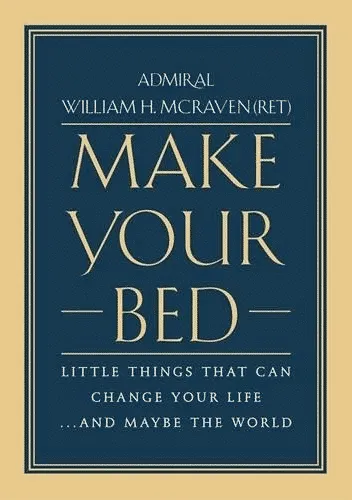
If you want to change the world, start off by making your bed.
On May 17, 2014, Admiral William H. McRaven addressed the graduating class of the University of Texas at Austin on their Commencement day. Taking inspiration from the university's slogan, "What starts here changes the world," he shared the ten principles he learned during Navy Seal training that helped him overcome challenges not only in his training and long Naval career, but also throughout his life; and he explained how anyone can use these basic lessons to change themselves-and the world-for the better.
Admiral McRaven's original speech went viral with over 10 million views. Building on the core tenets laid out in his speech, McRaven now recounts tales from his own life and from those of people he encountered during his military service who dealt with hardship and made tough decisions with determination, compassion, honor, and courage. Told with great humility and optimism, this timeless book provides simple wisdom, practical advice, and words of encouragement that will inspire readers to achieve more, even in life's darkest moments.
It was 0530 on a Tuesday in November when Derek made his bed for the first time in eleven years. He was 34 years old, three months out of a divorce, living in a studio apartment with a mattress on the floor and no frame. He’d read Make Your Bed on his phone at 2 AM in an insomnia spiral, ordered the physical copy at 2:45 AM, and started the practice the next morning. Not because he believed it would change his life. Because he’d run out of reasons not to.
By month three, the bed was made every morning before 6. By month six, Derek had also established a consistent workout routine, reduced his alcohol consumption from nightly to weekends, and began showing up five minutes early to his project management role instead of three minutes late. Not because of the bed. Because of what the bed represented: a decision that he was going to be the kind of person who did what he said he’d do, starting with the smallest possible commitment he could make to himself every day.
Admiral William H. McRaven delivered the commencement address at the University of Texas at Austin in 2014 that became this book. It has since sold over two million copies. The speech is ten minutes. The book is 128 pages. The core idea can be stated in a sentence: small disciplines, executed consistently, compound into large outcomes, and they begin with the simplest possible test of your commitment to yourself.
This is a review of what McRaven actually teaches, why it works when it works, why it fails when it fails, and how to build a genuine disciplinary architecture around it that extends far beyond the morning routine.
- Key Takeaway 1: Small wins create momentum — not through motivation but through identity reinforcement. Each completed task casts a vote for the person you’re trying to become.
- Key Takeaway 2: Military discipline is not about feeling motivated. It’s about making action independent of feeling through habit, ritual, and accountability structures.
- Key Takeaway 3: The “sugar cookie” principle — being unfairly punished and continuing anyway — is one of the most useful mental models for operating in an unjust world without being destroyed by it.
- Key Takeaway 4: Teamwork is not about liking your teammates. It’s about executing your assigned function regardless of personal feeling — a discipline modern culture has nearly abandoned.
- Key Takeaway 5: Failure and suffering are not aberrations to be avoided but essential training that can only be metabolized by continuing to function through them.
Who McRaven Is and Why It Matters
William H. McRaven is a four-star Navy admiral who spent 37 years as a Naval Special Warfare operator. He commanded SEAL Team 3, Naval Special Warfare Command, and Joint Special Operations Command (JSOC) — the organization responsible for the most sensitive counterterrorism operations in the world. He oversaw Operation Neptune Spear, the raid that killed Osama bin Laden. He has been shot, had his pelvis shattered in a parachute training accident, nearly drowned in BUD/S training, and commanded operations where people he knew and respected died.
This matters because the book’s authority rests almost entirely on McRaven’s credibility as a practitioner. There is very little in Make Your Bed that is original as psychology or philosophy. The ideas — discipline, resilience, teamwork, courage, hope — are ancient. What McRaven offers is not novelty but testimony: these principles have been tested under conditions of lethal pressure, and they hold. His stories are not parables. They are events that happened.
The SEAL BUD/S training that forms the book’s backbone is the most demanding military selection course in the world, with an attrition rate of 70-80%. McRaven’s ten lessons emerge from that crucible: make your bed, find someone to help you paddle, measure a person by the size of their heart, get over being a sugar cookie and keep moving forward, don’t be afraid of the circuses, sometimes you have to slide down the obstacles headfirst, don’t back down from the sharks, you must be your very best in the darkest moments, start singing when you’re up to your neck in mud, and don’t ever ring the bell.
These lessons are ordered psychologically rather than arbitrarily: small discipline leads to team orientation leads to resilience under unfairness leads to perseverance through failure leads to courage in extreme circumstances leads to commitment to the mission above personal comfort. It’s a developmental arc, not a list.
The Small Wins Science
McRaven’s intuitive framework for why making your bed matters has been systematically studied by psychologists. The mechanism is more interesting than it first appears.
Teresa Amabile and Steven Kramer at Harvard Business School spent years studying the “inner work lives” of employees — their daily moods, motivations, and perceptions. Their research, published as “The Progress Principle,” identifies the single most powerful driver of engagement and motivation: making meaningful progress on work that matters, even if that progress is small. The brain’s reward response to progress doesn’t scale linearly with task size — making your bed and completing a major project produce neurochemically similar small bursts of accomplishment. The bed-making win counts.
James Clear’s atomic habits framework provides the identity mechanism: every action you take is a vote for the type of person you believe yourself to be. Make your bed: vote for “I am a disciplined person.” Leave it unmade: vote for “I can’t be bothered with basics.” Over time, the accumulated votes form a strong identity signal that influences subsequent behavior. This is not metaphorical — it describes how the self-concept operates as a behavioral anchor.
Charles Duhigg’s “The Power of Habit” introduces the concept of keystone habits: behaviors that have disproportionate cascading effects on other behaviors. Exercise is the classic example — people who establish exercise habits tend, without direct intention, to eat better, sleep more regularly, drink less, and be more productive. Bed-making appears to function similarly for a significant subset of people. It is a morning discipline signal that primes the rest of the day’s decision-making architecture.
But — and this is important — keystone habits don’t work for everyone. The research on individual variation in habit formation (Phillippa Lally, University College London) shows enormous variation in the time required for a habit to become automatic, ranging from 18 to 254 days. Some habits never become automatic for some people. The book’s implication that bed-making is a universal lever is oversimplified. It’s a useful starting point, not a guaranteed mechanism.
For the most complete framework on building these habits and making them compound over time, the deliberate practice literature offers the most rigorous protocol for converting small, consistent actions into genuine skill and capability.
The Sugar Cookie Principle: Operating in an Unfair World
This is the lesson that distinguishes Make Your Bed from every other discipline-and-habits book published in the last decade. In BUD/S training, instructors will sometimes randomly select a trainee who has done everything right — made their bed perfectly, passed every test, performed every exercise correctly — and roll them in the surf zone until they’re soaked and sand-covered. Then send them to PT in that condition for the rest of the day. A sugar cookie. No reason. No warning. No injustice to protest because the system didn’t promise fairness.
McRaven’s point: the world is not fair. You will be punished for things you didn’t do wrong. You will work harder than someone else and get less. You will perform excellently and be overlooked. You will follow the rules and watch someone break them and prosper. The question is not whether this happens — it does, constantly — but what you do when it happens.
The trainee who gets sugar-cookied and lets it poison their mindset for the next twelve hours has failed a more important test than any physical challenge. The trainee who gets sugar-cookied, does PT covered in sand, and returns the next morning ready to make their bed again and do it right — that person has demonstrated something much more valuable than physical endurance. They’ve demonstrated that their internal standards are independent of external validation.
This principle runs directly counter to a dominant cultural narrative about grievance and victimhood. The psychological comfort of assigning blame for your circumstances to external forces is real — Roy Baumeister’s research on evil and self-esteem shows that external attribution of failure protects the self-concept in the short term. But it also produces learned helplessness (Martin Seligman’s foundational research), where the belief that circumstances are outside your control leads to passivity and reduced effort even in situations where your actions would make a real difference.
McRaven is not arguing that injustice doesn’t exist or that you shouldn’t fight it. He’s arguing that your effectiveness in fighting injustice depends on your ability to function through it without being destroyed by it. You can’t fix what’s unfair if you’ve been incapacitated by the unfairness. This is not victim-blaming; it is operational realism. Extreme ownership extends this principle into a full accountability framework — taking responsibility for outcomes regardless of who caused them, because that’s the only stance from which you can actually change them.
“Life is not fair. And sometimes there is nothing you can do about it. But if you start the day with a task completed, if you fall in and out of the surf repeatedly, if you face down your failure in the obstacle course of life, you will find that each small victory gives you the confidence to take on the next obstacle, and the next, and the next.” — Admiral William H. McRaven
The Discipline Cascade Model
The problem with Make Your Bed as a standalone prescription is that it establishes the entry point (small consistent discipline) without providing the architecture for scaling that discipline into every domain of your life. Here is the Discipline Cascade Model that makes McRaven’s insights operational at scale.
Level 1: The Foundation Discipline. This is Make Your Bed territory. Identify the single smallest commitment you can make to yourself that you have been consistently failing to keep. Make your bed. Do ten push-ups. Write one sentence. Drink a glass of water before your first coffee. The specific action matters far less than the consistency. You are not building a skill at Level 1 — you are building the infrastructure of personal reliability. The commitment must be small enough that there is no legitimate excuse not to keep it, and important enough that keeping it means something.
Level 2: The Domain Disciplines. Once your foundation discipline is automated (minimum 60 days of unbroken consistency), identify one discipline in each of three domains: physical (exercise, sleep, diet), cognitive (reading, skill practice, focused work), and relational (consistent contact with people who matter, deliberate investment in key relationships). These domains correspond to the military framework of readiness: physical readiness, mental readiness, and unit cohesion. Each discipline should be specific, scheduled, and non-negotiable — meaning you’ve removed the decision point about whether to do it.
Level 3: The Stress Disciplines. This is where McRaven’s sugar cookie training becomes directly applicable. Identify regular situations in your life that trigger your worst disciplinary failures — the stressful evening when you drink too much, the social rejection that sends you into avoidance for a week, the professional setback that produces cynicism and coasting. Design a specific protocol for each: what you will do instead, said in advance, in implementation intention format (“When X happens, I will do Y”). Pre-committed stress protocols are the difference between discipline that holds under pressure and discipline that only works when things are easy.
Level 4: The Team Disciplines. McRaven’s chapter on paddling with a team is undervalued. Sustained individual discipline is much harder than sustained discipline within a structure of accountability. Identify the people who hold you accountable by their standards and expectations, and deliberately construct your social environment to include more of them. This is why the military produces extraordinary individual discipline: the individual is embedded in a unit with shared standards and mutual accountability. Deliberate selection of your reference group is one of the highest-leverage interventions available, and it’s entirely within your control. Related approaches can be found at monk mode — the structured withdrawal that creates conditions for focused, disciplined work by changing your environment and social context.
What The Book Doesn’t Say (And Should)
McRaven’s framework is built for a specific type of person facing a specific type of challenge: someone who has the basic cognitive and physical capacity to execute but who lacks the disciplinary structure and mental framework to direct that capacity effectively. For that person, the book is genuinely excellent.
But the book’s 128-page format means it necessarily skips important complexity. Here’s what it doesn’t address.
Trauma and the limits of willpower-based frameworks. For people whose disciplinary failures are driven by trauma responses — hypervigilance, dissociation, the survival behaviors that made sense in a dangerous past and are now sabotaging a safer present — McRaven’s framework doesn’t reach deep enough. Telling someone whose chaotic morning routine is a symptom of PTSD to make their bed is not wrong, but it’s incomplete. The behavioral intervention needs to run alongside a trauma-processing intervention, not substitute for it.
The role of sleep and nutrition in discipline capacity. Research on sleep deprivation (Matthew Walker, UC Berkeley) and glucose/decision fatigue (Baumeister, Levav and Danziger) shows that the physiological substrate of willpower and discipline is significantly influenced by sleep quality and nutrition. You cannot sustainably make your bed, exercise, focus on cognitively demanding work, and manage emotional regulation if you’re sleeping five hours a night and eating processed carbohydrates. The discipline practices McRaven recommends require physiological support that the book doesn’t address.
Environmental design. McRaven’s framework is almost entirely internal — it’s about your mental orientation and behavioral choices. But the research on defaults and environmental design (Richard Thaler and Cass Sunstein, “Nudge”; BJ Fogg, “Tiny Habits”) shows that the physical environment has enormous leverage over behavior, often exceeding the leverage of motivation and willpower. Making your bed is harder if your bedroom is chaotic, your clothes are on the floor, and your mattress is on a frame that makes tucking the sheets difficult. The small environmental investments that make good behaviors frictionless are the complement that turns McRaven’s prescriptions into systems rather than just aspirations.
The dopamine crisis that makes sustained discipline increasingly difficult for modern people is also unaddressed — McRaven trained in an era before smartphones, social media, and the constant dopamine stimulation that has rewired reward circuitry in ways that make the patience required for long-term discipline much harder to sustain. His framework needs a digital hygiene addendum for the modern application.
The Military-Civilian Translation Problem
Every military-derived personal development framework faces the same translation challenge: the military creates extraordinary behavior through a combination of external enforcement (consequences for non-compliance are severe and immediate), social immersion (you live with the people who share your standards), mission clarity (your purpose is unambiguous), and institutional culture (you are surrounded by people who model the behaviors you’re trying to adopt). Remove all four of these and ask someone to maintain military-grade discipline in a civilian life characterized by weak accountability, social diffusion, purpose ambiguity, and cultural comfort — and you’ve changed the problem substantially.
McRaven doesn’t entirely ignore this, but he significantly underestimates it. The difference between a Navy SEAL and a middle manager is not primarily a difference in values, motivation, or character. It’s a difference in the system each operates in. The SEAL’s system ruthlessly removes people who don’t maintain standards; the middle manager’s system often actively rewards people who don’t. The SEAL has 20 teammates watching his performance daily; the manager may work primarily alone. The SEAL’s purpose is crystal clear; the manager may genuinely not know why his work matters.
This is not a criticism of McRaven’s framework — it’s a clarification of what additional work the civilian reader must do to create analogous conditions. You need to construct accountability structures (accountability partners, coaches, public commitments). You need to clarify your purpose beyond “be successful” (the values hierarchy exercise from Robbins is useful here). You need to curate your reference group. The bed-making is the easy part. The system design is the hard part and the book’s real gap.
The Science of Military Discipline: Why Civilians Struggle
The gap between military discipline and civilian behavior is not primarily a values gap or a motivation gap. It is a systems gap. Understanding what creates extraordinary discipline in the military context — and why those same conditions are largely absent in civilian life — is essential for anyone trying to apply McRaven’s framework honestly.
The military’s disciplinary engine runs on four mechanisms that operate simultaneously and reinforce each other. First: selection and attrition. The people who lack the requisite discipline are removed from the system through training processes designed to identify and exclude them. BUD/S doesn’t build SEALs from raw material — it identifies candidates who already have the psychological substrate and eliminates those who don’t. The 20-30% who complete BUD/S are not a representative sample of American adults. They are a highly selected sample with pre-existing psychological characteristics that training then refines, not creates.
Second: total immersion. Military personnel live their standards. They don’t maintain discipline in one domain while operating differently in others. The person who sleeps in a made bed, maintains a clean living space, shows up on time, exercises daily, and performs their duties at standard is embedded in a system where every element of their environment reinforces those standards. Deviation is immediately visible and immediately corrected. There is no equivalent in civilian life unless you deliberately construct it.
Third: unit accountability. Military discipline is not individual — it is collective. When one team member fails a standard, the entire unit often bears the consequence. This creates powerful social accountability mechanisms that have no civilian parallel except in deliberately constructed environments like competitive athletic teams or disciplined religious communities. Your office coworkers do not bear consequences when you fail to execute your most important work. Your accountability partners typically don’t either.
Fourth: mission clarity. Military personnel operate within a clear command hierarchy that provides explicit standards and explicit consequences. Civilian life offers almost none of this. Your personal goals are self-defined, your standards are self-imposed, and your consequences for non-compliance are entirely self-administered. This is structurally much harder than operating within an external accountability system, and McRaven’s framework assumes the external system in a way that civilian readers need to supplement with their own construction.
The practical implication: applying Make Your Bed in civilian life requires building the four mechanisms yourself. Selection (curating your social environment to include people with high standards). Immersion (designing your physical environment to make discipline the default and comfort the exception). Unit accountability (finding accountability partners with genuine stakes in your performance, not just cheerleaders). Mission clarity (defining your standards and consequences with the same explicitness a military order would provide).
Resilience: The Science Behind “Keep Moving Forward”
McRaven’s repeated instruction — keep moving, don’t stop, continue functioning through difficulty — is both the simplest lesson in the book and the one most strongly supported by the research on resilience and post-traumatic growth.
George Bonanno at Columbia University has spent two decades studying how people respond to major adversity — bereavement, severe injury, natural disasters, assault. His research challenges two dominant narratives: that severe adversity inevitably produces lasting psychological damage, and that recovery requires intense emotional processing. Bonanno’s data shows that the most common response to major loss and trauma is resilience — the ability to maintain relatively stable psychological functioning through the adversity and return to baseline within months, not years. The resilient response is not absence of grief or distress; it’s the continued ability to function, maintain positive affect in appropriate contexts, and continue moving forward even while experiencing significant pain.
What predicts resilience? Bonanno identifies several factors, several of which McRaven’s framework addresses directly. Emotion regulation (the ability to modulate emotional intensity without suppression — you feel the pain but don’t drown in it). Positive emotions under stress (the ability to find genuine moments of meaning, humor, or connection even in terrible circumstances). Repressive coping (selectively not attending to every negative thought and feeling — not denial, but managed focus). And pragmatic coping (taking action on what you can control rather than ruminating on what you can’t).
The SEAL tradition is, in effect, a training program for all four of these resilience factors. Emotion regulation: trainees are put through situations designed to generate maximum emotional activation and required to perform precisely through it. Positive emotions: the dark humor and camaraderie of military training are documented features of resilience-building, not accidents. Repressive coping: the instruction to not think about how much longer the evolution will last, but to focus entirely on the current task. Pragmatic coping: the military’s relentless action orientation, where rumination is punished and problem-solving is rewarded.
Steven Southwick and Dennis Charney at Yale School of Medicine, drawing on interviews with Vietnam POWs, Special Forces personnel, and 9/11 first responders, identified ten factors that predict resilience under extreme adversity. Several of these — realistic optimism (not Pollyanna thinking but genuine belief that effort will produce results), facing fear directly, having a moral compass, drawing on models and mentors, having an accepted framework for suffering (religious, philosophical, or cultural) — are implicit in McRaven’s ten lessons. The book is an experiential argument for evidence-based resilience factors, though Robbins never frames it that way. For a complete framework connecting these resilience principles to daily practice, see mindset tools.
The Ten Lessons: Rapid-Fire Assessment
McRaven’s ten lessons deserve brief individual treatment, since the book’s format gives each roughly equal weight but they are not of equal value or equal practical applicability to civilian life.
Lesson 1: Start your day with a task completed (make your bed). Genuine value as a keystone habit and morning discipline signal. Practical ceiling: it’s an entry point, not a complete system. Rating: 9/10 for what it is.
Lesson 2: Find someone to help you paddle (teamwork). Critical and undervalued. The research on performance in teams (Amy Edmondson, Harvard) and the multiplier effect of high-quality collaboration is robust. Most people try to accomplish too much alone. Rating: 8/10.
Lesson 3: Measure people by the size of their heart (not superficial characteristics). Philosophically correct but operationally thin as stated. McRaven is arguing for judgment by character over appearance — a truth that is easy to affirm and hard to practice systematically. Rating: 7/10 for truth, 5/10 for actionability.
Lesson 4: Get over being a sugar cookie and keep moving forward. The most uniquely valuable lesson in the book — the framework for operating under unfair conditions without being destroyed by them. No equivalent in civilian self-help that I’m aware of. Rating: 10/10.
Lesson 5: Don’t be afraid of the circuses (extra suffering builds capability). Voluntarily seeking difficulty to build capability — what Kelly McGonigal calls the “stress inoculation” approach. Strongly supported by research on deliberate discomfort and resilience building. Rating: 9/10.
Lesson 6: Sometimes you have to slide down the headfirst (take the risk). The argument for calculated risk and bias toward action over analysis paralysis. Valid, but requires the qualification that the risk must be calculated — McRaven himself advocates for thorough planning. Rating: 7/10.
Lesson 7: Don’t back down from the sharks (face your fears). Direct, powerful, and supported by the entire exposure therapy literature. The only way through fear is through it. Rating: 9/10.
Lesson 8: You must be your very best in the darkest moments. The elite performance principle — that excellence under pressure is the defining test of capability. True and important, but requires the physiological support (sleep, nutrition, recovery) that the book doesn’t address. Rating: 8/10.
Lesson 9: Start singing when you’re up to your neck in mud (find hope). The Viktor Frankl lesson — that meaning-making under suffering is a choice and a practice. Among the deepest lessons in the book. Rating: 9/10.
Lesson 10: Don’t ever ring the bell. The commitment lesson — voluntary withdrawal is always available and should never be chosen when the obstacle is temporary suffering rather than genuine impossibility. The most direct statement of the book’s core philosophy. Rating: 10/10.
Verdict
Make Your Bed earns an 8 out of 10 for what it is: a crisp, credible, personally tested framework for discipline delivered by someone who has earned the right to deliver it. It earns a 6 out of 10 as a complete personal development system, because it is too brief to address the complexity of sustainable behavior change and too reliant on individual willpower to substitute for the environmental and social structures that make that willpower available.
Read it. It takes two hours. The ten lessons are worth internalizing. The sugar cookie principle alone is worth the read time. Then build the system that McRaven’s framework points toward but doesn’t construct for you: the environmental design, the accountability structures, the physiological support, the purpose clarity. The bed-making is the beginning of a journey that the book describes but doesn’t complete.
Derek still makes his bed. He did it this morning. Not because it changed his life — though the discipline cascade it anchored probably did. He does it because eleven years of not doing it produced a certain kind of person, and the version of himself he’s building now starts every day by doing what he said he’d do. Small stakes. Every morning. Non-negotiable. That is the whole point.
For the deeper accountability framework that McRaven’s book points toward but doesn’t fully build, see the extreme ownership model and the full catalog at mindset tools.
Books Similar to Make Your Bed
- Extreme Ownership by Jocko Willink and Leif Babin — More comprehensive SEAL-derived leadership and discipline framework with direct civilian application protocols.
- Atomic Habits by James Clear — The civilian science companion to McRaven’s military testimony; explains the mechanics of why small consistent actions compound.
- Can’t Hurt Me by David Goggins — More extreme version of the same philosophy, less polished, more visceral; Goggins’s accountable suffering methodology is both inspiring and instructive.
- The Obstacle Is the Way by Ryan Holiday — Stoic philosophy applied to the same challenge McRaven addresses: transforming adversity into capability.
- Discipline Equals Freedom by Jocko Willink — Short, blunt companion to Extreme Ownership; the field manual version of everything McRaven’s book points toward.
FAQ
- Does making your bed actually improve your life? There is correlational research (a National Sleep Foundation poll found bedmakers reported better sleep) and theoretical support (keystone habit theory), but no RCT proving causation. It works for the subset of people for whom it functions as a discipline anchor. Trying it costs nothing.
- What is BUD/S training? Basic Underwater Demolition/SEAL training — the Navy SEAL selection course. 24 weeks, with an 8-day continuous exercise period called Hell Week in week three. 70-80% of candidates don’t complete it. The training is designed to identify candidates who can perform under extreme stress, sleep deprivation, cold, and physical suffering.
- What does “don’t ring the bell” mean? In BUD/S, there is a brass bell at the training compound. Ring it and you’ve voluntarily withdrawn from training. McRaven’s instruction is to never voluntarily give up. Quitting is always available as an option; the principle is to never choose it when the obstacle is temporary suffering rather than genuine impossibility.
- What is the sugar cookie lesson? The principle that you will sometimes be punished despite doing everything right, and that your response to unfair punishment is a test of your character. Getting sand-covered and continuing to perform is the lesson. Becoming bitter, cynical, or defeated is the failure.
- How long should you do a discipline before adding another? Research suggests 60-90 days minimum before a behavior becomes automatic. Adding new disciplines before earlier ones are automated creates cognitive load that undermines all of them.
- Is military discipline applicable to civilian life? The principles are applicable; the specific implementation requires civilian translation. You need to build the accountability structures and environmental conditions that the military provides automatically. This is the work the book doesn’t do for you.
- Why do the SEAL books sell so well? They offer something most self-help books don’t: testimony from people who’ve been tested in conditions of lethal pressure. The authority isn’t theoretical. Whatever problems a SEAL framework has, it has been tested in conditions far harder than most readers will ever face. That credibility is genuine.
- What is McRaven doing now? He retired from the Navy in 2014, became chancellor of the University of Texas System, and has been an outspoken critic of political threats to the rule of law and democratic institutions. His book “Sea Stories” is the memoir companion to Make Your Bed.
- Is this book appropriate for young people? Yes — arguably more appropriate for teenagers than for adults. The framework for discipline, resilience, and teamwork is most formative when internalized early. The language is accessible and the stories are engaging without being gratuitously violent.
- How do I build a complete discipline system beyond bed-making? Use the Discipline Cascade Model: foundation discipline → domain disciplines (physical, cognitive, relational) → stress protocols → team accountability structures. Each level requires the previous one to be stable before adding complexity.

