
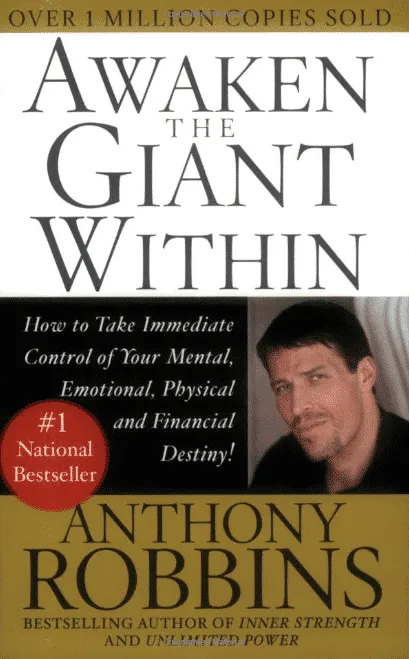
Wake up and take control of your life! From the bestselling author of Inner Strength, Unlimited Power, and MONEY Master the Game, Anthony Robbins, the nation's leader in the science of peak performance, shows you his most effective strategies and techniques for mastering your emotions, your body, your relationships, your finances, and your life.
The acknowledged expert in the psychology of change, Anthony Robbins provides a step-by-step program teaching the fundamental lessons of self-mastery that will enable you to discover your true purpose, take control of your life, and harness the forces that shape your destiny.
The seminar started at 9 AM and didn’t end until 1 AM. Sixteen hours in a hotel ballroom in Phoenix, surrounded by 3,000 people who had each paid between $600 and $3,000 to be there. By hour twelve, Jennifer was clapping to music with strangers, walking across a bed of hot coals, and crying in the arms of a man she’d met forty minutes earlier. By hour fourteen, she had committed to the $20,000 “Platinum Partnership” package. She drove home with a credit card balance that would take four years to pay off and a three-ring binder of worksheets she would open exactly once.
Ten years later, Jennifer runs a successful small marketing agency. When asked if Tony Robbins changed her life, she pauses. “Some of it was real,” she says. “The part about making a decision and committing to it completely — that part was real. The rest was theater.”
That answer is the most honest review of “Awaken the Giant Within” you’re likely to find. Some of it is real. Some of it is theater. The challenge is knowing which is which — and Robbins, to his credit and his discredit simultaneously, makes that harder than it needs to be by wrapping genuine psychological insight in the most aggressively hyperbolic packaging in the history of American self-help.
At 544 pages, “Awaken the Giant Within” is Robbins’s magnum opus, published in 1991 and still selling hundreds of thousands of copies annually. Its ambition is total: it promises to give you mastery over your emotions, your body, your relationships, your finances, and your destiny. In the Robbins universe, there are no limits except the ones you’ve accepted. The giant within is always ready. You just need to awaken it.
- Key Takeaway 1: Decisions, not conditions, determine your direction — but only when they’re accompanied by a specific changed behavior, not just a changed emotional state.
- Key Takeaway 2: The Neuro-Associative Conditioning (NAC) framework is a real psychological mechanism, but the book’s compressed version skips the maintenance work that makes it stick.
- Key Takeaway 3: Robbins’s “values hierarchy” exercise is one of the genuinely useful diagnostics in personal development literature — most people’s behavior conflicts with their stated values because they’ve never audited the hierarchy.
- Key Takeaway 4: The emotional state management techniques work for short-term performance but can mask underlying issues that require different interventions.
- Key Takeaway 5: The book’s financial advice section is dangerously thin for its confidence level and should not be followed without significant additional research.
The Robbins Method: What He Actually Teaches
Before dismantling the mythology, it’s worth accurately representing the substance. Robbins is not an empty hype machine — beneath the fire-walking and the aggressive upsells is a framework that synthesizes several legitimate psychological traditions into something more accessible, if less rigorous, than the source material.
The book’s central architecture rests on four pillars. First: beliefs. Robbins argues that your beliefs are not facts about reality but decisions about what you’re going to treat as facts, and those decisions are revisable. This is consistent with cognitive behavioral therapy’s foundational insight, though Robbins learned it from NLP (Neuro-Linguistic Programming) rather than from Beck and Ellis. NLP has significant methodological problems as a formal therapeutic system, but the underlying principle — that conscious examination and reframing of beliefs can change behavior — is sound.
Second: values. The book contains a genuinely excellent exercise for mapping your personal values hierarchy — the ordered list of what you care about most, from which all behavioral trade-offs follow. Most people have never consciously examined this list. They say they value family above career, then work sixty hours a week. They say they value health above pleasure, then choose the french fries. The values hierarchy exercise forces you to confront the gap between your stated values and your revealed preferences. That confrontation is uncomfortable and useful.
Third: emotional state management. Robbins teaches that your physical state (posture, breathing, movement) and your mental state (focus, language, meaning-making) are the primary determinants of your emotional state, and that you can intervene in both deliberately. The physiology-emotion connection is real: Amy Cuddy’s power pose research (and its subsequent controversy and partial replication) notwithstanding, the basic principle that body position influences neurochemistry is well-established. Exercise, posture, and breathing all have documented effects on cortisol and testosterone levels.
Fourth: Neuro-Associative Conditioning (NAC). Robbins’s version of behavioral change: identify what you’re currently getting from a destructive pattern (the payoff), create new associations (pain with the old behavior, pleasure with the new one), and interrupt the old pattern while installing the new one. This is essentially operant conditioning dressed in NLP language, and it works — for habits that are primarily maintained by immediate reward/punishment loops. It works less well for deeply ingrained patterns with complex neurobiological components.
The Decision Myth
The most powerful and most misleading idea in “Awaken the Giant Within” is Robbins’s treatment of decisions. “It is in your moments of decision that your destiny is shaped,” he writes. The book is structured around the premise that a single, committed, emotionally charged decision can instantly transform a life trajectory.
This is not entirely false. There is solid research supporting the idea that public commitment to a goal increases follow-through (Robert Cialdini’s commitment and consistency principle). There is also research showing that the specific moment someone decides to change a behavior — the “crystallization of discontent” described by William Miller and Janet C’de Baca in their work on quantum change — can be a genuine turning point rather than just a temporary spike.
But Robbins’s treatment elides a crucial distinction: the difference between the decision to change and the process of change. A decision is a starting condition, not a sufficient cause. The research on relapse in addiction (William Miller, UNM), on the failure of New Year’s resolutions (John Norcross, University of Scranton), and on the gap between intention and behavior (implementation intention research, Peter Gollwitzer, NYU) all point to the same conclusion: the decision is necessary but radically insufficient.
The seminar environment Robbins creates is optimized to produce the feeling of having made a transformative decision. The music, the physical activity, the social pressure, the fire-walking, the public commitments — these are all tools for generating the emotional state associated with a major life decision. But emotional states are transient. When Jennifer drove home from Phoenix at 2 AM with her $20,000 charge on her Visa, she was in a fundamentally different emotional state than she’d been in sixteen hours earlier. The decision had been made in one state and had to be maintained in another.
The people who succeed after Robbins events — and some genuinely do — are typically people who take the emotional activation of the seminar and immediately connect it to a specific behavioral structure. They join accountability groups, hire coaches, start daily practices, restructure their schedules. The seminar gave them ignition; the system they build afterward gives them fuel. Robbins would agree with this in theory. In practice, his events are better at selling the next event than at providing the structural support that makes change stick.
“The decision to change is the beginning of change, not the change itself. Confusing the two is how people spend their lives in the airport and never get on the plane.” — Original framework analysis
The Values Audit: The One Exercise Worth Doing
If you read nothing else in the book’s 544 pages, do the values hierarchy exercise. It is, without exaggeration, one of the highest-value diagnostic tools in personal development literature, and Robbins teaches it better than almost anyone.
The exercise: write down everything you value in life — freedom, family, security, adventure, health, wealth, status, love, achievement, creativity, spirituality, and so on. Then force-rank them by asking: “If I could only have this or that, which would I choose?” Work through the entire list until you have a numbered hierarchy from 1 to whatever. Then compare that hierarchy to your last 90 days of actual behavior.
The gap between your stated hierarchy and your revealed hierarchy is your character work. If health is #3 on your stated list but you haven’t exercised in three months, health is not actually #3. Something else — comfort, convenience, social approval — is operating higher in your revealed hierarchy than you’ve acknowledged. The values audit forces that acknowledgment.
Jonathan Haidt at NYU (formerly UVA) describes the human psyche as an elephant (the emotional, automatic, value-driven system) and a rider (the rational, deliberate, language-using system). The rider thinks he’s in charge but is mostly engaged in post-hoc rationalization of where the elephant has already decided to go. The values audit is one of the few tools that can surface the elephant’s actual hierarchy rather than the rider’s preferred self-narrative.
This connects directly to the mindset tools framework, which offers a structured catalog of interventions for exactly this kind of gap analysis between who you are and who you’re trying to become.
The State-Structure-Story Model
Robbins himself talks about state, story, and strategy as the three forces that shape your life. I want to propose a modified framework that corrects what I think is a significant sequencing error in his model: the State-Structure-Story Model.
Robbins’s sequence is essentially: change your state (emotional condition) → change your story (beliefs about yourself and the world) → deploy better strategies (specific actions). This is backwards. Here’s why.
Structure comes first. Before you can reliably change your state or your story, you need structural conditions that make the change sustainable. Structure means: your schedule, your environment, your defaults, your social context, your physical space. If your structure generates chronic sleep deprivation, financial stress, social isolation, and environmental chaos, no amount of state management will overcome it for long. You will get exhausted, and your old patterns will reassert themselves — because those old patterns are, among other things, stress responses.
BJ Fogg at Stanford’s Behavior Design Lab has demonstrated that the most effective behavior change interventions redesign the environment first, creating what he calls “motivation waves” — transient periods of high motivation that coincide with specific behavioral triggers. His research shows that lasting behavior change requires making the desired behavior easier (reducing friction) and the undesired behavior harder (increasing friction), not primarily generating more willpower or motivation.
Story comes second. Once you have structural support in place, narrative work — reframing limiting beliefs, building identity-consistent self-talk, developing an accurate story about your capabilities and possibilities — becomes much more tractable. The story you tell yourself is both cause and effect of your behavior; once behavior starts changing (because structure supports it), the story naturally begins to update. And deliberate narrative work can accelerate that update.
State comes third — as fuel, not foundation. State management — the breathing techniques, the physical rituals, the peak performance practices — is most valuable as a tool for executing in high-stakes moments, not as the primary mechanism of lasting change. Use it before important presentations, difficult conversations, demanding physical performances. Don’t rely on it to maintain a changed life against a hostile structure.
This model explains why Robbins seminar participants so often fail to maintain their gains: they change their state dramatically over a weekend, make story commitments while in that state, then return to an unchanged structure that gradually erodes both the state and the story. The integration work — the structural redesign — is precisely what the seminar format doesn’t provide and what Robbins’s coaching products (expensive as they are) sometimes do.
What Robbins Gets Dangerously Wrong
The book’s treatment of health and psychology includes several prescriptions that range from unsupported to actively dangerous, and these deserve direct address.
On clinical depression and anxiety: Robbins consistently frames these as state management problems — failures of focus, physiology, and meaning-making. “Depression is a choice,” in his worldview, in the sense that it’s maintained by a particular pattern of thought and posture that can be interrupted. There is a grain of truth here: behavioral activation (a CBT intervention that involves increasing positive activity regardless of mood) does produce measurable improvement in depression. But Robbins’s framework has no room for the neurobiological components of depression — the actual chemical and structural brain differences that characterize clinical depression, which require intervention beyond fire-walking and better posture.
His dismissal of medication (implicit throughout the book, explicit in his seminars) has caused real harm to people who read his framework as permission to abandon pharmacological treatment. This is not an anti-medication argument — the research on antidepressant efficacy is more complicated than pharmaceutical marketing suggests. But the decision about medication is a medical decision, not a personal development decision, and Robbins has no business making it for his readers.
On the dopamine crisis in modern life: Robbins’s framework is, in some ways, an amplifier of the very problem it claims to solve. The seminar high, the emotional peak states, the sense of transformation — these produce significant dopamine responses that create a motivation to return to seminars rather than to do the difficult, undramatic, day-to-day work of actual change. For people with dopamine dysregulation issues (which is increasingly most people), Robbins can be an expensive and escalating habit rather than a genuine intervention.
On financial advice: Part IV of the book, on financial mastery, should come with a warning label. Robbins’s advice to “pay yourself first,” eliminate debt, and invest consistently is fine as far as it goes. His specific investment recommendations and his treatment of compounding are superficial to the point of being misleading. He has since released “Money: Master the Game,” which is far more serious on this topic. The financial sections of “Awaken the Giant Within” should be treated as motivation, not instruction.
The Robbins Legacy: What Remains Valuable
Thirty-three years after publication, the book that has held up best is not the metaphysics or the financial advice. It’s the diagnostic framework — specifically the tools for understanding why you do what you do rather than what you say you’ll do.
The values hierarchy audit remains excellent. The pleasure/pain association analysis (what payoffs are you getting from your current destructive patterns?) is legitimate behavioral science. The language audit — examining the habitual words you use to describe your experiences, since language shapes meaning which shapes emotion which shapes behavior — is supported by research in cognitive linguistics (George Lakoff, UC Berkeley) and emotion science (Lisa Feldman Barrett, Northeastern).
The book also contains an underrated section on relationships that applies the same diagnostic framework productively: what are your partner’s primary values, and how are you systematically violating or honoring them? This is less theatrical than the rest of the book and more practically useful. John Gottman’s research at the University of Washington on relationship success factors shares significant conceptual DNA with Robbins’s relationship analysis, though Gottman’s empirical rigor is obviously superior.
For the behavioral principles that underlie the Robbins framework — and for a more actionable system for implementing them — the extreme ownership model offers a complementary discipline-first approach that corrects for Robbins’s motivation-first bias. The combination is powerful: Robbins for the diagnostic framework, extreme ownership for the implementation discipline.
The NLP Problem: Where Robbins’s Science Comes From
Much of Robbins’s framework is explicitly built on Neuro-Linguistic Programming (NLP), a system developed by Richard Bandler and John Grinder in the 1970s based on their study of several highly effective therapists (Milton Erickson, Virginia Satir, Fritz Perls). NLP claims to provide a model of how the brain processes experience and how that processing can be deliberately reprogrammed to change behavior and emotion. Robbins trained directly with Bandler and is NLP’s most famous commercial practitioner.
The scientific status of NLP is poor. Multiple systematic reviews — including a 2012 review published in the British Journal of General Practice and a meta-analysis by Sturt et al. — found insufficient evidence to support NLP’s core claims, partly because the claims are often unfalsifiable and partly because well-controlled studies consistently fail to replicate the results claimed by practitioners. The American Psychological Association does not recognize NLP as an evidence-based therapy. The methodological problems are fundamental: NLP’s theoretical framework is not grounded in actual neuroscience (despite the name), its “patterns” are observational rather than experimentally derived, and its training and practice have no standardization that would allow rigorous comparison across practitioners.
This matters for evaluating Robbins’s prescriptions because NLP is not just the theory behind his approach — it’s the specific intervention technology. Techniques like “anchoring” (associating a physical gesture with a desired emotional state so that the gesture later triggers the state), “submodality shifts” (changing the size, brightness, or distance of mental images to change their emotional impact), and “timeline work” (mentally traveling along a spatial representation of your personal history to reframe past events) are NLP technologies that Robbins deploys extensively. These may produce short-term state changes under the influence of an skilled practitioner in an emotionally charged environment. The evidence that they produce lasting behavioral change in real-world conditions is considerably weaker.
The honest position: Robbins’s framework contains genuine psychological insights that are independently supported by CBT, behavioral conditioning, and motivational science research — and it contains NLP-derived prescriptions that may or may not work for reasons that have nothing to do with the explanatory framework offered. Reading “Awaken the Giant Within” with this filter active is essential. When Robbins tells you what to do and it aligns with independently supported research (the values hierarchy exercise, the explanatory style work, the identity-behavior connection), follow the prescription. When he’s explaining why it works using NLP theory, engage skeptically with the explanation while remaining open to the prescription if it seems to produce results in your direct experience.
A Realistic 90-Day Implementation Plan
The failure mode for most people who read “Awaken the Giant Within” is identical to the failure mode of most transformational content: a period of high enthusiasm during and immediately after reading, followed by gradual return to previous patterns as the reading becomes a memory. Here is a 90-day implementation structure designed to convert the book’s insights into durable behavioral change rather than another inspiring experience that produces no lasting result.
Days 1-7: The Values Hierarchy Audit. Do nothing else from the book until you have completed the values hierarchy exercise with genuine rigor. Write down every value that matters to you — a minimum of fifteen items. Force-rank them using the “if I could only have X or Y” method. Then pull up your calendar and bank statement for the last 90 days and identify your revealed hierarchy — what your actual time and money allocation shows you value. Map the gaps between stated and revealed. These gaps are your agenda for the next 83 days. This is not a pleasant exercise. It is the most useful diagnostic in the book, and most people skip it in favor of reading the more exciting parts.
Days 8-28: One Values Gap, One Behavior. Select the single most important values gap — the place where your revealed behavior most contradicts your stated values. Identify one specific behavior that would close that gap incrementally. Just one. Implement it daily for 21 days. Log it. Do not attempt any other implementation work during this period. The single biggest failure mode in personal development implementation is attempting too many changes simultaneously. One change, consistently executed for three weeks, is worth more than twenty changes attempted halfheartedly for three days each.
Days 29-60: The Language Audit. Implement Robbins’s “transformational vocabulary” work. For two days, notice and log every word you use to describe your negative emotional states. Then deliberately replace habitual high-intensity negative emotion words with lower-intensity alternatives. “Furious” becomes “frustrated.” “Devastated” becomes “disappointed.” “Terrified” becomes “concerned.” This is not about suppressing emotion — it is about accurate labeling that matches the actual intensity of what you’re experiencing rather than defaulting to the highest-intensity word available. Monitor the effect on your internal experience and your behavior over the following thirty days. This is the Robbins prescription most strongly supported by the Lisa Feldman Barrett emotion construction research.
Days 61-90: The Morning Architecture. Implement a morning protocol that combines the physiological state management and mental rehearsal elements from the book. Not an elaborate ritual — twenty minutes is sufficient. Five minutes of physical activation (the simplest form is cold water on the face plus thirty seconds of vigorous movement). Five minutes of explicit gratitude practice (not generic — specific things you genuinely appreciate that are true right now). Five minutes of values-aligned intention setting for the day (what is the single most important action today in service of your top three values?). Five minutes of mental rehearsal of that action (visualize the specific process, including the obstacles most likely to arise and exactly how you will handle them). This architecture is derived from the book’s prescriptions, filtered through the implementation intention and mental rehearsal research that provides the evidence base.
After 90 days, reassess. Not whether you feel transformed — feeling transformed is not the metric. Whether your revealed hierarchy (time and money allocation) has measurably moved toward your stated hierarchy. Whether the single behavior you committed to in days 8-28 is now automatic. Whether your emotional vocabulary has actually shifted. Concrete, observable change in these three domains is the minimum evidence of genuine implementation. Anything less is reading the book, not using it. For the accountability framework that makes this implementation stick, see extreme ownership, and for the focus systems that protect the morning architecture from distraction, see monk mode.
Verdict
Awaken the Giant Within earns a 7 out of 10 for the diagnostics, a 4 out of 10 for the prescriptions, and a 2 out of 10 for the health and financial advice sections. The overall package is a 6 — genuinely valuable in places, actively misleading in others, requiring a critical filter that most readers in the Robbins demographic don’t have.
If you’re going to read it, read it with a pen and do the values hierarchy exercise seriously. That alone is worth the time. Skip the fire-walking mythology, the health prescriptions, and the financial advice. Take the NAC framework as a starting point for thinking about behavior change and supplement it immediately with Fogg’s “Tiny Habits” and Gollwitzer’s implementation intention research.
Jennifer, ten years on, has extracted the real from the theatrical. She runs her values hierarchy audit every January. She hasn’t been to another seminar. The giant, it turns out, doesn’t need to be awakened — it needs to be directed. That’s a less exciting book but a more useful one.
The Event Industry Business Model
Any honest examination of “Awaken the Giant Within” must grapple with the economic model it’s embedded in. The book is partly a product and partly a marketing vehicle for the Robbins event ecosystem — a system of escalating commitments (book → DVD program → weekend seminar → five-day immersive → year-long coaching engagement) that can run from hundreds to tens of thousands of dollars. Understanding this doesn’t invalidate the content, but it explains certain structural features of the book that otherwise seem puzzling.
The book is designed to create a profound sense of possibility and an equally profound sense that you need help accessing it. The opening chapters establish that you have within you the capacity for extraordinary achievement — then the rest of the book, and the event ecosystem it promotes, positions Robbins as the mechanism for unlocking that capacity. This is not cynical — Robbins genuinely believes his work transforms lives, and in many cases it does. But the business model creates a structural incentive to make transformation feel more dependent on Robbins than it actually is.
The research on this is pointed. Robert Cialdini’s work on social influence identifies “authority” and “social proof” as two of the six principles of persuasion. Robbins is a master of both: he presents himself as the supreme authority on human performance, and his events use the powerful social proof of thousands of people in collective emotional states. The result is an influence environment of extraordinary power — one that can produce genuine insight AND that can produce financial commitments that would not survive a forty-eight-hour cooling-off period.
This is not unique to Robbins — it is structural to the personal development industry. The book is the best-value entry point to any motivational system, because the book has to justify its arguments rather than relying on emotional state manipulation to do it. “Awaken the Giant Within” is more rigorous and honest than any Robbins event, because in a book he cannot use music, crowd psychology, or physical arousal to create the feeling of transformation. He has to actually argue his case. Read the book. Be cautious about the events.
The Language of Emotion: Robbins’s Underrated Insight
One of the most genuinely innovative ideas in “Awaken the Giant Within” is Robbins’s analysis of emotional vocabulary — and it’s one that modern emotion science has independently validated, making it more interesting in retrospect than it may have seemed when the book was published.
Robbins argues that the words you use to describe your emotional states don’t merely describe those states — they actively shape them. If you habitually describe frustration as “furious,” you’re amplifying the emotion. If you describe it as “a bit peeved,” you’re dampening it. If you describe excitement as “nervous,” you’re coloring it with threat. If you describe it as “alert and energized,” you’re coloring it with opportunity. The emotion is not entirely separate from the language used to describe it — they are co-constitutive.
Lisa Feldman Barrett at Northeastern University has developed a theory of constructed emotion that provides the scientific grounding for this insight. Barrett’s research shows that emotions are not hardwired, universal responses to stimuli (the classical view). They are constructed by the brain from a combination of bodily sensations, prior experience, and — crucially — the conceptual categories available to describe them. The more granular your emotional vocabulary (what Barrett calls “emotional granularity”), the more precisely your brain can construct specific emotional responses rather than blunt, undifferentiated states of high or low arousal.
In practice: people with higher emotional granularity (a larger, more precise vocabulary for emotional states) show better emotional regulation, better decision-making under stress, less reactive behavior in interpersonal conflict, and better mental health outcomes than people with lower emotional granularity. This is a measurable capability that can be developed — and it develops partly through expanding your emotional vocabulary. Robbins’s “transformational vocabulary” exercise, where he has readers replace their habitual negative emotion words with less intense alternatives, is a crude but directionally correct version of emotional granularity training.
The practical protocol is more rigorous than Robbins describes: keep an emotion log for two weeks, recording what you felt and what word you used. Then research more precise emotion words — the difference between “angry,” “frustrated,” “resentful,” “indignant,” and “exasperated” is not just semantic. Each describes a different configuration of physiological state, cognitive appraisal, and behavioral impulse. As you develop more precise vocabulary, you gain more precise access to your own states — and more options for responding to them deliberately rather than reactively. For more structured approaches to this kind of cognitive self-awareness work, see mindset tools.
Designing Your Identity: The Right Way
Robbins’s treatment of identity change is one of the book’s most powerful sections and also one of its most incomplete. He correctly identifies that sustained behavior change requires identity change — you must become the kind of person who does the new behavior, not just a person who is trying to do it. The smoker who “is trying to quit” is in a fundamentally different psychological position than the person who “doesn’t smoke.” The first is managing a temptation; the second has resolved a question about who they are.
But Robbins’s mechanism for identity change — primarily emotional intensity and public commitment — is not the most effective available. The research on identity-based behavior change is more nuanced and more practically useful.
Bea Johnson, whose research on sustainable behavior change at UC San Diego focused on identity rather than motivation, found that the most durable behavior changes involved a clear shift in self-concept — “I am a person who exercises” rather than “I exercise” — combined with the behavioral evidence that made that self-concept credible to the person holding it. The emotional intensity of a Robbins seminar can produce the identity declaration; it cannot produce the behavioral evidence. That part comes later, through consistent small actions that confirm the new identity.
Amy Cuddy’s research on “personal nudges” at Harvard Business School found that people who focus on small, achievable identity-confirming behaviors (not on grand transformation) show more durable identity change over time. The person who says “I am an athlete” and then does one push-up per day is doing identity work more effectively than the person who says “I am an athlete” and runs a marathon once every two years. Frequency matters more than intensity for identity formation, because frequency provides more data points confirming the new self-concept.
James Clear synthesizes this beautifully in “Atomic Habits”: every action you take is a vote for the type of person you want to become. The goal of habit formation is not to achieve the outcome (lose 20 pounds) but to become the person who does the behavior consistently (an active person). Two votes for “I am an active person” per week for two years produces a more durable identity than one dramatic decision at a Robbins seminar. The dramatic decision is useful as an ignition event. The small daily votes are what build the engine. This is what the book points at without fully articulating — and it’s more practically useful than the theatrical version.
Related frameworks for building these behavioral systems are explored in depth at deliberate practice, which provides the structured protocols for turning identity aspirations into demonstrable competencies.
Books Similar to Awaken the Giant Within
- Mindset by Carol Dweck — The empirically grounded version of Robbins’s beliefs framework; less theatrical, more durable.
- Tiny Habits by BJ Fogg — The structural behavior change approach that provides what Robbins’s motivational approach lacks: a system for making change automatic.
- The Happiness Hypothesis by Jonathan Haidt — Sophisticated framework for understanding the elephant/rider dynamic that underlies Robbins’s state management work.
- Can’t Hurt Me by David Goggins — The military-grade version of the same “no excuses” philosophy, with considerably more personal credibility and less commercial machinery.
- Man’s Search for Meaning by Viktor Frankl — The philosophical foundation of meaning-making under adversity that Robbins references throughout but never fully engages with.
FAQ
- Is Tony Robbins legitimate or a scam? Neither entirely. His psychological frameworks derive from real cognitive and behavioral science traditions (CBT, NLP, behavioral conditioning). His event model is commercially optimized in ways that don’t always align with participant outcomes. The books are more reliable than the live events for most people.
- Does fire walking actually work? Fire walking works as a confidence-building ritual in the specific context of a Robbins event, where social proof, emotional priming, and physics (pine wood coals conduct heat poorly) combine to make it safe and emotionally memorable. It does not transfer as a metaphor for daily life challenges any better than any other dramatic ritual.
- What is Neuro-Associative Conditioning? Robbins’s branded version of classical and operant conditioning principles — associating desired behaviors with pleasure and undesired behaviors with pain through deliberate mental rehearsal and pattern interruption. The mechanism is real; his version skips the maintenance work.
- How does the values hierarchy exercise work? List everything you value, then force-rank by asking “if I could only have X or Y, which would I choose?” until you have a complete ordered list. Compare to your last 90 days of actual behavior. The gap is your growth work.
- Should I go to a Tony Robbins seminar? Only if you have the structural support in place to convert the emotional activation into specific behavioral commitments immediately afterward, and if you can afford it without financial stress. The financial stress of the $20,000 packages directly contradicts the state of mind required to implement what you learn.
- Is Robbins good for people with depression or anxiety? His state management techniques can help with situational anxiety and mild mood issues. For clinical depression or anxiety disorders, his framework is inadequate and potentially harmful as a substitute for evidence-based treatment. Consult a qualified clinician.
- What’s the most actionable part of the book? The values hierarchy audit and the language audit (examining your habitual emotional vocabulary). Both are diagnostics that surface real information about your current operating system that you can actually work with.
- Why do so many people credit Robbins with changing their lives? A subset of people — those with the structural support and self-direction to implement what they learn — do experience genuine lasting change. Selection bias means we hear from these people more than from the majority who experience temporary state changes and return to baseline.
- Is the book better than the seminars? For most purposes, yes. The book gives you the framework without the manufactured emotional intensity that creates poor financial decisions. You can process it at your own pace and return to the diagnostic exercises repeatedly.
- How does Awaken the Giant Within compare to Extreme Ownership? Complementary frameworks with opposite emphasis. Robbins is emotion-first, motivation-first, state-driven. Extreme Ownership is structure-first, discipline-first, accountability-driven. Combining them gives you both diagnostic richness and implementation discipline.

