
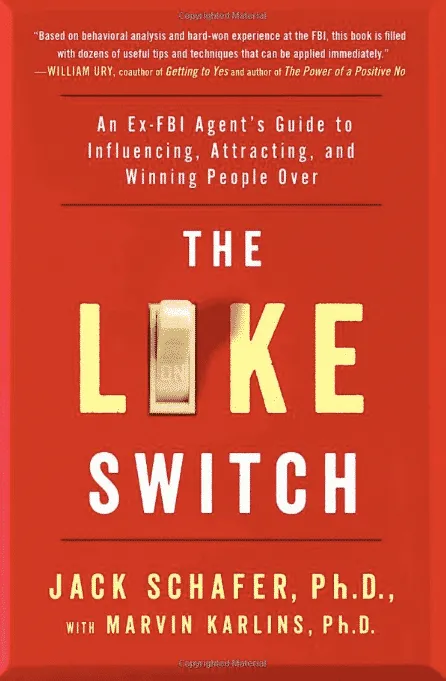
From a former FBI Special Agent specializing in behavior analysis and recruiting spies comes a handbook filled with his proven strategies on how to instantly read people and influence how they perceive you, so you can easily turn on the like switch.
The Like Switch is packed with all the tools you need for turning strangers into friends, whether you are on a sales call, a first date, or a job interview. As a Special Agent for the FBI's National Security Division's Behavioral Analysis Program, Dr. Jack Schafer developed dynamic and breakthrough strategies for profiling terrorists and detecting deception. Now, Dr. Schafer has evolved his proven-on-the-battlefield tactics for the day-to-day, but no less critical battle of getting people to like you.
In The Like Switch, he presents these techniques for how you can influence, attract, and win people over. Learn how to think and react like your favorite TV investigators from Criminal Minds or CSI as Dr. Schafer shows you how to improve your LQ (Likeability Quotient), "spot the lie" both in person and online, master nonverbal cues that influence how people perceive you, and turn up or turn down the intensity of a relationship.
Dr. Schafer cracks the code on making great first impressions, building lasting relationships, and understanding others' behavior to learn what they really think about you. With tips and techniques that hold the key to taking control of your communications, interactions, and relationships, The Like Switch shows you how to read others and get people to like you for a moment or a lifetime.
There is a moment most of us have experienced without naming it. You meet someone for the first time — a job interview, a first date, a networking event, a chance encounter — and within sixty seconds, you have already decided whether you like them. You don’t know why. You can’t articulate it. You tell yourself it’s instinct, chemistry, a gut feeling. What you’re actually experiencing is the output of a social evaluation system so ancient and so deeply embedded in human neurology that it operates almost entirely below conscious awareness.
Jack Schafer spent fifteen years at the FBI as a behavioral analyst and Special Agent working in the National Security Division. His job was not to chase criminals. His job was to get people to trust him — people who had every reason not to, people trained in counterintelligence, people who knew that federal agents were watching them and still found themselves inexplicably drawn into cooperation. He developed, tested, and refined techniques for building rapport under the most adversarial conditions imaginable. And then he wrote it all down in a book that most people who need it most have never heard of.
The Like Switch is one of those books that rewards slow reading. Not because it’s dense, but because almost every paragraph contains a practical insight that you immediately want to test against your recent social interactions. Why did that conversation feel off? Why did that person respond so well to you? Why has that colleague never quite warmed up despite your best efforts? Schafer has frameworks for all of it — derived not from social psychology labs but from the field, under conditions where failure meant national security incidents rather than awkward silences.
Today we’re going deep on what Schafer teaches — the neurological mechanics of likability, the specific signals that trigger the human brain’s friend-or-foe evaluation system, the techniques FBI agents use to build rapport with people who are actively resisting it, and how all of it applies to the real relationships in your life: professional, personal, and intimate.
This is not manipulation. This is applied social neuroscience. And the difference between those two things is everything.
The Friend-or-Foe Signal System You Never Knew Was Running
The human brain never stops running its social threat assessment. From the moment another person enters your field of awareness, a deep evaluative process activates — scanning for signals that indicate whether this person is a friend, a foe, or a neutral. This process predates language by hundreds of thousands of years. It operates faster than conscious thought. And it governs, more than almost any other variable, whether a social interaction will succeed or fail.
Schafer calls the outputs of this system “friend signals” and “foe signals,” and his central argument is straightforward: most people produce a random mix of both without realizing it, and the people who achieve extraordinary social outcomes do so largely because they’ve learned — consciously or intuitively — to send consistent friend signals while eliminating foe signals.
What are friend signals? They’re nonverbal and paralinguistic cues that the human brain has learned to associate with safety, benevolence, and social approach. Schafer identifies several that are both scientifically validated and immediately actionable.
The first is the eyebrow flash. When you see someone you know and like, your eyebrows make a rapid upward movement — less than a fifth of a second — that your brain registers before you consciously process the person’s identity. This is one of the most cross-culturally consistent nonverbal signals ever documented. People do it with family, with friends, with welcomed strangers. They don’t do it with people they perceive as threats. When someone flashes their eyebrows at you, you register it as a friend signal even if you’re not consciously aware of the movement. When you fail to do it — or when you maintain a flat, unexpressive face — people experience a subtle but real unease, even if they can’t explain why.
The second is the head tilt. Exposing the side of your neck — a vulnerable artery — is one of the most ancient signals of non-threat that vertebrates produce. Dogs do it when they approach another dog in play. Humans do it when they’re comfortable and open. When you maintain a perfectly erect, squared posture in conversation, you signal alertness and guardedness. When you introduce a slight head tilt, you signal comfort and openness. Schafer notes that this single behavioral change can dramatically alter how people respond to you in conversation — particularly in the first thirty seconds of an interaction.
The third is real, sustained eye contact combined with a genuine smile. Not the fake, performative smile that people produce for photographs and business meetings — the one that activates only the zygomaticus major muscle (the mouth corners) without engaging the orbicularis oculi (the muscles around the eyes). The Duchenne smile, named after the French physician who first described it, involves both muscle groups simultaneously, and research by Paul Ekman and others has shown that people detect the difference even when they can’t articulate it. A genuine smile with sustained (not staring) eye contact produces a powerful friend signal. A fake smile — even a well-practiced one — produces a foe signal, because the human brain evolved precisely to detect the difference.
These signals matter because they set the context for everything else. You can say all the right things and have a relevant, interesting conversation, but if you’re simultaneously broadcasting foe signals through your nonverbal channel, the person you’re talking to will feel an unease they can’t name, and the interaction will underperform what it could have been. Conversely, a person who broadcasts consistent friend signals creates an atmosphere of warmth and safety that makes the verbal content of the conversation almost secondary.
The FBI application here is stark. When Schafer was building rapport with a Russian intelligence officer the Bureau wanted to flip — someone who was trained in counterintelligence and deeply suspicious of any American who approached him — the verbal content of their first several meetings was nearly irrelevant. Schafer wasn’t trying to persuade him of anything. He was methodically building up a reservoir of friend signals, allowing the target’s own nervous system to gradually reclassify him from “threat” to “trusted contact.” The classification happened not because Schafer argued for it. It happened because he behaved, consistently, like someone safe.
“The biggest mistake people make when trying to get others to like them is trying too hard.” — Jack Schafer, The Like Switch
This principle — that likability is largely a function of what you signal rather than what you say — runs counter to most of what men are taught about social success. We’re taught to prepare good talking points, to have interesting things to say, to ask smart questions. All of that matters. But it matters second. What matters first is whether your nonverbal channel is broadcasting friend or foe. Get that wrong and the words become almost irrelevant.
The Golden Rule of Friendship — And Why It Works Every Time
Schafer structures the core of his rapport-building methodology around what he calls the Friendship Formula. It states that friendship — or any form of genuine social connection — is a function of four variables: proximity, frequency, duration, and intensity. The higher the combination of these four variables, the stronger the social bond.
Proximity is simple: physical closeness over time. You are more likely to become friends with your neighbors than with people who live across town. You are more likely to build strong working relationships with colleagues who sit near you than with those in different departments. This isn’t a character judgment — it’s physics. The proximity variable activates the other three. It creates the opportunity for frequency, duration, and intensity to accumulate.
The practical application is immediate: if you want to build a relationship with someone, engineer your proximity to them. Attend the events they attend. Sit in proximity at meetings. If you’re new to an organization and want to integrate quickly, position yourself physically where the people you want to know will encounter you regularly. The human brain tracks these encounters even when the conscious mind doesn’t, and repeated proximity builds familiarity — which the brain maps onto safety and trust.
Frequency is the number of encounters over a period of time. Regular exposure triggers what psychologists call the mere exposure effect — a well-documented phenomenon in which people develop preferences for things they’ve encountered before, simply as a function of having encountered them. The more often you see someone, the more familiar they feel, and familiarity maps onto positive evaluation. This is why advertising works through repetition rather than argument. It’s also why showing up consistently, in whatever context matters to you, pays social dividends that intermittent brilliant performance cannot match.
Duration is how long each interaction lasts. Short, frequent interactions build connection, but extended time together deepens it in ways that brevity cannot. The first thirty-minute conversation creates a different neurological record than ten three-minute conversations — even if the total time is the same. Duration allows for the kind of disclosure, vulnerability, and sustained attention that deeper connection requires.
Intensity is the emotional charge of the interaction. High-intensity shared experiences — whether positive (shared achievement, shared humor, shared discovery) or negative (shared challenge, shared hardship, shared uncertainty) — bond people in ways that routine, low-intensity interactions cannot. This is why military units, sports teams, and people who’ve been through difficult experiences together often form bonds that persist for decades. It’s also why the most memorable mentors are usually the ones who challenged you hardest, not the ones who were nicest.
The practical power of the Friendship Formula is that it shows you exactly where to focus when you want to build a relationship. Most people focus on intensity — trying to create memorable, high-impact interactions — without having built the foundation of proximity, frequency, and duration that makes intensity land with the right emotional tone. A high-intensity interaction early in a relationship can feel invasive or overwhelming. The same intensity later in a relationship, after the other variables have accumulated, feels like genuine connection.
Schafer’s FBI cases are instructive here. Flipping a foreign intelligence officer — getting someone to betray their country, their service, and their colleagues — is not accomplished through a single dramatic confrontation. It’s accomplished through patient, systematic accumulation of the four variables. You create proximity. You create frequency. You allow duration to build. And then, and only then, you introduce intensity — emotional depth, disclosure, genuine human connection. By the time the critical conversation arrives, the target is already bonded to you. The work was done in the months of ordinary interactions that preceded it.
The same architecture applies to every high-stakes relationship in your life. Your most important professional relationships were not built in single conversations. Your deepest friendships did not arrive fully formed. They were built through accumulated proximity, frequency, duration, and intensity — whether you were deliberate about it or not. Making the architecture conscious allows you to build relationships intentionally rather than accidentally.
Empathic Statements: The Single Most Powerful Rapport Tool
If the Friendship Formula tells you the architecture of relationship-building, Schafer’s work on empathic statements gives you the most powerful single conversational tool available. And it’s one that most men almost never use — not because they’re incapable of it, but because no one ever showed them how, or explained why it works so dramatically better than what they’re currently doing.
The most common response when someone shares a problem or a difficult experience is advice. Men are particularly prone to this. Someone tells us about their difficult situation and our brain immediately begins scanning for solutions. We want to help. We think helping means fixing. So we offer the fix.
The problem is that this response, however well-intentioned, communicates something the other person experiences as subtly invalidating. Before they’ve had a chance to feel heard — before the emotional content of their experience has been acknowledged — you’ve moved to problem-solving mode. The implicit message is: your feelings are a problem to be solved rather than an experience to be acknowledged. Even if your solution is brilliant, the interaction leaves them feeling slightly deflated, slightly less connected to you.
The empathic statement does something completely different. It mirrors back the emotional content of what someone has shared, in a way that demonstrates genuine attention and understanding. The formula is deceptively simple: “So you feel [emotion] because [reason].”
A colleague says: “This project is a disaster. The client keeps changing the brief and the deadline hasn’t moved.” The advice response: “You should push back harder on scope changes. Get everything in writing.” The empathic statement: “So you’re frustrated because you’re being asked to do more work in the same timeframe, and it feels like no one’s taking that seriously.”
Notice what happens. The colleague now feels genuinely heard. The emotional content of their experience has been acknowledged before anyone moved to solutions. This creates what Schafer calls an “emotional clearing” — a state in which the other person no longer needs to defend or amplify their position in order to feel understood. Once they feel understood, they become dramatically more receptive to everything that follows: your perspective, your advice, your challenge, your disagreement. The empathic statement is not a substitute for directness. It’s the prerequisite for directness landing with the right effect.
Schafer documents the impact of empathic statements in interrogation contexts, which are about as adversarial as human communication gets. FBI interrogators who used empathic statements before asking any questions consistently obtained more information, higher-quality information, and more willing cooperation than interrogators who used confrontational or accusatory approaches. The reason is neurological: when someone feels genuinely understood, their threat evaluation system downregulates. The social context shifts from adversarial to collaborative. The barriers come down.
The application in personal relationships is even more profound. The number of conflicts that escalate unnecessarily, the number of conversations that end in distance and disconnection, the number of times a partner, a child, a colleague feels unseen and responds with withdrawal or anger — a significant portion of these failures trace back to the absence of empathic acknowledgment before problem-solving. Not because people don’t care, but because no one taught them that acknowledgment comes before solution, and that skipping it costs far more than the time it would take to deliver it.
Schafer’s instruction on building empathic capacity is worth noting: begin by practicing the skill in low-stakes interactions. When a cashier makes an offhand comment about having a long shift, respond with an empathic statement. When a colleague mentions traffic or a difficult morning, pause before the automatic sympathetic noise and actually construct the acknowledgment. “So you’re exhausted because you’ve been on your feet for six hours with no break.” Watch what happens to the interaction. Watch how the person’s face changes. Watch how the quality of the next thirty seconds of conversation shifts. Then take that skill into the interactions that actually matter.
The LOVE and HATE Signals That Govern Every Relationship
Schafer extends his framework beyond first impressions into what he calls the “like switch” itself — the ongoing system of signals that determine whether a relationship is moving toward greater connection or away from it. He organizes these signals into two acronyms: LOVE (laws of verbal exchange) signals and nonverbal behavioral clusters that indicate approach or avoidance.
The LOVE signals are verbal and behavioral patterns that consistently build connection across cultural contexts. They include: asking questions that invite disclosure rather than yes/no responses; self-disclosure at a level slightly ahead of the other person’s disclosure (which pulls them forward without overwhelming them); humor that targets situations and ideas rather than people; and expressions of genuine interest in the other person’s perspective, goals, and concerns.
What’s notable about Schafer’s treatment of these signals is his insistence on authenticity as a prerequisite for their effectiveness. You can use all of the techniques mechanically and achieve a surface-level social performance — people will respond to the signals even when they’re deployed without genuine feeling — but sustainable, meaningful relationships require genuine interest behind the technique. The techniques work because they reflect and communicate real human interest. When they’re deployed purely as tactics without the underlying reality, people eventually sense the gap, and the revelation destroys more trust than never having tried at all.
This is a point worth sitting with. The Like Switch is not a manipulation manual in the conventional sense of that phrase, because manipulation implies inducing a response that serves the manipulator at the expense of the target. Schafer’s techniques, applied correctly, create genuine value for both parties. They build real rapport, real understanding, real connection. The “technique” is largely about removing the social friction — the inadvertent foe signals, the clumsy conversational approaches, the missed opportunities for empathic acknowledgment — that prevents genuine connection from forming even between people who genuinely want it.
He also covers the foe-signal side with equal rigor. The behaviors that most reliably destroy nascent rapport: interrupting, topic hijacking (the habit of taking whatever someone says and turning it into a story about yourself), premature advice, eye-rolling or other microexpressions of dismissal, checking your phone, and physical withdrawal cues like crossed arms or turned bodies. These behaviors are so common in ordinary social interaction that most people don’t notice them — including the people producing them. But the brains on the receiving end notice, even when the conscious minds don’t. The cumulative effect is a persistent low-level social friction that prevents relationships from deepening into the trust and connection that both parties ostensibly want.
One of Schafer’s most interesting observations is about the role of exclusivity in connection — the feeling of being the only person in the room who matters, at least for the duration of a conversation. Genuinely charismatic people, he notes, have an extraordinary ability to make whoever they’re talking to feel like the most interesting person in the room. This is partly technique (sustained attention, genuine questions, eliminating distractions) and partly an actual attitudinal state — a genuine curiosity about people that makes the technique redundant. Building that curiosity, or at minimum the behavioral habits that reflect it, is one of the highest-leverage social investments available.
Digital Rapport: The Like Switch in an Online World
Schafer wrote portions of The Like Switch with an explicit awareness that human social interaction was migrating rapidly onto digital platforms — and that the principles governing rapport were migrating with it, not disappearing. The online context strips out many of the nonverbal signals that carry so much weight in face-to-face interaction, but the underlying neurological systems are still running, evaluating available signals and making friend-or-foe classifications based on what’s presented.
In digital communication, the signals become textual and behavioral: response latency, language warmth, the ratio of questions to statements, the presence or absence of genuine personal disclosure, the degree to which your communication makes the other person feel seen and valued rather than processed. The same principles that govern face-to-face rapport govern digital rapport — they just manifest through a different channel.
Schafer’s advice on digital communication is consistent with his broader framework: lead with empathy and genuine interest before moving to your purpose. When you email someone, acknowledge something real about their situation before asking for what you want. When you send a connection request on LinkedIn, include a personal reference that demonstrates you’ve actually looked at who they are rather than mass-adding contacts. When you text someone after a long absence, begin with acknowledgment of the time gap rather than acting as if continuity was never broken. These small moves signal that you view the person as a full human being rather than an instrument for your purposes — and the human brain rewards that signal even through the most stripped-down digital channel.
The deeper point here is about the relationship between digital and in-person connection. Schafer’s position is clear: digital tools can maintain and reinforce relationships that were built face-to-face, and they can create the initial conditions for in-person connection to begin. But they cannot substitute for the full bandwidth of in-person interaction, which carries far more social data per second than any digital channel currently available. Men who are building their social world primarily through screens are working with a fraction of the channel capacity that human social bonding evolved to use. The application of Schafer’s principles in the online world is valuable — and it should be in the service of building connections that eventually manifest in physical space, where the real work of deep relationship happens.
Reading People: What FBI Agents Know That You Don’t
Beyond rapport-building, Schafer spends considerable time on the other side of the equation: reading other people’s signals accurately. This is where the FBI training background becomes most distinctive, because intelligence work depends as much on accurate perception of others as on influence over them.
The most important meta-principle Schafer teaches here is baseline calibration. Before you can identify meaningful deviations in someone’s behavior — signs of stress, deception, discomfort, or interest — you need to know their baseline. What does this specific person look like when they’re relaxed, engaged, and comfortable? Only against that baseline do deviations become meaningful. A person who makes minimal eye contact normally is not signaling deception when they make minimal eye contact during a difficult question. A person who normally makes strong eye contact and suddenly shifts their gaze is providing a more meaningful signal.
This is a corrective to the pop-psychology approach to body language that circulates widely and causes significant damage to social perception. “Crossed arms means defensive.” “Touching your nose means lying.” These decontextualized rules miss the most important variable: what’s normal for this person in this context? Without baseline calibration, behavioral interpretation produces noise, not signal.
Once you’ve calibrated a baseline, Schafer teaches you to watch for behavioral clusters — multiple simultaneous signals that point in the same direction — rather than isolated behaviors. A single unusual signal is ambiguous. Three simultaneous unusual signals pointing in the same direction is meaningful data. Someone who becomes more still, avoids eye contact, and produces a tight smile when a specific topic arises is displaying a cluster that warrants attention, regardless of what any single component of that cluster would mean in isolation.
He applies this framework to detecting genuine romantic interest (clusters of preening, orientation, and extended eye contact), detecting deception (clusters of paraverbal changes, increased self-touching, and gaze behavior modifications), and detecting stress (increased movement, voice pitch changes, and reduced eye contact). None of these are infallible — human behavior is genuinely complex and ambiguous — but the cluster approach, applied with humility and continued calibration, produces far more accurate social perception than either trusting your gut blindly or applying decontextualized rules.
The takeaway for everyday life is a practice of more deliberate, more patient social observation. Most of us are so focused on our own internal monologue during conversations — what we’ll say next, how we’re coming across, whether we’re making a good impression — that we’re not actually watching the other person with full attention. The information they’re broadcasting about their internal state goes unread. Schafer’s invitation is to redirect some of that attention outward: to watch more than you talk, to calibrate before you interpret, and to treat social perception as a skill worth developing with the same intentionality you’d bring to any other capability.
Long-Term Relationships: Maintaining the Like Switch Over Time
The Like Switch covers something that most rapport books ignore: what happens after the initial connection is established. Getting people to like you initially is a solvable problem with teachable techniques. Keeping people liking you over months and years — through conflict, through change, through the inevitable accumulation of disappointments and misunderstandings that any real relationship produces — requires something more sophisticated.
Schafer’s insight here is about relationship maintenance through what he calls “the nudge.” Long-term relationships don’t maintain themselves. They require regular, low-intensity positive input — not grand gestures or crisis interventions, but consistent small signals that communicate ongoing interest, appreciation, and regard. A text that references something the person mentioned last time you spoke. A referral that connects them to someone who can help with a challenge they described. A brief note when you see something that makes you think of them. These micro-investments, made consistently over time, compound into the kind of deep relationship trust that survives significant adversity.
The failure mode here is what he calls “taking a deposit and spending it.” You invest in building a strong initial connection with someone — you deploy the Friendship Formula, you use empathic statements effectively, you generate real rapport — and then you coast on that investment, treating the relationship as banked capital that can be drawn down without replenishment. All relationships have this dynamic: the initial intensity of connection tends to fade, and the parties either maintain it through continued investment or watch it slowly deplete. Most people’s social lives are full of relationships that reached a high point and have been slowly declining since, because no one was maintaining them.
Schafer is also direct about conflict, which is the primary destroyer of long-term relationships not because it exists — all relationships experience conflict — but because it’s managed poorly. His guidance on conflict is consistent with everything else in the book: lead with empathic acknowledgment before problem-solving, maintain physical proximity during conflict rather than withdrawing, and focus on understanding the other person’s position before advocating for your own. The relationship maintenance principle applies under conflict conditions at higher intensity: the empathic statement that would build mild rapport under normal conditions is a critical intervention under conflict conditions.
There’s a deeper theme running through the final chapters of The Like Switch that deserves explicit attention: the relationship between likability and genuine character. Schafer is unambiguous that the techniques he teaches are most effective — and most ethical — when they’re in service of genuine interest in other people. The person who masters friend signals, empathic statements, and the Friendship Formula while remaining fundamentally self-absorbed and transactional will achieve surface-level social outcomes. The person who combines these techniques with genuine curiosity about people, genuine care for their wellbeing, and genuine investment in mutual flourishing will achieve something qualitatively different: the kind of deep, loyal, enduring relationships that constitute one of the most reliable predictors of human well-being across every major longitudinal study ever conducted.
What This Means for You
There are men reading this right now who are technically excellent at their jobs, intellectually capable, and fundamentally good people — who are nevertheless struggling with the social dimension of their lives. Their professional relationships are functional but not deep. Their friendships have thinned as the years have passed. Their most important intimate relationships are characterized by connection in some moments and distance in others, and they’re not sure what determines which state they’re in on any given day. They would not describe themselves as unlikable, but they would privately acknowledge that building connection has always felt harder than it seems to be for other people.
The Like Switch is a book for those men. Not because it reduces human connection to a set of techniques — it explicitly resists that reduction — but because it makes visible the specific behavioral and psychological factors that determine social success, and it demonstrates that those factors are learnable, improvable, and subject to deliberate practice in the same way that any other skill is.
The neurological systems that evaluate social signals were shaped over hundreds of thousands of years. They were not designed with the modern social context in mind. They can be confused, misled, and miscalibrated. But they can also be deliberately aligned with your genuine intentions by learning to express those intentions in the nonverbal and behavioral language they’re designed to read.
Start with the eyebrow flash. Pay attention to your head position. Practice constructing genuine empathic statements in low-stakes interactions before you need them in high-stakes ones. Begin calibrating baselines for the people who matter most in your professional and personal life. Apply the Friendship Formula to the relationships you’ve been meaning to build or deepen but haven’t quite gotten to.
None of this requires you to become someone you’re not. It requires you to become more clearly, more visibly, more communicably the person you already are. That’s the paradox at the heart of Schafer’s work: the techniques teach you to remove the social static that was preventing your genuine character from landing with the people around you. The Like Switch is not about influence in the sense of bending people to your will. It’s about connection — building the kind of deep, genuine, mutually enriching relationships that make a life actually worth the effort of living it.
That’s a goal worth working toward. And now you have a map.
The Science of First Impressions — Why You Have Seconds, Not Minutes
One element of Schafer’s work that doesn’t get enough attention in popular discussions of the book is his treatment of the speed at which first impressions form and — more importantly — how resistant they are to revision once formed. The social neuroscience here is both sobering and actionable.
Research by Nalini Ambady and Robert Rosenthal on what they called “thin slices” of behavior demonstrated that judgments formed from extremely brief behavioral observations — as little as thirty seconds of video — predict outcomes in domains as varied as teacher effectiveness, surgical malpractice risk, and election results with remarkable accuracy. People are not consciously aware of what information they’re processing in those thirty seconds, but the evaluation system is running at full capacity and producing assessments that correlate surprisingly well with assessments formed over much longer periods.
The implication is not that first impressions are always accurate — they’re often wrong in systematic ways, biased by appearance, accent, and cultural familiarity in ways that produce unjust outcomes. The implication is that they are real and persistent, and that deliberate management of the signals you produce in the first thirty to sixty seconds of an interaction has outsized influence on how an entire relationship develops. The work done in those first moments is disproportionately important relative to the time available.
Schafer’s guidance on first impressions is specific. Before you speak — before you’ve said a word that could be evaluated for its content — your body has been broadcasting signals for several seconds. Your posture as you approach or as someone approaches you. Your facial expression in the moment of initial eye contact. The speed and quality of your smile. These cues set the emotional frame within which everything you say will be interpreted. A genuine eyebrow flash and a real Duchenne smile in the first three seconds of visual contact creates an ambient warmth that makes every subsequent exchange easier. Walking in with a neutral or tense expression, even if your subsequent words are friendly, means you’re working against an initial negative register that your words alone may not be powerful enough to overcome.
He also addresses what he calls “invitations” — conversational openers that explicitly give the other person permission and encouragement to talk about themselves. Rather than launching into your own story or agenda, the invitation approach asks a question that opens the other person’s world: “What’s been the best part of your week?” “What are you working on that you’re excited about?” “How did you end up in this field?” The information content of your opening matters less than the meta-message: I am genuinely interested in you. That meta-message, when it’s real, is a friend signal of the highest order.
The research on self-disclosure reciprocity adds another dimension. Arthur Aron’s work on accelerated intimacy — including his famous “36 questions” study — demonstrated that mutual, escalating self-disclosure produces genuine feelings of closeness between strangers within a remarkably short period. The mechanism is not the specific content of the disclosures but the behavioral pattern itself: when one person shares something real, the other person’s nervous system registers it as a trust signal, and the impulse is to reciprocate at a comparable level. Two people who alternate in escalating disclosure can generate in forty-five minutes a degree of felt connection that might otherwise take months of casual interaction to develop.
The practical lesson is that the pace of relationship development is more under your control than most people assume. Not through manipulation — through the deliberate choice to offer genuine disclosure rather than staying at the surface level that most social interaction never exceeds. The question is not whether you have interesting things to say. The question is whether you’re willing to say the things that actually matter — and to invite the other person to do the same. That invitation, extended authentically and at an appropriate moment, can accelerate a relationship trajectory dramatically. It’s the application of the friend signal concept at the deepest level: showing yourself genuinely, and making space for the other person to do the same.

