
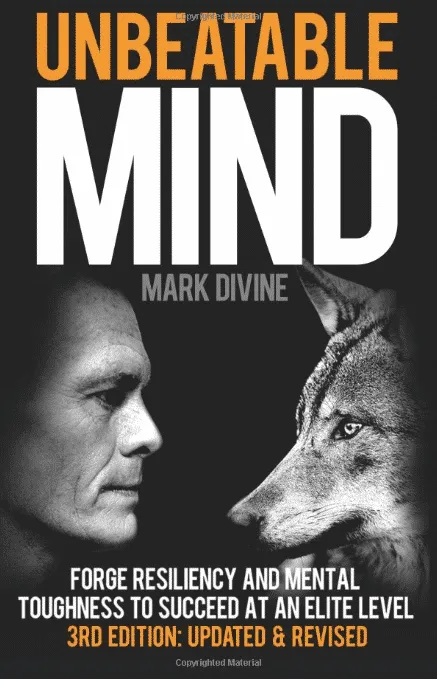
In this revised and updated third edition of Unbeatable Mind, Mark Divine offers his philosophy and methods for developing maximum potential through integrated warrior development. This work was created through trial and error, proving to thousands of clients that they are capable of 20 times more than what they believe.
The powerful principles for forging deep character, mental toughness, and an elite team provided in this book are the foundation of the Unbeatable Mind "working in" program of Divine's SEALFIT Academies and renowned Kokoro Camp. They are being employed by a growing number of coaches, professors, therapists, doctors, and business professionals worldwide.
Commander Divine is a retired Navy SEAL and human performance expert who works with elite military, sport, and corporate teams, SEAL/SOF candidates, and others seeking to maximize their potential, leading to more balanced success and happiness. The training is leading to breakthroughs in all walks of life and cultivating a robust community of practitioners.
This book will specifically help you develop:
- Mental clarity - to make better decisions while under pressure.
- Concentration - to focus on the mission until victory is assured.
- Awareness - to be more sensitive to your internal and external radar.
- Leadership authenticity - to be a heart-centered leader and service-oriented teammate.
- Intuition - to learn to trust your gut and use mental imagery to your advantage.
- Offensive "sheepdog" mindset - to avoid danger and stay one step ahead of the competition or enemy.
- Warrior spirit - to deepen your willpower, intention, and connection with your spiritual self.
Mark Divine spent twenty years as a Navy SEAL officer. He deployed to some of the most dangerous environments on earth, trained hundreds of operators, and commanded men in conditions where psychological failure meant death. When he left the service and began teaching civilians what he had learned about human performance, people expected war stories and physical challenges. What they found instead was something far more interesting: a complete system for developing an unconquerable mind.
Unbeatable Mind is that system. It draws on Divine’s SEAL experience, his background in martial arts, his study of yoga and Eastern philosophy, and his work with thousands of athletes, executives, and veterans through his SEALFIT training program. The result is a framework for mental toughness that is both more accessible and more demanding than anything most people have encountered — accessible because it is built on universal principles of human psychology, and demanding because it requires confronting the parts of yourself that you have spent years avoiding.
This is a book about the 20x factor — the idea that you are capable of twenty times more than your current performance suggests, and that the gap between where you are and where you could be is not physical but mental. Close that gap, and everything changes.
The 20x Factor: Why Your Mind Is the Constraint
The claim at the heart of Unbeatable Mind — that humans are capable of twenty times more than they typically access — is not motivational hyperbole. It is grounded in a specific observation about how the mind governs physical and cognitive performance.
Divine draws on a well-documented phenomenon in exercise physiology: the body’s first signal of discomfort arrives when physical reserves are still largely intact. When you feel the urge to stop, you have typically used somewhere between 20 and 40 percent of your available capacity. The remaining 60 to 80 percent is locked behind a mental governor — a deeply ingrained survival mechanism that sends “stop” signals long before you are in genuine danger. This governor is adaptive in normal circumstances. It prevents injury and conserves resources. But it also prevents extraordinary performance, and it operates far below the level of conscious awareness for most people.
SEAL training — BUD/S in particular — is designed to systematically break down this governor. The six months of relentless physical, mental, and sleep-deprived stress that candidates endure is not primarily about building physical fitness. It is about forcing trainees to discover, through direct experience, that they can continue far beyond where their mind first tells them to stop. This discovery — visceral and unmistakable once you have made it — fundamentally changes a person’s relationship to their own limits. What felt like a wall was actually a checkpoint. And checkpoints can be passed.
The 20x factor is not about pushing to physical destruction. It is about learning to distinguish between the mind’s protective noise and genuine physiological necessity. Most people stop at the noise. SEALs learn to evaluate it, acknowledge it, and then continue moving. This capacity — which Divine calls mental toughness — is trainable by anyone, not just military operators. The methods are different in a civilian context, but the underlying mechanism is the same.
What makes this insight so powerful is its implication for every domain of life, not just physical performance. The same mental governor that tells a SEAL candidate to quit during Hell Week tells an entrepreneur to give up after the third rejection, tells a writer to abandon the manuscript when the first draft is ugly, tells a parent to retreat from a difficult conversation with their teenager. The capacity to remain present, grounded, and functional when every instinct screams “stop” is transferable across contexts. Training it in one domain builds it everywhere.
The Five Mountains: A Map of Integrated Development
One of the most distinctive features of Unbeatable Mind is its insistence that mental toughness cannot be developed in isolation from the rest of human development. Divine introduces the framework of the Five Mountains — five domains that must be developed together for genuine unbeatable mind performance.
The first mountain is Physical. This is the foundation. Without a body that is strong, capable, and well-maintained, the mental and spiritual dimensions of performance are built on unstable ground. Divine is not advocating for elite athletic performance as a requirement for mental development. He is making the more modest but important claim that deliberately developing physical capacity — through training, nutrition, and recovery — creates the physiological platform on which all other development rests. The body and mind are not separate systems. Training one trains the other.
The second mountain is Mental. This encompasses the specific cognitive skills that Divine identifies as the foundation of mental toughness: concentration, visualization, the ability to regulate attention, and the capacity to work under pressure without losing clarity. These are trainable skills, not fixed traits. The mental training practices in Unbeatable Mind — breath work, visualization protocols, attention training — are designed to develop these capacities systematically, the way physical training develops strength.
The third mountain is Emotional. Divine makes an argument here that surprises many readers who come to the book expecting pure hardness. Emotional intelligence — the ability to understand, regulate, and express emotions appropriately — is not soft or peripheral to mental toughness. It is central. Men and women who cannot manage their emotions become reactive under pressure, make poor decisions in high-stakes situations, and exhaust the people around them. The SEAL teams are not staffed with emotionally underdeveloped people. They are staffed with people who have developed enough emotional mastery to remain functional when everything is going wrong.
The fourth mountain is Intuitional. This is the most unusual element of Divine’s framework and the one that generates the most skepticism from readers with a purely materialist worldview. Divine argues that a significant portion of high-performance decision-making bypasses the conscious rational mind — that experienced operators develop a form of intuitive pattern recognition that processes environmental information faster than deliberate analysis can. Training this intuitive capacity requires practices that most Western performance culture ignores: meditation, reflective journaling, time in nature, contemplative prayer. These are not peripheral activities. They are the training ground for the intuitive mind.
The fifth mountain is Kokoro — a Japanese concept that translates roughly as “heart-mind,” or the integration of courage, commitment, and spirit. This is the summit of the model: the state in which all four other mountains are integrated into a unified expression of who you are. A person operating from Kokoro does not experience the conflict between what they believe and how they act, between who they want to be and who they are showing up as. They have done the work of integration, and the result is a groundedness and authenticity that is unmistakable to everyone around them.
The Ethos of the Warrior: Why Purpose Precedes Performance
Divine is insistent that mental toughness divorced from purpose is just stubbornness, and that stubbornness without direction is destructive. The unbeatable mind is not simply a mind that refuses to quit. It is a mind that refuses to quit in service of something meaningful. This distinction matters enormously, and it is one of the places where Unbeatable Mind diverges most sharply from the toughness culture that has proliferated in the fitness and business worlds.
The warrior ethos that Divine describes is not about aggression or competition. It is about commitment to a code — a set of values and principles that guide behavior independently of circumstance. Warriors in the truest sense are not people who enjoy conflict. They are people who have the capacity to function effectively in conflict because they have clarity about who they are and what they stand for. That clarity is the source of their power, and it comes from the deliberate work of defining and internalizing a personal ethos.
Divine asks readers to do this work explicitly. He prompts a process of identifying core values, defining the principles that govern behavior in service of those values, and articulating a purpose that transcends personal benefit. This is not a casual exercise. It requires honest self-examination, the willingness to confront the gap between espoused values and lived behavior, and the courage to commit to a standard that will sometimes be inconvenient.
The payoff is worth the difficulty. Men and women who have done this work operate with a different quality of motivation than those who have not. They are not dependent on external rewards or punishments to generate effort. They do not need the approval of others to feel confident in their direction. They have an internal compass that remains reliable even when external conditions are chaotic — and that compass is the foundation of everything else in the unbeatable mind framework.
The warrior ethos also provides the frame for understanding failure. Divine does not treat failure as something to be avoided or minimized. He treats it as a necessary and valuable part of the development process — the feedback mechanism through which character is built. But this framing only works when there is a clear purpose to orient toward. Without purpose, failure is just pain. With purpose, failure is information — data about what needs to change so that the purpose can be more effectively served.
Breath, Box Breathing, and the Tactical Reset
One of the most immediately practical contributions of Unbeatable Mind is its detailed treatment of breath control as a performance tool. This is not generic wellness advice about breathing deeply. It is a specific technology, developed and refined in the SEAL teams and other elite military units, for managing the physiological stress response in real time.
The technique Divine calls box breathing — inhale for four counts, hold for four counts, exhale for four counts, hold for four counts — is a deliberate intervention in the autonomic nervous system. The physiological mechanism is direct: extending the exhale phase and introducing breath holds activates the parasympathetic nervous system, counteracting the sympathetic activation that produces the tunnel vision, impaired decision-making, and loss of fine motor control that accompany acute stress. Four to six cycles of box breathing can measurably shift the physiological state from threat response to controlled performance.
This matters in extreme situations — a firefight, a medical emergency, a high-stakes negotiation — but Divine argues that its daily practice is even more important than its emergency use. Regular breath work builds the capacity to access the parasympathetic state on demand, shortening the recovery time from stress activation and raising the baseline level of physiological regulation. It is, in essence, a daily training practice for the nervous system.
Divine extends the breath work into a broader meditation practice that he calls DIRECT or the Warrior Meditation. This combines breath awareness with visualization, mantra repetition, and interoceptive scanning — systematic attention to the physical sensations of the body — in a daily practice of 20 to 45 minutes. The claims he makes for this practice are substantial, and they are backed by the research literature on meditation’s effects on stress resilience, emotional regulation, and cognitive performance under pressure.
What distinguishes Divine’s approach to meditation from the mindfulness-app version is its explicit performance orientation. This is not meditation for relaxation or general wellbeing. It is meditation as mental training — a deliberate practice of strengthening the attentional, emotional, and regulatory capacities that distinguish high performers from everyone else. The same discipline that a competitive athlete brings to physical training, Divine brings to the cultivation of mental capacity. The results, for those who practice consistently, are comparably dramatic.
Visualization: The Inner Training Ground
Visualization is treated in most performance literature as a secondary tool — something you do to prepare for a presentation or prime yourself before an event. In Unbeatable Mind, it is a primary training modality with its own protocols, progressions, and performance standards. This elevation of visualization to equal status with physical training reflects the neuroscience: the brain largely cannot distinguish between a vivid mental rehearsal and an actual physical event. Neurons fire in the same patterns. Motor sequences are encoded. Emotional responses are prepared. Mental visualization is not a substitute for physical practice, but it is a genuine amplifier of it.
Divine’s visualization protocols are structured around specific outcomes: rehearsing successful performance in high-pressure scenarios, processing and learning from failures without being destabilized by them, building the mental representation of the kind of person you are working to become. The practices are deliberate and graduated — beginning with simple sensory visualization of physical movements and progressing to complex multi-sense simulations of high-stakes scenarios.
The use of visualization in military training has a long history, and Divine draws on this tradition while adapting it for civilian contexts. The fundamental principle is the same: you perform the way you have trained, and you can train mentally as well as physically. Men and women who have mentally rehearsed how they will respond to failure, pressure, conflict, and exhaustion recover more quickly and perform more reliably when those situations arise in reality. The visualization has prepared the neural pathways. The response arrives more automatically and with less cognitive cost.
One application of visualization that Divine emphasizes is future-self projection — the practice of creating a detailed, vivid mental image of the person you are working to become. This is not wishful thinking. It is identity construction. The brain’s self-concept system responds to vivid, emotionally resonant imagery. By regularly visualizing yourself operating as the person you want to be, you begin to make decisions consistent with that identity before the external evidence of transformation is visible. The identity shift precedes the behavioral shift, and the visualization accelerates the identity shift.
Team Development: The SEAL Principle of Collective Resilience
Divine is careful to situate individual mental toughness development within a larger context of team and relational performance. SEALs do not operate alone. Their extraordinary effectiveness is a function not just of individual capability but of the collective resilience, trust, and coordination of their teams. The unbeatable mind, in this context, is not a solo achievement. It is a contribution to a collective capacity.
The principles of team development that Divine draws from the SEAL experience are directly applicable to any high-performance team context: absolute clarity of purpose and standards, radical accountability between team members, the cultivation of trust through consistent action rather than declaration, and the willingness to have difficult conversations rather than allowing conflict to fester. These are not soft management concepts. They are operational necessities in environments where failure is catastrophic.
Divine introduces the concept of Front Sight Focus at the team level — the organizational version of the individual capacity to maintain clarity and focus on the mission under conditions of extreme stress. High-performance teams develop shared mental models of the objective and of each member’s role, practice scenario rehearsals together, and build the communication protocols that allow rapid, accurate information sharing in fast-moving situations. This is not bureaucratic procedure. It is collective mental training.
The leadership implications are particularly rich. Divine argues that the most important function of a leader in a high-performance team is not tactical expertise or strategic vision — though both matter. It is the cultivation of psychological safety and high standards simultaneously. Team members must feel genuinely safe to take risks, make mistakes, and speak truthfully, while also holding themselves and each other to genuinely demanding standards of performance. Creating this combination — safety and standards — is the art of leadership, and it is the environment in which the unbeatable mind capabilities of individual team members can be most fully expressed.
The Role of Hardship: Why Comfort Is the Enemy
One of the most counterintuitive messages in Unbeatable Mind is its treatment of hardship not as an unfortunate obstacle but as an essential developmental resource. Divine is explicit: the capacity for mental toughness is built through voluntary exposure to difficulty, and a life organized around the avoidance of discomfort actively prevents the development of the capabilities that make life most worth living.
This is not masochism and Divine is careful to distinguish the two. Masochism seeks pain as an end in itself. The warrior ethos seeks growth through the intelligent use of challenge. The distinction is purpose: hardship pursued in service of development is transformative; hardship pursued for its own sake is merely suffering. The SEAL training environment is designed with this distinction in mind — every element of BUD/S serves a developmental function, even (especially) when it feels purely punishing.
For civilians, the practical implication is the deliberate seeking of challenges that exceed current capacity. Divine’s SEALFIT program embeds this principle through regular exposure to physical challenges that are genuinely difficult — 20X events, multi-hour workouts, deliberate fatigue challenges — not because the physical outcomes matter primarily, but because the psychological adaptations produced by persisting through genuine difficulty are exactly what the unbeatable mind framework is trying to build.
The cold exposure practices that Divine recommends serve the same purpose. Cold water immersion is intensely uncomfortable in a way that cannot be cheated or reasoned around. The discomfort is immediate and undeniable. Choosing to enter cold water and remain there while the discomfort intensifies, then remaining present and breathing through it rather than thrashing or exiting — this is a direct training of the exact psychological capacity that defines mental toughness in every domain. The cold does not care about your story. It just shows you who you are.
The broader principle here is that every domain of significant achievement — physical, relational, professional, creative — requires the capacity to remain present and functional in the presence of difficulty. This capacity cannot be developed in its absence. You cannot think your way to toughness. You cannot read your way to it, though reading can point you in the right direction. You build it by putting yourself in situations where you need it and choosing, repeatedly, to stay rather than flee.
The Crucible Experience: Breaking Through the Wall
Divine describes what he calls the Crucible experience — a moment of transformation that often occurs during extended, intense challenges when the ego’s normal resistance finally exhausts itself and something quieter and more fundamental becomes available. This is a well-documented phenomenon in endurance sports, extreme military training, and contemplative practice: a state that athletes call “second wind,” that mystics call grace, and that psychologists call flow or peak experience.
Whatever we call it, the phenomenology is consistent: after a period of intense struggle, the normal mental chatter and resistance fall away, replaced by a kind of effortless functioning in which performance improves dramatically and subjective experience becomes vivid, clear, and oddly pleasant despite the objective difficulty of the situation. Divine interprets this experience through multiple lenses — physiological (the stress hormones have peaked and begun to fall, endorphins are elevating), psychological (the ego’s narrative control has given up, leaving pure present-moment experience), and spiritual (connection to something larger than the individual self has become accessible).
The relevance for everyday life is profound. Most people never approach this threshold because they stop long before reaching it. The extraordinary states of consciousness and capability available beyond the wall are available to any human being — they are part of our design — but they require passing through the discomfort that precedes them. The man or woman who can stay in the fire long enough, who has the tools to remain present and functional when everything in them is screaming to stop, is the one who gets to discover what lies on the other side.
The practices in Unbeatable Mind — breath work, visualization, cold exposure, deliberate physical challenge, daily meditation — are all, in different ways, training for the moment before the Crucible. They build the physiological regulation, psychological stability, and spiritual depth that allow a person to pass through the wall rather than stop in front of it. They are preparation for transformation.
Daily Practices: Building the Unbeatable Mind One Day at a Time
The theoretical framework of Unbeatable Mind is impressive, but its value lies in its practical implementation. Divine is very specific about daily practices — the non-negotiable habits that, compounded over time, build the unbeatable mind one day at a time. This specificity is one of the book’s greatest strengths.
The morning ritual is the anchor. Divine recommends a structured sequence that begins with five to ten minutes of box breathing to activate the parasympathetic nervous system and transition from sleep to deliberate wakefulness. This is followed by a brief physical practice — even five to ten minutes of movement counts — to activate the body. Then a period of meditation, visualization, or journaling that engages the mental, emotional, and intuitional dimensions of the Five Mountains. The whole sequence can be as brief as 20 minutes if time is genuinely constrained, but the discipline of doing it daily matters more than its length.
The daily physical training is designed around the principle of functional fitness — movements and challenges that translate to real-world capability rather than aesthetic outcomes. Swimming, running, gymnastic movements, heavy lifts, combat training — the specific modalities are less important than the consistency and the deliberate pursuit of progressive challenge. Divine recommends training six days a week, with one day of active recovery. The volume is substantial but not extreme. The intensity is consistently high.
Evening reflection closes the daily cycle. Divine recommends a brief journaling practice that reviews the day through the lens of the personal ethos — where did you live up to your values, where did you fall short, what do you want to do differently tomorrow. This is not self-criticism. It is self-evaluation in service of continuous improvement. The SEAL teams call this the after-action review, and its consistent application is one of the primary mechanisms through which they learn and adapt faster than conventional military units.
Weekly challenges — deliberately chosen activities that push beyond the comfort zone in a structured way — complete the practice architecture. These might be cold water immersion, a long endurance effort, a difficult conversation that has been postponed, a new physical skill, a creative challenge. The specific content matters less than the principle: choose something that is genuinely difficult for you right now, do it fully, and extract the learning from the experience.
Integration: Becoming Whole
The ultimate aim of Unbeatable Mind is not the production of a more effective killing machine or a more productive business person. It is the development of a whole human being — one who is simultaneously physically capable, mentally sharp, emotionally mature, intuitively developed, and spiritually grounded. This integration is what Divine means by Kokoro, and it is the state from which genuine high performance — and genuine contribution to the world — becomes possible.
This integrated state is rare but not inaccessible. Divine encounters it in the SEAL teams, in elite athletes, in certain business leaders, in committed spiritual practitioners from every tradition. What these people share is not superhuman talent or exceptional circumstances. What they share is the discipline of development across multiple dimensions simultaneously — the refusal to let physical atrophy, mental laziness, emotional avoidance, or spiritual neglect go unaddressed. They have taken full responsibility for their development as human beings, and the integration that results from that responsibility produces a quality of presence and effectiveness that is visible and unmistakable.
The barriers to this state are almost entirely self-imposed. The information is available. The practices are accessible. The time required is substantial but not prohibitive. What is required is the decision to treat your own development as the primary project of your life — not as a hobby or an occasional priority, but as the central organizing commitment from which everything else flows. This is the decision that separates the people who access the unbeatable mind from those who remain in the comfortable 20 percent.
Divine is honest about the cost. The path he describes is demanding. The practices require consistency. The honest self-examination required for genuine development is uncomfortable. The hardships that build character are genuinely difficult. There are no shortcuts, and the people who look for them typically find that the shortcut leads them back to the beginning of the path they were trying to avoid.
What the SEAL Experience Actually Teaches About Performance
Divine is careful throughout Unbeatable Mind not to romanticize military service or imply that SEAL training is the only path to the capabilities he describes. But he is also unwilling to pretend that the SEAL experience does not teach things about human potential that are genuinely extraordinary.
The most important thing SEAL training teaches is not how to fight, shoot, or move tactically. It is that your estimation of your own limits is radically conservative. Every SEAL candidate who survives BUD/S arrives on the other side with a permanently revised model of human capability — not just their own capability but human capability in general. They have proven to themselves, through direct experience that cannot be argued away, that the human being is capable of functioning effectively at levels of exhaustion, fear, discomfort, and stress that would stop most people before they even began.
This knowledge changes everything. When you know from direct experience that you can function at 100% exhaustion, then 70% exhaustion stops feeling like a crisis. When you know that you have operated effectively under genuine mortal threat, then professional pressure stops triggering the same physiological response. The experiences have calibrated your threat assessment system with real data, and the recalibration is permanent.
For civilians who will never experience SEAL training, Divine argues that analogous experiences are available and valuable. The specific form of the challenge matters less than its intensity, its voluntary nature, and the deliberate extraction of learning from the experience. His SEALFIT program is designed to provide controlled versions of these experiences. But so is a marathon, a wilderness survival course, a serious martial arts program, or any sustained engagement with genuinely demanding physical and psychological challenge.
What to Take From This Book
The central message of Unbeatable Mind is simultaneously simple and demanding: you are not living at your capacity, the gap between where you are and where you could be is primarily mental, and closing that gap requires deliberate daily practice across five integrated dimensions of development. This message is available in one sentence. Living it is the work of a lifetime.
The practices Divine recommends are accessible to anyone willing to commit to them. Box breathing and meditation require nothing but time and consistency. Physical training requires equipment and a schedule. Visualization requires only a quiet space and a willingness to sit with your own mind. Journaling requires honesty and a notebook. These tools are not exotic. They are the daily hygiene of an examined life — the minimum maintenance required to keep the human instrument functioning at the level it was designed for.
What separates the people who do this work from those who do not is not information. Almost everyone who picks up this book has access to the same information. What separates them is the decision to take their own development seriously — to treat the cultivation of physical, mental, emotional, intuitional, and spiritual capacity as a genuine priority rather than a vague aspiration. Divine has made this decision and built a life and a career around it. This book is his invitation for you to do the same.
The unbeatable mind is not a destination. It is a direction. Every day that you choose the practice over the comfort, the challenge over the retreat, the honest self-examination over the comfortable story — that day you move in the direction of the person you are capable of becoming. Over time, that direction becomes a life. And that life becomes a gift, not just to yourself, but to everyone your strength makes possible.
Front Sight Focus: Clarity Under Fire
The title of Divine’s training organization — SEALFIT — is misleading if you read it as a fitness brand. It is better understood as a shorthand for a specific performance principle: the SEAL quality of maintaining focus on the immediate mission-critical objective regardless of the chaos in the peripheral environment. Divine calls this Front Sight Focus, borrowing from marksmanship training where the fundamental principle is to maintain absolute clarity of focus on the front sight of the weapon, rather than the target, the threat, or the surrounding environment.
Applied to life, Front Sight Focus is the capacity to remain clearly oriented toward what matters most in any given moment — the next right action, the present task, the immediate responsibility — without being drawn into the noise of everything that is less important. This sounds straightforward and it is absolutely not. The human mind evolved to scan for threats, to monitor the peripheral environment, to plan ahead and ruminate on the past. Maintaining sustained, deliberate focus on what matters most is a trained skill, not a natural default.
The practice of Front Sight Focus begins with clarity about what the front sight actually is. What is the most important thing you can be doing right now? What is the task, the conversation, the relationship, the project that most deserves your full attention in this moment? Most people have a vague answer to this question at best. Divine argues that the first step of mental toughness training is developing the habit of explicitly identifying your front sight before any significant period of work, and then returning to it deliberately whenever your attention wanders.
The digital environment makes this more challenging than ever. Notifications, social media, email, and the endless demands of connectivity create a constant pressure toward fragmented attention — what researchers call continuous partial attention, the state in which you are technically present but not fully focused on anything. This state feels busy and engaged but produces a fraction of the output of genuine deep focus. The unbeatable mind trains itself out of continuous partial attention through deliberate practice of sustained focus, using the same progressive overload principle that governs physical training: start with short intervals of focused work, extend them gradually, rest and recover, repeat.
The Long Game: Why This Work Never Ends
Divine is careful not to promise that the practices in Unbeatable Mind lead to a permanent state of peak performance. They do not. What they lead to is a different relationship with the inevitable fluctuations of human experience — a greater capacity to return to baseline quickly after disruption, a higher baseline of functional performance, and a deeper reservoir of psychological resources available during genuine crises.
The work of developing an unbeatable mind is not a project with a completion date. It is a practice with a direction. Every day brings new challenges to the Five Mountains, new opportunities to apply the tools, new feedback about where growth is needed. The man who has been practicing for ten years is not finished; he is ten years deeper into a practice that continues to reveal new dimensions of development. The woman who has been meditating daily for five years is not enlightened; she is five years into the cultivation of a quality of attention that continues to deepen and refine.
This framing — practice as a direction rather than a destination — is itself one of the most valuable things the book offers. It removes the performance pressure from the development process. You are not trying to achieve a final state. You are trying to show up consistently for the practice and trust the process to produce the development. This is simultaneously less dramatic and more sustainable than the goal-fixated approach to self-improvement that most people bring to the work.
The SEALs have a saying: the only easy day was yesterday. It sounds like bravado, but Divine reads it as a description of the nature of genuine growth. Every day that you show up for the practice, you encounter a version of yourself that is slightly more capable than the version from yesterday — which means the challenges required to grow are also slightly more demanding. Growth generates the conditions for further growth. The horizon never stops moving. This is not frustrating. This is the entire point.

