
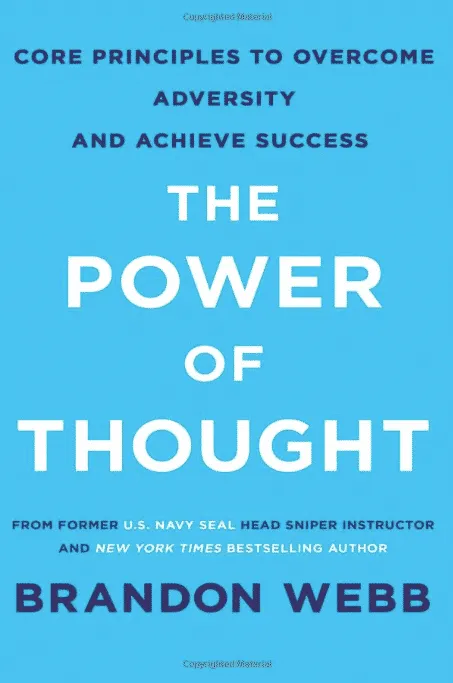
What are the core elements that allow top performers to achieve success repeatedly?
One clear, positive thought can set a goal in bedrock or trigger peak performance.
Study three easy fundamentals and make them a habit, and you have a recipe for sustained success no matter what hurdles life throws at you.
This is a story of a small boy, scared and alone in the world, who ran away from home at 16, overcame numerous hostile environments to pursue his dream to become a Navy SEAL, and eventually became the naval special warfare sniper course manager (head) instructor. The lessons learned along the way were powerful.
When I was part of the sniper instructor cadre, we studied the habits of champions and top performers. Then we applied them to our course curriculum and students. The results were incredible and undeniable.
The power of thought works.
Marcus had been telling himself the same story for eleven years. Every morning, same ritual: alarm at 6:47, coffee in the same chipped mug, the same affirmations written on a Post-it note above the bathroom mirror. “I am successful. I am abundant. I am worthy.” Eleven years of affirmations. He was still $40,000 in debt, still in the same mid-level accounts position, still calling his mother every Sunday to explain why he hadn’t moved yet. The thoughts were there. The reality wasn’t cooperating.
The Power of Thought promises to bridge that gap. It’s a motivational framework book drawing from multiple contributors — the kind of text that assembles wisdom from Napoleon Hill, Norman Vincent Peale, William James, and the broader tradition of mental science that dominated American self-help from 1890 to 1960. The core thesis: your dominant thoughts shape your dominant reality. Think better thoughts, build a better life.
Is it true? Partially. Is it the whole story? Absolutely not. And the gap between “partially true” and “the whole story” is where millions of Marcuses lose decades of their lives chasing mental alchemy that was never going to transmute wishful thinking into structural change.
This is a full-length examination of what The Power of Thought gets right, what it catastrophically misses, and how to extract the genuine psychological signal from the motivational noise.
- Key Takeaway 1: Thought quality does influence action quality — but only when thoughts are tied to specific behavioral commitments, not vague affirmations.
- Key Takeaway 2: The “law of attraction” framing is scientifically incoherent, but the underlying attention-direction mechanism (reticular activating system) is real and useful.
- Key Takeaway 3: Negative thought patterns create genuine neurological grooves that must be actively overwritten — this is legitimate cognitive behavioral science.
- Key Takeaway 4: The framework breaks down completely without a companion system for action, accountability, and environmental design.
- Key Takeaway 5: The most powerful application is not positive thinking but accurate thinking — seeing obstacles clearly while maintaining forward momentum.
What The Book Actually Argues
Strip away the inspirational language and The Power of Thought is making a relatively modest cognitive claim: the quality of your mental inputs shapes the quality of your mental outputs, which shapes your behavior, which shapes your results. This is not a controversial statement. It is, in fact, supported by decades of cognitive science. Where the book goes off-rails is in its causal architecture — the leap from “thoughts influence behavior” to “thoughts directly manifest reality” is where philosophy becomes fantasy.
The book’s contributors draw heavily from the mental science movement, a late-19th-century American spiritual tradition that blended Protestant optimism, Emersonian transcendentalism, and proto-psychology. Norman Vincent Peale’s “The Power of Positive Thinking,” Napoleon Hill’s “Think and Grow Rich,” and James Allen’s “As a Man Thinketh” are the canonical texts of this tradition. The Power of Thought sits squarely in this lineage.
The central claims can be organized into three tiers. First tier: your thoughts create your emotional state, your emotional state influences your behavior, and your behavior produces your results. This is true and valuable. Second tier: by deliberately cultivating positive thoughts, you can sustain the emotional states that lead to productive behavior. Also true, with caveats about what “positive” means. Third tier: the universe literally responds to your mental frequency, bringing circumstances into alignment with your dominant thoughts. This is where the wheels come off.
The third tier is metaphysics dressed as mechanism. There is no peer-reviewed evidence that the universe has a response function to human cognition. The anecdotes that appear to support it are survivorship bias: we remember the times our positive thinking coincided with good outcomes and forget the thousands of times it didn’t. The human brain is a pattern-matching machine that will always find confirmation for whatever narrative it’s currently running.
But here’s the uncomfortable nuance: even if the mechanism is wrong, the prescription can still produce real-world results. Not because the universe is listening, but because attention is a finite resource, and where you direct it determines what you notice, pursue, and build. This is the reticular activating system at work — a real neurological filter that decides what sensory data reaches conscious awareness.
The RAS Framework: What Actually Works
The reticular activating system (RAS) is a bundle of nerves in your brainstem responsible for filtering the roughly 11 million bits of sensory data your body receives per second down to the roughly 50 bits your conscious mind can process. It is your brain’s bouncer, and it lets in what it’s been told to look for.
When you buy a red Honda Civic, you suddenly see red Honda Civics everywhere. They were always there. Your RAS just wasn’t filtering for them. When you decide you want to launch a freelance business, you start noticing clients, opportunities, and relevant conversations that were always happening around you. The Power of Thought is correct that mental focus shapes what you perceive — it’s just wrong about why.
Dr. Moshe Bar’s research at Harvard Medical School on predictive cognition demonstrates that the brain is constantly generating predictions about what it expects to encounter, then sampling the environment to confirm or disconfirm those predictions. Dominant thought patterns literally shape what the brain predicts, which shapes what it notices, which shapes what feels “real” to you. This is the legitimate science behind what motivational writers mystify as “manifestation.”
The practical implication: if you want to change your results, you need to change what your RAS is scanning for. You do this through repeated, specific mental rehearsal — not vague affirmations, but detailed visualization of specific actions and specific outcomes. Military snipers do this. Elite athletes do this. Surgeons rehearse operations mentally before performing them. The research on mental rehearsal (reviewed comprehensively by Guang Yue and Kelly Cole at the Cleveland Clinic) shows that mental practice activates the same neural circuits as physical practice, producing measurable skill improvement.
This is what The Power of Thought is accidentally pointing toward. The problem is that its framework is too mystical to give you an actionable protocol, and too optimistic to warn you about the failure modes.
For a more grounded approach to deliberate practice and how to build skills through intentional mental and physical repetition, that framework is worth examining alongside this one.
The Thought-Action Gap Model
Here is the framework I’d propose for actually using what this book teaches without falling into its traps. I call it the Thought-Action Gap Model, and it operates on three principles that The Power of Thought gestures toward but never quite articulates.
Principle 1: Thoughts are proposals, not commands. A thought that fires in your mind is not a directive from the universe and not a guarantee of outcome. It is a proposal to your attention system: “This is worth noticing and pursuing.” The thought has no power except the power you give it by acting on it. Positive thoughts that generate zero action are mentally sedating, not empowering. They create what psychologists call “mental contrasting” failure — the warm feeling of imagining success that reduces the drive to actually pursue it.
Gabriele Oettingen’s research at NYU, documented in “Rethinking Positive Thinking,” found that pure positive visualization actually decreases motivation and goal achievement compared to people who engage in “mental contrasting” — visualizing both the desired outcome AND the specific obstacles standing in the way. The effective protocol is called WOOP: Wish, Outcome, Obstacle, Plan. It combines positive goal-setting with realistic obstacle identification. This directly contradicts the simplistic “only think positive thoughts” prescription of motivational literature.
Principle 2: The gap between thought and result is always filled with action. The Power of Thought creates the impression that mental work alone closes the gap between where you are and where you want to be. It doesn’t. Every example in the book of someone who “thought their way” to success is actually an example of someone who thought their way to a specific set of actions that produced success. The thought was a catalyst, not a cause. This distinction matters because it tells you where to invest your energy: not in thinking longer and harder, but in thinking more precisely about what specific actions your desired outcome requires.
Principle 3: Environment beats willpower; structure beats motivation. The book’s framework requires sustained mental discipline — the daily maintenance of positive thought patterns against the constant pull of anxiety, doubt, and distraction. This is metabolically expensive and historically ineffective as a long-term strategy. Research on ego depletion (Roy Baumeister, Florida State) and decision fatigue (Jonathan Levav and Shai Danziger, Columbia and BGU) shows that willpower is a depletable resource. You cannot think your way to excellence if your environment is constantly depleting your mental resources.
The structural intervention — changing your physical environment, social circle, information diet, and daily defaults — is far more powerful than any mental technique. This is why monk mode works: it creates environmental conditions that make focused work the path of least resistance, rather than relying on willpower to maintain focus against a hostile environment.
The Dark Side of Positive Thinking
Barbara Ehrenreich spent years investigating the positive thinking industry and produced “Bright-Sided: How the Relentless Promotion of Positive Thinking Has Undermined America.” Her central finding: the mandatory optimism culture that permeates American corporate and self-help life actively suppresses honest assessment of problems, making them worse. The Power of Thought’s tradition is directly implicated in this dynamic.
When your framework tells you that negative thoughts attract negative outcomes, you create a psychological penalty for acknowledging problems. Employees don’t report issues because doing so feels “negative.” Entrepreneurs don’t plan for failure scenarios because that’s “limiting beliefs.” Patients don’t research alternative diagnoses because that’s “attracting illness.” The logical endpoint of pure positive thinking is an information filter that screens out precisely the data you need to make good decisions.
The research on this is damning. Martin Seligman, the founder of positive psychology at Penn, is often cited by positive thinking advocates, but Seligman’s actual work makes a crucial distinction between optimism (believing that effort will produce results) and Pollyanna thinking (believing that things will work out regardless of effort). Learned optimism, Seligman’s actual prescription, involves accurate assessment of situations combined with a “flexible” explanatory style that doesn’t catastrophize setbacks. It is emphatically not about ignoring negative information.
The dopamine crisis running through modern productivity culture is partly a creation of the motivational industry itself — the endless cycle of inspirational content that produces brief dopamine hits without changing underlying behavior patterns. The Power of Thought, consumed passively as motivational reading, can become part of this problem rather than the solution.
“The problem with positive thinking is not that it doesn’t work. The problem is that it works just well enough to feel like progress while preventing the deeper structural changes that would actually move the needle.” — Adapted from Barbara Ehrenreich, Bright-Sided
The Napoleon Hill Problem
Napoleon Hill is the patron saint of this tradition, and The Power of Thought draws significantly from his framework. Hill’s “Think and Grow Rich” has sold over 100 million copies and influenced virtually every motivational text written in the 20th century. It also contains significant fabrications that the positive thinking industry has never honestly reckoned with.
Hill claimed to have personally interviewed Andrew Carnegie, Henry Ford, Thomas Edison, and hundreds of other industrialists for his research. Many of these interviews are now believed to have been invented or heavily embellished. Hill’s personal life was characterized by financial instability, fraud charges, and multiple failed ventures — a biography somewhat at odds with his message that sustained positive thinking produces sustained prosperity.
This doesn’t invalidate every insight in the Hill tradition. The observation that successful people tend to have clear, specific goals rather than vague wishes is empirically supported. The claim that persistence in the face of failure is a predictor of eventual success is supported by research on grit (Angela Duckworth, Penn). But these insights don’t require the metaphysical framework Hill built around them. They stand on their own as observations about behavior and psychology.
What the Hill tradition introduced that is genuinely problematic: the idea that failure is always and only a thought problem. If you’re poor, it’s because you’re thinking poor thoughts. If your business failed, it’s because you lacked the right mental state. This framework is not just intellectually wrong — it is morally corrosive, because it turns structural disadvantages (poverty, discrimination, illness, market conditions) into personal character failures. The person born into poverty didn’t fail to think their way to wealth. They encountered real structural obstacles that no amount of positive thinking would remove.
What To Actually Do With This Book
If you’ve already read The Power of Thought or are considering it, here is a practical extraction protocol — how to take the genuine value without swallowing the mythology.
Extract 1: The morning mental rehearsal practice. The book’s prescription of beginning your day with deliberate, focused thought about your goals is legitimate when executed correctly. Spend 10 minutes in specific mental rehearsal — not “I am successful” but “Today I will make three cold calls, and here is exactly how I will handle the likely objections.” This primes your RAS for opportunity recognition and your prefrontal cortex for planned execution. It is not magic. It is preparation.
Extract 2: The thought interruption technique. The book’s various prescriptions for interrupting negative thought patterns are grounded in real cognitive science. Cognitive behavioral therapy’s core technology — identifying automatic negative thoughts, challenging their accuracy, replacing them with more accurate assessments — is a proven intervention. The book’s version is less rigorous but points in the right direction. When a negative thought arises, don’t suppress it; interrogate it. “Is this thought accurate? What evidence supports or contradicts it? What would a reasonable person conclude?”
Extract 3: The identity shift framework. The book’s insight that behavior tends to align with self-concept is well-supported by identity-based behavior change research (James Clear’s “Atomic Habits” systematizes this beautifully). If you want to change what you do, you need to change who you believe you are. But the mechanism is not affirmations — it is small, consistent actions that provide evidence for a new identity. Every time you keep a commitment to yourself, you cast a vote for a particular identity. The thoughts follow the evidence; the evidence comes from action.
Extract 4: The goal clarity prescription. The book is correct that vague goals produce vague results. “I want to be successful” is not a goal; it is a wish. “I will generate $10,000 in freelance revenue by July 1st by securing three clients at $3,300 each, through a specific outreach strategy I will execute for 90 minutes each weekday” is a goal. The precision matters because it gives your RAS a specific target to scan for and your executive function a specific action sequence to run. For building these systems, the mindset tools framework offers structured approaches worth exploring.
The Research The Book Ignores
The Power of Thought was assembled from a tradition that predates most modern cognitive science. Here is the research it couldn’t know about, and what it changes about the prescription.
Carol Dweck’s growth mindset research at Stanford demonstrates that the most important belief about your capabilities is not “I can achieve anything I think about” but “My abilities can grow through effort and learning.” Fixed mindset — believing your capabilities are innate and fixed — produces avoidance of challenges and catastrophizing of failure. Growth mindset produces engagement with challenges and persistence through failure. The difference is not optimism vs. pessimism; it’s a specific belief about the relationship between effort and capability. This is a meaningfully different, and more empirically grounded, version of what The Power of Thought is trying to teach.
Peter Gollwitzer’s research on implementation intentions at NYU shows that people who specify in advance exactly when, where, and how they will perform a goal-related action are two to three times more likely to actually perform it. “I will exercise” is a wish. “I will exercise on Monday, Wednesday, and Friday at 6:30 AM in my garage using the barbell” is an implementation intention. This research has been replicated hundreds of times across dozens of domains. It is the most powerful single behavioral change technique known to psychology, and it is entirely absent from The Power of Thought’s framework.
Roy Baumeister and John Tierney’s work on willpower and self-regulation (“Willpower: Rediscovering the Greatest Human Strength”) establishes that self-control is most effectively deployed to change habits and environments, not to resist moment-to-moment temptations. The practical implication: stop trying to “think your way” through bad habits and instead redesign the environment that produces them. This is a 180-degree reversal of The Power of Thought’s basic approach, and it’s better supported by evidence.
Verdict and Honest Rating
The Power of Thought earns a 6 out of 10 for genuine insight buried under metaphysical scaffolding that actively misleads. The core observation — that the quality of your mental inputs shapes the quality of your outputs — is true and important. The mechanisms it proposes are scientifically illiterate. The prescriptions it derives are incomplete at best and actively harmful at worst when applied without the corrective of modern cognitive science.
Read it if you respond to inspirational frameworks and can apply your own critical filter. Skip it if you want a rigorous, evidence-based protocol for cognitive optimization — in that case, go directly to Carol Dweck’s “Mindset,” Gabriele Oettingen’s “Rethinking Positive Thinking,” and Peter Gollwitzer’s research on implementation intentions.
The Marcus at the beginning of this piece eventually got out of his debt, but not through affirmations. He got out when he stopped rehearsing success and started rehearsing the specific uncomfortable conversations, the specific skill-building routines, and the specific financial behaviors that closing a $40,000 gap actually required. His thoughts did change — but only after his actions gave them something real to build on.
That sequence — action first, then the thoughts that reinforce it — is the inversion The Power of Thought never quite manages to teach. For a framework that gets the sequence right, extreme ownership offers a military-grade model built on accountability before attitude.
The Historical Roots: Where This Tradition Came From
Understanding The Power of Thought requires understanding the cultural moment that produced it. The mental science movement emerged in America in the 1880s and 1890s — a period of extraordinary social disruption. Industrialization was displacing traditional agrarian life. The Gilded Age was producing obscene concentrations of wealth alongside widespread poverty. Calvinism’s doctrine of predestination — the idea that your fate was determined before you were born — was losing cultural authority. Into that vacuum came a new gospel: the idea that the mind was the primary cause of material circumstances, and that any individual could remake their life by remaking their thinking.
This was a democratizing message. It said: you don’t need birth, class, or connections. You need the right thoughts. Phineas Quimby, Mary Baker Eddy, Emma Curtis Hopkins, Ralph Waldo Trine — these were the pioneers. William James at Harvard, though not part of the movement, was watching closely. His pragmatist philosophy — “beliefs that work are beliefs worth holding” — provided secular scaffolding for what the mental scientists were doing spiritually.
Napoleon Hill came later, in 1937, with “Think and Grow Rich” — the text that turned mental science into a commercial industry. Hill interviewed five hundred of the wealthiest Americans of his era (or claimed to) and extracted thirteen principles of achievement, all centered on the power of a “burning desire” held with absolute conviction. The law of attraction was implicit in Hill’s work long before Rhonda Byrne made it explicit in “The Secret” (2006), which was essentially Hill’s framework with better production values and less intellectual content.
The Power of Thought sits in this lineage. The key question for any reader: what in this tradition is genuine insight about human psychology, and what is cultural mythology that got dressed up as mechanism? The answer matters because the mythology is not merely false — it actively misleads people about where to invest their change efforts.
The Real Psychology of Mental Strength
What the positive thinking tradition is pointing toward, without adequate precision, is the psychology of mental strength — a domain that modern sports psychology, military psychology, and organizational behavior research have actually investigated rigorously. The results are nuanced in ways that the motivational genre can’t accommodate, but they’re worth understanding.
Mental toughness research (Graham Jones, then at the University of Wales; Peter Clough at Manchester Metropolitan) identifies four components: control (belief in your ability to influence outcomes), commitment (the tendency to involve yourself fully in what you’re doing), challenge (viewing difficulty as opportunity rather than threat), and confidence (unshakeable belief in your capability). This is meaningfully different from “positive thinking” — it is a specific set of cognitive and behavioral orientations that can be trained and measured.
The control dimension maps to Carol Dweck’s growth mindset. The commitment dimension maps to Csikszentmihalyi’s flow research. The challenge orientation maps to Kelly McGonigal’s “The Upside of Stress” — the research showing that the belief that stress is harmful produces worse health outcomes than stress itself, and that reframing stress as a signal of engagement produces better performance and wellbeing. The confidence dimension maps to Albert Bandura’s self-efficacy research at Stanford — the finding that task-specific confidence is one of the strongest predictors of performance, and that it develops through experience of success at progressively difficult challenges, not through affirmations.
Bandura’s research is particularly instructive here. Self-efficacy — confidence in your ability to perform a specific task — is built through four mechanisms: mastery experiences (actually succeeding at the task), vicarious learning (watching similar others succeed), social persuasion (credible encouragement from people whose opinion you respect), and physiological feedback (interpreting your bodily state as indicating readiness rather than threat). Notice what is not on this list: affirmations. Repeating “I am capable” does not build self-efficacy. Doing the task, learning from it, and building a track record of execution does.
This is the core correction that transforms the vague prescription of The Power of Thought into actionable psychology: thought quality matters, but thought quality is downstream of behavioral track record, not the other way around. You build the thoughts by doing the actions, not the actions by thinking the thoughts. The sequence is the whole game.
Building the Mindset Systematically: A 12-Week Protocol
Rather than leaving you with principles, here is a practical 12-week protocol that takes the genuine insights from The Power of Thought and builds them into a systematic training program grounded in evidence. This is not meditation-and-affirmation territory. This is structured cognitive and behavioral work.
Weeks 1-2: The Thought Audit. Before you can change your thinking, you need accurate data about your current thinking. Keep a running log of your self-talk for two weeks — particularly in three categories: statements about your capabilities (“I can/can’t”), statements about permanence of situations (“this always/never happens”), and statements about cause (“because of me/them/circumstances”). You’re looking for your default explanatory style. Martin Seligman’s work on learned helplessness and explanatory style shows that the most resilient people use specific, temporary, external explanations for setbacks (“I made a tactical error in this situation”) while people prone to depression use global, permanent, internal explanations (“I always fail, nothing works for me, I’m just not capable”). Audit first. Intervene second.
Weeks 3-4: Explanatory Style Training. Using the data from your audit, deliberately challenge each global-permanent-internal explanation for a setback with a specific-temporary-situational alternative. Not: “I always fail presentations.” Instead: “That presentation went poorly because I didn’t prepare the opening two minutes adequately, and I was fighting a cold. Next time I’ll record myself running the opening three times the week before.” This is not positive thinking. It is accurate thinking — more specific, more truthful, more actionable than the catastrophizing alternative.
Weeks 5-8: The Behavioral Evidence Campaign. Identify one goal in each of three domains — professional, physical, relational. For each goal, identify the smallest possible action you can take this week that would constitute genuine progress. Execute it. Log it. You are not trying to achieve the goal in these four weeks; you are building a database of behavioral evidence for a new identity. Each completed action is evidence. Evidence builds belief. Belief compounds. This is the sequence that actually works.
Weeks 9-12: The Integration Work. Review your behavioral evidence log. Update your self-concept statement in each domain based on what the evidence actually shows — not on how you feel, not on what you wish were true, but on what the record demonstrates. Then project forward: if you continued this behavioral evidence campaign for the next twelve months at the same pace, what identity would the evidence support? That projection is your goal. Now you’re doing real goal-setting: targets grounded in demonstrated behavioral trajectory rather than aspirational fantasy.
The connection between this protocol and the broader self-development ecosystem is direct. For the focus and discipline systems that support this kind of consistent behavioral work, see deliberate practice. For the environmental design that makes the behavioral evidence campaign sustainable, see monk mode. For the accountability framework that prevents the audit from becoming another self-improvement project that fades after week two, see extreme ownership.
The Spiritual Dimension: What To Do With It
The Power of Thought has a spiritual dimension that its secular critics tend to dismiss entirely and its devotees tend to accept uncritically. There is a more useful response: understand what the spiritual framing is pointing at, separate it from the metaphysical claims, and evaluate the psychological content on its own merits.
When the tradition talks about aligning your thoughts with “universal intelligence” or “the infinite mind,” it is, in practical psychological terms, describing the importance of acting from your deepest values rather than from fear, social pressure, or survival anxiety. Research on self-determination theory (Edward Deci and Richard Ryan, University of Rochester) distinguishes between autonomous motivation (acting from intrinsic values and genuine interest) and controlled motivation (acting from external pressure, fear of punishment, or desire for reward). Autonomous motivation produces better performance, greater wellbeing, and more sustainable behavior change than controlled motivation. The spiritual instruction to “align with universal intelligence” is, functionally, an instruction to act from autonomous motivation rather than controlled motivation.
When the tradition talks about “raising your vibration” or “attracting abundance,” it is, in practical terms, describing the importance of maintaining a mental state characterized by openness, curiosity, and positive expectancy — which research on approach vs. avoidance motivation shows does produce better exploratory behavior and better use of available resources. Not because the universe is responding to your vibration, but because the brain in an approach state explores more broadly, processes information more flexibly, and makes better decisions than the brain in an avoidance state.
Barbara Fredrickson’s “broaden and build” theory at the University of North Carolina provides the mechanism: positive emotional states broaden the scope of attention and cognition, which builds psychological resources over time. The practical implication: cultivating positive emotional states is genuinely useful — not because it attracts good outcomes metaphysically, but because the cognitive broadening it produces leads to more opportunities noticed, more connections made, and more creative solutions generated. The Power of Thought is accidentally right about the prescription while being entirely wrong about the mechanism.
Books Similar to The Power of Thought
- Mindset by Carol Dweck — The empirically rigorous version of the same core insight, grounded in decades of Stanford research on fixed vs. growth mindsets.
- Rethinking Positive Thinking by Gabriele Oettingen — Direct challenge to the positive thinking tradition, with a better replacement framework (WOOP) backed by NYU research.
- Think and Grow Rich by Napoleon Hill — The foundational text of this tradition; read critically to understand the origin of these ideas.
- The Power of Now by Eckhart Tolle — Spiritual framework for mental presence that overlaps thematically but from a different philosophical tradition.
- Atomic Habits by James Clear — The practical action-side companion to any thought-focused framework; shows how identity change actually works through behavior, not belief.
FAQ
- Does positive thinking actually work? Partially — but the mechanism is behavioral, not metaphysical. Positive thinking that generates specific action plans works. Positive thinking that substitutes for action planning doesn’t.
- What is the law of attraction and is it real? The “law of attraction” as typically described — that thoughts magnetically attract corresponding circumstances — has no scientific support. The attention-direction mechanism (RAS) that produces similar-looking results is real.
- Can thoughts change brain structure? Yes. Neuroplasticity research shows that repeated thought patterns strengthen corresponding neural pathways. This is the legitimate neuroscience behind mental training practices.
- Why do affirmations not work for most people? Because they are typically too vague and too disconnected from behavior. “I am successful” gives your brain nothing actionable. “I will complete three client proposals by Thursday” does.
- What’s the difference between optimism and positive thinking? Learned optimism (Seligman) is the belief that effort produces results — it remains realistic about obstacles. Positive thinking in the Hill tradition often involves denial of obstacles, which research shows reduces motivation.
- How does the reticular activating system relate to goal achievement? The RAS filters sensory data based on what you’ve repeatedly told it to look for. Clear, specific goals prime the RAS to notice relevant opportunities and information that you’d otherwise screen out.
- Is visualization a useful technique? Process visualization (rehearsing specific actions) is well-supported by research. Outcome visualization alone (imagining success without rehearsing the process) can actually reduce motivation by creating premature feelings of achievement.
- What’s the most effective replacement for affirmations? Implementation intentions — specific “if-then” behavioral plans (“If it’s 6:30 AM Monday, then I will begin my workout”) backed by Gollwitzer’s research showing 2-3x improvement in follow-through.
- Why do successful people often credit positive thinking? Survivorship bias. We hear from successful people who used positive thinking techniques; we don’t hear from the much larger population who used the same techniques and failed. Success requires multiple factors of which mental attitude is just one.
- How should I combine mental training with physical action? Follow the WOOP protocol: identify your Wish, imagine the Outcome in detail, identify the specific Obstacle most likely to block you, create a specific Plan for handling that obstacle. Then execute the plan and track results against reality.

