
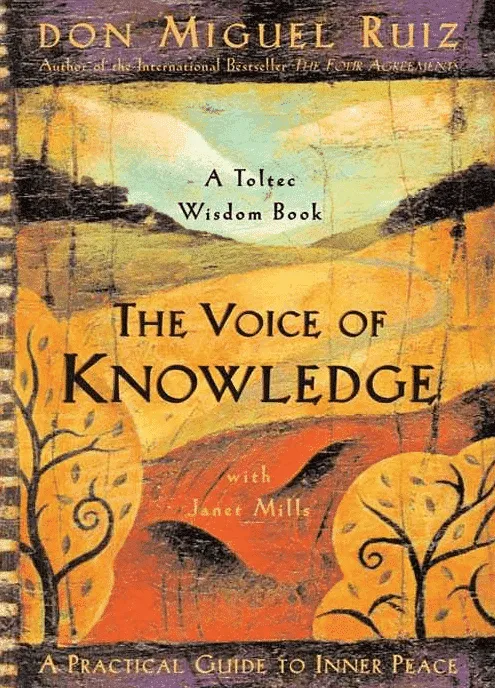
In The Voice of Knowledge, don Miguel Ruiz reminds us of a profound and simple truth: The only way to end our emotional suffering and restore our joy in living is to stop believing in lies, mainly about ourselves.Before we learn to speak, our true nature is to love and be happy, to explore and enjoy life. As little children, we are completely authentic. Our actions are guided by instinct and emotions, we listen to the silent "voice of our integrity". Once we learn to speak, the people around us hook our attention and program us with knowledge. The "voice of knowledge" comes alive inside our head, and what is that voice telling us? Mostly lies. That voice never stops talking, judging, gossiping, and abusing us. It constantly sabotages our happiness and keeps us from enjoying a reality of truth and love.
Ruiz shows us how to recover the silent voice of our integrity and find inner peace. When the voice of knowledge no longer controls us, our life becomes an expression of our authentic self, just as it was before we learned to speak. Then we return to the truth, we return to love, and we live in happiness again.
Marcus had been a trial lawyer for eleven years. Brilliant, sharp, relentless in court. Outside of it, he was a disaster. Three failed relationships. A drinking problem he called “social.” A mother he hadn’t spoken to in four years over something she’d said at a Christmas dinner — something she probably didn’t even remember saying. He knew the facts of every case he’d ever tried. He could recall precedent from memory. But ask him why he felt a low-grade hum of misery on Sunday evenings, or why he picked fights with people he loved, and Marcus would stare at you like you’d asked him to explain quantum physics in Swahili. “I just know things,” he told his therapist before quitting after three sessions. “That’s who I am.” The problem wasn’t that Marcus didn’t know things. The problem was that he couldn’t stop knowing them. His mind ran a continuous broadcast of commentary, judgment, memory, and prediction — and he had mistaken that broadcast for truth. He had confused the voice in his head with reality itself. Don Miguel Ruiz would say Marcus was living entirely inside the Book of Law — a closed system of inherited beliefs so internalized that he couldn’t see the walls of the prison anymore. He had become the warden of his own confinement, and the cruelest part was that he considered himself a free man.
Don Miguel Ruiz’s The Voice of Knowledge is a short book that arrives like a scalpel. It belongs to the Toltec wisdom tradition — the same intellectual lineage that produced The Four Agreements — but where that book gave you rules to live by, this one asks a more destabilizing question: What if everything you believe about yourself is a story you were told, not a truth you discovered? What if the voice that narrates your life — the one that tells you you’re not good enough, not smart enough, too emotional, too cold, too much, not enough — what if that voice has been lying to you since childhood, and you’ve spent decades building a life around its lies?
This isn’t therapy-speak. This isn’t a call to “do the work” on some expensive retreat. Ruiz is making a harder and more precise claim: the suffering human beings experience is almost entirely self-generated, not because they’re weak, but because they have accepted a fictional account of reality as if it were factual. And unlike the stoics, who tell you to control your judgments, or the Buddhists, who tell you to observe your thoughts, Ruiz targets something more fundamental — the belief that the voice doing the narrating has any authority at all.
What follows is a deep examination of that claim, why it matters for people trying to build better lives, where Ruiz’s framework lands squarely and where it needs to be pushed further, and what it practically means to stop letting a fictional narrator run your life.
Key Takeaways
- The “voice of knowledge” is the continuous inner narrator that interprets reality through a filter of inherited beliefs, childhood wounds, and social programming — it is not you, and it is not truth.
- Suffering is not caused by events but by the stories the narrator builds around events, most of which were written by other people before you were old enough to consent.
- The “Book of Law” — the internal rulebook of beliefs you obey without examining — is the primary mechanism of self-imprisonment.
- Knowledge (as Ruiz uses the word) is not intelligence. It is the accumulated fiction of what you’ve been told is real, true, and possible about yourself.
- Recovering integrity — acting in alignment with your authentic self rather than the narrator’s script — requires nothing more (and nothing less) than choosing truth over story, repeatedly.
- The antidote is not silence but awareness: learning to hear the voice as a voice, not as reality itself.
- Ruiz’s framework maps onto modern neuroscience: the narrator is largely the brain’s default mode network running predictive pattern-matching — useful for survival, catastrophic when mistaken for identity.
- The practical application is not philosophical detachment but increased action capacity: when you stop believing the narrator’s worst-case projections, you do more, risk more, connect more honestly.
The Narrator Problem: Why Your Brain Lies to You Constantly
Every human being has a narrator. You have one right now, running commentary on these words — agreeing, disagreeing, connecting this to something you read last year, judging the quality of the prose, wondering if this is going to be useful. The narrator never sleeps. It runs during meals, during sex, during the moments you’re supposed to be present with your children. It processes every experience through a filter and delivers you a verdict: good, bad, safe, threatening, worthy, shameful.
The question Ruiz asks is deceptively simple: where did the narrator come from? Because it wasn’t always there. Infants don’t have one. A two-year-old smashing a xylophone isn’t thinking “I wonder if I’m good at music.” They’re just doing the thing. The narrator develops as we accumulate language, social feedback, and the need to predict the behavior of the powerful adults who control our survival. By the time you’re seven, you’ve got a fairly stable character: the smart one, the athletic one, the troublemaker, the people-pleaser. By thirty, that character has calcified into something that feels like personality but is actually just a very old story.
Ruiz calls the content of the narrator the “Book of Law.” This is every belief you hold about yourself, other people, and the world — most of which you inherited without examination. The Book of Law contains entries like: “People who love you leave eventually.” “Showing weakness is dangerous.” “I’m not the kind of person who succeeds at things like this.” “Being direct causes conflict and conflict is dangerous.” “I don’t deserve good things until I’ve suffered enough.” None of these were written by you. They were written by parents, teachers, siblings, ex-partners, coaches, religious institutions, and a culture with its own agendas. But you’ve been enforcing them on yourself with the same ferocity that a totalitarian state enforces its laws — which is the entire point of Ruiz’s metaphor.
What makes this particularly insidious is that the narrator doesn’t announce itself as a narrator. It presents its verdicts as facts. “I’m bad at relationships” doesn’t arrive labeled “here is a story I’m generating based on a pattern I detected at age nine.” It arrives as simple truth. This is what neuroscientists call the transparency illusion — the brain’s interpretations feel like direct perceptions of reality. Your judgments feel like observations. Your stories feel like facts. And you act accordingly, which confirms the story, which strengthens the narrator’s authority, in a feedback loop that can run for decades.
Marcus the trial lawyer wasn’t bad at relationships because he was fundamentally broken. He was bad at relationships because the narrator told him that closeness meant vulnerability and vulnerability meant being destroyed — a lesson from a childhood with a volatile father who punished emotional openness. That was the narrator’s story, built on real evidence from a real experience. But it was a story about one man in one context, and the narrator had been applying it to every intimate relationship Marcus had for thirty years as though it were a universal law of physics.
The RWF: The Reality-versus-Narration Framework
Reading Ruiz carefully across this book and his broader Toltec framework, a specific analytical structure emerges that he never quite names but consistently applies. I’ll call it the Reality-versus-Narration Framework, or RWF — a practical tool for identifying when you’re living in reality versus living inside a story generated by the narrator.
The RWF operates on three levels:
- The Event Layer — what actually happened, stripped of interpretation. Not “she dismissed me,” but “she didn’t respond to my message for three hours.” Not “my boss thinks I’m incompetent,” but “he gave me corrective feedback on the report.” The event layer is almost always smaller, more neutral, and more specific than the narrator’s version of it.
- The Narration Layer — what the voice of knowledge added to the event. This is where meaning gets assigned, patterns get detected, worst-case scenarios get constructed, and identity conclusions get drawn. The narration layer is where “he didn’t call” becomes “no one will ever truly choose me.”
- The Belief Layer — the underlying Book of Law entry that the narration is protecting or confirming. This is the root. This is what the narrator is actually running. If you want to change the narration, you have to find the belief underneath it.
The practical move is always to slide back from narration to event. Not to deny the narration — you can’t think your way out of a feeling by telling yourself it’s irrational — but to locate the event clearly and ask: what actually happened here? What can I verify is true independent of what the narrator is saying about it?
This is where Ruiz’s framework becomes genuinely useful rather than just philosophically interesting. The narrator gains its power from conflation — the merging of event and interpretation into a single undifferentiated blob that feels like fact. The RWF is a wedge. It pries the event loose from the narration and gives you room to ask: is this story serving me? Is it accurate? Is it the only story available? Or is it just the familiar one?
Here’s where Ruiz parts company with modern cognitive behavioral therapy, which also teaches you to identify and challenge distorted thinking. CBT says: challenge the thought, replace it with a more accurate one. Ruiz says something subtler: you don’t need to replace the story with a better story. You need to recognize that you are the one who generates stories, that you always have been, and that you can generate different ones whenever you choose. The goal isn’t accurate narration. The goal is freedom from the compulsion to narrate — which occasionally produces silence, and more often produces choice.
The Architecture of Self-Betrayal: How People Become Strangers to Themselves
One of Ruiz’s most powerful observations is about what happens when the narrator’s Book of Law contradicts your direct experience. The narrator says “I’m not creative” and then you have an undeniably creative idea, write something that surprises you, build something beautiful. What does the narrator do? It doesn’t update. It rationalizes: “That was a fluke.” “Anyone could have done that.” “I got lucky.” It will protect its existing content at almost any cost.
Ruiz calls this “domestication” — the process by which human children are trained to accept a social reality and a self-concept that may have very little to do with who they actually are. Domestication is not malicious. Parents aren’t trying to harm their children by teaching them that the world works a certain way. But domestication operates through punishment and reward, through approval and withdrawal, and it is extraordinarily effective. By the time a child reaches adulthood, they have been thoroughly trained to suppress, deny, or explain away any experience that contradicts the story they’ve been given about themselves.
This is the architecture of self-betrayal. You don’t need an enemy to betray you. The narrator does it every day, by insisting that its version of you is the correct one and that any evidence to the contrary is the error.
Consider what happens to ambition under this architecture. A person raised with the belief that “people like us don’t succeed at things like that” will find countless ways to ensure they don’t. Not through laziness — often through tremendous effort in exactly the wrong direction, proving the narrator right. They’ll pick goals that confirm the narrative of limitation. They’ll bail at the first real difficulty, which the narrator files as confirmation. They’ll surround themselves with people who share the same Book of Law, because those people feel familiar, which the narrator codes as safe. The self-betrayal is elegant, invisible, and feels entirely like reality.
What Ruiz adds that the standard self-help canon misses is that effort alone doesn’t fix this. Reading more books doesn’t fix this. Working harder doesn’t fix this — because all of those behaviors are still being generated inside the narrator’s framework. You’re running faster inside a story about someone who needs to run faster. The narrator is perfectly happy to tell a story about a hardworking self-improver who never quite gets there. That’s still its story.
The only thing that actually interrupts the architecture is awareness of the architecture itself. Not as an idea — as a living, ongoing perception. This is what Ruiz means by “awakening”: not a spiritual event, but the moment you begin to perceive the narrator as a narrator rather than as yourself.
Where Ruiz Is Right, Where He Gets Sloppy, and What the Science Says
Let’s be honest about where Ruiz lands and where he doesn’t, because treating this book as pure wisdom is as big a mistake as dismissing it as new-age fluff.
Where Ruiz is precisely right: the neuroscience is on his side. The default mode network — the brain’s “resting state” system, active when you’re not engaged in external tasks — is now understood to be the biological substrate of self-referential thought, narrative identity, and autobiographical memory. When it runs unchecked, it generates the kind of rumination, self-criticism, and future-worry that Ruiz describes as the voice of knowledge. Studies by researchers like Matthew Killingsworth at Harvard found that people spend roughly 47% of their waking hours thinking about something other than what they’re doing — and that this mind-wandering is reliably associated with unhappiness, regardless of what they’re doing when they wander. The narrator is not metaphor. It is a biological system.
Where Ruiz gets sloppy: he treats the narrator as entirely adversarial. The voice of knowledge is cast as the villain, and the solution is to transcend it toward some purer, wordless self. This is too clean. The narrator is also how we plan, problem-solve, learn from experience, and build meaningful narrative identities. The goal isn’t to destroy the narrator — it’s to develop what psychologists call metacognitive awareness: the ability to observe your thoughts as thoughts rather than identifying with them automatically. Ruiz knows this, but his framing often suggests a more radical transcendence that isn’t realistic or even desirable.
Where Ruiz is romantically incomplete: he gives almost no attention to how hard this actually is. The Book of Law is not a software update you can delete. It’s wired into neural circuitry that was laid down during developmental windows when the brain was maximally plastic. Changing deep beliefs requires sustained behavioral evidence over long periods — which is why cognitive behavioral therapy takes months and why even therapy works partly through the relationship with the therapist, not just the cognitive reframing. Ruiz makes it sound like choosing truth over story is a decision you make once and live. It’s not. It’s a discipline you practice under pressure, and you will fail at it constantly before you get better.
With those caveats acknowledged, the core insight is sound and important: the suffering most people experience in their daily lives is not caused by their circumstances but by the story the narrator generates about their circumstances. Viktor Frankl made the same point in a concentration camp. Epictetus made it in slavery. The specific contribution Ruiz makes is locating the narrator as a social artifact — something built from domestication, not from fundamental human nature — which opens the possibility of revising it in a way that pure stoicism sometimes doesn’t.
“The only way to end your suffering is to tell the truth. The truth will set you free, but first it will make you miserable — because it will reveal exactly how much of your life has been built on a story that was never yours to begin with.”
The Five Mechanisms of Narrator Maintenance
Understanding why the narrator is so persistent requires understanding how it maintains itself. Ruiz gestures at this, but the full mechanism is worth spelling out because it’s essential to practical change.
Mechanism 1: Selective Attention. The narrator filters incoming information to confirm existing beliefs. This is confirmation bias at the deepest level — not just seeking confirming information consciously, but literally failing to perceive disconfirming information at the perceptual level. The person who “knows” they’re unlikeable walks into a room and notices the two people who didn’t greet them warmly. The eight who did are processed and discarded. The narrator was right again.
Mechanism 2: Story Completion. When the narrator has an incomplete account of what happened, it fills in the gaps with the most narratively consistent explanation — which is almost always the most familiar one, which is almost always the one that confirms the Book of Law. “He seemed cold on the phone” becomes “he’s upset with me” becomes “I’ve done something wrong” becomes “I always ruin relationships.” The narrator writes the ending before it happens.
Mechanism 3: Identity Protection. Humans will defend a negative self-concept rather than let it be disconfirmed, because the self-concept, even a bad one, provides the experience of coherence and predictability. The person who “knows” they’re unlucky in business will unconsciously arrange to confirm this rather than face the vertigo of a world where their beliefs about themselves might be wrong. This is not rational. It is deeply human.
Mechanism 4: Emotional Amplification. The narrator doesn’t just label — it generates emotion that feels like evidence. You believe someone disrespects you, you feel anger, and the anger feels like proof that the disrespect is real. The emotion is the narrator’s way of making the story physically real in your body, which makes it much harder to question. This is why cognitive reframing alone often fails: you’re trying to think your way out of something that has become physiological.
Mechanism 5: Social Mirroring. The narrator is maintained and confirmed by the social environment you inhabit, which is partly selected to be consistent with the narrator’s world. People who believe the world is hostile tend to act in ways that elicit hostility, which confirms the belief. The social mirror reflects the narrator back at you, and the narrator uses this as definitive proof. Breaking the maintenance loop often requires changing the social environment — which the narrator will resist, because unfamiliar social environments are threatening to its worldview.
Practical Application: The Three Disciplines of a Quieter Narrator
Ruiz’s book is light on specific practices, so here is a structured approach derived from his principles, grounded in what actually works.
Discipline 1: The Separation Practice. Several times a day, particularly when the narrator is loudest — in conflict, in failure, in anxiety — practice separating event from narration. The procedure: pause, identify the bare factual event in one neutral sentence, then write out the narration separately. Do not try to change or challenge the narration. Just observe that it is narration. The separation itself is the practice. Over weeks, the habit of separation begins to create a small but real perceptual gap between experience and interpretation, and that gap is freedom.
Discipline 2: The Book of Law Audit. This is a periodic exercise — best done quarterly — where you examine your current beliefs about yourself, other people, and the world by looking at your behavior. Not your stated values — your actual behavior. Where do you consistently self-sabotage? Where do you consistently choose a smaller version of available possibilities? What do your most painful recurring conflicts have in common? These behavioral patterns are the fingerprints of the Book of Law entries that are running your life. Once identified, the question is simply: where did this entry come from? Whose voice is this? Was it ever actually true, or was it just useful to someone who needed you to believe it?
Discipline 3: The Integrity Test. For every significant decision, run it through the integrity test: Am I doing this because it’s true to who I actually am and what I actually value? Or am I doing this to satisfy the narrator — to confirm a story, avoid a feared outcome, maintain an image? This test is not about perfection. It’s about developing the capacity to notice when you’re living someone else’s script versus your own. The more often you catch the difference, the more often you choose differently.
The goal of all three practices is not to eliminate the narrator — it is to develop a healthy relationship with it. The narrator is a tool. Like any tool, it serves you when you control it and harms you when it controls you. Ruiz’s entire project is about shifting the relationship from one of unconscious identification to one of conscious engagement.
The Voice of Knowledge in Relationships: Where the Narrator Does the Most Damage
If the narrator does its worst damage anywhere, it’s in close relationships — which is where Marcus the trial lawyer found himself building walls out of old stories.
The dynamics Ruiz describes are especially visible here. Two people enter a relationship. Each brings a narrator with its own Book of Law. Each narrator immediately begins generating interpretations of the other person’s behavior — not based on who that person actually is, but based on the patterns the narrator recognizes from its prior data set. Within weeks or months, each person is relating not to the actual human in front of them but to a character in a story they’ve been writing since childhood.
The arguments that seem to be about dishes or money or time management are almost always arguments between two narrators defending their respective Books of Law. He doesn’t clean up because he “doesn’t care about me” — his narrator says — but actually his Book of Law contains an entry that says effort should be acknowledged before more is demanded, and he’s waiting for acknowledgment that will never come because her narrator says appreciation should come after performance, not before. Two entries from two Books of Law, running on autopilot, creating a conflict that neither of them actually chose.
The Ruiz solution here — choose truth over story, speak impeccably, don’t make assumptions — sounds almost too simple. But the practice of not making assumptions in intimate relationships is genuinely radical and extraordinarily difficult. It requires catching the narrator in the act of generating a character for the other person and replacing the character with a question: What do you actually mean? What are you actually feeling? What do you actually need? Not what the narrator says you mean, feel, and need — what’s actually there, if you’re willing to look.
For people who have been in relationships built almost entirely on narrator-to-narrator interaction, the experience of person-to-person contact can be disorienting at first. The narrator mistakes the unfamiliar for the dangerous. But the people who persist report something that sounds almost like meeting their partner for the first time — because in a real sense, they are.
Emotional resilience strategies — bouncing back from hardship
The Voice of Knowledge and Masculine Identity: A Specific Application
Ruiz doesn’t address this directly, but his framework has specific and underexplored relevance to the way men develop and maintain identity.
The masculine Book of Law in most Western cultures is dense with entries about performance, emotional suppression, self-sufficiency, and status. “Men don’t ask for help.” “Emotional openness is weakness.” “Your value is what you produce.” “Showing uncertainty is dangerous.” These entries are installed early — through sports culture, peer groups, family expectations, media — and they are enforced with brutal consistency by the social environment boys and men navigate. The narrator becomes a performance monitor, constantly evaluating whether the man is measuring up to the Law’s standards and generating shame when he doesn’t.
The result is a particular kind of suffering that Ruiz’s framework illuminates precisely: the experience of living inside a set of rules that feel non-negotiable and self-generated but are in fact entirely imposed, arbitrary, and often actively harmful. The man who can’t ask for help when he’s overwhelmed isn’t weak — he’s obeying a Book of Law entry that was written for a social environment that may not even exist anymore. The man who can’t be emotionally present with his children isn’t cold — he’s performing a script that someone else wrote for someone else’s reasons.
The Voice of Knowledge framework offers a way out of this that doesn’t require the man to “become emotional” or “be vulnerable” as some kind of therapeutic imperative — which the narrator will reject as threatening to identity. Instead, it offers something more fundamental: the recognition that the identity being protected was never his to begin with. That opens a different kind of question — not “how do I change who I am?” but “who am I when I’m not performing the role I was assigned?”
Stoicism for everyday life — wisdom that holds up
Books Similar to The Voice of Knowledge
If this book landed with you, these go deeper in adjacent directions:
- The Four Agreements by Don Miguel Ruiz — the precursor, with four behavioral principles derived from the same Toltec framework. More prescriptive, less philosophical.
- The Untethered Soul by Michael A. Singer — examines the inner narrator with more psychological precision. Stronger on the practice of disidentification.
- Man’s Search for Meaning by Viktor Frankl — the most rigorous empirical test of the idea that suffering is generated by meaning-making, not circumstance.
- Thinking, Fast and Slow by Daniel Kahneman — the neuroscience side of why the narrator generates the stories it does. System 1 is the narrator operating at speed.
- The Body Keeps the Score by Bessel van der Kolk — what happens when the narrator’s Book of Law is written by trauma rather than ordinary domestication. Essential companion.
- Loving What Is by Byron Katie — a radical practical application of the narrator-questioning practice, more structured than Ruiz and more immediately usable.
FAQ
- Is “The Voice of Knowledge” religious or spiritual in a way that makes it inaccessible to secular readers?
Ruiz comes from a Toltec shamanic tradition and the language sometimes reflects that. But the core framework — that the inner narrator is a constructed identity maintained by inherited beliefs — is entirely compatible with secular psychology and neuroscience. You can get everything useful from this book without accepting any metaphysical claims. - How is this different from just “positive thinking”?
Positive thinking says: replace negative thoughts with positive ones. Ruiz says: stop treating the narrator’s output as truth, positive or negative. The goal isn’t a better story — it’s freedom from the compulsion to generate stories in the first place. Much more sophisticated and much harder. - How long does it actually take to change the narrator?
The honest answer is years. Deep belief revision requires sustained behavioral evidence against the existing belief, repeated often enough to build new neural patterns. But the perception shift — beginning to see the narrator as a narrator — can happen quickly once you’re looking for it, and that shift alone changes the relationship to suffering immediately. - Can this framework help with anxiety disorders, depression, or trauma?
It has genuine relevance to all three, but it is not a clinical intervention and shouldn’t replace one. For anxiety and depression, the framework maps well onto acceptance and commitment therapy (ACT). For trauma, the Book of Law entries are written with such force that somatic approaches (like those in Peter Levine’s work) are often necessary companions. - What does Ruiz mean by “integrity”?
Not moral correctness but integration — the state of acting in alignment with your actual values, desires, and perceptions rather than the narrator’s script. Integrity in Ruiz’s sense is the experience of being whole, which is not possible when you’re performing a role you were assigned rather than living a life you’ve chosen. - Is there a practical exercise that works quickly?
The most immediately effective is the separation practice: in any moment of distress, write down the bare factual event (what actually happened) and then write the narrator’s version separately. The act of writing creates the separation. Do this for a week and you’ll start seeing the gap without the writing. - Ruiz seems to suggest we should live without knowledge altogether. Isn’t that unrealistic?
Yes, if taken literally. The practical target is not no-knowledge but right-relationship with knowledge — holding your beliefs as working hypotheses rather than immutable facts, staying open to evidence that contradicts the Book of Law, and distinguishing between functional knowledge (useful models for navigating the world) and identity-defining knowledge (stories about who you fundamentally are). - Does this apply to positive self-stories as well, or just negative ones?
Yes, and this is one of the subtler points in the book. Positive self-stories can be as limiting as negative ones when they’re used to avoid real contact with reality. The man who believes he’s the smartest person in the room doesn’t learn anything. The woman who believes she’s the ultimate team player avoids the necessary confrontations. The narrator’s distortions aren’t always self-critical. - What’s the relationship between this framework and mindfulness?
Very close. The mindfulness instruction to “observe your thoughts without judgment” is essentially the same operation as Ruiz’s “hear the narrator as a narrator.” The difference is that Ruiz gives you more content — specifically the Book of Law — to work with, which can make the practice more targeted than generic mindfulness. - How do I help someone I love who seems completely trapped in their narrator?
You can’t change someone else’s narrator. What you can do is refuse to play a character in their story — which means staying factual, asking genuine questions rather than accepting narrative interpretations, and modeling the behavior of separating event from narration in your own life. The most powerful thing is contagious: people around someone who has genuinely quieted their narrator often begin to question their own.
The Uncommon Truth at the Center of This Book
Marcus eventually did stop practicing law. Not because it was the narrator’s story telling him he was a failure — but because when he finally stripped the narration away, he discovered he’d never actually wanted to be a lawyer. He’d wanted his father’s approval, and law had been the vehicle his father approved of. The actual work left him cold in a way he’d never let himself acknowledge because the narrator had a story that made it mean weakness.
He’s now teaching at a university. He’s not rich. He’s in a relationship that has lasted four years, which is longer than anything he managed before. He still has a narrator — we all do — but he’s learned to hear it as a narrator. When it tells him he’s going to fail, he notices. When it tells him someone is dismissing him, he checks the event layer first. He is not a different person. He is the same person with a different relationship to the voice in his head.
That’s the promise and the limit of this book. It won’t change your circumstances. It won’t give you a new personality. It won’t make difficult things easy or painful things painless. What it will do, if you let it, is introduce you to the possibility that the narrator generating your experience of your life is not you, was not chosen by you, and does not have to be obeyed.
That’s not a small thing. That might be the only thing that actually matters.
How to break bad habits — the neuroscience of lasting change
The power of self-awareness — how knowing yourself changes everything

