

Both framings are selling something. Neither is entirely accurate.
The actual comparison between spring water and filtered water runs more interesting and more complicated than either brand story lets on. Hydrogeology, federal and state regulation, mineral chemistry, contaminant profiles, environmental impact, and the gap between what “natural” implies and what it actually guarantees. Both spring water and filtered water can be excellent choices. Both can also be mediocre ones. Quality comes down to specific, testable factors — not to the category itself.
Americans consume approximately 14.4 billion gallons of bottled water a year — the largest per-capita consumption of any country. The bottled water industry pulls in roughly $19 billion in annual revenue, with premium spring waters commanding the highest per-liter prices. Meanwhile, in most American cities, filtered tap water meets or beats the quality of bottled spring water at roughly 1/1,000th the cost.
Understanding the actual differences between source types — where they matter, where they don’t — is useful for anyone spending money on premium water or deciding on home filtration.
What Spring Water Actually Is (Legally and Practically)
The FDA regulates bottled water sold in interstate commerce and has specific standards of identity defining what can legally be labeled “spring water.” Under 21 CFR 165.110, spring water must be collected only at the spring itself, or through a borehole tapping the underground formation feeding it.
The water needs a natural underground force pushing it to the surface at a natural orifice, and at the point of collection, it has to retain the same physical properties — mineral and overall composition — as when it flows naturally.
In practice, most bottled “spring water” gets collected through bore holes rather than from the spring’s natural surface expression. Legal. Doesn’t affect water quality. Does put some distance between the product and its marketing imagery of water flowing freely off an untouched rock face. The key legal requirement is that the underground source be a confirmed spring formation — not just a deep well into a groundwater aquifer.
Matters for regulatory categorization. The chemical and microbiological quality of the water itself is determined by the specific aquifer and local geology, not by the collection method.
What spring water is not — and this surprises a lot of people — is inherently superior from a safety standpoint. It’s not tested or regulated more strictly than municipal tap water. It’s actually tested less frequently. The FDA requires bottled water companies to test source and finished product for microbiological, chemical, physical contaminants, but the testing frequency runs lower than the continuous monitoring required of municipal systems.
The EPA tests municipal water supplies continuously through distribution — hundreds of required tests annually for large systems. FDA bottled water regulations require periodic testing, no real-time monitoring specified.
The 2008 Government Accountability Office report on bottled water regulation found bottled water rules were significantly less stringent than municipal tap water rules across several specific areas: municipal operators must disclose contamination immediately, bottlers aren’t required to; municipal water must be filtered and disinfected (or meet alternative criteria), while bottled water requirements vary by source type; municipal water must use certified lab testing, bottled water testing requirements run less specific.
The FDA has tightened bottled water regulations since that report. The comparison still matters, though, for understanding what “spring water” actually guarantees relative to a well-regulated municipal supply.
The Mineral Profile Argument: Why It Sometimes Matters
Spring water’s legitimate advantage over most filtered water is mineral content. Groundwater that’s percolated through mineral-bearing rock picks up dissolved minerals — calcium, magnesium, potassium, bicarbonate, silica, mainly — that give it characteristic flavor and possibly some nutritional contribution. Filtered and purified waters, reverse osmosis especially, have most minerals stripped out along with contaminants. Chemically clean, but also low in minerals some people actually value.
Mineral content in spring waters varies enormously by source. Evian, from the French Alps, runs about 80 mg/L calcium and 26 mg/L magnesium. Gerolsteiner, German mineral water, runs about 348 mg/L calcium and 108 mg/L magnesium — unusually high, genuinely useful as a dietary calcium and magnesium source. Fiji water, from an artesian aquifer in Fiji, is naturally high in silica (93 mg/L) with low sodium.
San Pellegrino is naturally carbonated, high in calcium and magnesium bicarbonate. Each brand reflects its geological origin, and that origin sets the taste.
Whether these mineral differences carry meaningful health implications for most consumers is a smaller claim than spring water marketing usually makes. For people already getting adequate calcium and magnesium from food, the mineral contribution of 2 liters of spring water a day is modest — maybe 5 to 15 percent of daily calcium needs depending on the water, versus 30 percent or more from a single dairy serving.
For people who can’t or don’t eat enough mineral-rich food, mineral-rich water can make a real supplementary contribution. Epidemiological studies have found associations between high-mineral water consumption regions and reduced cardiovascular mortality — though that’s an ecological association carrying multiple confounders.
The mineral argument doesn’t apply to premium low-mineral spring waters — Volvic and some American spring waters carry low mineral content. Spring waters by origin, but with few of the mineral properties sometimes cited in favor of the category. Different rock formations. Different profiles.
Buying “spring water” for its mineral benefits without checking the mineral analysis panel on the label is a common, avoidable mistake.
Filtered Water: What “Filtered” Actually Means
“Filtered” on a water label is almost meaninglessly broad. Virtually all water — spring water included — gets filtered in some form before bottling. The real questions are what filtration technology was used, what it removes, what it leaves.
Point-of-use activated carbon filters — the standard home filtration tech in pitcher, faucet, refrigerator filters — remove chlorine, chloramine, certain organic compounds, some heavy metals, taste and odor compounds. Standard carbon doesn’t effectively remove nitrates, fluoride, most dissolved minerals including low-concentration lead, or PFAS.
The Brita filter a lot of people trust runs significantly better than nothing for taste and some organics. Not comprehensive protection against the full range of possible contaminants, though.
Reverse osmosis (RO) filtered water is the most comprehensively treated water available for home use. RO membranes reject roughly 95 to 99 percent of dissolved contaminants — lead, arsenic, nitrates, PFAS, most heavy metals, organic compounds. The resulting water runs chemically very pure, often purer than premium bottled spring water by any contaminant measure.
Its mineral content is also low, which brings up the trade-off at the center of this whole comparison: filtered water strips out both the bad things and a lot of the good things.
Remineralized filtered water — RO water with minerals added back — is increasingly available bottled and through home RO systems with remineralization stages. Theoretically the best of both worlds: RO’s contaminant rejection, plus a controlled, consistent mineral profile.
The mineral profile in remineralized water tends to be more standardized than natural spring water, but may skip the complex mineral matrix some researchers think matters for the biological availability of minerals from natural groundwater.
Municipal tap water treated for distribution is technically “filtered” too — sedimentation, coagulation, often membrane filtration, plus disinfection. Calling it filtered water is technically accurate, if not how most consumers use the term.
Municipal treated water quality varies by utility, source water quality, infrastructure. But the best-run US municipal systems produce tap water that routinely beats premium spring waters in blind taste tests and analytical contaminant testing.
The Contamination Reality: When Spring Sources Fail

Several significant bottled water recalls have involved spring sources. In 2019, a Niagara Bottling recall (sold under many store brand names) involved spring water with E. coli-positive upstream sampling. In 2016, Whole Foods recalled 365-brand spring water over total coliform contamination.
A 2015 academic study testing 45 bottled water brands found detectable disinfection byproducts in multiple brands claiming to be “spring” or “mountain” water — suggesting some products contained treated municipal water sold under spring labeling, a practice the FDA subsequently investigated.
A 2019 study in Environmental Science and Technology tested 263 bottled water products for PFAS and found 39 with detectable levels, some exceeding proposed health advisory limits. Spring waters and filtered waters both showed up in the contaminated group — contamination tracked to the specific source location and treatment process, not the source category.
Some premium brands tested below detection limits. Some generic brands tested at concerning levels. The category label told you nothing reliable about PFAS content.
Microplastics turn up in both spring water and filtered water. A 2018 study commissioned by Orb Media tested 11 bottled water brands across nine countries and found microplastic contamination in 93 percent of samples — an average of 314 particles per liter across all brands. Spring waters, sparkling waters, still waters, all represented. Source origin and spring status didn’t predict contamination levels; packaging and production process did.
The WHO’s 2019 report on microplastics in drinking water concluded that current evidence doesn’t suggest a risk to human health at existing exposure levels, while calling for more research — a position that hasn’t substantially shifted since.
Environmental Comparison: The Cost Nobody Talks About
The spring-water-versus-filtered-tap comparison would be incomplete without the environmental cost differential, which is substantial and badly under-appreciated by consumers who’ve made sustainability a real value in their purchasing.
Producing single-use plastic water bottles requires roughly 2,000 times more energy per liter delivered than tap water production and distribution. A 2009 lifecycle assessment in Environmental Science and Technology found the energy needed to produce one liter of bottled water — plastic production, extraction, bottling, refrigeration, transportation — ran 1,100 to 2,000 times greater than delivering the same volume through tap infrastructure.
The carbon footprint gap is comparably large.
Water itself gets extracted for spring bottling in ways raising real concern in source communities. Nestlé’s water extraction contracts in drought-stressed California, Michigan, Oregon have drawn public controversy and legal challenges. Pumping groundwater from ecologically sensitive areas at volumes exceeding natural recharge, then selling it nationally at $2 a liter, externalizes environmental costs the retail price never reflects.
Recent activism has pushed several municipalities to restrict or deny bottling permits for spring extraction in water-stressed regions.
Plastic recycling rates for single-use water bottles in the US run roughly 25 to 30 percent — meaning 70 to 75 percent end up in landfills, incineration, or the environment as litter, eventually as microplastics. The irony that the leading concern about spring water purity — microplastics — gets introduced partly by the packaging spring water marketing uses to imply natural purity isn’t lost on environmental analysts.
Point-of-use home filtration, by contrast, produces no packaging waste beyond the filter cartridges themselves (recyclable through programs from major manufacturers), needs minimal transportation, and uses a small fraction of the energy bottled water production requires. For consumers who weigh environmental impact alongside water quality, filtered tap water is the clear choice anywhere municipal water meets regulatory standards.
The Taste Question: What Actually Determines How Water Tastes
Plenty of consumers pick spring water over filtered tap primarily on taste, and the preference is real and measurable — blind taste tests consistently show many people preferring certain spring waters over certain filtered or tap waters. Understanding what actually determines taste clarifies whether the preference reflects genuine quality difference or just specific mineral characteristics that may or may not carry value.
Water taste is set mainly by dissolved mineral content, dissolved gas content (carbon dioxide especially, in sparkling water), temperature, and the presence or absence of disinfectant residuals like chlorine. Chlorine and chloramine from tap disinfection produce the characteristic “tap water” taste many people dislike — even when chlorine levels sit well within safe ranges.
Activated carbon filtration removes these compounds effectively, and filtered tap water from good municipal sources often scores comparably to premium spring water in blind taste tests once the chlorine flavor’s gone.
The mineral “mouthfeel” of high-mineral waters is a genuine sensory trait. Water with significant calcium and magnesium bicarbonate has a slightly round, almost sweet quality against very-low-mineral water, which can taste flat or empty by comparison. Whether that sensory preference tracks any health-relevant difference is a separate question — plenty of people prefer high-mineral taste while getting adequate minerals elsewhere in their diet, which makes the preference purely sensory rather than nutritionally significant.
Water temperature strongly shapes perceived taste quality. Same water tastes noticeably better at 10 to 15°C (50 to 60°F) than at room temperature or a slightly-cold fridge temperature. A lot of people who prefer bottled spring water to tap are actually comparing cold bottled water against ambient-temperature tap water — a comparison conflating source quality with temperature. Serve filtered tap at the same temperature as the preferred bottled water, and the preference gap shrinks substantially under controlled tasting.
Specific Use Cases: Where Each Option Makes Most Sense

For daily drinking at home: high-quality home filtration — point-of-use activated carbon for taste-optimized tap with a low contaminant profile, or under-sink RO for tap with known contaminant concerns — gives the best quality-to-cost ratio. The environmental profile beats bottled water by a mile. Testing your specific tap water before committing to any filtration approach ensures you’re addressing actual, not hypothetical, contaminants.
For mineral supplementation: naturally mineral-rich spring water, or mineral drops added to filtered water. If there’s a specific reason to boost dietary calcium and magnesium through water — lactose intolerance, low dairy intake, elevated needs from athletic training — knowing the specific mineral content of the chosen source and calculating its contribution to daily intake is the relevant framework. Not all spring water runs high in minerals. Read the panel.
For travel to areas with uncertain tap water quality: bottled water from sealed commercial containers is a reliable safe fallback when source water quality can’t be verified. The environmental argument against bottled water weakens fast when the alternative is genuine microbiological risk. Portable filtration — SteriPen UV, Sawyer squeeze filters, tablet purification — offers safety without single-use plastic when weight and portability allow.
For infant formula: use water testing below 10 mg/L nitrates, below the lead action level at the tap, with acceptable fluoride levels for the infant’s age if that’s a concern. Whether that’s spring water or filtered water depends on what the specific source actually contains, not on the category label.
The Bottled Water Market’s Biggest Secret
Roughly 45 percent of bottled water sold in the US is municipal tap water — treated public supply — that’s been further purified, typically by reverse osmosis, and packaged for retail. The most visible examples: Dasani (Coca-Cola) and Aquafina (PepsiCo), both purified municipal water products. Dasani lists the source as local municipal supply plus additional purification; Aquafina similarly.
Both have faced regulatory scrutiny and consumer lawsuits for not making that origin sufficiently clear on the label.
None of this makes these products inferior to spring water on quality grounds — purified municipal water treated with RO can actually have lower contaminant levels than plenty of spring waters. But it does mean consumers paying premium “water” prices on the assumption of natural spring origin are often getting something else entirely.
The FDA requires that purified municipal water not be labeled “spring water” — a rule that’s generally followed — but the failure to proactively disclose municipal origin on the front of the label, rather than buried in small print on the side, is a transparency problem the industry has resisted fixing.
Common Questions About Spring Water Actually
Is spring water safer than filtered tap water?
Not inherently. Spring water is regulated by the FDA under standards that in some respects run less stringent than EPA municipal water standards — less frequent testing, no real-time monitoring requirement. High-quality municipal water, properly treated and continuously tested through distribution, is often cleaner than spring water by analytical measurement. Both source types can be excellent or compromised depending on the specific source, treatment, distribution conditions.
Testing your specific sources tells you more than assuming one category beats the other.
Should I remineralize my RO filtered water?
Depends on mineral intake from food and taste preference. For people getting adequate calcium and magnesium from dairy, leafy vegetables, nuts, legumes, remineralization is mainly a taste question — RO water tastes flat to a lot of people used to mineral-rich water. For people with limited dietary mineral intake, remineralization offers a modest supplementary contribution.
Home RO systems with remineralization stages (typically adding calcium and magnesium bicarbonate through a post-filter cartridge) are the most convenient route; mineral drops added to RO water give comparable chemistry.
What makes some spring waters taste so different from others?
Mineral content, dissolved gas, and pH are the primary drivers of spring water taste variation. High-calcium, high-magnesium waters run round, slightly heavy. Very-low-mineral waters taste light, sometimes flat. Naturally carbonated waters have effervescence masking mineral taste and adding CO₂-related acidity. High-silica waters get described as softer in mouthfeel, though it’s a subtle characteristic.
Reading the mineral analysis panel — required on all bottled water labels — explains most of the taste differences between brands.
Is it safe to drink filtered tap water during pregnancy?
High-quality filtered tap water is safe for most pregnant women. Specific concerns during pregnancy: lead exposure (particularly relevant in older homes), nitrates (more relevant for wells in agricultural areas), specific pharmaceutical or industrial contaminants in some municipal supplies. Testing your specific tap water for lead is the single most important step for pregnant women in homes built before 1986.
If lead turns up above action levels, point-of-use filtration with NSF Standard 53 lead certification handles it effectively. Spring water isn’t inherently safer for pregnant women unless the specific tap water has confirmed problems that an alternative source addresses.
Is the cost difference between bottled spring water and filtered tap water actually significant?
Yes, dramatically. Municipal tap water runs roughly $0.005 per liter in most American cities. Basic activated carbon home filtration adds $0.005 to $0.02 per liter depending on filter cost and usage. Under-sink RO systems typically run $0.03 to $0.10 per liter including filter and membrane replacement. Premium bottled spring water runs $1.50 to $4.00 per liter.
Over a year at 2 liters a day: filtered tap water costs $20 to $75 annually; premium spring water costs $1,000 to $3,000 annually. The quality case for that gap just isn’t supported by the analytical evidence, not for most consumers in cities with good municipal water.
The mountain on the label is not a quality guarantee. It is a branding choice. The actual quality of water is determined by the specific aquifer geology, the treatment and bottling process, and the testing program of the specific producer — none of which are conveyed by the mountain. Read the mineral analysis. Test what you don’t know. The chemistry is specific and the marketing is general, which means the marketing will always tell you less than the chemistry.
The Bottled Water Supply Chain: From Source to Shelf
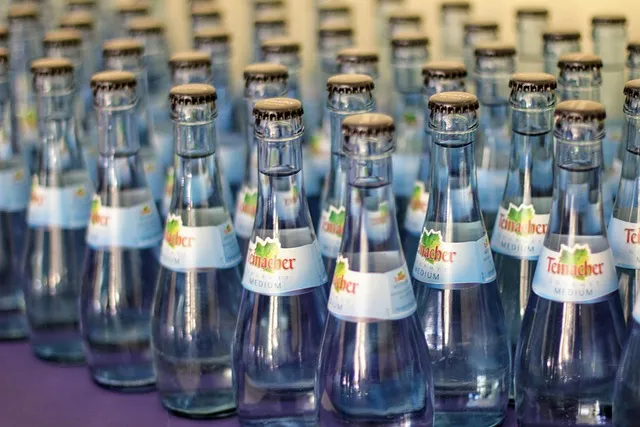
Source water gets pumped from the spring or borehole through industrial piping to collection tanks, then trucked or piped to a bottling facility that might be miles away. At the facility: sediment and carbon filtration to remove particulates and organics, UV or ozone treatment to knock microbial contamination down to safe levels, testing at multiple production stages.
The bottling line rinses plastic bottles with treated water or ozone-treated air, fills, caps, labels, palletizes — all under conditions designed for microbial safety, not pharmaceutical sterility.
Plastic bottle chemistry interacts with the water it holds over time and temperature. Polyethylene terephthalate (PET), the standard water bottle plastic, is generally stable at normal conditions, but studies have found some plastic additives and degradation products migrating into the water — particularly when bottles hit heat (a hot car, a warehouse), sit stored for extended periods, or get reused.
A 2020 study found water stored in PET bottles at elevated temperatures (38°C) for four weeks showed significantly higher concentrations of antimony (a metal catalyst used in PET production) and other organic compounds than freshly bottled water.
The concentrations detected sat below regulatory limits. Still, the chemistry illustrates that “pure spring water” sitting in a hot warehouse for six months before hitting the shelf isn’t the same composition it was at the source.
“Best by” dates on water bottles aren’t regulatory safety dates. Voluntary dates, placed by manufacturers mainly to flag the point after which flavor changes from plastic interaction might become noticeable. Water itself doesn’t expire in any microbiological sense while sealed.
The dates serve retail inventory management and quality reference more than safety signaling — though they do carry some relevance to the plastic migration question. Drinking from bottles near or past the date, stored under warm or sunlit conditions, carries higher plastic compound exposure than fresher, better-stored product.
At-Home Carbon Filtration Versus Reverse Osmosis: Practical Guidance
The choice between basic carbon filtration and more comprehensive reverse osmosis is one of the most common practical questions for anyone improving home water quality. The answer depends on what your water actually contains — testing first, again — and on the specific trade-offs that matter for your household.
Carbon filtration is sufficient when water quality concerns run mainly aesthetic — chlorine taste and odor, some organic flavor issues — and lab testing has confirmed the absence of elevated lead, arsenic, nitrates, PFAS. Modern high-quality carbon block filters certified to NSF/ANSI Standard 53 also remove cysts (Cryptosporidium, Giardia), some organics including trihalomethanes, and lead in certified models.
Carbon filtration preserves mineral content (good for taste and possible nutrition) and installs and maintains easily. The main limitation is simply the contaminants it can’t touch.
Reverse osmosis is appropriate when testing reveals lead, arsenic, nitrates, PFAS, or multiple organics at levels warranting treatment, or when you want the most comprehensive protection available and are willing to accept mineral removal and slower production in trade. Pairing RO with a post-filter remineralization stage addresses the mineral depletion and produces water that’s both comprehensively treated and palatable.
Modern RO systems have improved a lot in efficiency — “zero-waste” or high-efficiency RO now hits 1:1 or 2:1 waste-to-product ratios, against the 3:1 or 4:1 of older systems, substantially cutting the wastewater concern that historically dogged the technology.
For households with young children or pregnant members where lead is the primary concern: point-of-use carbon filtration certified for lead removal at the kitchen tap gives adequate mitigation if lead levels sit in the moderate range (below 15 ppb at first-draw sampling). For higher lead levels, or for broader protection, under-sink RO combines lead removal with wider contaminant reduction.
Installing whole-house carbon pre-filtration alongside point-of-use RO extends the RO membrane’s life and improves product water quality by cutting the sediment and organic load hitting the system.
The Cost Reality: What People Actually Spend on Premium Water
The economics of premium water consumption deserve explicit attention, because the gap between high-quality home filtration cost and premium bottled water cost is large enough to fund genuinely impactful health improvements once redirected. Americans spent roughly $31 billion on bottled water in 2020 — the most consumed packaged beverage in the country by volume.
A household buying two cases of premium spring water weekly (roughly 48 liters) spends approximately $3,000 to $6,000 a year depending on brand. A high-quality under-sink RO system costs $200 to $400 to install plus $50 to $100 a year in filter and membrane replacement — producing water analytically superior to virtually any bottled spring water, for about 2 percent of the bottled water cost.
The environmental opportunity cost is just as striking. The plastic, energy, and water consumed producing, transporting, and disposing of one household’s annual bottled water supply would offset dozens of refillable bottles, a quality pitcher, and years of home filtration. For consumers who’ve made sustainability a meaningful value, the environmental math on premium bottled water versus filtered tap isn’t close.
Carbon footprint per liter from a home RO system on the average US electricity grid: roughly 0.002 kg CO₂ equivalent. Carbon footprint per liter of imported premium spring water — plastic production, bottling, shipping, retail refrigeration included — runs 0.4 to 0.8 kg CO₂ equivalent. 200 to 400 times higher.
The health value of the money saved switching from premium bottled water to home filtration could, realistically, fund meaningful health investments. Three thousand dollars a year redirected from bottled water could cover a comprehensive nutritional genomics evaluation and personalized supplementation protocol, annual comprehensive blood panel testing, a proper gym membership with personal training, a standing desk and ergonomic office setup, or several years of preventive dental care including annual X-rays and professional cleanings.
Not abstract comparisons. Real alternative uses of the same dollars, producing documented, measurable health benefits — against a premium water whose benefits sit mostly in the aesthetic and marketing column.
Water for Cooking: How Source Affects Food Quality
Water quality discussions usually focus on drinking water, but water used in cooking has its own quality implications most home cooks underappreciate. Water is the primary ingredient in soups, stews, rice, pasta, plenty of baked goods, and its mineral content, pH, and chemical composition shape the flavor and texture of the finished dish.
Hard water — high calcium and magnesium — affects cooking in several documented ways. It slows the softening of dried legumes by forming calcium-pectin complexes in cell walls that resist heat breakdown. It can make pasta firmer at a given cook time. It reacts with tea tannins to produce that “scum” film on tea brewed with hard water.
For baked goods, hard water can strengthen gluten structure — calcium reinforces gluten networks — good for bread, but can leave cakes and muffins less tender. Professional bakers sometimes adjust water hardness specifically to fine-tune gluten development for different applications.
Chlorinated water affects flavor wherever water plays a large ingredient role. Chlorine and chloramine from disinfection produce off-flavors most noticeable in clear broths, delicate teas and herbal infusions, plain cooking water for rice and pasta. These off-flavors ease when water sits open to air (chlorine evaporates — less effective for chloramine, which is more stable) or when activated-carbon-filtered water is used instead.
The difference between chicken broth made with filtered water and one made with heavily chlorinated tap water is perceptible, particularly to sensitive palates.
For espresso and pour-over coffee, water mineral content is recognized by specialty coffee professionals as one of the primary determinants of extraction quality and cup flavor. The Specialty Coffee Association’s water quality guideline: total hardness 50 to 175 mg/L (as CaCO₃), total dissolved solids 75 to 250 mg/L, sodium below 10 mg/L, chlorine zero, pH 6.5 to 7.5. Water too soft under-extracts, producing thin, sour flavor.
Water too hard over-extracts, producing bitter, astringent coffee. The relationship between mineral content and coffee extraction quality is one of the most practically documented examples of water chemistry shaping food product quality — and it illustrates why the notion of a single “ideal” water is insufficient. The ideal depends on the application.
References
Editorial StandardsCorrectionsMedical DisclaimerAbout Our ContentAffiliate DisclosureSite Map