
Stoicism vs Buddhism for Modern Men gets asked constantly, and most answers collapse it into a false binary — pick a team, defend it on a podcast. The real picture is messier than that. More useful, too.

Stoicism and Buddhism both have genuine value here, and they’re more complementary than competing — closer to two different tools in the same box than rival philosophies. But they serve different functions. Knowing which one you need right now is what prevents the common mistake of grinding hard on the wrong thing for months.
Here’s the part nobody tells you: getting this wrong doesn’t just cost time. It can set you back. Men who throw themselves at the wrong approach often build resistance to the right one afterward, because they’ve already “tried everything” — when what they actually tried was the wrong thing, applied with total conviction. Clarity up front saves the frustration later.
What follows: what each one actually involves, where they differ on the criteria that matter, the strengths and weaknesses of each, and a framework for knowing which one serves you right now.
Both traditions are roughly 2,300-2,500 years old, developed independently on opposite ends of the ancient world with no contact between them, and arrived at strikingly overlapping conclusions about the relationship between desire, judgment, and suffering. That convergence is itself worth noting before diving into either one — two civilizations, no communication, and both landed on some version of “your reaction to events, not the events themselves, is where the actual problem lives.” Which suggests the insight isn’t a cultural artifact. It’s closer to an observation about how human minds actually work, discovered twice.
WHAT IS STOICISM?

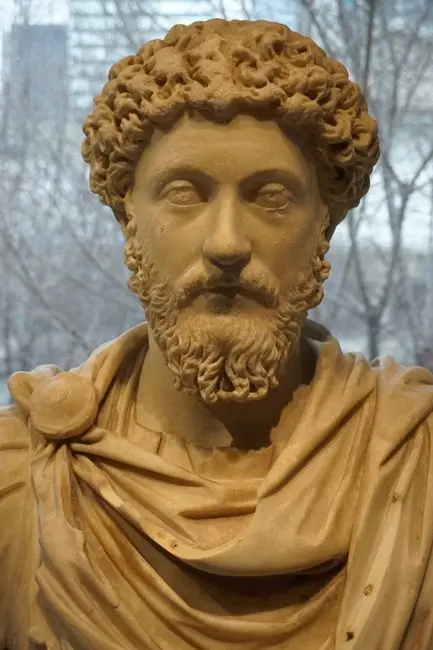
Zeno founded the school around 300 BC, teaching under the Stoa Poikile — the “painted porch” — in the Athenian agora, which is where the name comes from. The four figures most men encounter today represent a striking range of life circumstances, and that range is part of the philosophy’s actual argument: Epictetus was born into slavery in Hierapolis, crippled (possibly by a master who broke his leg), and freed only in adulthood, teaching from a position of having genuinely nothing in his control except his judgments — the doctrine wasn’t abstract for him, it was survival. Seneca sat at the other extreme: tutor and advisor to the emperor Nero, immensely wealthy, and eventually ordered by that same emperor to take his own life, which he reportedly did with composure that either vindicates his philosophy or, depending on the reading, exposes the gap between what a wealthy Stoic writes about detachment from fortune and how he actually lived surrounded by it. Marcus Aurelius wrote his Meditations — never intended for publication, a private journal — largely while commanding Roman legions during the Antonine Plague and a grinding frontier war, jotting reminders to himself about patience and duty between military campaigns that were, by any account, exhausting and largely thankless. The philosophy was built by people under real pressure, not in a seminar room.

Buddhism — particularly Zen and Theravada practice as adapted for Western secular use — centers on the impermanence of all phenomena, the origin of suffering in attachment, and the cultivation of non-self through meditative practice. Where Stoicism operates at cognition and judgment, Buddhism works one layer down, at perception and awareness itself. The goal isn’t to reason about experience differently. It’s to see it more clearly in the first place. Mindfulness-Based Stress Reduction (MBSR) is the clinical distillation of this — Buddhist meditation practice extracted into a secular framework with extensive research support behind
| Stoicism | Buddhism | |
|---|---|---|
| Foundational distinction | What is in your control vs. what is not | Impermanence, and suffering’s origin in attachment |
| Operates at | Cognition and judgment | Perception and awareness itself |
| Clinical distillation | Cognitive-behavioral approaches | MBSR (Mindfulness-Based Stress Reduction) |
it.
Siddhartha Gautama taught in the 5th century BC in what’s now Nepal and northern India, and the core doctrine — the Four Noble Truths and the Eightfold Path — is, in its original form, considerably more metaphysically loaded than the version that shows up in a corporate wellness app: rebirth across lifetimes, karma as literal cosmic causation, the goal of full liberation (nirvana) from the entire cycle of existence, not just a calmer Tuesday. Jon Kabat-Zinn, a molecular biologist at the University of Massachusetts, built MBSR in 1979 by deliberately stripping out the religious cosmology and keeping the attentional technology — breath awareness, body scanning, non-judgmental observation of thought — repackaged for a hospital pain clinic. That extraction was enormously successful clinically and enormously controversial among some Buddhist scholars and teachers, who’ve pointed out that meditation removed from its ethical and metaphysical framework (the precepts, the orientation toward non-attachment as a spiritual goal rather than a stress-reduction technique) risks becoming what critic Ron Purser called, in his 2019 book, “McMindfulness” — a productivity tool stripped of the tradition’s actual aim, sold back to the same corporate environments generating the stress in the first place. Worth knowing which version is being practiced. They’re not quite the same thing wearing different clothes.
HOW STOICISM AND BUDDHISM FOR MODERN MEN ACTUALLY DIFFER
The gap between these two runs deeper than the usual surface-level comparison suggests. Quick orientation first, then the real breakdown — because the decision-making information lives in the detail, not the summary.
DETAILED BREAKDOWN: WHERE EACH ONE WINS
Core Definition and Purpose
Stoicism serves a specific function, one that gets blurred the moment people start treating it as a synonym for “toughness” or “not caring.” At its core it addresses a particular slice of personal development — judgment, response, composure under pressure. Knowing that specific function, without inflating it into something bigger, is what lets a man apply it where it actually works instead of everywhere.
Buddhism for Modern Men targets a different dimension, even where the surface description can sound similar to an outsider. The practical gap shows up in how a man structures his days, what he prioritizes, and what results he can honestly expect from the practice.
There’s a real intellectual lineage connecting Stoicism to modern clinical psychology that’s worth naming, because it explains why so much of Stoic practice feels immediately familiar to anyone who’s encountered cognitive behavioral therapy. Aaron Beck, developing what became CBT in the 1960s and 70s, explicitly credited Epictetus’s line — “Men are disturbed not by things, but by the views which they take of them” — as an intellectual forerunner of cognitive therapy’s central premise: that emotional distress is generated by interpretation, not by events directly, and that changing the interpretation changes the distress. Albert Ellis, developing Rational Emotive Behavior Therapy around the same period, cited the identical Epictetus passage as his founding insight. Buddhism’s relationship to modern clinical practice runs through a different channel — not cognitive reappraisal of a specific judgment, but sustained attentional training that changes the relationship to thought itself, which is a genuinely different mechanism even though both traditions end up reducing suffering.
Daily Application
In practice, Stoicism looks like specific behaviors, decisions, small habits repeated. The men who get the most out of it apply it in small doses consistently rather than treating it as a grand philosophy to be admired from a distance. Practical use beats theoretical mastery here — nobody needs to have read all of Seneca to start using the dichotomy of control by Tuesday.
Buddhism for Modern Men shows up differently day to day. The gap between the two becomes obvious the moment you look at what each one actually asks a man to do, hour by hour. Seeing that gap clearly helps identify which one is already being practiced, even informally, and which one is being neglected.
Concretely, the classic Stoic daily practice is journaling-based: a morning premeditation (what obstacles might today bring, and which are actually within control) and an evening review (Seneca describes this explicitly in On Anger, examining the day’s actions against one’s values before sleep). It’s cognitive and retrospective — thinking clearly about events that already happened or are about to. The classic Buddhist daily practice is meditation-based: seated attention training, usually 10-20 minutes, observing breath or bodily sensation and noting when attention has wandered into thought, then returning it, over and over. It’s experiential and present-tense — training the mechanism of attention itself rather than reasoning about specific events. A man could do both in under 30 minutes a day and never feel like he was duplicating effort, because the two practices are training genuinely different capacities.
Psychological Demands
Stoicism makes specific psychological demands. It requires certain mental capacities and produces certain stress patterns along the way. Some men take to it naturally. Others find it draining, at least at first. Knowing the cost in advance is what allows a man to build a sustainable practice instead of white-knuckling it on willpower alone.
Buddhism for Modern Men asks something different psychologically. Easier for some, harder for others — and neither is inherently more difficult, they just draw on different internal resources. Knowing which one comes naturally and which requires deliberate effort is what lets a man spend his energy where it counts.
Gross’s foundational 1998 study in the Journal of Personality and Social Psychology compared cognitive reappraisal (the Stoic move — reinterpreting a situation before the emotional response fully forms) against suppression (grinding through the emotion without reinterpreting it) and found reappraisal reduced the experienced negative emotion itself, while suppression left the internal experience intact and only masked its outward expression — at a measurable physiological cost, including elevated sympathetic nervous system activation. That’s a meaningful distinction for anyone who thinks “Stoic” means “grit your teeth and don’t show it.” The actual practice, done correctly, is upstream of the emotion, not a mask clamped over it after the fact. Buddhism’s demand is different and, for a lot of men, initially more uncomfortable: sitting still with an untrained mind for the first time tends to surface exactly how loud and undisciplined the internal monologue actually is, which a lot of men have simply never noticed because they’ve never stopped moving long enough to listen.
Long-Term Development
Over years, Stoicism produces specific character traits and capabilities. The long-term trajectory matters, because what serves a man in month one is rarely what serves him in year five. Men who stick with Stoicism over time report real shifts in how they meet challenges, relationships, and their own self-perception.
Buddhism for Modern Men develops different long-term capacities. The traits it builds and the worldview it cultivates overlap with Stoicism in places and diverge sharply in others. The most developed men tend to build both — but usually in sequence, not at the same time.
On the neuroscience side, Hölzel and colleagues, in a 2011 Psychiatry Research study, put 16 subjects through an eight-week MBSR course and found measurable increases in gray matter density in the hippocampus (associated with learning and memory) and decreases in the amygdala (the brain’s threat-detection center), with the amygdala change correlating with self-reported stress reduction. Brewer and colleagues, in a 2011 PNAS study, found experienced meditators showed reduced activity in the default mode network — the brain circuit active during mind-wandering and rumination — both during meditation and, notably, during ordinary rest, suggesting the trait carries over outside the formal practice session. There’s no equivalent long-term neuroimaging literature for Stoic cognitive practice specifically, since it’s a philosophical framework rather than a standardized meditative protocol researchers can put someone through in a scanner — the closest available evidence is the broader cognitive-reappraisal literature Gross’s work sits within, which shows the technique reliably reduces measured negative affect but hasn’t been mapped onto structural brain change the way MBSR has.
Common Misconceptions
The biggest misconception about Stoicism is that it’s simpler than it actually is. Pop-culture versions strip out the complexity that makes it useful in the first place, leaving a caricature — “just don’t care” — that doesn’t survive contact with a genuinely hard week. Understanding what Stoicism actually demands, uncomfortable parts included, is what separates real practice from performative imitation.
Buddhism for Modern Men suffers its own misunderstandings. The most common: confusing the external appearance with the internal reality. What it looks like from the outside — calm, unbothered, a little detached — is not what it demands on the inside, and men chasing only the external markers miss the substance entirely.
Worth being honest about the limits of the meditation research too, since the wellness industry rarely is. Goyal and colleagues ran a major 2014 systematic review and meta-analysis in JAMA Internal Medicine, covering 47 trials and over 3,500 participants, and found moderate evidence that mindfulness meditation programs improved anxiety, depression, and pain — but found no evidence that meditation programs were better than active controls (exercise, structured relaxation training, other credible interventions) on most outcomes measured. That’s an important corrective to the framing of meditation as uniquely powerful. It works. It isn’t magic, and it isn’t obviously superior to several other structured practices, cognitive reappraisal among them.
STRENGTHS AND WEAKNESSES OF STOICISM
Strengths:
- Addresses a specific dimension of personal development
- Produces concrete, observable results when practiced consistently
- Well-understood through both tradition and modern research
- Builds specific capabilities that transfer to multiple life domains
Weaknesses:
- Can become rigid or dogmatic without self-awareness
- Doesn’t address every dimension of growth — complementary practices needed
- Often oversimplified in popular discourse
- Can be taken to an extreme that becomes counterproductive
On that last weakness: the “Modern Stoicism” nonprofit has run an annual online program called Stoic Week since 2012, using a validated instrument (the Stoic Attitudes and Behaviours Scale) to measure participants before and after a week of guided Stoic exercises. Reported results across multiple years show increases in life satisfaction and positive affect alongside decreases in negative affect — genuinely encouraging for a philosophy this old. But it’s self-selected participants doing a structured week under guidance, which is a different thing from a man white-knuckling “just don’t let it bother you” through a divorce with no framework at all. The rigidity risk named above is real: Stoicism badly applied curdles into suppression wearing the vocabulary of acceptance, and the distinction between the two isn’t always obvious from the inside.
STRENGTHS AND WEAKNESSES OF BUDDHISM FOR MODERN MEN
Strengths:
- Targets dimensions that the alternative may neglect
- Offers a different framework that suits different personalities
- Provides balance when combined with complementary practices
- Growing appreciation for its distinct value in modern applications
Weaknesses:
- Can be mistaken for its surface-level expression
- Requires sustained practice for genuine development
- Less straightforward to measure or track than alternatives
- Can be used as an excuse to avoid the harder work of the alternative
On that last weakness specifically — the “excuse to avoid the harder work” pattern has a name in the critical literature. Purser and Loy’s original 2013 essay coining “McMindfulness” argued that meditation, stripped of its ethical framework and sold as a purely individual stress-management tool, can function as a way of making a man calmer about circumstances that actually deserve to be changed rather than accepted — a kind of psychological anesthetic for problems that need action, not equanimity. That’s a real risk with Buddhism’s emphasis on acceptance and non-attachment specifically, and it’s precisely the gap Stoicism’s activist streak — full engagement with the world rather than detachment from it — is built to cover.
One more historical wrinkle worth knowing, because it complicates the “Stoicism equals hardship, Buddhism equals stillness” shorthand that’s crept into a lot of modern content: both traditions were developed as full, integrated philosophical systems with physics, logic, and ethics as interdependent branches, not as isolated self-help techniques. The Stoics believed in a rational, ordered cosmos (the “logos”) that their ethics were derived from; classical Buddhism includes a detailed cosmology of rebirth across six realms of existence that has almost nothing to do with a guy trying to stay calm in a difficult meeting. Modern practitioners of both traditions — this piece included — extract the practical psychological technology and leave the surrounding metaphysics on the shelf. That’s a defensible move. It’s also worth naming honestly rather than pretending the ancient Stoics or the historical Buddha were secular productivity coaches avant la lettre. They weren’t. The techniques survived the extraction. The worldviews mostly didn’t.
WHEN TO CHOOSE STOICISM
Stoicism is the better framework for men in active lives — leadership roles, high-stakes environments, running teams, running families, absorbing external demands from every direction. The dichotomy of control and the emphasis on virtue through action are immediately usable. Not theoretical. Usable by Monday morning.
Reach for Stoicism when structure is what’s missing, when discipline or consistency is the growth edge, or when the current shape of life favors the specific capacities it builds. Same during periods of transition or difficulty, when its particular strengths provide stability and a direction to walk in.
A minimal, usable Stoic protocol looks like this: five minutes each morning listing what’s actually within control for the day ahead (effort, attitude, preparation) versus what isn’t (other people’s reactions, outcomes, market conditions, the weather); five minutes each evening reviewing where judgment slipped and where it held. Epictetus’s Enchiridion — a short handbook, not a full treatise — is the most practical entry point, thirty-some pages that can be read in an evening and referenced for years.
WHEN TO CHOOSE BUDDHISM FOR MODERN MEN
Buddhism is the better framework for men whose primary struggle is with their own mind — chronic rumination, anxiety, reactivity, or trouble simply being present in a room. The meditative practices go directly at the mental hardware that Stoicism addresses one level up, at judgment.
Reach for Buddhism for Modern Men once a solid foundation already exists and additional dimensions need developing, or when the specific demands of current life favor its strengths, or when it’s become clear the current approach has started to limit rather than help. It often serves men best after they’ve already built Stoicism to a functional level — second, not first.
A minimal entry point: ten minutes daily of breath-focused seated attention, noting when the mind has wandered and returning it without judgment or self-criticism about the wandering itself — the noticing and returning is the actual exercise, not the absence of distraction. Tang, Hölzel, and Posner’s 2015 review in Nature Reviews Neuroscience summarizes the mechanism: sustained practice strengthens anterior cingulate cortex and prefrontal regulation of the amygdala, essentially building the neural infrastructure for noticing a reactive impulse before acting on it. Most secular MBSR-style courses run eight weeks — a reasonable structured starting point rather than freelancing it entirely alone from an app.
COMMON MISTAKES MEN MAKE WITH THIS DECISION
- Treating them as opposing forces. The biggest error is framing Stoicism and Buddhism for Modern Men as enemies rather than partners. The most effective men draw on both, applying each where it’s most needed. The question isn’t which is better. It’s which one needs more attention right now.
- Pursuing one to the exclusion of the other. Overdeveloping one capacity while neglecting the other builds imbalance. The man who’s all Stoicism and no Buddhism — or the reverse — hits predictable walls eventually. Development means building both, even while leading with one.
- Confusing understanding with practice. Reading about Stoicism and Buddhism is not practicing them. Intellectual understanding without embodied practice is trivia, not growth. Pick one. Practice it daily for 30 days. Evaluate based on what actually happened, not on theory.
- Mistaking Stoic detachment for genuine indifference. This one deserves its own line because it’s the most common misreading of the entire tradition. The dichotomy of control was never an instruction to stop caring about outcomes — Marcus Aurelius commanded armies, Seneca ran significant portions of Roman state business, Epictetus taught for decades. The instruction was to invest fully in the effort and release attachment to the outcome, which is a much harder discipline than simple indifference and gets flattened into “nothing bothers me” by men using the vocabulary as an excuse to disengage from things that actually deserve their care — a spouse’s needs, a struggling kid, a job that genuinely matters. Stoic composure under pressure and emotional avoidance dressed up as composure look identical from the outside. They are not the same thing, and the difference only shows up over time, in whether the man is actually still showing up for the things he claims not to be attached to.
HOW TO MAKE THIS DECISION FOR YOURSELF
Three questions. First: what specific outcome is being aimed at — not a vague aspiration, a concrete, measurable result? The clearer the target, the easier it is to judge which approach actually serves it. Second: which one is more likely to actually get practiced consistently over the next 90 days? Consistency beats intensity, always. Third: which one addresses the current weakest point? Growth happens at the edges of current capacity, not in the places already comfortable.
Still unsure after those three? Try both — sequentially, not at the same time. Give each 30 days of genuine effort. Track something specific. Compare results. Direct experience is worth more than any article’s recommendation, because it accounts for the one variable no general advice can capture: the actual man doing it.
One last thing. Don’t let perfectionism about the decision itself become the delay. The gap between choosing Stoicism or Buddhism today is almost always smaller than the gap between choosing either one today and spending another month debating it on a forum somewhere. Action produces information. Deliberation without action produces more deliberation. That’s it. That’s the whole trap.
Take a guy we’ll call Nathan, 45, running his own contracting business through a brutal stretch — a lawsuit from a former client, a foreman who quit mid-project, a marriage under real strain from the stress bleeding into every dinner conversation. He picked up Marcus Aurelius on a friend’s recommendation and, for about six weeks, ran the morning-and-evening journaling hard. It helped with the lawsuit and the business decisions — genuinely helped, he could feel the difference in how he handled a hostile phone call with the client’s attorney. It did nothing for the 2am waking with his heart pounding over nothing in particular, no specific worry attached, just raw physiological alarm. The journaling gave him better judgments about real problems. It didn’t touch a nervous system that had learned to run hot regardless of whether there was an actual problem in front of it at the time. A men’s group he’d started attending mentioned a meditation app almost as an aside. He resisted it for two months — felt soft, felt like the kind of thing that wouldn’t help a guy who needed to close a lawsuit, not sit on a cushion. Started anyway, ten minutes most mornings, missed plenty of days. The 2am waking didn’t disappear. It got less frequent, and shorter, over about ten weeks. He kept both. Neither one alone had covered the whole problem.
There’s also a trap of perpetual research. Some men spend months reading comparison articles and discussion threads about Stoicism and Buddhism without ever committing to either. It feels productive. It produces nothing. At some point there’s enough information to decide. Action — even imperfect action — teaches what research can’t. Pick one. Run it for 30 days. Judge it on direct experience.
Needs change over time, too. What serves a man at 25 may not serve him at 40. What works in stability may not work in crisis. Rather than hunting for the one permanently correct answer, build the habit of honest self-assessment instead. Check in periodically. Is this still working? Has the situation changed? Does something need adjusting? That adaptive approach beats any single permanent commitment.
THE DEEPER PATTERN BEHIND THIS CHOICE
Most men who get stuck choosing between Stoicism and Buddhism are actually wrestling with a deeper question: what kind of person am I trying to become? The choice between approaches is really a choice between values, priorities, identities. Seeing that underlying dynamic is what allows a decision that actually fits who a man is, rather than who the internet insists he should be.
The men who get the most out of both Stoicism and Buddhism approach them with genuine curiosity rather than desperate seeking. They’re not hunting for the answer to every problem they have. They’re testing tools, checking results, building a personal kit that evolves as they do. That mindset — more than any specific choice between the two — is what actually produces lasting growth.
THE BOTTOM LINE ON STOICISM VS BUDDHISM FOR MODERN MEN
The two frameworks are deeply compatible, and plenty of serious practitioners draw from both. Stoic journaling plus Buddhist meditation is a complete daily practice on its own. If a single choice has to be made, make it based on where the gap actually sits: action and judgment (Stoicism) or perception and stillness (Buddhism).
Honest answer: both are needed eventually. But one probably needs to come first. Look at where current life runs weakest — the most underdeveloped capacity is the one that pays off biggest when invested in. For most men, whichever one feels harder or less natural is the one that deserves priority, precisely because that’s the growth edge. Start there. Build it to a functional level. Then expand.
COMMON QUESTIONS ABOUT STOICISM VS BUDDHISM FOR MODERN MEN
Is Stoicism just repackaged CBT, or did CBT come from Stoicism? The influence runs one direction historically — Aaron Beck and Albert Ellis both explicitly credited Epictetus as a founding influence on cognitive therapy in the 1960s and 70s, not the reverse. Stoicism predates CBT by roughly two thousand years. What’s accurate to say is that modern cognitive-behavioral therapy independently validated, through controlled research, a mechanism the Stoics had already identified by observation: that reframing judgment about an event changes the emotional response to it.
Does meditation actually change the brain, or is that overstated? The structural findings are real but should be sized correctly. Hölzel’s 2011 study found measurable gray matter density changes after eight weeks of MBSR in a small sample (16 subjects) — a genuine finding, not overstated in itself, but also not proof that meditation is uniquely more powerful than other interventions. The Goyal 2014 meta-analysis is the needed corrective: meditation helps with anxiety, depression, and pain, roughly on par with other credible structured interventions like exercise, not dramatically above them.
Can a genuinely non-religious man practice either of these without buying into supernatural claims? Yes for both, with different amounts of stripping required. Stoicism’s core mechanics — the dichotomy of control, cognitive reappraisal, memento mori as urgency rather than doctrine — require no metaphysical commitment at all; the ancient Stoics held physical and theological views (a rational, ordered cosmos, a form of pantheism) that almost no modern practitioner adopts, and the practical techniques function fine without them. Buddhism requires more deliberate stripping if the goal is a purely secular practice — MBSR is the existing, well-tested template for doing exactly that, removing rebirth and karma-as-cosmic-law while keeping the attentional training intact.
What’s the actual evidence that journaling specifically — not just Stoic thinking in general — helps? The Stoic Week data from the Modern Stoicism project is the most direct evidence specific to the practice, showing self-reported gains in life satisfaction and reductions in negative affect over a structured week of guided exercises including journaling. It’s not a randomized controlled trial against an alternative intervention, so it can’t claim journaling specifically beats other approaches — but it does support that structured Stoic practice, done consistently for even a short period, produces measurable subjective benefit.
Is it a problem to practice Buddhist meditation without adopting Buddhist ethics or community? It’s a real critique, not a fabricated one — Purser’s “McMindfulness” argument specifically targets meditation extracted from its ethical container and sold as an individual productivity tool. The practical response isn’t necessarily converting to Buddhism formally; it’s being honest about what’s being practiced. A man using breath meditation purely to perform better at work, with zero attention to the tradition’s actual aims around compassion and non-attachment, is using a fraction of the tool and shouldn’t expect the fraction to deliver everything the whole tradition promises.
How long before either practice actually produces a noticeable change? The meditation research gives the clearer timeline — Hölzel’s structural brain changes were measured after a standard eight-week MBSR course, and most subjects report subjective shifts in reactivity somewhere in the four-to-six-week range of consistent daily practice, not after a single session. Stoicism doesn’t have an equivalent standardized-course literature, but the Stoic Week data suggests measurable shifts in reported affect within as little as seven days of structured, guided practice — though a single week is obviously a floor, not a target, for a philosophy meant to be lived with over years rather than sampled once.
References
Editorial StandardsCorrectionsMedical DisclaimerAbout Our ContentAffiliate DisclosureSite Map