
The Yoga vs Tai Chi debate generates strong opinions in every gym and fitness forum you’ll ever wander into. Most of those opinions are personal preference wearing the costume of universal truth.
Both approaches have produced real results in the right context. Neither wins universally. The question was always which context matches yours.
What makes this comparison matter for men specifically: training methodology shapes not just the body but daily energy, injury risk, psychological state. The wrong approach doesn’t just slow progress — it creates setbacks that eat months. Getting this right saves time nobody gets back.
Five criteria that matter more than opinion, compared: effectiveness for specific goals, injury risk, time efficiency, long-term sustainability, adaptation potential.
Both practices also carry a lot more history than the strip-mall studio and the community-center folding chairs currently hosting them would suggest — and that history explains a fair amount about why each one ended up built the way it did.
WHAT IS YOGA?
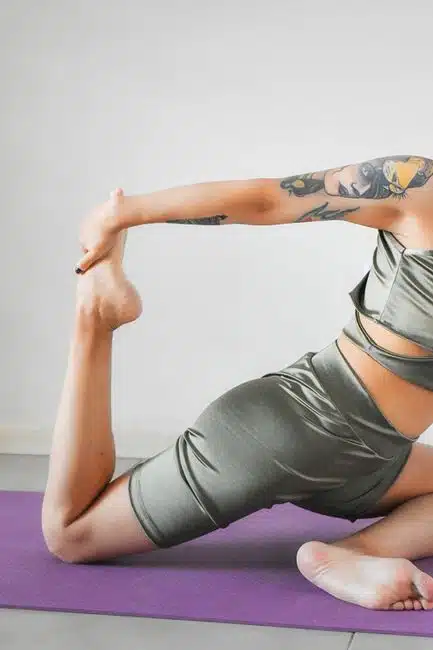
What gets called “yoga” in a strip-mall studio bears a more complicated relationship to its origins than most instructors let on. The philosophical roots run deep into ancient Indian tradition, codified in Patanjali’s Yoga Sutras — a text compiled somewhere around 400 CE, itself drawing on an oral tradition older still, laying out yoga as an eight-limbed path toward a state of stilled mind, of which physical posture (asana) is only one limb, and a minor one at that in the original framework. The heavily posture-focused, physically demanding practice that dominates Western studios today is a substantially more recent development. Tirumalai Krishnamacharya, teaching in Mysore in the early twentieth century, is generally credited as the central figure who built the modern physical vocabulary of postural yoga, blending traditional hatha yoga with elements of contemporary gymnastics and European physical-culture movements of the era. His students carried that system West and split it into the major lineages most recognizable today — B.K.S. Iyengar, whose precision-and-alignment-focused system became Iyengar Yoga; Pattabhi Jois, whose demanding, sequence-based system became Ashtanga; Indra Devi, who did more than almost anyone to popularize the practice among Western women in the mid-twentieth century. Worth sitting with for a second: the vigorous, sweat-through-your-shirt vinyasa class booked through an app today is roughly a century old as a physical system, not a millennium. That doesn’t make it less legitimate. It does mean the “ancient practice” marketing framing oversells the continuity a bit.
The research base on yoga’s physiological effects has gotten genuinely rigorous over the last two decades, moving well past vague claims about “energy” and “balance.” Streeter and colleagues, publishing in 2010 in the Journal of Alternative and Complementary Medicine, compared a group doing regular yoga practice against a walking-exercise control group and found the yoga group showed a significantly greater increase in brain GABA levels — gamma-aminobutyric acid, the primary inhibitory neurotransmitter, the same one implicated in most pharmaceutical anti-anxiety approaches. That’s a real neurochemical finding, not a subjective wellness claim, and it gives a plausible mechanism for why yoga practitioners consistently report reduced anxiety beyond what would be expected from the exercise component alone. Pascoe and Bauer ran a broader review in 2015 in the Journal of Psychiatric Research, synthesizing multiple trials on yoga’s effect on the HPA axis, and found a consistent pattern of reduced cortisol output across studies — evidence the stress-reduction effect isn’t purely psychological self-report, it shows up in the actual stress-hormone cascade. Ross and Thomas, in a 2010 review published in the same journal as the Streeter study, compared yoga head-to-head against standard exercise protocols across a range of health outcomes and found yoga performing comparably, and in some measures better, despite typically involving lower cardiovascular intensity than the exercise comparisons — a finding that runs against the intuition that “harder must be better.”
The injury side of the yoga research is less flattering, and it’s the part most studio marketing skips entirely. Swain and McGwin analyzed emergency-room visit data related to yoga injuries, publishing in 2016 in the Orthopaedic Journal of Sports Medicine, and documented a rising injury rate over the period studied — with the knee, shoulder, lower back, and wrist showing up as the most commonly injured sites. The mechanism behind most of these injuries isn’t mysterious once you’ve watched a heated power-yoga class for ten minutes: postures that push joints toward end-range flexibility, performed under fatigue, sometimes in a room heated specifically to increase flexibility artificially (and reduce the body’s normal proprioceptive warning signals about how far is too far), sometimes in a competitive studio culture where a student pushes to keep visual pace with the person on the next mat. None of that is inherent to yoga as a philosophical system. All of it is common in how yoga gets practiced in a lot of Western studio settings, and it’s worth knowing before walking into one expecting a purely gentle experience.
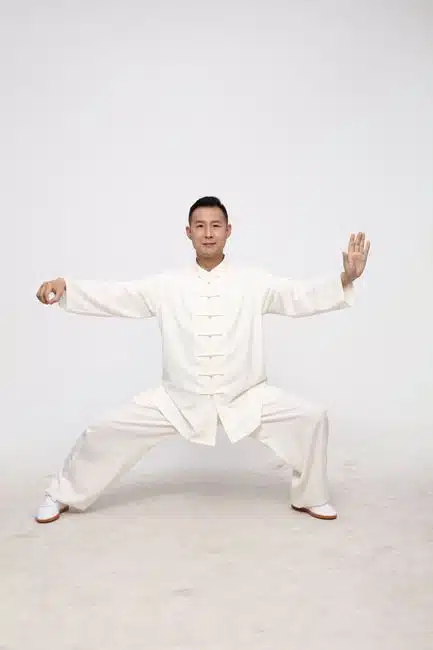
Tai chi is a Chinese martial art practiced as a slow-flow movement sequence, breath coordinated with fluid, continuous motion. It’s one of the most-researched exercise interventions in older adults — multiple meta-analyses confirm its edge for fall prevention, balance, and proprioception. It also improves blood pressure, reduces anxiety, and has documented benefits for Parkinson’s symptoms, fibromyalgia, and chronic pain. The learning curve runs steeper than yoga’s, and decent instruction is harder to find, but the practice is meditative in a way movement-focused yoga doesn’t always reach.
| Yoga | Tai Chi | |
|---|---|---|
| Style | Static and dynamic postures, breathwork, mindfulness | Slow-flow movement sequence, breath-coordinated |
| Strongest evidence | Cortisol reduction, balance, chronic pain, sleep quality | Fall prevention, balance/proprioception in older adults (multiple meta-analyses) |
| Other benefits | Cardiovascular benefit (Vinyasa, power yoga) | Blood pressure, anxiety, Parkinson’s symptoms, fibromyalgia |
| Learning curve | Easier to find instruction | Steeper, decent instruction harder to find |
The practice originated as an actual martial art, developed in Chen Village, Henan Province, China, generally credited to Chen Wangting sometime in the seventeenth century — Chen-style tai chi remains a recognizable, more overtly martial branch of the practice today, with sharper movements and explicit combat applications still visible in the form. The slower, softer, more widely practiced version most Westerners encounter descends from Yang Luchan, a nineteenth-century martial artist who studied under the Chen family and later adapted and taught the form in Beijing, producing what became Yang-style tai chi — gentler in appearance, though the martial structure underneath every movement is still there for anyone trained to see it, which is part of why practitioners with a martial arts background often describe tai chi as deceptively demanding rather than simply gentle. What began as a fighting system, over roughly two centuries, gradually became known primarily as a health practice — a genuine irony, given how much of the modern research now specifically credits it for outcomes (fall prevention, balance) that have almost nothing to do with its original combat purpose.
The modern research infrastructure behind tai chi owes a lot to one figure in particular: Peter Wayne, a researcher at Harvard Medical School’s Osher Center, whose synthesis work — much of it done alongside Ted Kaptchuk — did more than almost anyone to move tai chi from “interesting anecdote” to a legitimately studied clinical intervention within American academic medicine. The fall-prevention research specifically is where tai chi’s evidence base is strongest, and it isn’t close. Wolf and colleagues ran what’s become one of the most-cited studies in the entire exercise-and-aging literature — the Atlanta FICSIT trial, published in 1996 in the Journal of the American Geriatrics Society — comparing tai chi against a computerized balance-training program in older adults, and found the tai chi group experienced roughly a 47.5% reduction in falls relative to controls. That’s an enormous effect size for a non-pharmaceutical intervention, and it’s held up reasonably well across follow-up research. Li and colleagues, publishing further RCT evidence in the Journals of Gerontology in 2005, reinforced the fall-reduction finding in a separate cohort of older adults.
The evidence extends well past general fall prevention into specific clinical populations. Li and colleagues ran a genuinely major trial, published in 2012 in the New England Journal of Medicine, comparing tai chi against resistance training and a stretching control in patients with Parkinson’s disease, and found the tai chi group showed meaningfully better postural stability and balance outcomes than either comparison group — a striking result given that balance deficits are one of the more disabling and dangerous aspects of Parkinson’s progression. On the musculoskeletal side, Wang and colleagues published a trial in the NEJM in 2010, and a follow-up in the Annals of Internal Medicine in 2018, both examining tai chi for knee osteoarthritis; the 2018 trial specifically found tai chi noninferior to standard physical therapy for pain and functional outcomes — meaning, for a meaningful subset of knee-OA patients, a slow-movement practice performed roughly as well as the conventional medical intervention it was tested against.
The safety data is where tai chi separates itself most sharply from yoga. Wayne and colleagues conducted a safety review across tai chi trials, published in 2014 in BMC Complementary and Alternative Medicine, and found an adverse-event rate dramatically lower than most other exercise modalities studied at comparable intensity. The mechanism behind that low injury rate isn’t complicated: tai chi, by design, keeps every joint within its natural, comfortable range of motion. There’s no equivalent of a deep end-range yoga backbend or an aggressive forward fold pushed past what the hamstrings are ready for. The form asks the body to move continuously, but never to reach for its structural limit — which is precisely why it reads as “boring” to some newcomers expecting more of a workout, and precisely why it produces so few injuries in a research literature otherwise full of exercise interventions with real, documented downsides.
YOGA VS TAI CHI: BREAKING DOWN THE REAL DIFFERENCES
The gap between the two runs deeper than the surface comparisons suggest. Quick reference points below; the real decision-making material sits in the breakdown that follows. Use the table to orient. Read the analysis for the rest.
Here’s the plainest version of the actual split, once the research gets laid out side by side: yoga’s strongest evidence clusters around flexibility, mobility, cortisol reduction, and mental-health markers like anxiety and GABA — genuinely useful territory, especially for a younger man carrying the physical residue of a desk job — but comes bundled with a rising, documented injury rate concentrated in the knee, shoulder, back, and wrist, largely tied to end-range postures pushed too far under fatigue or studio pressure. Tai chi’s strongest evidence clusters around balance, fall prevention, proprioception, and specific clinical outcomes in aging and joint-disease populations — a narrower but exceptionally well-supported lane — with an adverse-event rate low enough that it’s routinely recommended for frail, elderly, or injury-recovering populations precisely because it’s considered safe enough to prescribe. Two practices that get lumped together under “gentle Eastern movement” in casual conversation, carrying two genuinely different research profiles once you actually pull the studies apart.
DETAILED BREAKDOWN: WHERE EACH ONE WINS
Effectiveness for Specific Goals
Yoga produces its best results applied to the training goals that match its mechanism. Know what it’s optimized for — and what it isn’t — and you skip the common mistake of aiming the right tool at the wrong problem. Match the approach to the actual goal and progress speeds up dramatically.
The mechanism, concretely: sustained static holds in end-range or near-end-range positions build both passive flexibility (through neuromuscular adaptation that allows tissues to tolerate greater stretch without triggering a protective reflex) and a specific kind of strength — the ability to control and stabilize the body in ranges of motion most other training never touches. That’s genuinely valuable for goals like improved hip and shoulder mobility, reduced stiffness from prolonged sitting, and general movement quality, and it’s largely wasted effort if the actual goal is raw balance training or fall-risk reduction in an older body — different tool, different problem.
Tai Chi is optimized for a different set of outcomes. The overlap creates an illusion the two are interchangeable, but that illusion breaks down fast once you’re past the beginner stage. Intermediate and advanced trainees need to be deliberate about matching method to objective.
The mechanism here runs through continuous weight-shifting between legs, single-leg loading during transitions, and constant small proprioceptive corrections demanded by the slow, unbroken movement — which is precisely the training stimulus the balance and fall-prevention research keeps confirming works. It’s largely wasted effort, by contrast, if the actual goal is building end-range flexibility or a deep stretch through tight hip flexors; tai chi’s range of motion stays too conservative to meaningfully challenge flexibility the way a static yoga hold does.
Injury Risk Profile
Every training approach carries injury risk, and Yoga has its own specific patterns. Knowing where injuries tend to cluster — acute and chronic both — is what lets you build in prevention. Most training injuries, incidentally, are overuse injuries from poor load management. Not the methodology itself.
Per Swain and McGwin’s 2016 data, the yoga injury pattern clusters heavily around the shoulder (from prolonged weight-bearing in poses like downward dog or arm balances, and from forcing shoulders into ranges they aren’t ready for), the lower back (particularly from deep backbends and aggressive forward folds performed with poor spinal positioning), the hamstrings (from forced end-range stretching, especially in heated rooms where reduced proprioceptive feedback lets a practitioner push past a safe limit without the usual warning signs), and the wrists (from repeated weight-bearing in poses like plank and chaturanga, especially for anyone without adequate wrist and shoulder strength to support bodyweight loading in that position). None of this is inherent to yoga. All of it is preventable with a slower pace, an instructor willing to say “not that far” instead of cheering deeper stretches on, and honest self-assessment about which poses a given body isn’t ready for yet.
Tai Chi carries a different injury profile. Some approaches run higher acute risk; others produce more chronic overuse issues. The safest version of any of it is the one implemented with proper progression, real recovery, and an honest read on readiness.
Tai chi’s injury profile, per Wayne’s 2014 safety review, is close to negligible by comparison — the main risk isn’t acute strain but knee strain from poor form on low, sustained stances (particularly in more martial, lower-stance styles like Chen), which is a coachable technique issue rather than an inherent hazard of the practice. There’s essentially no equivalent to the shoulder, hamstring, and back injury clusters that show up repeatedly in the yoga literature, because the form structurally avoids the end-range loading that produces most of those injuries in the first place.
Time Efficiency
How much weekly time Yoga demands for meaningful results matters for men on a tight schedule. Some approaches deliver in 3-4 hours a week; others need 6+. The most time-efficient option isn’t always the most effective one, but for most men, whatever actually fits the schedule reliably is the one that produces the results.
A single 60-to-75-minute yoga class, two to three times a week, is a realistic minimum for noticeable mobility and stress-reduction gains within a few months, based on the general dosing used across most of the cited trials. Daily practice accelerates results but isn’t strictly required to see meaningful change; most of the referenced research used sessions in the two-to-three-per-week range rather than daily protocols.
Tai Chi has its own time demands. Weigh session length against frequency, warm-up requirements, recovery time between sessions. Four sessions a week with full recovery days built in looks nothing like a protocol demanding daily practice.
Tai chi’s fall-prevention and balance research typically used protocols in a similar range — often two to three sessions a week over a period of several months, sometimes with a home-practice component layered on top. The bigger time cost with tai chi isn’t the weekly hours, it’s the learning curve up front — the form itself takes considerably longer to learn correctly than most yoga sequences, and a beginner spending the first several sessions mostly confused about foot placement and weight transfer isn’t yet getting the full proprioceptive training benefit the research measured in more experienced practitioners.
Long-Term Sustainability
Picture doing Yoga at 50. At 60. Sustainability matters because the best training approach is the one still running decades from now, not the one producing the fastest six-month result before burnout or injury ends it. Weigh joint health, motivation, variety, how well it ages.
Yoga ages reasonably well if the practice itself is adjusted with age — less end-range pushing, more attention to joint-friendly variations, less ego about matching the twenty-five-year-old on the next mat. It ages poorly if the same aggressive, deep-stretch approach from someone’s twenties gets carried unmodified into their fifties and sixties, at which point declining tissue elasticity and joint health make the same postures considerably riskier than they used to be.
Tai Chi’s sustainability rests on similar factors. Some approaches age well; others need modification as the body changes. The most sustainable protocols build in variation, manage volume intelligently, and don’t demand maximal effort every single session.
Tai chi is, almost by design, one of the more age-proof physical practices that exists — the entire form is built around staying within comfortable range of motion, which means it doesn’t demand the same kind of modification as a body ages that a more aggressive practice would. This is a meaningful part of why it shows up so consistently in research on healthy aging specifically: it doesn’t just happen to be safe for older bodies, it was arguably always closer to what an aging body needs than what a young, flexible body is chasing.
Adaptation Ceiling
Every approach hits a point of diminishing returns — Yoga included. Knowing where that ceiling sits helps plan the transition before frustration sets in. Some men ride one approach for years; others need to shift methodology periodically to keep progressing. Knowing when most of the available adaptation has been extracted prevents the plateau from turning into quitting.
Yoga’s flexibility gains follow a fairly standard adaptation curve — rapid early progress in the first several months as chronically tight tissue responds to consistent stretch stimulus, followed by a longer, slower phase where further range-of-motion gains require more advanced postures, longer holds, or more frequent practice to keep progressing. The cortisol and anxiety-reduction benefits appear to plateau less sharply, per the Pascoe review, remaining fairly stable with continued regular practice rather than diminishing the way pure flexibility gains do.
Tai Chi has its own ceiling. How long productive training runs before plateauing depends on starting point, genetics, recovery capacity, how well the programming’s managed. When progress stalls, the fix is usually a programming adjustment. Not abandoning the whole approach.
Tai chi’s ceiling looks different because the goal itself is different — balance and proprioception continue improving with practice for a genuinely long time, since the form’s complexity (longer sequences, more advanced styles, eventually partner-based push-hands practice for those who go deep enough) keeps offering new proprioceptive challenges well past what a beginner form provides. Practitioners with years or decades of experience routinely describe still finding refinement in the movement, which isn’t a claim yoga’s flexibility-focused branches make with quite the same frequency once a practitioner’s range of motion has largely maxed out for their tissue type and age.
STRENGTHS AND WEAKNESSES OF YOGA
Strengths:
- Effective for its specific target adaptations
- Well-understood when properly programmed
- Scalable to different fitness levels
- Supported by both research and decades of practical application
Weaknesses:
- Not optimal for goals outside its primary adaptation
- Requires proper programming to avoid common pitfalls
- May need periodization to prevent staleness and overuse
- Can be misapplied by those following generic protocols
STRENGTHS AND WEAKNESSES OF TAI CHI
Strengths:
- Targets different adaptations that may better match your goals
- Provides variety that supports long-term adherence
- Can address limitations that the alternative creates
- Growing body of evidence supporting its applications
Weaknesses:
- Less effective for specific goals that favor the alternative
- Own set of injury risks and programming demands
- May require more knowledge to implement effectively
- Results depend heavily on individual response and execution
WHEN TO CHOOSE YOGA
Yoga wins for flexibility, at-home accessibility, breathwork integration, and for anyone wanting a full mind-body workout that also builds strength and cardiovascular fitness. Better choice for younger men, athletes using it for mobility work, and anyone with limited access to instruction.
Choose Yoga when the primary goal lines up with its strengths, when the knowledge — or coaching — to program it well is there, and when schedule and recovery capacity can support its demands. Choose it too if it’s actually enjoyable — training looked forward to beats theoretically superior training that gets dreaded.
Take a guy we’ll call Marcus — 28, software developer, ten hours a day in a chair, chronically tight hips and a lower back that complains after any deadlift session heavier than what he warmed up with. Started a twice-weekly vinyasa class mostly because his physical therapist suggested “something with more mobility work” after a minor disc-related scare. First few sessions were humbling — a room full of considerably more flexible people, an instructor cueing depth he had no business attempting yet, and a genuine temptation to keep up rather than stay in his own range. He tweaked his hamstring in week three pushing a forward fold he wasn’t ready for, which is more or less the textbook version of the injury pattern described above. Took two weeks off, came back with a private instructor for a few sessions specifically to learn where his actual limits were rather than the class’s average limits, and settled into a version of the practice considerably less dramatic than what the Instagram version of yoga suggests — less depth, more control, longer holds at 70% of his range rather than briefer holds at 100%. A year in, his hip mobility measurably improved, his lower back stopped complaining after heavy pulls, and he still can’t touch his toes with straight legs, and has stopped caring.
WHEN TO CHOOSE TAI CHI
Tai chi wins for balance, fall prevention, proprioception training, and for men over 50 needing low-impact, joint-friendly movement that builds neurological coordination. The research on tai chi for balance and aging outcomes is among the strongest of any exercise modality, period.
Choose Tai Chi when the goals are better served by its specific adaptations, when the alternative’s already plateaued, or when the practicalities — time, equipment, enjoyment — favor it. Also worth considering during training phases where its strengths line up with current priorities.
Take a guy we’ll call Walt — 61, retired electrician, two knee replacements behind him and a general wariness of anything described as a “workout” after watching his old CrossFit-adjacent gym membership contribute to the second knee replacement in the first place. His daughter, a physical therapist, more or less dragged him to a beginner tai chi class at the community center, and he spent the first month convinced it was too easy to matter — slow, weird foot patterns, nothing that raised his heart rate the way he thought exercise was supposed to. What changed his mind wasn’t a dramatic moment. It was noticing, maybe four months in, that he’d stopped grabbing the stair rail out of habit, and that a stumble stepping off a curb — the kind of near-miss that used to genuinely worry him at his age — resolved itself without him even really registering it as a close call until afterward. He still thinks it looks a little silly from the outside. He’s also, by his own account, the steadiest on his feet he’s been in a decade, which lines up with exactly what the Wolf and Li research would predict, even though Walt’s never read either study and wouldn’t care to.
WHAT YOUR BODY IS TELLING YOU
Most men approach this decision intellectually. The body’s already given the answer, for anyone paying attention. Try each practice for one session and notice what happens afterward — not during, after. Yoga tends to leave a feeling of physical release and muscular relaxation. Tai Chi tends to leave mental clarity and energetic balance. Whichever aftereffect is needed more says which practice to prioritize.
Age gets underweighted in this comparison. Men in their 20s and 30s often get more from yoga, since their primary limitations are muscular tightness, poor mobility, the physical residue of desk work. Men over 45 often find Tai Chi more valuable, since balance, joint health, and nervous system regulation matter more with age — and Tai Chi addresses all three with less injury risk than plenty of yoga poses carry.
The injury profiles differ in a way worth noting. Yoga injuries are surprisingly common, particularly shoulders, lower back, hamstrings, wrists. The trouble is yoga encourages pushing into end-range positions plenty of bodies aren’t ready for, especially in heated or competitive class settings. Tai Chi injuries are rare — the practice emphasizes staying within natural range of motion, never forcing a position. For men with existing joint issues or injury history, that safety margin is a real practical advantage.
Worth adding a note that gets skipped in most versions of this comparison: the two aren’t mutually exclusive by physiology, only by scheduling. A younger man building mobility through yoga loses nothing by also spending ten minutes learning a basic tai chi form for the proprioceptive training it offers — and vice versa, an older man doing tai chi for balance can still benefit from a gentle, well-taught yoga session focused on maintaining hip and shoulder range rather than chasing depth. The tribal framing that forces a choice between the two is mostly a studio-marketing artifact, not a physiological constraint.
COMMON MISTAKES MEN MAKE WITH THIS DECISION
- Choosing based on identity rather than goals. Don’t pick a training approach because of the community around it. Pick it because it serves the specific physical goal. Methodology is a tool, not a personality trait. Use whatever produces the wanted result.
- Switching approaches every 4-6 weeks. Adaptation takes time. Jumping between approaches before either has had time to produce results guarantees mediocre outcomes from both. Commit to one for a minimum of 12 weeks before evaluating anything.
- Ignoring what your body responds to. Individual variation in training response is massive. Two men on identical programs get different results. Pay attention to what the body actually responds to — not what the internet insists should work — and program from there.
- Chasing depth over control in yoga. The instructor cueing “go deeper” is talking to a room, not to any one specific spine or hamstring. Depth without control is exactly the mechanism behind most of the injuries documented in the Swain and McGwin data. Control at 70% of range beats instability at 100%, every time, and nobody in the room is actually judging how deep anyone else’s forward fold goes.
Dismissing tai chi as “not real exercise.” The slow pace and low heart-rate response fool a lot of men into underestimating it before they’ve actually tried to hold a low horse stance for two minutes or execute a weight transfer with real control. The cardiovascular stimulus is modest. The neuromuscular and proprioceptive stimulus is not, and it’s precisely the stimulus the fall-prevention research keeps measuring.
HOW TO MAKE THIS DECISION FOR YOURSELF
Simplest framework going: define the primary goal in one sentence. Write it down. Ask which approach has a stronger track record for that specific goal — not which is more popular, more fun, more aligned with the gym’s culture. Which one actually produces the wanted adaptation. If the answer’s clear, follow it regardless of tribal loyalty.
If it isn’t clear — if both serve the goal reasonably well — default to whichever gets done more consistently. Adherence beats optimization, every time. The man showing up 5 days a week with a good-enough program outperforms the one showing up 2 days a week with a perfect one. Be honest about what actually gets stuck with.
Factor in training age too. Beginners progress on almost any structured approach, so choosing for enjoyment and consistency makes sense early. Intermediate and advanced trainees need more specificity, so matching method to goal starts to matter more. Where someone sits in their training career should shape how these factors get weighed.
One more concrete filter, useful when the goal itself is genuinely ambiguous: pull up the actual research question each practice answers best. “Do I need more range of motion and lower stress hormones” points toward yoga. “Do I need better balance, fewer near-falls, more control over my own footing” points toward tai chi. Most men, asked plainly which of those two questions describes their actual limiting factor, already know the answer — it’s just rarely phrased that specifically before the gym-culture noise gets involved.
THE LONG GAME: WHAT MATTERS AT YEAR 5 AND BEYOND
Most training debates fixate on short-term results — which approach produces faster gains in the first 12 weeks. That framing misses the point entirely. The approach that matters is the one still running at year 5, year 10, beyond. Short-term optimization paired with long-term burnout produces nothing. Sustainable progress, even slower out of the gate, compounds into results no 12-week program can touch.
Both Yoga and Tai Chi can serve long-term, implemented intelligently. The key is periodization — systematically varying training emphasis over weeks and months to prevent staleness, manage fatigue, keep stimulating adaptation. No single approach works optimally forever. The men making the best long-term progress know when to push, when to back off, when to shift emphasis.
Injury prevention matters more with age. The approach that keeps you healthy and consistent beats the one producing faster results while creating chronic joint issues, tendon problems, recurring tweaks. After 35, recovery capacity drops and accumulated wear becomes a real factor. Weigh durability into the decision. Not just performance.
Finally — what’s actually enjoyed matters. Training should be something looked forward to, not endured. Dread the workouts, and adherence eventually collapses no matter how optimal the programming is on paper. Find the version of Yoga or Tai Chi genuinely enjoyed, and the most important variable in training success gets solved on its own: showing up, consistently, for years.
THE BOTTOM LINE: YOUR GOALS DETERMINE THE RIGHT CHOICE
Goals, age, and personality should guide the choice. Yoga suits most men under 50 as a mobility and stress tool. Men over 50 should seriously investigate tai chi — the fall prevention data alone makes a compelling case on its own.
Match the approach to the primary goal and give it an honest 12-week trial. Specific goal — strength, hypertrophy, endurance — pick the methodology optimized for that adaptation. General fitness and longevity as the goal, whatever gets enjoyed and sustained wins by default. And don’t overlook the hybrid option: plenty of experienced trainees run both in different phases, or within the same week, pulling the best from each.
References
Editorial StandardsCorrectionsMedical DisclaimerAbout Our ContentAffiliate DisclosureSite Map