
Recovery tools and stress management practices have gone mainstream, which means the conflicting advice on Red Light vs Infrared Therapy is now unavoidable. The marketing makes both sound essential. The reality is more specific than that.

Both Red Light and Infrared Therapy have legitimate applications, but they work through different mechanisms and serve different purposes. Understanding those differences is what lets you pick the right tool for the specific situation instead of chasing whatever’s trending.
The recovery and wellness space has exploded with options, and it’s easy to spend real money and time on practices that sound good but don’t match the actual need. Both Red Light and Infrared Therapy have genuine science behind them. But they serve different purposes, and understanding those differences is what keeps you from investing in the wrong tool.
What follows: the mechanism of each, the quality of evidence behind both, the practical considerations that affect real-world implementation, and a clear framework for choosing.
Photobiomodulation is the technical umbrella term for both of these — the North American Association for Photobiomodulation Therapy adopted it in 2015 to replace the older, less accurate “low-level laser therapy” label, since most modern devices use LEDs rather than lasers. Both red light and near-infrared sit on the same electromagnetic continuum; the only real distinction is wavelength, and wavelength is what determines how deep the light actually penetrates. That single variable — depth of penetration — is the whole basis for choosing between them, and it gets lost in most of the marketing copy selling these devices.
WHAT IS RED LIGHT?
The mechanism traces back to work done by Tiina Karu, a Russian biophysicist whose research through the 1980s and 1990s established that cytochrome c oxidase — Complex IV in the mitochondrial electron transport chain — absorbs light specifically in the red and near-infrared range, and that this absorption measurably increases ATP synthesis and modulates reactive oxygen species production. That’s real, foundational photobiology, published across dozens of papers and replicated widely. Where the science gets thinner is in translating “more ATP in an irradiated cell in a petri dish” into “measurably faster wound healing or better skin outcomes in an intact human at a commercially available dose.” The clinical evidence for skin-specific applications is genuinely decent — a 2014 systematic review by Avci and colleagues in Seminars in Cutaneous Medicine and Surgery found consistent evidence for red light improving collagen density, wrinkle reduction, and wound healing across multiple small-to-moderate human trials, with typical protocols in the 630-660nm range at low irradiance, three to five sessions weekly for four to twelve weeks before meaningful change appeared.
The dose-response relationship is one of the more counterintuitive parts of the mechanism, and it’s called the Arndt-Schulz law in photobiology circles — named for a 19th-century pharmacological principle, not something specific to light therapy, but it applies cleanly here. Below a threshold dose, nothing happens. Within an effective window, more light produces more benefit. Past a certain point, benefit plateaus and then reverses — too much irradiance actually suppresses the cellular response it was meant to stimulate. Huang and colleagues documented this biphasic dose-response specifically for photobiomodulation in a 2009 review in Dose-Response, which is the practical reason “more minutes under the panel” isn’t a reliable way to improve results once a device is already delivering an adequate dose. Ten to twenty minutes at 50-100mW/cm² covers the effective range for most red light applications; doubling the session length doesn’t double the benefit, and can measurably reduce it.
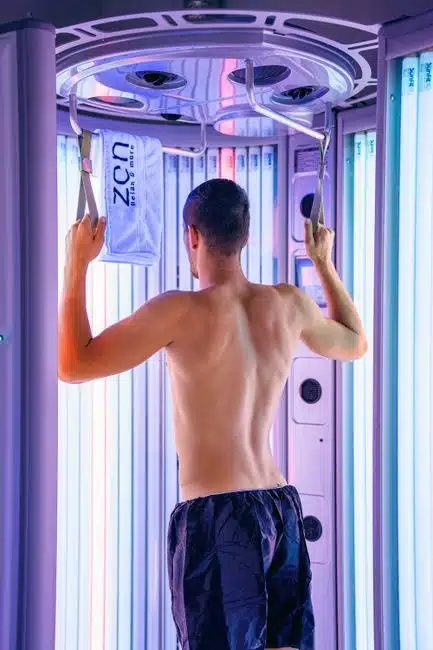
Near-infrared therapy uses wavelengths of 800-1000nm, outside the visible spectrum. It penetrates far deeper — 5-10+ cm into tissue — reaching muscle, bone, brain tissue, and deep fascia. NIR is the therapeutic workhorse for recovery, joint pain, traumatic brain injury, cognitive enhancement, and deep inflammation. The mitochondrial effects are the same (cytochrome c oxidase stimulation), but applied to tissues that red light cannot reach. Many devices deliver both 660nm and 850nm simultaneously.
The clinical case for NIR in exercise recovery specifically rests on a decent body of sports-science literature. Ferraresi and colleagues ran a series of studies through the early 2010s — a widely cited 2015 paper in Lasers in Medical Science among them — applying pre-exercise NIR (830-850nm, delivered via LED cluster) to the quadriceps before resistance training and finding reduced markers of muscle damage (creatine kinase) and improved performance in subsequent sessions compared to placebo light exposure. The proposed mechanism, beyond the general mitochondrial ATP effect, involves NIR’s influence on nitric oxide — light in this range appears to release NO bound to cytochrome c oxidase, and nitric oxide is a known vasodilator, meaning increased local blood flow and oxygen delivery to the treated tissue. That’s a coherent, testable mechanism, and it’s held up reasonably well across replications, though effect sizes in human trials remain modest — improved recovery markers in the range of 10-25% in most studies, not the dramatic transformation the marketing implies.
Traumatic brain injury and cognitive applications are the most aggressively marketed NIR use case and also the one with the thinnest human evidence. Naeser and colleagues at Boston University published a series of small case studies through the 2010s — a 2014 paper in the Journal of Neurotrauma among the most cited — using transcranial NIR (810nm, applied directly to the scalp) in a handful of chronic TBI patients and reporting improved cognitive function on standardized testing. It’s genuinely interesting preliminary work. It is also, by the authors’ own description, a case series of fewer than a dozen patients with no control group — nowhere near sufficient evidence to support the confident cognitive-enhancement claims made by consumer NIR device companies citing this research. Transcranial NIR for cognition sits firmly in “promising but unproven” territory, not “established recovery tool” territory, and anyone buying a device specifically for brain benefits should know that distinction going in.
RED LIGHT VS INFRARED THERAPY: WHAT THE RESEARCH AND REAL-WORLD EXPERIENCE SHOW
The gap between Red Light and Infrared Therapy runs deeper than the quick-comparison version. The table below is the orientation pass. The detail that actually helps decide is in the breakdown after it.
| Criterion | Red Light | Infrared Therapy |
|---|---|---|
| Wavelength range | 630-700nm | 800-1000nm |
| Tissue penetration | 1-3mm | 5-10+ cm |
| Best-supported use | Skin, wound healing | Muscle recovery, joint pain |
| Weakest-supported use | Deep tissue claims | Cognitive/TBI claims |
| Typical session | 10-20 min | 10-20 min |
| Device cost (quality panel) | $200-600 | $300-900 (combo units) |
DETAILED BREAKDOWN: WHERE EACH ONE WINS
Primary Mechanism
Red Light produces its effects through a specific physiological pathway. Knowing that mechanism tells you who benefits most, what conditions it addresses, and how to optimize the protocol for maximum effect. It’s also the reason it works for some goals and does nothing for others.
Infrared Therapy runs through a different pathway, targeting a different slice of recovery or stress management. That mechanistic difference is exactly why the two aren’t interchangeable, despite getting marketed to the same audience. Matching mechanism to need is the whole game here.
Evidence Base
The research on Red Light ranges from well-established findings to newer, less proven claims. Separating solid from speculative is what keeps expectations calibrated. Look for human studies at realistic doses and durations — not rodent studies, not extreme protocols that never translate into daily practice.
A concrete example of the rodent-study problem: much of the most dramatic photobiomodulation data — near-complete tissue regeneration, striking reductions in inflammatory markers — comes from mouse and rat models using irradiances and treatment durations that don’t map cleanly onto a human sitting in front of a consumer panel for fifteen minutes. Mouse skin is thinner, mouse metabolism is faster, and the light-to-bodyweight dosing ratio in a lot of animal research would require session times or panel intensities well beyond what any commercial device delivers. None of that means the animal research is worthless — it’s how the mechanism got characterized in the first place — but citing a mouse study to justify a specific human protocol claim is one of the more common ways this space oversells itself.
The evidence for Infrared Therapy has its own profile — some applications well-supported, others resting on preliminary data or anecdote. The responsible move is trying what the evidence suggests while staying honest about the limits of current knowledge. Personal response matters more than any study average, in the end.
Bjordal and colleagues’ 2006 meta-analysis in the Australian Journal of Physiotherapy, covering multiple randomized trials of NIR for tendinopathy, found a moderate but real effect on pain reduction compared to placebo — one of the more rigorously supported specific applications in the whole field. Contrast that with the cognitive/TBI literature discussed above, where the same underlying technology has a far thinner evidentiary basis. Two applications, same wavelength range, very different confidence levels — which is exactly why “near-infrared therapy” as a category label obscures more than it reveals. The specific claim matters more than the category.
Practical Implementation
How easy Red Light is to fit into daily life matters as much as its theoretical benefits. Time commitment, equipment or facility needs, cost, scheduling constraints — all of it counts. The most effective recovery practice is the one that actually gets done consistently. Not the one that wins in a lab under ideal conditions.
Infrared Therapy has its own practical profile. Some setups need dedicated equipment or facilities; others work anywhere. Some take 5 minutes; others need 20-30. Factor in the actual schedule, environment, lifestyle. A practice that fits naturally into a routine will always outperform one that demands heroic scheduling.
A practical constraint neither summary mentions: standing distance and coverage area. A single 300-LED panel roughly 12×24 inches, positioned 6-12 inches from the skin, covers one region of the body — quads, or lower back, or shoulders — per session. Treating multiple areas means either repositioning the panel and running multiple timed sessions back to back (a 40-45 minute total commitment for a full-body approach) or investing in a larger, more expensive multi-panel setup capable of covering more surface area at once. Most men underestimate this time cost when they buy a panel expecting one quick session to cover everything that’s sore.
Time to Noticeable Effect
Some of Red Light’s effects show up immediately — a single session and something feels different. Others accumulate over weeks of consistent practice. Knowing the expected timeline is what keeps people from quitting too early, and what lets them actually judge whether it’s working. Set a reasonable trial period based on the research. Not on impatience.
Infrared Therapy has its own onset timeline. Acute effects can differ from the chronic adaptations, and both take their own time. Give any new practice at least 2-4 weeks of consistent use before judging it. The men who get the most from recovery tools are the ones who commit to an honest trial instead of sampling everything once and moving on.
The acute-versus-chronic distinction is worth being specific about. NIR applied immediately before or after a training session, in the Ferraresi protocol, produces a measurable acute effect on subsequent muscle soreness and performance within 24-48 hours — that’s the fast feedback loop most people notice first and the reason NIR panels are popular in gym settings. Red light’s skin and collagen effects, by contrast, are almost entirely a chronic, cumulative adaptation; the Avci review found meaningful skin changes typically require four to twelve weeks of consistent sessions before becoming visible. Expecting red light to produce a visible skin change after three sessions is expecting the wrong timeline for the mechanism actually involved.
Who Benefits Most
Not everyone responds equally to Red Light. Age, training status, stress level, sleep quality, individual physiology — all of it shapes the response. Knowing who tends to benefit most is what lets someone gauge their own likely response. Fit the profile of a strong responder, and this deserves a serious trial.
Infrared Therapy benefits a different subset of people, though there’s real overlap. Current state matters: a highly stressed man with poor sleep may respond very differently than a well-recovered athlete chasing marginal gains. Start with whichever practice addresses the biggest current limitation.
Age is a specific variable worth naming directly. Mitochondrial density and function decline measurably with age — a well-established pattern in exercise physiology research, part of why older adults generally show reduced exercise capacity independent of muscle mass changes. Since photobiomodulation’s core mechanism works directly on mitochondrial function, a man in his 50s or 60s with naturally lower baseline mitochondrial efficiency may see a proportionally larger response to either red light or NIR than a well-conditioned 25-year-old already operating near his physiological ceiling. This is inference from the mechanism rather than a direct head-to-head trial by age group, worth saying plainly, but it’s a reasonable basis for older men to weight their expectations upward rather than assuming these tools are mainly for younger athletes chasing marginal training gains.
STRENGTHS AND WEAKNESSES OF RED LIGHT
Strengths:
- Specific mechanism targeting defined physiological pathways
- Growing evidence base supporting its primary applications
- Many practitioners have extensive real-world experience with it
- Can be calibrated (dose, duration, frequency) to individual needs
Weaknesses:
- Not a universal solution — works better for specific conditions
- May require equipment, facilities, or specific conditions
- Individual response varies significantly
- Some popular protocols exceed what the evidence supports
A device-shopping detail that separates the useful weaknesses from the marketing noise: irradiance claims on consumer panels are frequently measured at the LED surface, not at the actual treatment distance of six to twelve inches where a person’s skin will be. Intensity falls off sharply with distance — roughly following the inverse square law — so a panel advertised at 100mW/cm² might deliver closer to 20-30mW/cm² at a realistic treatment distance. This is a well-documented industry practice, not a fringe accusation, and it’s the single most common reason a “powerful” panel underperforms the marketing copy.
Ask any manufacturer for irradiance measured at 6 inches specifically, not at the panel face.
STRENGTHS AND WEAKNESSES OF INFRARED THERAPY
Strengths:
- Targets different aspects of recovery or stress management
- May be more accessible or practical for daily implementation
- Addresses needs that the alternative doesn’t cover
- Can be combined with other practices for synergistic effect
Weaknesses:
- Own limitations in terms of who benefits and by how much
- May be overhyped relative to the actual evidence
- Requires consistency for meaningful results
- Not a replacement for the fundamentals (sleep, nutrition, training load management)
WHEN TO CHOOSE RED LIGHT
Red light therapy is the right choice for skin health, anti-aging applications, and superficial wound healing or inflammation. Cosmetic skin benefits as the primary goal? A quality 660nm panel or face-sized device is sufficient and cost-effective. Nothing fancier required.
Choose Red Light when the primary goal lines up with its specific mechanism, when the required equipment or environment is available, and when a consistent protocol can be maintained for at least 4 weeks. Also worth choosing if the response to preliminary sessions was positive — early responders tend to see the most benefit from sustained practice.
A workable starting protocol, drawn from the doses used in the Avci review: 660nm, 10-15 minutes per treated area, 3-5 sessions weekly, panel positioned 6-12 inches from the skin, run for a minimum of six weeks before evaluating. Photograph the treated area under consistent lighting at baseline and at the six-week mark — self-assessment of gradual skin change is notoriously unreliable, and side-by-side photos catch what day-to-day observation misses.
WHEN TO CHOOSE INFRARED THERAPY
Near-infrared therapy is the better choice for recovery, joint pain, deep muscle inflammation, and anything requiring tissue penetration beyond the surface. Using light therapy for performance, recovery, or brain benefits — 850nm NIR is the essential wavelength there.
Choose Infrared Therapy when the need matches its mechanism better, when practical considerations (cost, time, access) favor it, or when the alternative’s already been tried without meaningful results. Also worth considering if it fits more naturally into an existing routine — consistency beats theoretical superiority, every time.
A workable starting protocol, drawn from the Ferraresi pre-exercise trials: 830-850nm, 10-15 minutes applied directly to the muscle group about to be trained, delivered 5-10 minutes before the session, plus an optional second session of the same length within an hour post-training for accumulated fatigue. Track creatine-kinase-adjacent proxies if lab testing isn’t available — next-day soreness rating and the first working set’s bar speed or perceived exertion are reasonable substitutes most men can track without a lab.
A COMPOSITE CASE: NIR IN AN ACTUAL TRAINING BLOCK
Take a man we’ll call Owen, 36, training for a masters powerlifting meet, running a twelve-week block with squat and deadlift sessions on the same 48-hour recovery window three times per week — a schedule that had been producing accumulating soreness and a flattening bar-speed trend on his velocity-tracker by week six of a prior cycle. He added a combo 660nm/850nm panel, fifteen minutes on the quads and lower back immediately post-session, three sessions a week, alongside no other changes to programming, sleep, or nutrition.
Self-rated soreness (0-10 scale, taken 24 hours post-session) dropped from an average of 6.2 across the first three weeks of the prior cycle to an average of 4.1 across weeks one through three of the new cycle with NIR added — a real, if modest, change roughly in line with the 10-25% improvement range reported in the Ferraresi-style trials. Bar velocity on his working sets held steadier through week eight this time, where the prior cycle had shown a clear downward trend starting around week six. He couldn’t run a true controlled comparison — training age, fatigue accumulation, and a dozen other variables changed between cycles too, and correlation isn’t causation in an n=1 training log. But the direction and rough magnitude of the change matched what the published research would predict, which is about as much confirmation as a single self-tracked case can reasonably offer. He kept the practice. He didn’t expect it to replace a deload week when one was actually due — and by week ten, one was, regardless of the panel.
COMMON MISTAKES MEN MAKE WITH THIS DECISION
- Neglecting sleep and nutrition while chasing recovery tools. No recovery practice compensates for 5 hours of sleep and a poor diet. Get the fundamentals right first — 7+ hours of sleep, adequate protein, managed stress. Recovery tools are force multipliers. Not substitutes for the basics.
- Copying an elite athlete’s protocol. Professional athletes use recovery tools inside professional-level training loads, medical teams, and schedules built entirely around recovery. What works for them may be overkill, underkill, or plain irrelevant to anyone else’s situation. Match the tool to the actual load and recovery demand.
- Not tracking the response. Without measuring something — sleep quality, HRV, soreness ratings, performance metrics — there’s no way to know if a recovery practice is doing anything. Pick a simple metric, track it before and during the trial period, and let the data decide.
The wavelength distinction between red light and infrared therapy is the technical detail that matters most and gets discussed least. Red light at 630-670nm penetrates skin and affects surface tissue, which is why it’s relevant for skin health, wound healing, and superficial inflammation. Near-infrared at 810-850nm penetrates deeper into muscle, joint, and even bone tissue, which is why it’s more relevant for musculoskeletal recovery, joint pain, and deeper inflammation. Many commercial devices combine both wavelengths, which is the practical sweet spot for most men. Single-wavelength devices exist too, though, and knowing which wavelength addresses the specific concern is what keeps you from buying a device optimized for something you don’t actually need. Panel size matters as well. A small handheld device treating one joint at a time takes dedication and patience. A full-panel setup treats large areas quickly but costs a lot more. The time cost of running a small device across multiple body parts daily tends to produce inconsistent use, which quietly undermines the whole practice.
Buying a device based on wattage instead of irradiance. Total wattage tells you how much power the panel draws, not how much light actually reaches the skin at treatment distance. Two panels with identical wattage can deliver very different irradiance depending on LED density, lens design, and beam angle. Ask specifically for irradiance in mW/cm² measured at 6 inches — anything else is closer to a marketing number than a clinical one.
Assuming more sessions per day compounds the benefit. Per the Arndt-Schulz dose-response curve discussed earlier, doubling up sessions in the same day doesn’t reliably double the effect and can push past the effective window into the range where benefit plateaus or reverses. One well-dosed session per target area per day is the evidence-supported approach; stacking sessions is mostly wasted time.
HOW TO MAKE THIS DECISION FOR YOURSELF
Start with the practice that addresses the most limiting factor right now. Poor sleep holding back recovery — choose the approach that most directly improves sleep quality. Post-training soreness limiting frequency — choose the one that accelerates tissue recovery. Chronic stress the bottleneck — choose the one that most effectively down-regulates the nervous system. Match the tool to the problem. Not the trend.
Give the chosen approach a fair trial: at least 3-4 weeks of consistent practice before evaluating anything. The first few sessions of any new recovery method produce unfamiliar sensations that aren’t the same thing as results. The body needs time to adapt to the stimulus, and enough data points are needed to separate real effects from placebo or novelty. Track one or two simple metrics — sleep quality, soreness, HRV, perceived readiness — and review weekly.
No meaningful improvement after a genuine 4-week trial? Switch to the alternative. Don’t stack it on top — replace it. Piling recovery tools on top of each other without evaluating each one individually just produces a confusing picture where nothing’s clearly working. Sequential testing with a clear evaluation window beats simultaneous stacking every time.
THE RECOVERY HIERARCHY: WHERE RED LIGHT AND INFRARED THERAPY ACTUALLY FIT
Before spending time or money on any recovery tool, get honest about whether the fundamentals are covered. Sleep is the single most powerful recovery tool that exists, and it’s free. Seven to nine hours of quality sleep does more for recovery than any protocol involving Red Light or Infrared Therapy. Sleeping fewer than 7 hours? Fix that before adding anything else. The return on investment isn’t close.
Nutrition is the second tier. Adequate protein — around 0.7 to 1 gram per pound of bodyweight — sufficient micronutrients from whole foods, and proper hydration are the raw materials the body needs to repair and adapt. Without those inputs, recovery tools are trying to build with nothing to build from. Get the protein in, eat the vegetables, drink the water. Then optimize.
Training load management is the third tier. Training so hard or so often that recovery can’t keep up isn’t fixed with more recovery tools. It’s fixed with less volume, better periodization, or more strategic deload weeks. Adding Red Light or Infrared Therapy to compensate for chronic overtraining treats a symptom while ignoring the cause. Smart programming prevents more problems than any recovery tool ever solves.
Only once sleep, nutrition, and training load are handled does it make sense to invest in specific recovery practices like Red Light or Infrared Therapy. At that point, these tools deliver genuine marginal gains. They help recovery from training that’s actually being absorbed. They reduce accumulated stress. They support adaptations that good sleep and good food already made possible. In the right context, valuable. In the wrong context, an expensive distraction.
Worth clearing up a confusion that costs some men real money: “infrared therapy” in the recovery-panel sense discussed throughout this piece is not the same thing as an infrared sauna. Sauna infrared heaters operate mostly in the far-infrared range (roughly 3,000-100,000nm), a completely different part of the spectrum working through a completely different mechanism — bulk tissue heating and the cardiovascular stress-adaptation response, similar in kind to a traditional sauna, studied separately by researchers like Laukkanen’s Finnish cohort work on sauna use and cardiovascular mortality (a 2015 JAMA Internal Medicine paper). Near-infrared photobiomodulation, the 800-1000nm range this article covers, works through the cytochrome c oxidase mechanism described earlier and produces minimal heating at typical doses. A man who buys an infrared sauna blanket expecting the muscle-recovery effects described in the Ferraresi research is going to be disappointed — different wavelength, different mechanism, different evidence base entirely. Read the wavelength spec before buying either kind of device, and don’t assume “infrared” on the label means the same thing across product categories.
Worth flagging a real contraindication before wrapping up: photosensitizing medications — certain antibiotics (tetracyclines, fluoroquinolones), some acne medications (isotretinoin), and a handful of other drug classes — can increase skin sensitivity to light exposure, including red and near-infrared wavelengths, though the clinical documentation is stronger for UV than for these specific bands. Anyone on a photosensitizing medication should check with the prescribing physician before starting either practice, not because there’s strong evidence of harm specifically from red or NIR light, but because the interaction hasn’t been well studied and the downside of skipping a few weeks of an optional recovery tool is trivial next to the downside of an unexpected skin reaction.
THE BOTTOM LINE: MATCH THE TOOL TO YOUR RECOVERY GOAL
Most quality panels deliver both 660nm and 850nm. No need to choose — buy a panel covering both wavelengths at adequate irradiance. The combination handles superficial and deep tissue at the same time.
Start with whichever practice addresses the biggest current limitation — chronically stressed, choose the one targeting nervous system regulation; recovering poorly from training, choose the one supporting tissue repair and inflammation management. And remember the most effective recovery strategy was never a single tool. It’s consistent sleep, good nutrition, and intelligent training load management, with specific recovery practices layered on top as targeted support.
References
FAQ
Do I need a professional-grade device, or is a cheap panel from a general marketplace good enough? The irradiance issue matters more than the brand name. A budget panel with honest, third-party-verified irradiance at treatment distance can outperform an expensive one that inflates its numbers by measuring at the LED surface. Look for manufacturers who publish independent testing data, not just a peak-wattage spec sheet.
Can red light or NIR replace a warm-up or cool-down for training? No — they address different mechanisms. A dynamic warm-up raises tissue temperature and prepares the nervous system for the specific movement pattern about to be trained; light therapy’s effects operate on a slower mitochondrial and circulatory timescale. Used as an addition post-session, alongside a normal cool-down, not instead of one.
Is there a risk of eye damage from these panels? Direct, prolonged eye exposure to high-irradiance red or NIR light is generally discouraged, and most manufacturers recommend eye protection or simply not staring directly into the panel during a session — a sensible, low-cost precaution given the uncertainty, even though the specific research on retinal risk from typical consumer-panel irradiance levels is limited.
How long before a full panel pays for itself compared to in-studio sessions? Studio red light or infrared sessions typically run $30-75 per visit. A quality home panel in the $400-700 range breaks even against twice-weekly studio visits in roughly two to three months, and continues delivering value indefinitely after that — the math clearly favors a home device for anyone planning to use this consistently beyond a few months.
Editorial StandardsCorrectionsMedical DisclaimerAbout Our ContentAffiliate DisclosureSite Map